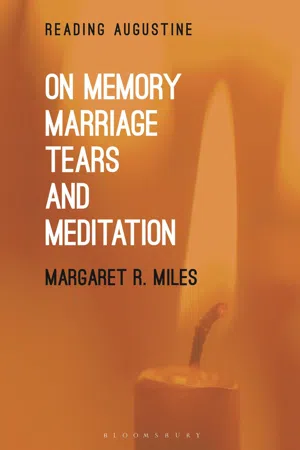
On Memory, Marriage, Tears, and Meditation offers readers the tools for reading Augustine's journey to human emotions through his writings on feeling, marriage, conversion, and meditation.
Augustine understood that feeling, not rationality, gathers and reveals the deep longing of the whole person. Throughout his ecclesiastical career, he discussed marriage in sermons, letters, and treatises from the perspective of his own experience. Miles examines Augustine's prototypes for conversion – reading and conversion; sacrifice and conversion; and the importance of friends in what might be considered a subjective and private process. Meditation was central to Augustine's Christian life and Miles argues that his practice of meditation suggests that penitence included a rich range of feeling leading to gratitude, peace, wonder, and love.
- 128 pages
- English
- ePUB (mobile friendly)
- Available on iOS & Android
eBook - ePub
On Memory, Marriage, Tears, and Meditation
About this book
Information
1
Augustine: Theologian of Feeling
St. Augustine’s Confessions often narrates the young Augustine’s intellectual quandaries over philosophical questions, such as the origin of evil and the operations of memory and time, but the text is continuously propelled by Augustine recollecting and reliving his feeling at particular moments, and his analysis of how his feeling was triggered and altered. The earliest and most fundamental of his gifts, he said, were life and feeling: “Even then I had a being; I lived and I felt” (conf. 1. 20). He recalled many childhood feelings vividly and in detail, and he did not wear rose-colored glasses when remembering and observing infancy and childhood. He found the infant’s hard work of birthing, and the child’s acclimatization to the world of human society, strenuous indeed: “Who would not tremble and wish rather to die than to be an infant again if the choice were put before him?” (ciu. 21. 4)
When he was nineteen years old, he read Cicero’s Hortensius: “It was this book which altered my feeling (mutauit adfectum meus), turning my prayers to you, Lord, yourself, and gave me different ambitions and desires.” A powerful feeling consumed him: “I was inflamed (flagrantia) … I was on fire (ardebam) to leave earthly things behind and fly back to you [God].” Even in the heat of passion, however, Augustine missed any reference to Christ, whose name he had “drunk in devoutly” (biberat pie) with his mother’s milk, and “it remained deeply treasured” (conf. 3. 4). It was not intellectual curiosity that urged him forward on his journey to becoming Christian. It was strong feeling.
Augustine on Feeling
The role of feeling is key to understanding Augustine’s Confessions. “What exactly was this feeling?” (conf. 2. 9) He distinguished between momentary emotions, provoked by events, and feeling, the expression of himself. He was often annoyed and dismayed by uncontrollable rogue emotions. For example, his mother’s death created a split in Augustine’s feeling. His reason told him that she was (as they say), “in a better place,” but he could not contain his tears: “I was deeply vexed that these human feelings should have power over me … and I grieved at my grief with a new grief and so was consumed with a double sorrow.” Emotions overwhelmed him; he drowned in his grief rather than rejoicing that “she did not die in misery, nor was she altogether dead” (conf. 9. 12). His youthful irritation at his mother’s insistent interference in his life dissolved in his sorrow at her loss. He loved her. His grief inspired one of the most intimate and tender eulogies written by a son for his mother in Western literature (conf. 9. 13).
However, feeling (singular), as St. Augustine used the word, is not the same as emotions, nor is it the same as feelings (plural). Everyday usage does not help to express this very significant distinction. Augustine used the singular noun “feeling” (adfectus) to describe a cluster of intellect, emotions, and body. Feeling collects and expresses desire, belief, perceptions of beauty, regret, gratitude, delight, and more. Rationality is part of feeling, but is neither dominant nor decisive. In Augustine’s usage, feeling gathers, reveals, and directs the deep longing of the whole person.
The idea of feeling as a heterogeneous mass of emotions and intellect was a profoundly counter-cultural idea for philosophers of antiquity, challenging their instinct to identify and differentiate phenomena. Plato said that lacking organization and clear distinctions “what you are bound to get … is not real mixture but literally a miserable mass of unmixed messiness” (Philebus 1147e). Romans called the contents of the sewer under Rome “mixtus” (Miles, 2009: 80).
It is commonplace today to think of rationality as separate—and to be carefully sequestered—from feeling. We must jettison this assumption if we are to begin to understand Augustine, his contemporaries, and his followers. For Augustine, feeling was a settled disposition, a coordinated and weighted energy that focuses and directs the intention of the self. To refer to this integrated expression of self, I will use “feeling.” To distinguish, as Augustine did, between feeling and emotions, I will use “emotions” to designate externally provoked “feelings.”
At its most strongly concentrated―that is, not distracted by multiple and conflicting desires―Augustine recognized feeling’s intention as a longing for more life. He said in a sermon:
I know you want to go on living. You do not want to die. And you want to pass from this life to another in such a way that you will not rise again as a dead person, but fully alive and transformed. This is what you desire. This is the deepest human feeling. Mysteriously, the soul itself wishes and instinctively desires it.
(s. 314. 4; emphasis added)
Augustine came to understand by his experience that feeling, not intellectual persuasion, was both the site of his own subjectivity and the location of God’s direction of his life (conf. 7. 16). He attempted to describe a fundamentally ineffable feeling that is himself, relating two occasions on which he experienced what modern readers might call “mystical experiences.” (conf. 7. 17; 9. 10)
And sometimes working within me you open for me a door into a state of feeling which is quite unlike anything to which I am accustomed―a kind of sweet delight which, if I could only remain permanently in that state, would be something not of this world, not of this life. But my sad weight makes me fall back again; I am swallowed up by normality.
(conf. 10. 40)
Those are not the only moments of powerful feeling in the Confessions, however. When Augustine recalled moments of strong feeling, he not only remembered but also relived those moments. Multiple times, in the middle of describing an incident or a thought―in Confessions or in a sermon or letter―he was suddenly overcome with feeling, interrupting his narrative, he burst out: “Turn us, O God of hosts, show us thy countenance and we shall be whole” (conf. 4. 10); “O eternal truth and true love and beloved eternity! You are my God” (conf. 7. 10); “O beauty of all things beautiful!” (conf. 3. 6). His text is peppered with such ejaculations of feeling.
Augustine loved the Psalms, commenting on them shortly after his conversion and for the next three decades (until 421 or 422 CE). Like Augustine, medieval monks loved the Psalms because of their expression of strong feeling.
How loudly I cried out to you, my God, as I read the psalms of David, those faithful songs and sounding syllables of holiness quite excluding the swelling boastfulness of the spirit! … How I cried aloud to you in those psalms! How they fired me toward you! How I burned to utter them aloud, if I could, to the whole world against the pride of mankind!
(conf. 9. 4)
Misused Emotions
Because Augustine believed that God ordered his life through his feeling, he had strong objections to exploitation of the emotions. As a youth, he had been carried away (rapiebant) by stage plays: “I, poor wretch, at that time loved to feel sad and went looking for something to feel sad about.” Reflecting on his experience later, however, he thought it crazy (insania) that people derive pleasure from viewing “miserable and tragic happenings which they would certainly not like to suffer themselves” (conf. 3. 2). He found this pleasure perverse. It is noteworthy that he did not object to stage plays because of their content, although Roman theater notoriously featured wicked acts and lewd scenes. He was dismayed, rather, by the manipulation of fake sympathy.
Augustine knew why he was entertained by fictional characters’ sorrows; he understood why he enjoyed most of all “an actor who brought tears to my eyes.” The displacement of genuine sorrow onto a fictional character briefly alleviated his own deep and unfocused sadness. Although he found momentary relief in weeping over fictional sorrows, Augustine nevertheless resented this manipulation. He also distinguished his feeling from the loud and volatile emotions displayed by crowds for “a famous charioteer or a fighter with wild beasts in the theater.” My love (amabam) was not like that, he wrote: “it was different and more serious” (sed longe et grauiter). Indeed, his violent metaphors suggest the pernicious depth of his attraction. Fictional sorrow “scratched the surface of my skin … [with] poisoned nails … [producing] feverish swellings, abscesses, and running sores” (conf. 4. 14).
Compassion (miserichordia), an emotion Augustine valued very highly, should not, he said, be squandered on imaginary miseries. True compassion, he wrote, does not enjoy others’ sufferings, but wishes that “they did not exist” (conf. 3. 2). “Is compassion, then, to be cast out?” he asks and answers, “Certainly not!” Augustine recognized that false compassion, created by enjoyment of fictional miseries, comes from the same root as the foundation of friendship. But emotions are not innocent; compassion, a good, can also lead to “foul lust.” Emotions must be interrogated: “See where it leads; in what direction does it flow?” (conf. 4. 14; ps. 121. 1).
Bodies and Feeling
In his youthful rhetorical training, St. Augustine had startled his teachers with his ability to interpret Aristotle’s Ten Categories. Aristotle may have alerted Augustine to the connection of bodies and emotions: “The soul’s passions all seem to be linked with a body, as the body undergoes modifications in their presence” (Aristotle, De anima IA. 1. 403a. 15). Whether guided by Aristotle or by his own observation, Augustine noticed this connection. Throughout Confessions, he narrates life-changing moments as showcased in his body. His famous conversion to celibacy was one such occasion, characterized by an emotional storm acted out in his body. The restlessness that began his Confessions (1. 1) was at its most intense in this conversion. Augustine stated repeatedly that the restlessness that precipitated his conversion to celibacy was not an intellectual crisis. His mind, he said, was perfectly made up: “there was no longer any reason for me to doubt” (conf. 7. 10); “now I could see it perfectly clearly” (conf. 8. 5); “now the truth is certain” (conf. 8. 7). Rather, his conversion to celibacy vividly demonstrates the critical significance of feeling.
In Chapter 3, I discuss Augustine’s conversion to celibacy as one of many conversions―conversions extending long before, and long after, his conversion to celibacy. Each conversion involved crucial shifts in his feeling. Together they were moments in his long process of becoming Christian. Augustine knew that celibacy was not required: “Not that the apostle forbade me to marry, though he might recommend something better” (conf. 8. 1). Nevertheless, his conversion to celibacy was a climactic event, for sex was the cherished pleasure without which Augustine could not imagine himself.
His so-called crisis of the will (uoluntas) was a crisis of feeling, “so went the controversy in my heart—about self, and self against self” (ista controversia in corde meo non nisi deme ipso aduersus me ipsum; conf. 8. 11). In his childhood and youth, both his parents had urged him to pursue “marriage and worldly success.” Marriage to a wealthy and well-connected wife would have advanced Augustine’s worldly success considerably. But according to his own testimony, it was sex, not marriage, that Augustine desired (conf. 6. 15). By the time Augustine reached young adulthood, Monica’s hope for him had changed; she hoped that his sexuality would be stabilized in marriage so that he could be baptized (conf. 6. 13).
By the time of his conversion to celibacy, his desire for marriage and worldly ambition, conjoined in his mind as “slavery to the affairs of this world” (conf. 8. 6), was already modified by his interest in celibate monastic communities: “I no longer had the impulse and encouragement of my old hopes and desires for position and wealth … these things no longer pleased me” (conf. 8. 1). All Augustine’s questions and objections had melted away; the battle for “himself” was focused on his feeling, divided between two pleasurable attractions he considered incompatible―sex, which in retrospect he called the “violence of habit” (conf. 8. 11), and “If I want, I can be a friend of God now, this moment!” (conf. 8. 6). In what follows I turn to two themes which recur as leitmotivs throughout Augustine’s description of his lifelong process of becoming Christian: humility and beauty.
Humility
Clearly, humility was central to Augustine.
The way is firstly humility, secondly humility, and thirdly humility. And however you should ask me I would say the same, not because there are no other precepts to be explained, but if humility does not precede and accompany and follow every good work we do, and it is not set before us to look upon, and beside us to lean upon, and behind us to fence us in, pride will wrest from our hand any good work we do while we are in the very act of taking pleasure in it.
(ep. 118. 3)
Why was humility of central importance to St. Augustine? His intelligence, education, social location, achievement as a teacher of rhetoric, and prizewinner in rhetoric contests in Milan did not foster humility. Nor did his education or the classical authors he read. Augustine reported that as a youth, he was “puffed up with knowledge” (insuper autem inflabar scientia; conf. 7. 10). He was a proud man: “I was separated from you by the swelling of my pride. It was as though my cheeks had swollen up so that I could not see out of my eyes” (conf. 7. 7).
“I had not the faintest notion of the mystery contained in ‘The Word was made flesh’” (conf. 7. 18, 19). In Etienne Gilson’s apt phrase, Augustine “discovered” humility (1960: 227) in the figure of Jesus Christ, who revealed humility―“divinity in the weakness that it had put on by wearing our ‘coat of skin’ … [thus] healing the swelling of pride, and fostering love.” Christ’s humility was decisively established by his willingness to accept human flesh, “making a humble dwelling out of our clay.” But as yet, Augustine confessed, “I was not humble enough to possess Jesus in his humility and weakness” (conf. 7. 17). For Augustine, the primary and lasting importance of Jesus was not his miraculous birth, not his teaching, nor his raising the dead to life; his example of humility was. “All Christians should hold fast to humility because they derive their name Christians from Christ; and no person who studies his gospel carefully fails to find him the teacher of humility” (uirg. 33). Christ’s humility was fully demonstrated in his assumption of a human body, thus granting humans participation in his divinity.
Augustine believed that he had seen the truth, but he recognized the vast difference between seeing the way and being able to follo...
Table of contents
- Cover
- Halftitle Page
- Title Page
- Contents
- Preface
- Acknowledgments
- Texts and Translations
- List of Abbreviations
- 1 Augustine: Theologian of Feeling
- 2 Augustine’s Coniugium
- 3 Augustine’s Conversions
- 4 Bodies, Pleasures, and the Young Augustine
- 5 Augustine’s Meditation
- 6 Augustine’s Deathbed Tears
- Notes
- References
- Index
- Imprint
Trusted by 375,005 students
Access to over 1.5 million titles for a fair monthly price.
Study more efficiently using our study tools.
Frequently asked questions
Yes, you can cancel anytime from the Subscription tab in your account settings on the Perlego website. Your subscription will stay active until the end of your current billing period. Learn how to cancel your subscription
No, books cannot be downloaded as external files, such as PDFs, for use outside of Perlego. However, you can download books within the Perlego app for offline reading on mobile or tablet. Learn how to download books offline
Perlego offers two plans: Essential and Complete
- Essential is ideal for learners and professionals who enjoy exploring a wide range of subjects. Access the Essential Library with 800,000+ trusted titles and best-sellers across business, personal growth, and the humanities. Includes unlimited reading time and Standard Read Aloud voice.
- Complete: Perfect for advanced learners and researchers needing full, unrestricted access. Unlock 1.5M+ books across hundreds of subjects, including academic and specialized titles. The Complete Plan also includes advanced features like Premium Read Aloud and Research Assistant.
We are an online textbook subscription service, where you can get access to an entire online library for less than the price of a single book per month. With over 1.5 million books across 990+ topics, we’ve got you covered! Learn about our mission
Look out for the read-aloud symbol on your next book to see if you can listen to it. The read-aloud tool reads text aloud for you, highlighting the text as it is being read. You can pause it, speed it up and slow it down. Learn more about Read Aloud
Yes! You can use the Perlego app on both iOS and Android devices to read anytime, anywhere — even offline. Perfect for commutes or when you’re on the go.
Please note we cannot support devices running on iOS 13 and Android 7 or earlier. Learn more about using the app
Please note we cannot support devices running on iOS 13 and Android 7 or earlier. Learn more about using the app
Yes, you can access On Memory, Marriage, Tears, and Meditation by Margaret R. Miles in PDF and/or ePUB format, as well as other popular books in Philosophy & Christian Theology. We have over 1.5 million books available in our catalogue for you to explore.