eBook - ePub
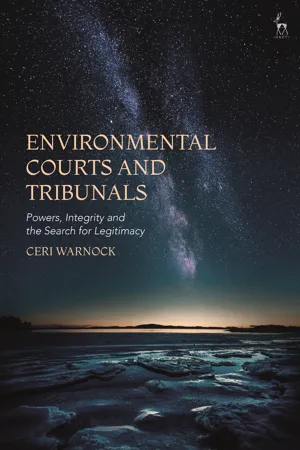
Environmental Courts and Tribunals
Powers, Integrity and the Search for Legitimacy
- 224 pages
- English
- ePUB (mobile friendly)
- Available on iOS & Android
eBook - ePub
About this book
The global phenomenon of the establishment of specialist courts is one of the most important recent developments in environmental law. Although they are generally seen as a much needed innovation, they do pose challenges, particularly around questions of legitimacy. This important book tackles these questions directly, looking specifically at the courts in the common law world. It argues that to fully understand the nature of the adjudication of these courts, a bottom-up approach must be taken: ie the question before the court is determinative. Despite its theoretical focus, the book will also provide invaluable insights to practitioners engaging with these new courts for the first time. An innovative study on a seismic change in how environmental law is adjudicated.
Information
1
Introduction
At its heart, this is a book about legal integrity. Specifically, it considers the role that integrity plays in legitimising adjudicative institutions and it explores this issue within the context of environmental adjudication for good reason. The exponential growth in specialist environmental adjudication is a remarkable modern phenomenon. Around the world, states have created bodies with novel constitutions and powers in order to reconcile the need for a certain nimbleness – a flexibility and creativity in environmental dispute-resolution – with the values that we expect from adjudication: political neutrality, legal coherence, equality of treatment and calculability. Environment courts and tribunals are now a distinct feature of the legal landscape. Collectively, their decisions impact the environmental, socio-cultural and economic wellbeing of nations, and scholars praise them for their ability to foster environmental legal literacy and to facilitate access to environmental justice. But fault lines are emerging. The unusual legal nature and relative power of these adjudicative institutions impacts wider structures of governance and raises difficult issues of legitimacy. At a national level, they are open to criticism and susceptible to the ebb and flow of varying ideologies, with their powers, functions, duties – existence even – waxing and waning within political tides. And as the analysis in this book shows, environment courts and tribunals are especially vulnerable to attack because there is no underlying theory that justifies and shores up the normative legitimacy of specialist environmental adjudication.
The aim of this book is to address that lacuna. Its purpose is to develop a theory1 for specialist environmental adjudication that is of universal applicability and that sets the parameters for debate about environment courts and tribunals; a theory that is both enabling and constraining, and so useful to policymakers (in creating or reforming these bodies), the judiciary (in their reasoning) and litigants (in managing cases). In this introductory chapter, I sketch a brief overview of the theory that I propose, which I term an ‘interactional theory for normative legitimacy’. I outline the methodology employed to develop and test that theory, and illustrate how the use of the interactional theory will help foster effective environmental dispute-resolution while ensuring adjudicative integrity. To some readers, the theory that I sketch in this chapter may prove provocative, leading to more questions than answers, but I would encourage readers to suspend their judgement until they have reached the end of the book.
I.THE RISE IN SPECIALIST ENVIRONMENTAL ADJUDICATION
Since the turn of the millennium, there has been a huge proliferation in specialist environmental courts and tribunals around the world. There are now over 1,200 such bodies in over 44 nations.2 In other jurisdictions, debates centre on the need for creating new institutions, alternative adjudicative processes or training judges to oversee the enforcement of environmental law.3 And in nations with relatively embryonic institutions, the focus of discussion is upon expanding their jurisdiction, the role they might reasonably be expected to play in crafting solutions to environmental problems,4 and the continuing ability of the ordinary courts to supervise these bodies.5
In line with this phenomenon, references to specialist environmental adjudication in the scholarly literature have increased exponentially.6 This body of literature notes that specialist environment courts and tribunals are unusual and highly complex legal institutions, and representative of modern, dynamic forms of dispute resolution. Many are chaired by independent and tenured judges7 or legally qualified decision-makers and considered part of the judicial branch of government,8 or are clearly classified as courts within their nations’ institutional arrangements (some of the oldest and best-known specialist bodies are courts9 and held out as exemplars for others to follow).10 Yet they often have powers that we might not expect to find in judicial bodies. They may mix adjudicative forms and functions with powers more traditionally found in the executive branch, having the authority to prospectively review the merits of proposed activities, permitting the use, despoliation or alternatively, providing for the conservation of natural resources.11 In this way, they have a role in governing environmental issues. Some have quasi-legislative roles, having the power to amend regulations, policies and plans on the merits.12 Regardless of their multifunctional nature, many play an important role in developing environmental law and in some circumstances, human rights law in their nations.13 Specialist environment courts (ECs) might therefore be seen as the ultimate ‘modern courts’14 – attempting to determine public benefits while managing impacts on individual rights – and as mentioned, these bodies are charged with adjudicating disputes that collectively have significant importance for the economic, socio-cultural and environmental wellbeing of nations.15 As this book explains, one could perceive ECs as new sites of disaggregated power and governance in the constitutional matrix.
However, the combination of novel legal form and relative power make ECs vulnerable. Specialist environment courts and tribunals have been seen as politically controversial, fostering an environmental ethic that gets in the way of economic development.16 They have been criticised for enabling ‘judicial overreach’17 and accused of challenging both traditional notions of court-based adjudication and related separation of powers concepts.18 In some jurisdictions, an anxiety about the appropriate powers and constitutional place of ECs manifests in policy debates,19 public inquiries20 and through continual legislative amendments,21 and the struggle to make legal sense of them plays out in extrajudicial writing22 and even case law.23 While there is a surprisingly large literature on ECs, the existing academic scholarship fails to take these concerns and criticisms seriously. By and large the scholarship is promotional, extolling the virtues of specialism in environmental adjudication and encouraging the creation of ECs. These bodies are overwhelmingly seen as a ‘good thing’. In the main, the scholarship does not acknowledge that they are highly vulnerable institutions, susceptible to changing political climates.24 Nor does it attempt to develop a theoretical anchor that helps make legal sense of specialist environmental adjudication. However, without some form of conceptual buttressing that explains and justifies their unusual nature, ECs face continuing criticism and challenges25 that may undermine their efficacy, development and possibly their continued existence.26
II.AN INTERACTIONAL THEORY FOR ENVIRONMENTAL ADJUDICATION
The main purpose of this book is to develop a theory capable of justifying specialist environmental adjudication. It makes sense to sketch out my theory in a relatively pithy way at this point before gradually expanding upon the explanation in this introduction and the following chapters. The theory is as follows: to attract comprehensive support, adjudication must foster normative legitimacy. In very simple terms, normative legitimacy is created by the shared beliefs of the relevant community, and a shared belief of near universal support is that integrity in adjudication matters. To have integrity, I argue, adjudicators must be able to respond to the legal and factual context that they are working within. Clearly, the concepts that I am using here – normative legitimacy and legal integrity – are complex and contestable and I explain what I mean by these terms in the following paragraphs and more fully in chapters three and four. But in essence, the theory is that in order to foster normative legitimacy, environmental adjudication must have legal integrity and legal integrity will be promoted if the adjudicatory body responds to rather than ignores the inherent nature of the problems it is charged with resolving.
I have termed the theory that I develop an ‘interactional theory for legitimacy’ because responsive environmental adjudication necessitates contextual interaction. Interaction connotes a dynamic process, requiring an awareness of context, communication that facilitates reciprocal feedback (or a two-way flow of information) and adaptation. Responsive environmental adjudication requires four factors to be considered as integral parts of the whole. First, identifying the distinct characteristics of environmental problems. Second, acknowledging the impact those characteristics have on law and dispute resolution, and the challenges they create for adjudication. Third, developing environmental law doctrine, procedure and remedies that respond to those challenges. Fourth, accepting that particular adjudicative forms and functions facilitate this process – ie, courts with particular constitutions, powers and expertise will be better able to respond to the nature of environmental problems. Taken together, these factors explain the interactional aspect of the theory building.27 It is the relationship or links between the parts that matters in my theory building and that underpin the legal integrity of the response: these components cannot be considered in isolation, rather the theory argues that a holistic, sequencing approach – with one component leading on to and influencing the next – justifies the specialist nature of environmental adjudication.
Accordingly, we can make sense of specialist environmental adjudication if we develop a deep understanding of the nature of environmental problems and then identify, understand and accept the impact those unassailable features have on adjudication. To illustrate the application of the theory in this context, I consider two inherent features of environmental problems, ‘interaction and change’, and a core characteristic, ‘uncertainty’ (although there are undoubtedly more), and I explain how these structural features create both top-down and bottom-up forces, impacting how we adjudicate over environmental disputes. In a top-down sense, the inherent nature of environmental problems impacts the way that law is written. In turn this affects the interpretative role of ECs and their application of the law to the facts. Second, the inherent nature of environmental problems impacts the way that ECs conduct the ‘fact-finding’ exercise. New legal frameworks have to be developed for resolving factual disputes in environmental adjudication that in turn create wider doctrine in the form of environmental law principles that guide decision-making and remedies. Both factors are relevant in helping to characterise the role of ECs, that is specialist environment courts have an important governance role in the system of environmental justice.
The theory that I propose justifies and helps construct a more detailed conceptual frame that government, policymakers, the judiciary (where the existing law is interstitial, uncertain, or they are empowered to exercise discretion), lawyers and participants in environmental adjudication may refer back to. While the meta-theory is of universal application, the resulting frame will have contours formed by particular legal cultures. Pausing for a moment, it may help to explain the idea of conceptual frames at this point. We often employ conceptual frames or metaphors both to make sense of complex phenomenon and to help constitute or set institutional constraints. By way of example, th...
Table of contents
- Cover
- Title Page
- Acknowledgements
- Contents
- 1. Introduction
- 2. Specialist Environment Courts: Mapping the Landscape
- 3. The Struggle to Make Legal Sense of Specialist Environment Courts
- 4. Developing the Theory: Adjudicative Integrity
- 5. Developing the Theory: Contextual Foundations
- 6. The Interactional Theory in Practice
- 7. Conclusion
- Index
- Copyright Page
Trusted by 375,005 students
Access to over 1.5 million titles for a fair monthly price.
Study more efficiently using our study tools.
Frequently asked questions
Yes, you can cancel anytime from the Subscription tab in your account settings on the Perlego website. Your subscription will stay active until the end of your current billing period. Learn how to cancel your subscription
No, books cannot be downloaded as external files, such as PDFs, for use outside of Perlego. However, you can download books within the Perlego app for offline reading on mobile or tablet. Learn how to download books offline
Perlego offers two plans: Essential and Complete
- Essential is ideal for learners and professionals who enjoy exploring a wide range of subjects. Access the Essential Library with 800,000+ trusted titles and best-sellers across business, personal growth, and the humanities. Includes unlimited reading time and Standard Read Aloud voice.
- Complete: Perfect for advanced learners and researchers needing full, unrestricted access. Unlock 1.5M+ books across hundreds of subjects, including academic and specialized titles. The Complete Plan also includes advanced features like Premium Read Aloud and Research Assistant.
We are an online textbook subscription service, where you can get access to an entire online library for less than the price of a single book per month. With over 1.5 million books across 990+ topics, we’ve got you covered! Learn about our mission
Look out for the read-aloud symbol on your next book to see if you can listen to it. The read-aloud tool reads text aloud for you, highlighting the text as it is being read. You can pause it, speed it up and slow it down. Learn more about Read Aloud
Yes! You can use the Perlego app on both iOS and Android devices to read anytime, anywhere — even offline. Perfect for commutes or when you’re on the go.
Please note we cannot support devices running on iOS 13 and Android 7 or earlier. Learn more about using the app
Please note we cannot support devices running on iOS 13 and Android 7 or earlier. Learn more about using the app
Yes, you can access Environmental Courts and Tribunals by Ceri Warnock in PDF and/or ePUB format, as well as other popular books in Law & International Law. We have over 1.5 million books available in our catalogue for you to explore.