The heroines of Greek tragedy presented in the plays by Aeschylus, Sophocles and Euripides have long captivated audiences and critics. In this volume each of the eleven chapters discusses one of the heroines: Clytemnestra, Hecuba, Medea, Iphigenia, Alcestis, Antigone Electra, Deianeira, Phaedra, Creusa and Helen. The book focuses on characterisation and the motivations of the women, as well as on those of the male playwrights, and offers multiple viewpoints and critiques that enable readers to understand the context of each play and form their own views. Four core themes bridge the depictions of the heroines: the socio-political dynamic of ancient Greek expectations of women and their roles in society, the conflict of masculinity versus femininity, the alternation of defiance and submission, and the interplay between deceit and rhetoric.
Each chapter offers clear descriptions of plot and mythical background, and builds on the text of the plays to enable reflections on language and performance. All technical terms are explained and key topics or references are pulled out into box features that provide further background information. Discussion points at the ends of chapters enable readers to explore various topics more deeply.
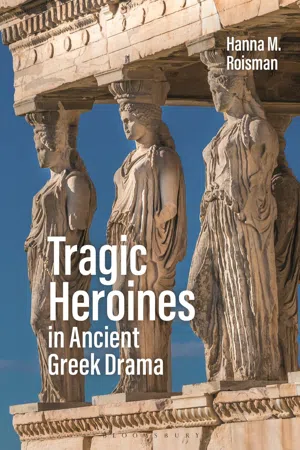
- 328 pages
- English
- ePUB (mobile friendly)
- Available on iOS & Android
eBook - ePub
Tragic Heroines in Ancient Greek Drama
About this book
Information
CHAPTER 1
CLYTEMNESTRA
Mythic background
In ancient Greek myth, Clytemnestra is the daughter of Leda, a princess in her own right, and of Tyndareus, King of Sparta. Leda was seduced by Zeus, who had appeared in the guise of a swan, and eventually gave birth to two sets of twins: Helen and Pollux are usually said to be descendants of Zeus, while Clytemnestra and Castor were the mortal children of Tyndareus. (In one account Castor and Pollux are both “sons of Zeus,” and thus termed Dioscuri.)
Tyndareus offers hospitality to Agamemnon and Menelaus, the two sons of the cursed house of Atreus, from nearby Mycenae. They were exiled when their father was murdered by his brother’s son, Aegisthus. According to some versions, Clytemnestra was already married at this point, and had an infant son. Menelaus marries Helen and succeeds Tyndareus becoming King of Sparta. Agamemnon returns to Mycenae, and with the help of Tyndareus’ army deposes King Thyestes, Aegisthus’ father, and claims the throne (see also Box on daimon, pp. 29–30). Agamemnon also kills Clytemnestra’s husband and new-born son, taking Clytemnestra to be his wife.
When Helen was carried off to Troy by Paris, the son of Priam, Menelaus and Agamemnon gathered a Greek force to sail to Troy in order to bring Helen back. The ancient myths give few if any details of Clytemnestra’s life during the ten years while Agamemnon is away at war. In the Ninth Book of Homer’s Iliad (9.145) Agamemnon speaks of his son Orestes and his three daughters: Chrysothemis, Laodice and Iphianassa (the last two possibly alternative names for Electra and Iphigenia) without mentioning their mother, Clytemnestra. In the Third Book of the Odyssey (3.263–75) the old counsellor Nestor tells Odysseus’ son, Telemachus, about the events leading up to the death of Agamemnon. Nestor attributes Agamemnon’s murder to Aegisthus, Agamemnon’s cousin (Od. 3.234–35). Nestor comments that Clytemnestra was naturally of good character, but that Aegisthus had tricked her with flattery and seduced her. Nestor adds that Aegisthus ruled for seven years after killing Agamemnon until Orestes returned home and killed Aegisthus in revenge, but nothing is said of Clytemnestra. In the Eleventh Book of the Odyssey, (11.409–10) during Odysseus’ visit to the Netherworld, Agamemnon tells Odysseus that Aegisthus with the help of his ‘accursed wife Clytemnestra’ caused his death. He adds that the “guileful Clytemnestra” killed Priam’s daughter Cassandra, whom Agamemnon had brought back from Troy as a prize (11.421–23). Agamemnon warns Odysseus that all women lack faithfulness/loyalty, even though he admits that Odysseus’ wife Penelope is a very admirable woman (Od. 11.441–56).

Introduction
Clytemnestra appears in six Greek tragedies: Aeschylus’ Oresteia (Agamemnon, Libation Bearers, Eumenides, 458 BCE), Sophocles’ Electra (418–410), Euripides’ Electra (422–417 or 415–413), and Iphigenia at Aulis (405?). Aeschylus, whose trilogy was written first, presents Clytemnestra as cruel and ruthless, but also as intelligent and decisive. Sophocles’ and Euripides’ Electra plays are dramatic reactions to the Aeschylean treatment of Clytemnestra, although the queen’s role in them is more comparable to that in Libation Bearers than in Agamemnon. This is not surprising since both of the Electra plays and the Libation Bearers are set after the regicide and focus upon planning the matricide resulting from Agamemnon’s murder. However, the depictions of the queen in the plays by Sophocles and Euripides differ markedly from one another, reflecting to some extent the portrayal of her daughter Electra. The Sophoclean Clytemnestra is just as cruel and savage as the Aeschylean one, expressing neither regret nor remorse. She is even less motherly than the woman portrayed in Libation Bearers. Euripides, however, presents a more sympathetic Clytemnestra. She is, however, a formidable figure throughout: a highly intelligent woman, capable of strategic planning and fully committed to any task she sets for herself.
While the plays were not written in mythic chronological sequence, the timeframe of their plots spans from the start of the Trojan War to shortly after Clytemnestra’s death. When Helen leaves Sparta for Troy with the young prince Paris, Clytemnestra has had several children with Agamemnon, the eldest of whom, Iphigenia, is already of a marriageable age. Agamemnon and Menelaus have mustered a fleet of a thousand ships to bring back the errant Helen, but the fleet is becalmed at Aulis. Clytemnestra brings two of her children, Iphigenia and the baby Orestes, to Aulis, only to discover that Agamemnon wishes to sacrifice Iphigenia to ensure fair winds for the fleet. The only play to depict these early events, Iphigenia at Aulis, was actually the latest composed—it was Euripides’ last piece of work and was performed posthumously. This episode in Clytemnestra’s life serves as a trigger for future events.
Clytemnestra returns to Argos without her daughter, and awaits Agamemnon’s return from Troy for ten long years. Left alone, this defiant, resolute queen not only runs her home and hearth—the oikos—but also takes on the public duties of ruling the polis, and plots her revenge. She chooses as a lover, and possibly a collaborator, none other than Aegisthus, Agamemnon’s cousin, who had murdered Atreus, Agamemnon’s father, in order to restore his own father, Thyestes, to power. When Agamemnon returns, Clytemnestra employs every weapon at her disposal to ensure her plan is carried out without delay, and murders not only Agamemnon, but also the tragic prophetess Cassandra, whom Agamemnon has brought from Troy as his concubine. In the fullness of time, Clytemnestra meets her death at the hand of her son Orestes, who had, as an infant, many years earlier traveled with her to Aulis. By committing the horrifying act of matricide, Orestes avenges the murder of his father, Agamemnon, but risks losing his own sanity and life. The final glimpse of Clytemnestra is in Eumenides, after her death, when she is urging the Furies to avenge her murder.
The tragic portrayal of Clytemnestra is particularly interesting as the Odyssey is ambivalent about her role in Agamemnon’s murder. While in Book Three only Aegisthus is named as the perpetrator of the plot, Agamemnon’s ghost in Book Eleven indicates that Clytemnestra bore some blame in his murder, though her guilt may have partly been through adultery, and aiding and abetting Aegisthus. The Odyssey does, however, sow the seed in the readers’ minds for imagining Clytemnestra as a cruel murderess.
* * *
Each tragedian constructs a complex character for Clytemnestra including a series of internal contradictions:
•traits considered masculine by the Greeks such as clarity of thought and strength of purpose intertwined with those considered feminine such as irrational hope, overwhelmingly strong passions, and the use of deceit;
•defiance of accepted conventions when she trusts her own judgment to rule the polis, yet later on submitting to a patriarchal order and willingly restricting herself to domestic pursuits;
•a loving mother who pleads for one daughter’s life, who later abuses and casts out another;
•a wife and mother who stops at nothing to avenge her daughter’s sacrifice, becoming herself a cold-blooded murderess;
•a mother who is prepared to defend herself even beyond her own death, demanding vengeance—against her own son.
This chapter will accompany the reader through an analysis of the texts of six plays as they each in turn cast light on the character so skillfully crafted by the tragedians. The sections of this chapter examine each depiction, starting with the complex character created by Aeschylus.
CLYTEMNESTRA IN AESCHYLUS’ AGAMEMNON
Aeschylus’ Agamemnon
The play starts with a Watchman lying awake scanning the horizon for a glimpse of beacons that will announce the long-awaited fall of Troy. His joyful outcry on finally seeing the beacons summons the Chorus of the city’s elders and eventually Clytemnestra. Clytemnestra and the Chorus are arguing over the reliability of the beacons when a Herald arrives, announcing not only the fall of Troy but also Agamemnon’s imminent return. Agamemnon arrives, accompanied by his concubine Cassandra. Clytemnestra lures him into an act of hubris when he demonstrates excessive self-pride, offensive to the gods, by walking into the palace on crimson tapestries. Cassandra ignores Clytemnestra’s order to follow Agamemnon inside the palace, eventually entering of her own accord. Clytemnestra returns, exulting over the corpses of Agamemnon and Cassandra and tries to justify her actions to the Chorus. When Aegisthus joins her, accompanied by an armed bodyguard, the Chorus attack his cowardice. He belittles Clytemnestra and boasts of his own role in the murder.
In Greek tragedy the first reference to a character is usually revealing. At the start of Agamemnon, the first play of the Oresteia, Aeschylus’ trilogy, a Watchman introduces Clytemnestra not by her name, but as an anomaly: “a woman with a hopeful heart which plans like a man” (gynaikos androboulon elpizon kear, 11). In the Greek text you can see that the word gynaikos (a form of the word for a “woman,” gynē), appears directly before the word androboulon (which is composed of anēr, meaning “man” and boulē, meaning “mind and counsel”). Clytemnestra is thus immediately presented as a complex character who comprises one of the fundamental polarities on which Greek tragedy is based. She possesses traits that the Greeks associated mostly with men: eloquence, strategic intelligence, the ability to use her resources while guarding her secrets, and the cold determination to pursue her goals relentlessly. She is also linked to traits traditionally considered female: deceitfulness and willingness to alter facts to suit her purposes, as well as an uncanny insight into other people, which may be called “feminine intuition.” The two antitheses she encompasses, that between the genders (male, anēr versus gynē, female) and that between “hope” (elpis), signifying the irrational, and “mind and counsel” (boulē), along with the reversal of their traditional assignations, feature as the main motifs in Agamemnon and the trilogy as a whole.1
When the male/female components of Clytemnestra’s personality are synchronized, she is unstoppable. Choosing from her impressive armoury of rhetorical skills whichever “weapon” best enables her to overcome her opponents, Clytemnestra pits her wits against all around her. She constantly engages her opponents in sophisticated and devious rhetoric, so that those hearing her words can never be quite certain what her true meaning is. She outsmarts all who engage with her until a tipping point is reached during her encounter with Cassandra, the eldest daughter of King Priam and Queen Hecuba of Troy. Cassandra was gifted the power of prophecy by Apollo, but later cursed by him, never to be believed by those who hear her. Essentially Clytemnestra’s power begins to wane when Cassandra simply refuses to engage with her. Cassandra, knowing her own fate, refuses to enter the palace when ordered by Clytemnestra. Remaining on s...
Table of contents
- Cover
- Half-Title Page
- Dedication
- Series Page
- Title Page
- Contents
- Acknowledgments
- Map
- Alphabetical List of the Tragedies Discussed
- Introduction
- 1 Clytemnestra
- 2 Electra
- 3 Iphigenia
- 4 Antigone
- 5 Helen
- 6 Hecuba
- 7 Alcestis
- 8 Deianeira
- 9 Medea
- 10 Creusa
- 11 Phaedra
- Conclusion
- Notes
- Glossary of Names and Terms
- Bibliography
- Index
- Copyright
Trusted by 375,005 students
Access to over 1.5 million titles for a fair monthly price.
Study more efficiently using our study tools.
Frequently asked questions
Yes, you can cancel anytime from the Subscription tab in your account settings on the Perlego website. Your subscription will stay active until the end of your current billing period. Learn how to cancel your subscription
No, books cannot be downloaded as external files, such as PDFs, for use outside of Perlego. However, you can download books within the Perlego app for offline reading on mobile or tablet. Learn how to download books offline
Perlego offers two plans: Essential and Complete
- Essential is ideal for learners and professionals who enjoy exploring a wide range of subjects. Access the Essential Library with 800,000+ trusted titles and best-sellers across business, personal growth, and the humanities. Includes unlimited reading time and Standard Read Aloud voice.
- Complete: Perfect for advanced learners and researchers needing full, unrestricted access. Unlock 1.5M+ books across hundreds of subjects, including academic and specialized titles. The Complete Plan also includes advanced features like Premium Read Aloud and Research Assistant.
We are an online textbook subscription service, where you can get access to an entire online library for less than the price of a single book per month. With over 1.5 million books across 990+ topics, we’ve got you covered! Learn about our mission
Look out for the read-aloud symbol on your next book to see if you can listen to it. The read-aloud tool reads text aloud for you, highlighting the text as it is being read. You can pause it, speed it up and slow it down. Learn more about Read Aloud
Yes! You can use the Perlego app on both iOS and Android devices to read anytime, anywhere — even offline. Perfect for commutes or when you’re on the go.
Please note we cannot support devices running on iOS 13 and Android 7 or earlier. Learn more about using the app
Please note we cannot support devices running on iOS 13 and Android 7 or earlier. Learn more about using the app
Yes, you can access Tragic Heroines in Ancient Greek Drama by Hanna M. Roisman in PDF and/or ePUB format, as well as other popular books in Literature & Ancient & Classical Drama. We have over 1.5 million books available in our catalogue for you to explore.