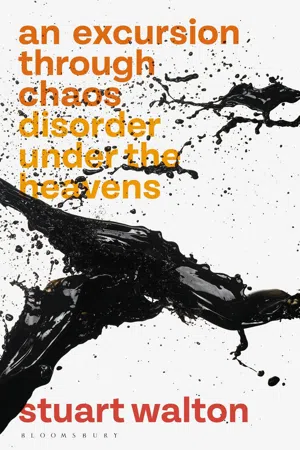
From its original meaning as a gaping void, or the emptiness that precedes the whole of creation, chaos has taken on the exclusive meaning of confusion, pandemonium and mayhem. This definition has become the overarching word to describe any challenge to the established order; be it railway strikes or political dissent, any unexpected event is routinely described in the media and popular parlance as 'chaos'.
In his incisive new study, Stuart Walton argues that this is a pitifully one-dimensional view of the world, as he looks to many of the great social, political, artistic and philosophical advances that have emerged from periods of disorder and from the refusal to think within the standard paradigms.
Exploring this worldview, Walton contends that we are superstitious about states of affairs in which anything could happen because we have been taught to prefer the imposition of rules in every aspect of our lives, from our diets to our romances. Indeed, in An Excursion through Chaos he demonstrates how it is these very restrictions that are responsible for the alienation that has characterised postwar society, a state of disengagement that could have been avoided if we had taken a less fearful attitude towards the unravelling of order.
- 280 pages
- English
- ePUB (mobile friendly)
- Available on iOS & Android
eBook - ePub
About this book
Information
Part One
The birth of order from chaotophobia
It is vital to have chaos within oneself, Nietzsche’s Zarathustra teaches in his opening remarks to his followers, to be able to give birth to a dancing star. Only if everything within is wrought up into a creative ferment can one hang a lasting, glittering legacy in the benighted sky.
In an epoch rapidly surrendering to forms of disorder unimaginable to any prior generation, a question urges itself upon us: What is chaos? Is it a transitional process or a final state, a matter of Becoming or of Being? Is it possible to see it coming, or does it always take us by surprise? Even if it may be anticipated, does it belong to its nature always to be worse on arrival than everybody had feared? What, after all, does it feel like? Or is it, rather, a place? In which case our inaugural question ought perhaps to be: Where is chaos? Does it have secure or porous borders? How near are we to it at any one time, and does its territory show a definite tendency to expand until it threatens the very edges of the republic of order? How do we extricate ourselves from it once it has annexed the avenues of our own once-peaceable domain? Why do some people actively want to go there?
In Ionian antiquity, where Western culture began, it lay somewhere beyond the Aegean coast, in lands to which the ancient mythic heroes had first ventured, but it also underlay the rushing current of the present everyday life, in which, as Heraclitus of Ephesus taught, everything that lives and moves is subject to change. If war has always represented the most noxious distillate of it in human experience, any place of disorder, or state of confusion, would become, by gradual metaphoric dilution, the placeholder of an original – and possibly originary – chaos. In the globalized and mass-mediatic present, chaos is at once feared and enjoyed. It is the ready epithet for any situation that is not sufficiently subject to, or even only marginally outside, official control, but it is also the delightful transgressive element of postmodernity that reminds us that ossified systems of regulation are not entirely or always at the command of the authorities. Whichever pole of this continuum one oscillates towards, chaos is not something freely adopted, a sudden access of the untrammelled will, but an adventitious state that takes over, in which seemingly anything can happen. If the failure of the traffic signals causes utter chaos on the roads, the double-booking of a lecture hall for two separate audiences might result in hilarious confusion. A power outage at the hospital causes life-threatening turmoil, but the breakdown of the electronic scoreboard at a boring tennis match reduces proceedings to a glorious befuddlement. Its ontological ambivalence as a category of experience is the index of truth of a society that veers between too little functional dependability and all too much.
A narrative of the potential excitements of disorder began and ended in the nineteenth century, bequeathed by the first Romantic generation as a call to free-spiritedness in the face of encroaching industrial urbanism, the confinement of the human soul within the tethers of mechanistic production, but had been comprehensively discredited by the century’s end in the discovery by theoretical physics that all systems tended to decay. The seething turbulence of a disintegrative phase was bound to issue in its entropic deceleration and final collapse, a law that was all too easily applicable to societies in the grip of fundamental technological and political change. A steady state could be monotonous enough, but was less menacing to human communion than social fragmentation and spiritual dissolution. The Victorian and Bismarckian eras closed amid threnodies of apocalyptic threat from imaginative writers and philosophers, an autumnal mood that soon turned, as the new century hit its stride, to abysmal winter, as the first continental war since the Napoleonic age engulfed an entire generation in technologized slaughter. Wholesale reconstruction after the devastations of both global conflicts appeared to have put an end to any lingering taste for disorder. In our own day, however, something resembling chaos has returned as the element of chance in late-modernist aesthetic movements, as the barely supervised belligerences and fantasies of online networks, and as a celebration of the stochastic element in mathematics, biology, astrophysics and other disciplinary systems once subject to the circumscription of immutable laws. A climate of uncertainty, once the guilty secret of scientific enquiry, the uncharted terra incognita of outer space and the inner brain alike, always offers the most propitious conditions for the freelance imagination, a jubilee period in which all are free to entertain their own theories until the correct one, or what appears for the time being to be the correct one, is imposed demonstratively. Despite the rationalist ideal, however, the science of the twentieth century was driven by the progressive realization that systems are not immutable and predictable, but that they display unaccountable variations within the same broad parameters. Nothing quite comes out how a fully qualified observer might have expected, for all that the deviations may be on the microscopic scale. Nothing can quite precisely be said, then, about what tomorrow’s reprise of the same experiment will produce. We laugh at the nonsense they believed a hundred years ago, Nabokov says somewhere, before replacing it with some nonsense of our own. I want to make it clear at the outset, however, that I do not intend this study to supplement the already voluminous philosophical consideration of mathematical chaos theory, which is not strictly about chaos at all, but rather chance or contingency. In this respect, ‘chaos theory’ ought to be seen as a contradiction in terms, and many of its exponents indeed have been concerned to demonstrate how many structural or temporal parameters so-called chaotic systems do in fact observe. Chaos itself, which is, to be sure, subject to the random influences of the accidental, just as are the air currents unleashed by the famous butterfly of nonlinear systems theory, is about what happens as a result of such motile contingency, making its study a matter of the effects of its movements, and not simply of the movements themselves.
A widespread sense that the civilized world had fallen apart by the 1940s persisted into the aftermath of the Second World War, made luridly visible by evidence of the extent of Nazi inhumanity, and then of the torturous conditions of paranoid control that obtained in the Soviet East. Reconstruction was not just an economic affair, but a social and cultural one too. The centre of gravity shifted from Europe with its old oppugnances and its clapped-out, crudely exposed gentilities to the unabashed consumer culture of a United States that may still have been in the grip of vicious racial segregation, but at least promised a loosening of social mobility, the unlacing of punctilious manners, and exciting new cultural currents in abstract expressionism, the modern picaresque novel, production-line public catering, Coca-Cola, rock-and-roll. What lay behind the Western renaissance of the years of reconstruction, both in its North American heartlands and financial centres and in the resurgent economies that they begot on Western Europe, was a return to order, something like the social correlative of the rappel à l’ordre in the arts of the 1920s that followed the experimental mayhem of wartime Dada. In this perspective, the turbulent decade and a half that extended from the rise of the 1960s counterculture to the vanquishment of Keynesian economics and the social consensus at the end of the 1970s represented what remains for now the final blip in the steamrolling juggernaut of administrative order. The later twentieth century hardly lacked for oppositional currents of thought and ways of life in wider contexts than the counterculture, but it was the moment of the late 1960s that both crystallized dissent across much of the first world and ensured its neutralization.
The reasons for the collapse of the culture of dissidence are readable from both ends of the spectrum. It is a now familiar point that what Thomas Frank has called ‘the conquest of cool’ had already begun to be prepared during the high-water mark of the festival era.1 Corporate culture was already appropriating the lineaments of alternative lifestyles – their patois, music, sartorial and sexual styles, even the ecstatic relation to intoxicants, where that remained roughly within the bounds of legal sanction – and not only selling them back to adepts of the counterculture, but incorporating them into their own economic and discursive procedures. It was possible, indeed positively encouraged, to be a risk-taking rebel in the advertising industry and in speculative finance, to practise an intuitive, self-rewarding approach to consumerism instead of heading out every Monday with a shopping list. As such, as Eugene McCarraher has argued, the alternative reality of the dissidents was assimilated more or less whole:
The Cold War counterculture, so often considered a flamboyant adversary of ‘conformity’ and virtuous consumerism, was in fact more amenable to pecuniary and technological rationality than it appeared to be … Replacing ‘virtuous consumerism’ as the quintessence of the American spectacle, the democratization of bohemia represented the final incorporation of Romanticism, the annexation of the modern sacramental consciousness into the empire of corporate iconography.2
By the same token, if corporate capitalism was busy drawing lifeblood from the legions of refuseniks, they themselves proved exceptionally porous to the oldest and most powerful tenets of class society. Free love turned out to be as much a provocation of erotic rivalrousness as it was a liberation from it, while it did precisely nothing to rebalance relations of clientage between the sexes. It clung to the definition of anything but heterosexual desire as thrillingly deviant, worth engaging in for its non-normativity, which thereby reinforced normativity itself. Where there was instinctual opposition to the economic structures of post-war capitalism, it was informed by nothing like the fully articulated analysis that might have convicted the economy of its injustice, only a sententious, soppy sense that it wasn’t nice. Niceness indeed was the watchword, readily apparent as one garlanded oneself with flowers and subsided into the bestial stupidity of being stoned. The cosmic gibberish of Al Hubbard and Timothy Leary stood in for articulate philosophy, and an amalgam of Hindu and Buddhist ceremonial ambience, carefully shorn of their pensive injunctions to the ascetic life, was as much belief as was required. Despite its revolutionary rhetoric, instead of a combative challenge, it amounted to an indolent accommodation with the way things were, a parallel world running peaceably alongside the predominant one.
There were, to be sure, intelligent critics of the post-war status quo who pointed out the terrible cost in self-alienation that societies forsworn to corporate culture and social obedience were extracting from their clients. People who had experienced corporations from the inside and then dropped out often had cautionary tales to tell about the spiritual effects of such structures on human will, but they rarely counselled outright opposition to the system as a whole. This was very much the tenor of William H Whyte’s sociological classic The Organization Man (1956) and Alan Harrington’s autobiographical fiction Life in the Crystal Palace (1959), texts that expressed a professionalized concern over the toll in spontaneous life and the creative faculty that working in Fordist corporate enterprises was taking on their middle managers. Menopausal discontent with the pedestrian time-serving that office life demanded of its officers in return for ample salaries, health insurance and pension plans began to be a durable novelistic theme from this period too, a tendency inaugurated by Sloan Wilson’s The Man in the Gray Flannel Suit (1955), whose hero Tom Rath is a PR writer for a New York television company. He accepts the system, which in turn accepts his own stifled chafing at its straitened expectations:
The important thing is to create an island of order in a sea of chaos, and an island of order obviously must be made of money, for one doesn’t bring up children in an orderly way without money, and one doesn’t even have one’s meals in an orderly way, or dress in an orderly way, or think in an orderly way without money. Money is the root of all order, he told himself, and the only trouble with it is, it’s so damn hard to get, especially when one has a job which consists of sitting behind a desk all day doing absolutely nothing.3
‘Order’ is the catchword that rings like a passing bell throughout Rath’s interior monologues, appearing to him as in a vision in the guise of something devoutly to be wished but forever just tantalizingly out of reach, and at the same time the brutal principle by which his working life is dominated anyway. He takes the sanguine view that while he is powerless to do anything about the state of the world, he can at least set his own life in order, failing to see that the two things are closely imbricated. There would be dissatisfied junior executives all over the cultural show as the American 1950s wore on towards the turning of the decade. Harry Angstrom, antihero of John Updike’s most celebrated novel cycle, makes his first appearance in his mid-twenties as the restlessly bored sales operative for a kitchen gadget in Rabbit, Run (1960). Richard Yates’s Frank Wheeler in Revolutionary Road (1961) is seduced by his wife into the fleeting dream of throwing the corporate life over and moving to Paris to begin a new life less trammelled by capitalist conformism. ‘At their most penetrating’, writes McCarraher of the rat-race critiques of the 1950s, ‘they revealed the religious longings that galvanized devotion to corporate life, yet they offered no alternative to the corporate system aside from an innocuous “nonconformity.”’4
Such nonconformity would eventually be given a nebulous shape in the hippie era, but even then not all dissenting intellectual voices were muffled by the monotonous churn of the conformist rock music. The American historian and sociologist Lewis Mumford’s coruscating counterblast to the Woodstock Festival of August 1969 saw in it nothing but a perpetuation of the same degraded consumer culture to which it imagined itself the antithesis. The light-shows and psychotropic intoxicants were nothing other than an exaggerated reflection of the dullness of mainstream society, with which they were thereby indissociably bound. Woodstock itself, apart from producing a massive traffic-jam and a gargantuan heap of trash, was an unbridled context of delusion mounted by the self-emancipated in hopeful escape from a thoroughly technologized culture:
The depressing monotony of megatechnic society, with its standardized environment, its standardized foods, its standardized invitations to commercial amusement, its standardized daily routines, produces a counter-drive in over-stimulation and over-excitement in order to achieve a simulation of life. Hence ‘Speed’ in all its forms, from drag races to drugs. With its narcotics and hallucinogens, its electrically amplified noise and stroboscopic lights and supersonic flights from nowhere to nowhere, modern technology has helped to create a counter-culture whose very disorder serves admirably to stabilize the power system.5
By 1971, the alienated executive of the 1950s had been taught by the dropout culture of the hippie interlude that a freewheeling life of self-invention might just be within reach, as is hoped for by David Bell, the television executive who embarks on a meandering road trip with a movie camera in Don De Lillo’s first novel, Americana. The trope is still enduring more hardily than the angst-ridden managers themselves in Alan Ball’s screenplay for the Sam Mendes film American Beauty (1999), in which a mid-life magazine executive, Lester Burnham, signals his own excursion into nonconformity by the time-hallowed, toothless tactic of behaving out of character – pumping weights in the garage, developing a sexual obsession with a teenage cheerleader, his daughter’s friend, and smoking cannabis supplied by the teenage boy next door. If nonconformity had to be the indispensable starting-point of any opposition, its performance alone, much satirized in comic films and TV shows in the 1970s – Leonard Rossiter’s Reginald Perrin, from a 1975–8 novel sequence by David Nobbs, was the British paradigm – would scarcely be sufficient. What was needed was the critical consciousness that could understand and see through the rationale for conformity mounted by the current dispensation in the first place. Order and hierarchy were firmly enough entrenched that they could withstand parodic onslaughts on their jargon and the pettiness of their bureaucratic procedures, much as they could absorb sudden resignations by executive staff. In the end, there was something cosy about peripheral spasms of discontent. If you chose not to resign, they were what helped get you through.
Although the alternative to regimented order does not indeed have to be what we are calling chaos, exponents of the status quo nonetheless typically insisted – and still do – that without the present order, there would be nothing but chaos. The most fully articulated attempt to resist that simple equation was expressed in the theoretical work of the first generation of the Frankfurt School, exiled to the United States with the ascendancy of the Nazi state in Germany, and bequeathing certain of its leading thinkers, most notably Herbert Marcuse, to American academia, after most of its luminaries returned to the Federal Republic after the war. Established as the Institute for Social Research in 1923, it had begun by constructing a multi-disciplinary Marxist assault on Western capitalism as the latter entered what was widely felt to be its final moribund phase, embracing economic and sociological analysis, as well as dialectical approaches to traditional and avant-garde culture. Translated piecemeal from Frankfurt University to New York and Los Angeles, it responded to its new cultural milieu by formulating a global theory of the progress of Enlightenment rationality towards the technological vapidities of the contemporary day, which it saw cathected in the shape of the narcotized consumerism being prepared in the United States as a modus vivendi for the world at large. Theodor Adorno and Max Horkheimer’s Dialectic of Enlightenment (1947), which circulated in draft in the period immediately following the war, prior to its issue by an independent Dutch publisher, was the Institute’s first fully articulated statement. A complete English translation would not appear until 1972, but the challenging substance and tone of the work made it notorious long before anybody in the Anglophone world had had chance to read it.
A key point of disputation raised by Adorno and Horkheimer was the thesis that society, in its progress from barbarism to civilization according to the narrative of the European Enlightenment, had been cumulatively founded on the principle of reason. Where mythology once held sway, the rationalistic sciences now reigned supreme. Among the Frankfurt School’s most provocative contentions was that Western civilization had unwittingly executed a reversal of this narrative. The heroic phase of the eighteenth-century Enlightenment purported to have freed humankind of antique superstition and the demons of the irrational, but the horrors of the twentieth century gave the lie to such brash triumphalism. Far from humane liberation, Europe had plunged into decades of savage barbarism. The Frankfurt School theorists argued that universal rationality had been raised to the status of an idol. At the heart of this was what they called ‘instrumental reason’, the mechanism by which everything in human affairs was consumed and metabolized. When reason enabled human beings to interpret the natural world around them in ways that ceased to frighten them, it was a liberating faculty of the mind. In the Frankfurt account, however, its fatal flaw was that it depended on domination, on subjecting the external world to the processes of abstract thought. Eventually, by a heuristic process of trial and error, everything in the phenomenal world would be explained by scientific investigation, which would lay bare the previously hidden rules and principles by which it operated, and which could be demonstrated anew any number of times. The rationalizing faculty had thereby become, according to Adorno and Horkheimer, a tyrannical process, through which all human experience of the world was subjected to infinitely repeatable rational explanation, a process in which reason had turned from being liberating to being the instrumental means of categorizing and classifying an infinitely various reality. As the most tangible proof of this thesis, culture itself was subjected to a kind of factory production in the cinema and recording industries. The Frankfurt theorists maintained a deep distrust of what passed as ‘popular culture’, which neither enlightened nor truly entertained the mass of society, but only kept people in a state of permanently unsatiated demand for the dross with which they were going to ...
Table of contents
- Cover
- Halftitle Page
- Title Page
- Dedication Page
- Contents
- Acknowledgements
- Part One: The birth of order from chaotophobia
- Part Two: The phenomenology of chaos: A mythical overture
- Notes
- Index
- Imprint
Trusted by 375,005 students
Access to over 1.5 million titles for a fair monthly price.
Study more efficiently using our study tools.
Frequently asked questions
Yes, you can cancel anytime from the Subscription tab in your account settings on the Perlego website. Your subscription will stay active until the end of your current billing period. Learn how to cancel your subscription
No, books cannot be downloaded as external files, such as PDFs, for use outside of Perlego. However, you can download books within the Perlego app for offline reading on mobile or tablet. Learn how to download books offline
Perlego offers two plans: Essential and Complete
- Essential is ideal for learners and professionals who enjoy exploring a wide range of subjects. Access the Essential Library with 800,000+ trusted titles and best-sellers across business, personal growth, and the humanities. Includes unlimited reading time and Standard Read Aloud voice.
- Complete: Perfect for advanced learners and researchers needing full, unrestricted access. Unlock 1.5M+ books across hundreds of subjects, including academic and specialized titles. The Complete Plan also includes advanced features like Premium Read Aloud and Research Assistant.
We are an online textbook subscription service, where you can get access to an entire online library for less than the price of a single book per month. With over 1.5 million books across 990+ topics, we’ve got you covered! Learn about our mission
Look out for the read-aloud symbol on your next book to see if you can listen to it. The read-aloud tool reads text aloud for you, highlighting the text as it is being read. You can pause it, speed it up and slow it down. Learn more about Read Aloud
Yes! You can use the Perlego app on both iOS and Android devices to read anytime, anywhere — even offline. Perfect for commutes or when you’re on the go.
Please note we cannot support devices running on iOS 13 and Android 7 or earlier. Learn more about using the app
Please note we cannot support devices running on iOS 13 and Android 7 or earlier. Learn more about using the app
Yes, you can access An Excursion through Chaos by Stuart Walton in PDF and/or ePUB format, as well as other popular books in Philosophy & Critical Theory. We have over 1.5 million books available in our catalogue for you to explore.