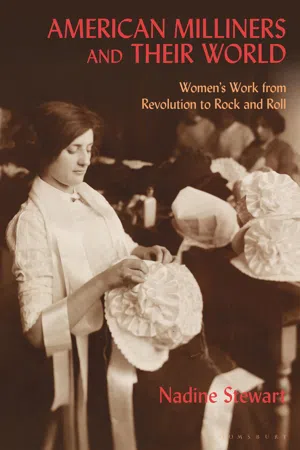
Studies of millinery tend to focus on hats, rather than the extraordinarily skilled workers who create them. American Milliners and their World sets out to redress the balance, examining the position of the milliner in American society from the 18th to the 20th century. Concentrating on the struggle of female hat-makers to claim their social place, it investigates how they were influenced by changing attitudes towards women in the workplace.
Drawing on diaries, etiquette books, trade journals and contemporary literature, Stewart illustrates how making hats became big business, but milliners' working conditions failed to improve. Taking the reader from the Industrial Revolution of the 1760s to the sexual revolution of the 1960s, and from Belle Epoque feathers to elegant cloches and Jackie Kennedy's pillbox hat, the book offers a new insight into the rise and fall of a fashionable industry.
Beautifully illustrated and packed with original research, American Milliners and their World blends fashion history and anthropology to tell the forgotten stories of the women behind some of the most iconic hats of the last three centuries.
eBook - ePub
American Milliners and their World
Women's Work from Revolution to Rock and Roll
- 248 pages
- English
- ePUB (mobile friendly)
- Available on iOS & Android
eBook - ePub
About this book
Information
1
Milaners to Milliners
Today the definition of the word “milliner” seems simple and straightforward. The Oxford English Dictionary’s definition only says:
Mil•li•ner (mil ′ ə nər), n. A person who makes or sells women’s hats.
But the roots of the word extend back to the Renaissance. While women and men have worn a wide variety of headgear over the centuries, the art of the milliner, a person who makes headgear specifically for women, is relatively new. It developed as the thirst for fashion grew along with a rise in consumerism and communication.
The word “milliner” originally referred to “Milaners,” peddlers from Milan who traveled to Northern Europe as early as the 1520s to sell trims—silks, braids, ribbons, and hats of fine Italian straw. Italy was the nexus of trade in luxury items since its ports had access to the riches of the East. There was a thriving Italian silk industry that could produce the ribbons, braids, and other embellishments the rich in the courts of Northern Europe craved. The sunny climate allowed the growth of the finest straw for bonnets. Along the way, these men passed along the latest word on fashionable styles to men and women who were hungry for such news.1
Because milaners sold items that were associated with women, the profession became associated with effeminate men. In Henry IV, Part 1 Shakespeare’s history play written in 1597, the blunt soldier Hotspur derides another courtier by comparing him to a milaner. “Fresh as a bridegroom; and his chin reap’d / Show’d like a stubble-land at harvest-home; He was perfumed like a milliner; And ’twixt his finger and his thumb he held a pouncet-box.”2
The portraits of Queen Elizabeth I give us a picture of the Renaissance love of trims. Dress after dress is bedecked with ribbons, lace, jewels, and fine embroidery. The queen used her dress to dazzle her subjects, so she clearly loved the goods a milaner could supply. By the time she died in 1603, she owned over 2,000 pieces of clothing.3 Her courtiers announced their wealth through their heavily embellished clothing too. The English court was not alone. Courtiers across Renaissance Europe covered themselves in clothing encrusted with the goods of the milaners.
The thirst for magnificent embellishments grew in seventeenth-century France. Louis XIV’s minister of finance Jean-Baptiste Colbert set out to make France the world leader in luxury, particularly in fine clothing. Protective laws were enacted aimed at wrestling production of luxury goods from Italy. French silk weavers and lace makers benefited and were supported by the state. Colbert also encouraged skilled artisans to move to France, sometimes arranging for them to be smuggled into the country.4
By the second half of the seventeenth century, the French court was the most prestigious in Europe, setting the style for most of the continent. Louis XIV dictated the dress in his court with an iron hand, making sure his courtiers supported French luxury artisans by investing heavily in fine clothes to wear in his court. Fashion historian Jennifer M. Jones points out how important trims had become to the clothing of these courtiers. “An elegantly dressed person, whether male or female, often used as much as 300 yards of ribbon on all parts of dress, including the hair.”5
The fashion world was changing. Men had been making clothing for both men and women since the Middle Ages. They belonged to tailors’ guilds that divided the work of producing garments into units that did not change with the changes in fashions. By the late seventeenth century, women began to work in secret as dressmakers though such work was risky since the tailors would break into their shops and destroy them. The new dressmakers were fined for violating guild rules, but this work continued because their women customers kept patronizing them.
In 1675, there was a breakthrough. The dressmakers petitioned Louis XIV to allow them to work legally. The king agreed. A new profession was born, the couturière (or seamstress in English). For the first time women were able to set up a guild of their own. They were restricted to making mourning gowns, clothes for children, and, most important, a new garment that would change women’s fashions—the manteau. Originally, this was a simple robe-like garment that was worn at home. Because it did not have a boned bodice like the grand habit, the formal court dresses produced by the tailors, it was much more comfortable. Even though a corset or stays were worn underneath, the fact that the manteau was looser meant that comfort and ease became the new fashion. Soon women were wearing the manteau outside the home. The success of these couturières meant that the door was opened for more women workers in the fashion world.
Even though women were able to cut and stitch garments, the actual shape of the clothes did not change much from year to year. Much of what we associate today with fashionable change did not exist. Hemlines did not rise and fall. Waistlines stayed in the same place. Silhouettes stayed the same as well. Fashion historian Anne Hollander explains: “For this kind of construction work, basic technical skill but no artistic talent was required. Creative fashion instead expressed itself on the surface, and there it changed very rapidly, particularly at idle and rich courts, with the aid of certain specialized experts.”6 Those expert s were the marchandes de modes or “fashion merchants,” a new profession in the eighteenth century. They provided the trims that varied the look of a dress or a hairstyle.
The marchandes emerged quickly in the second half of the eighteenth century. Originally, male merciers (or mercer in English) had taken over the function of the original milaners, selling the trimmings and ornaments, like lace and ribbons, which added the fine decorative touch to a fashionable garment along with fine textiles for the garments themselves. Women soon began to enter this profitable business of trims and embellishments.7 They were limited to making and trimming anything a woman wore on her head and shoulders, though they could also make belts and ruffles to decorate dresses. Merciers continued to sell dress fabric in precut lengths, but otherwise their involvement in the making of a dress was limited since they were prohibited from cutting cloth. In the intricate guild system, the seamstresses could cut cloth and stitch the gowns. But when it came to the crucial trims, seamstresses were restricted. They could not trim the gowns they made unless the trim was the same material as the gown itself.8
The marchandes did not have that restriction. They dictated how a gown would be decorated and, in the process, began to set the styles. The marchande with her bandbox of trims and measuring stick became a familiar sight in the homes of the rich, visiting her customers in the morning as they completed their toilette. The work offered an opportunity to women from the working class. No special training was needed to become a marchande—just a sure sense of taste.9 The Encyclopedie Methodique defined the marchandes’ work as:
Those who arrange and sell all the little objects that aid dress, particularly, of women, taffetas, gauze, linen, lace, decorations, ribbons of all types, flowers, feathers, and so on are the items they employ. They arrange, diversify, and mix these materials according to their purpose, their fantasy, and the manner that the taste and caprice of the moment inspires and necessitates.10
A key part of this definition follows. “Their art is not to make anything; it consists in ingeniously furnishing a new look withal the varied and gracious ornaments of other arts, particularly that of braid and trimmings.”11
The court began to move back to Paris in the late seventeenth century away from the rigid dress codes of Louis XIV that held sway in Versailles. A retail revolution took place in the center of Paris. Merchants established permanent shops where customers could meet and browse the latest items. By the mid-eighteenth century, marchandes’ shops and workrooms were located in the center of Paris on the Faubourg and Rue Saint-Honore. Their wares were visible from the street through large windows—a temptation to shop after an evening at the theater.12
By 1776 the marchandes got their own guild united with the feather suppliers and flower makers. They had gained the right to decorate the grand habit, the formal gown required for presentation at court, but with the creation of their guild they also gained the right to make the entire garment. Before that, the process was fragmented. Tailors made the boned bodice of the court gown and seamstress were allowed to stitch the skirt.13 With this new freedom to create, the marchandes established a foothold as the leaders of the fashion world. They soon appeared in other European countries from England to Italy, countries where the milaners first plied their trade.
In the second half of the eighteenth century, fashion became more ostentatious. The wide panniers expanded. Hairstyles rose to heights as high as 3 feet augmented by poufs which were concocted from false hair, wool, wire mesh, and gauze. The new styles allowed the marchandes to give free rein to their imaginations. They covered the new wider gowns with trims, but it was on the head where their creativity was really on display since the head was where the real changes in style could be seen. The marchandes piled on feathers, ribbons, lace, jewels, fur, and, even, fresh flowers. One baroness described the experience as “very unwieldy: small, flat bottles curved to fit the shape of the head, containing a little water for real flowers that could be kept fresh in the hairdo. This did not always work, but when it was mastered, it was charming.”14 Styles changed weekly and often featured tributes to important figures and current events, such as a high hairstyle topped with a ship in full sail in honor of the victory of a French ship over the English fleet.15
The leading marchande was Rose Bertin, who rose from humble origins in Picardy to become the head of the marchandes’ new guild and the favorite of Queen Marie Antoinette. She was allowed to meet with the queen alone twice a week in violation of the rigid etiquette of the French court. Her position made her many enemies, but her influence was so powerful many made their way to her exclusive shop on Rue St Honore. Many more copied her work shamelessly.16
There were male marchands as well. The most famous, Jean-Joseph Beaulard, a lso worked for Marie Antoinette. He is known for a unique invention—the bonnet à resort or springed bonnet. It enabled a woman to quickly lower her towering hairstyle by a foot by simply pressing a hidden spring. This was considered a safe way to avert criticism from those who did not approve of the three-foot-high hairstyles, like grandmothers.17 Despite Beaulard’s prominence, the ranks of male marchands were thin. The trade was increasingly seen as a female profession. As the centuries wore on, women would work hard to keep it that way.
Hairstyles began to flatten in the 1780s, but styles did not become simpler. La mode still required copious amounts of ribbons, artificial flowers, and feathers in combinations that changed frequently. In addition, marchandes des modes began to make and sell bonnets and turbans out of straw or fabric. This was the beginning of their evolution into the milliners and modistes in the nineteenth century.18
The marchandes continued to work during the French Revolution even though the guild system was abolished in March 1791, and the fashion industry of France was in chaos. The marchandes were able to make the iconic tricolor cockades required to show support of the new order, which were required by law in 1792.19 Some marchandes were even able to obtain pieces of stone from the Bastille which were placed in gold and silver settings and worn like jewels.20 But after five years of turmoil, it was dangerous to look like a fashion follower.
Bertin along with many other fashion workers went into exile in London. The frenzy over hairstyles had been less powerful ...
Table of contents
- Cover
- Half-Title
- Dedication
- Title
- Contents
- List of Illustrations
- Preface
- Acknowledgments
- Introduction
- 1 Milaners to Milliners
- 2 The Woman’s Sphere
- 3 War and Millinery
- 4 The Gilded Age
- 5 The Progressive ERA
- 6 The Men of The Milliner
- 7 1920s
- 8 1930s
- 9 War and Style
- 10 Rise of the Hairstyle
- 11 French-Fried Curls
- Epilogue
- Notes
- Bibliography
- Index
- Copyright
Trusted by 375,005 students
Access to over 1.5 million titles for a fair monthly price.
Study more efficiently using our study tools.
Frequently asked questions
Yes, you can cancel anytime from the Subscription tab in your account settings on the Perlego website. Your subscription will stay active until the end of your current billing period. Learn how to cancel your subscription
No, books cannot be downloaded as external files, such as PDFs, for use outside of Perlego. However, you can download books within the Perlego app for offline reading on mobile or tablet. Learn how to download books offline
Perlego offers two plans: Essential and Complete
- Essential is ideal for learners and professionals who enjoy exploring a wide range of subjects. Access the Essential Library with 800,000+ trusted titles and best-sellers across business, personal growth, and the humanities. Includes unlimited reading time and Standard Read Aloud voice.
- Complete: Perfect for advanced learners and researchers needing full, unrestricted access. Unlock 1.5M+ books across hundreds of subjects, including academic and specialized titles. The Complete Plan also includes advanced features like Premium Read Aloud and Research Assistant.
We are an online textbook subscription service, where you can get access to an entire online library for less than the price of a single book per month. With over 1.5 million books across 990+ topics, we’ve got you covered! Learn about our mission
Look out for the read-aloud symbol on your next book to see if you can listen to it. The read-aloud tool reads text aloud for you, highlighting the text as it is being read. You can pause it, speed it up and slow it down. Learn more about Read Aloud
Yes! You can use the Perlego app on both iOS and Android devices to read anytime, anywhere — even offline. Perfect for commutes or when you’re on the go.
Please note we cannot support devices running on iOS 13 and Android 7 or earlier. Learn more about using the app
Please note we cannot support devices running on iOS 13 and Android 7 or earlier. Learn more about using the app
Yes, you can access American Milliners and their World by Nadine Stewart in PDF and/or ePUB format, as well as other popular books in Conception & Stylisme. We have over 1.5 million books available in our catalogue for you to explore.