'A useful book of reference by the master of the history of the councils of the Church... There is enormous value in a short, reliable, and careful study of a sequence of events that may have unfamiliar joinings and passageways to modern believers...' - Catholic Historical Review
'A short, readable and informed survey of church history.' - The Church of England Newspaper
'A rich foundation for Catholic understanding and witness.' - Catholic San Francisco
____________
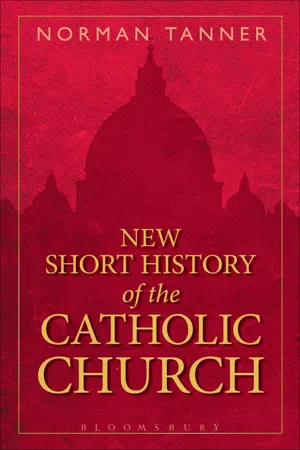
A one-volume history of the Christian people from Pentecost to the present day, with principal focus on the Catholic Church.
Having passed AD 2000 it seems appropriate and necessary to have a new short history of the first two millennia of the Christian era.
In the last half century there has been a massive amount of research into Church history, published in learned articles and in multi-volume works. Full notice is taken of these recent scholarly initiatives in writing this short account, which is also eminently readable.
In each section there is a balance between the institutional and the more directly religious dimensions of the Church - here are some of the elements: bishops, canon law, charity, councils crusades, devotions, heresies, laity, liturgy, martyrs, missionaries, parishes, pilgrimages, popes, prayer, priesthood, religious orders, sacraments, schools, theologians, universities and the vita consacrata.
The scope is wide; the pace of the narrative is attractive.
- 280 pages
- English
- ePUB (mobile friendly)
- Available on iOS & Android
eBook - ePub
New Short History of the Catholic Church
About this book
Information
Chapter 1
Pentecost to the Fourth Century
i. The Apostolic Age
When should this book begin? An obvious date is the birth of Christ, the founder of Christianity and its loadstar ever since. There is insufficient space, however, in this short history to review the life and times of Jesus Christ. The story is well known, as recorded principally in the four Gospels of Matthew, Mark, Luke and John, and the details have been investigated extensively by numerous writers. It forms, of course, the essential background, indeed the foreground, to all that will be said hereafter.
Pentecost makes a more realistic starting point, especially since this book is styled a history of the Church rather than of Christianity.
Acts of the Apostles
On Pentecost, the fiftieth day (fifty in Greek = pentecoste) after Christ’s ascension into heaven, according to the Acts of the Apostles, the Holy Spirit descended upon the disciples gathered together in Jerusalem and transformed them, principally through the gifts of wisdom and fortitude, into an enduring church. Traditionally the day has been called the birthday of the Christian church, on account of the gift of the Holy Spirit who sustains and guides the Church, as distinct from Christmas, the birthday of Christ. It is appropriate, therefore, to begin this history with the account of Pentecost in Acts 2.1–4 and 41–2:
When the day of Pentecost had come, the disciples were all together in one place. Suddenly a sound came from heaven like the rush of a mighty wind, and it filled all the house where they were sitting. There appeared to them tongues as of fire, distributed and resting on each one of them. They were all filled with the Holy Spirit and began to speak in other tongues, as the Spirit gave them utterance.
Peter the apostle then preached to the multitude. As a result:
Those who received Peter’s word were baptized, and there were added that day (to the number of believers) about three thousand souls. They devoted themselves to the apostles’ teaching and fellowship, to the breaking of bread and the prayers.
The period from Pentecost to the death of the John the Evangelist, who is usually reckoned to be the last to die of the twelve apostles chosen by Jesus Christ, has come to be called the Apostolic Age: that is, the age, after the death of Jesus, when at least one of the apostles was alive. It forms a convenient time span for the first part of this chapter. The large majority of directly relevant evidence comes from the New Testament, principally Acts of the Apostles and the letters of Paul; some additional information comes from various other sources, from both within and beyond the Christian community.
Acts of the Apostles is essentially an historical work; though one with an apologetic purpose. Indeed, the Greek word Praxeis, and the Latin Acta, which we translate as ‘Acts’, were commonly used in the titles of historical books. To begin this New Short History of the Catholic Church with Acts of the Apostles is doubly appropriate. First and most obviously, because Acts formed the most important document about the history of the Church during this early period. Secondly, to begin with Acts may give special encouragement to readers of the present book. For it shows that present-day interest in the history of the Church dovetails with that of the early Christians. For them history was informative and interesting, but it was also constitutive of the Christian message. Or, in the subsequent language of the councils of Trent and Vatican II, Tradition clarifies Scripture.
The account of Pentecost in Acts records that the multitude addressed by Peter included ‘Parthians and Medes and Elamites and residents of Mesopotamia, Judea and Cappadocia, Pontus and Asia, Phrygia and Pamphylia, Egypt and the parts of Libya belonging to Cyrene, and visitors from Rome, both Jews and proselytes, Cretans and Arabians’. From among them, as a result, ‘about three thousand souls’ were baptized. We can visualize the rapid expansion of Christianity to many parts of the Roman Empire and beyond, as those baptized returned to their own countries.
The place and timing of Christ’s life within the Roman Empire were extraordinarily favourable to the spread of Christianity, even from a human standpoint. Christians can praise the wisdom of Divine Providence in the choices. Good communications by land and sea as well as relative peace within the vast empire meant that, despite the trials of persecution, the Christian message could be preached and practiced, and thereby grow, throughout the Mediterranean world, and beyond it, for some four centuries (see Map, p. xv). Essential for this expansion, too, was the depth and sophistication of the Jewish religion, which provided for Christianity its rich foundation.
After the account of Pentecost, the early chapters of Acts of the Apostles focus on the spread and persecution of Christianity among the Jewish people within the lands known to Jesus. The story culminates with the preaching and martyrdom of Stephen, the first Christian martyr, in Jerusalem around the year 35 and the dramatic conversion of Paul of Tarsus on the road to Damascus.
Thereafter the account in Acts moves decisively to the wider world, to lands and peoples beyond Judea and the Jews. Crucial to this expansion were the difficult decisions to admit to the Christian fold persons who were not Jews and to lift several obligations – at least for non-Jewish converts to Christianity – regarding circumcision and diet: decisions that could be seen as going beyond the explicit teachings and practice of Jesus. Peter and Paul are represented as the key figures in these resolutions, with important roles also played by James ‘brother of the Lord’ and Barnabas, the companion of Paul. The decisions were ratified, after discussion, at the council ‘of the apostles and elders’ which was held at Jerusalem in about the year 49 (Acts, chapter 15).
After the council of Jerusalem, Paul dominates Acts. He parted from Barnabas following a difference over their choice of colleagues, and Timothy became his closest companion. His remarkable missionary journeys, which had already begun before the council of Jerusalem with visits to Cyprus and various places in modern Turkey, took him to cities in Syria and Greece as well as to Turkey again. Paul then returned to Jerusalem where he was arrested by the Roman authorities on account of the religious disturbances he was causing. As a result, he appealed to the emperor, following his rights as a Roman citizen, and he was taken in captivity to Rome. The book concludes with the story of this eventful journey and his sojourn in Rome, without describing his death. Besides Acts, there are the surviving letters traditionally ascribed to Paul that were written to various Christian communities and individuals: two each to the Christians in Corinth and Thessalonia, one each to the Christians of Rome, Galatia, Ephesus, Philippi and Colossae, two to his companion Timothy and one to his disciple Titus. Many of these letters are long and very substantial, informative regarding both Christian theology, as preached by Paul, and the communities and individuals to whom they are addressed. Taken together, Acts and Paul’s letters provide us with an exceptionally full and lively account of the development of the Church during the three decades or so after the death of Jesus.
Two quotations, both from Acts of the Apostles, must suffice to illustrate the vitality described by this early literature. The first comes from chapter 4 of Acts and portrays the early Christian community soon after Pentecost:
Now the company of those who believed were of one heart and soul, and no one said that any of the things which he possessed was his own, but they had everything in common. And with great power the apostles gave their testimony to the resurrection of the Lord Jesus and great grace was upon them all. There was not a needy person among them, for as many as were possessors of lands or houses sold them, and brought the proceeds of what was sold and laid it at the apostles’ feet; and distribution was made to each as any had need.
The portrayal may be idealistic, especially regarding common property, yet it captures something of the energy and dedication of the early Christians. The second quotation also portrays energy and commitment, novelty too within the Christian message, but also the difficulty of communicating this message, this time in the context of the preaching of Paul. It comes from chapter 17 of Acts, towards the end of Paul’s ministry, and describes his speech in the Areopagus – a meeting-place near the Acropolis – in Athens:
So Paul, standing in the middle of the Areopagus, said: ‘Men of Athens, I perceive that in every way you are very religious. For as I passed along, and observed the objects of your worship, I found also an altar with this inscription, “To an unknown god”. What therefore you worship as unknown, this I proclaim to you. The God who made the world and everything in it, being Lord of heaven and earth, does not live in shrines made by man, nor is he served by human hands, as though he needed anything, since he himself gives to all people life and breath and everything … Yet he is not far from each one of us, for “In him we live and move and have our being” … The times of ignorance God overlooked, but now he commands everyone everywhere to repent, because he has fixed a day on which he will judge the world in righteousness by a man (Jesus Christ) whom he has appointed, and of this he has given assurance to all people by raising him from the dead.’
Other sources
The other books of the New Testament provide only limited historical information about the early Church. Letter to the Hebrews (the author is now widely considered to be someone other than Paul) and Book of Revelation (Apocalypse) are important theological treatises but give few details about the life of the early Christians. The remaining seven books (entitled: James; Jude; 1 and 2 Peter; 1, 2 and 3 John) are letters addressed to Christians in general rather than to particular churches, hence their common description as ‘catholic’ (meaning ‘universal’) letters/epistles. As a result, while they are significant as theological treatises and moral exhortations, they are short on the details of the early Christian communities. They underline, nevertheless, the liveliness and religious commitment of the early Church.
There are no other surviving works written by Christians that clearly belong to the Apostolic Age; though a few writings discussed in the second section of this chapter may have been composed towards the end of this period. The absence of other such works comes as no surprise. Christians took great pains to establish which books should be included in the New Testament. The main list (or ‘canon’) of these works was essentially approved during the second century AD and finalized by the fourth or fifth century. The best works were chosen, it seems, on account of their quality and, in most cases, the writer’s privileged knowledge of Jesus. Certainly the books that were included, taken together, are of very high quality even from a human point of view. Other possibly contemporary writings, which were excluded from the canon, became lost.
Also excluded from the New Testament canon were a large number of ‘gospels’, ‘acts’, ‘letters/epistles’ and ‘apocalypses’ relating to the life of Jesus and the early Church which date, according to modern scholarship, from the second century onwards. They are usually called ‘Apocryphal Books’ because they were written after the Apostolic Age and their reliability is doubtful and, as a result of these and other factors, they were excluded from the canon. It is difficult to know what to make of them. They focus much on the strange and awkward, in contrast to the overall sobriety of the canonical books. They are essential reading for scholars of the period but they need not detain us here.
No extensive studies of the early Church by non-Christians – which might give us an outside evaluation of the movement – survive from the Apostolic Age. It seems unlikely that such works ever existed. However, a few scattered passages survive in the writings of various non-Christians from the late first and early second centuries. They provide precious independent evidence of the existence of the early Church even though the information is very limited. They may be considered here together.
The earliest passage comes from Antiquities of the Jews, which was written by the Jewish historian Flavius Josephus around the year 94. It provides an account of the martyrdom of James ‘the brother of Jesus’ in Jerusalem, probably in 62. The sentence of death was ordered by the Jewish high priest but it appears to have been an unpopular move. James’s martyrdom is not mentioned in the Acts of the Apostles or elsewhere in the New Testament, but Josephus’s account rings true and thus provides important independent evidence about the existence of the early Church. Josephus writes thus:
Ananus the High Priest assembled the Sanhedrin of judges and brought before them the brother of Jesus who was called Christ, whose name was James, and some others. When he had formed an accusation against them as breakers of the law, he delivered them to be stoned. But those who seemed the most equitable of the citizens, and accurate in legal matters, disliked what was done.
Two Roman historians, Tacitus in Annales (Annals) and Suetonius in Vita Neronis (Life of Nero), both writing between 110 and 120, described the persecution of Christians by the emperor Nero. Tacitus records how they were made scapegoats for the fire that ravaged Rome in 64. He acknowledged that the steadfastness of Christians under torture drew the citizens’ admiration: ‘All this punishment gave rise to a feeling of pity, even towards people (Christians) whose guilt merited the most exemplary punishment; for it was felt that they were being destroyed not for the public good but to gratify the cruelty of an individual (Nero).’ Suetonius, too, relates the sufferings inflicted by Nero upon Christians, while describing them disparagingly as ‘people adhering to a novel and mischievous superstition’.
Interesting further information is contained in an exchange of letters around the year 112 between emperor Trajan and his emissary in Bithynia (in modern Turkey), Pliny the Younger. Reporting to the emperor regarding affairs in that region, Pliny noted that Christians ‘had spread not only in the cities but in the villages and rural districts as well’. He summarized their practices and lifestyle thus:
On an appointed day (Sunday?) they had been accustomed to meet before daybreak, and to recite a hymn antiphonally to Christ, as to a God, and to bind themselves by an oath, not for the commission of any crime but to abstain from theft, robbery, adultery and breach of faith, and not to deny a deposit when it was claimed. After the conclusion of this ceremony it was their custom to depart and meet again to take food (the Eucharist?).
These, then, are the principal witnesses to the Church of the first century AD: writers, principally those of the New Testament, who wrote during this time or shortly afterwards. They provide the overwhelming majority of our reliable knowledge about the early Church, after the ascension of Jesus, during this century.
Tombs of Peter and Paul
One event that comes to us from later records is the burial of the apostle Peter. Neither Peter’s ministry in Rome nor his martyrdom are mentioned in Acts of the Apostles or elsewhere in the New Testament; though ‘Babylon’ mentioned in 1 Peter 5.13 may refer to Rome and therefore indicate Peter’s presence there. Two letters, which were written by Clement of Rome and Ignatius of Antioch just before and after the year 100, refer to Peter’s presence and death in the city. The first mention that his death was by crucifixion comes from Tertullian, writing in the early third century. Eusebius of Caesarea in his Historia Ecclesiastica, written in the early fourth century, dates this martyrdom more precisely to the persecution of emperor Nero – probably he was put to death during the persecution in 64 even though Eusebius indicates a later persecution in 68. For his tomb, we rely partly on the letter of a certain Proclus, which was reportedly written around 200 and survives in the same Historia Ecclesiastica of Eusebius. Proclus writes of the ‘trophy’ (Latin, trophaeum) of Peter, indicating his burial place, on the Vatican hill. We know that when emperor Constantine initiated the building of the original St Peter’s church in Rome (which remains the basis of the present Church today), he chose a somewhat inconvenient site: a marsh had to be filled in and a hill excavated in order to accommodate the building. An obvious motive for accepting these inconveniences, and the one generally recognized for centuries, was to include something very special within the church’s crypt, namely Peter’s tomb. Subsequently, in extensive excavations in the crypt carried out in the middle of the last century, a team of archaeologists (led by professors Kirschbaum, Ferrua, Ghetti and Josi) discovered a tomb with a flagstick that seemed to correspond with Proclus’s description of the trophaeum. Modern archaeology thus appeared to confirm the ancient tradition.
Acts of the Apostles mentions Paul’s captivity in Rome but not his death there. However, the letters of Clement of Rome and Ignatius of Antioch record the death of Paul in Rome alongside that of Peter. Paul was recognized to be a Roman citizen (Acts 22.25–30) and the normal form of death penalty for Roman citizens was beheading. Tertullian states explicitly that he was beheaded. The date of his execution is usually assigned to the Neronian persecution in which Peter also perished, though some scholars date it earlier and a few later. Early evidence places the execution at ‘Tre Fontane’ (following the legend that Paul’s head bounced three times after his execution, resulting in three fountains springing up) some three miles to the south of Rome. The tomb in which he was buried is ascribed to the crypt of the church of St Pauls outside the Walls – a location that recent excavations have corroborated. The tomb in St Pauls has recently been finely restored.
ii. Second and third centuries: continuing persecution
During these two centuries, persecution remained central to the life of the Church. It colours much of the surviving evidence of the period. It also explains many gaps in this evidence and therefore in our knowledge, inasmuch as Christians were reluctant to preserve incriminating evidence. This section begins by examining the persecutions of the period and their effects. Thereafter the main institutional developments are considered, then popular religion and some major theologians.
Persecutions
We have seen already that persecution – whether actual or threatening – featured prominently in the life of the Church during the first century. Much the same situation persisted through the next two centuries and into the early fourth century, when the conversion of emperor Constantine to Christianity radically altered the situation. Persecutions were intermittent and confined mostly to particular regions. Nevertheless they had a profound influence upon the history of Christianity in at least three important ways. First and most obviously, many people suffered grievously. Secondly, the possibilities for many normal forms of church life that we take for granted – for example, the establishment of church buildings – were very limited or out of the question. Thirdly, in following the example of Jesus Christ, the Christian martyrs of the time have ...
Table of contents
- Contents
- Acknowledgements
- Notes and Abbreviations
- Introduction
- Chapter 1
- Chapter 2
- Chapter 3
- Chapter 4
- Chapter 5
- Conclusion
- Appendix
- Glossary
- Bibliography
Trusted by 375,005 students
Access to over 1.5 million titles for a fair monthly price.
Study more efficiently using our study tools.
Frequently asked questions
Yes, you can cancel anytime from the Subscription tab in your account settings on the Perlego website. Your subscription will stay active until the end of your current billing period. Learn how to cancel your subscription
No, books cannot be downloaded as external files, such as PDFs, for use outside of Perlego. However, you can download books within the Perlego app for offline reading on mobile or tablet. Learn how to download books offline
Perlego offers two plans: Essential and Complete
- Essential is ideal for learners and professionals who enjoy exploring a wide range of subjects. Access the Essential Library with 800,000+ trusted titles and best-sellers across business, personal growth, and the humanities. Includes unlimited reading time and Standard Read Aloud voice.
- Complete: Perfect for advanced learners and researchers needing full, unrestricted access. Unlock 1.5M+ books across hundreds of subjects, including academic and specialized titles. The Complete Plan also includes advanced features like Premium Read Aloud and Research Assistant.
We are an online textbook subscription service, where you can get access to an entire online library for less than the price of a single book per month. With over 1.5 million books across 990+ topics, we’ve got you covered! Learn about our mission
Look out for the read-aloud symbol on your next book to see if you can listen to it. The read-aloud tool reads text aloud for you, highlighting the text as it is being read. You can pause it, speed it up and slow it down. Learn more about Read Aloud
Yes! You can use the Perlego app on both iOS and Android devices to read anytime, anywhere — even offline. Perfect for commutes or when you’re on the go.
Please note we cannot support devices running on iOS 13 and Android 7 or earlier. Learn more about using the app
Please note we cannot support devices running on iOS 13 and Android 7 or earlier. Learn more about using the app
Yes, you can access New Short History of the Catholic Church by Norman Tanner in PDF and/or ePUB format, as well as other popular books in Theology & Religion & Christian Denominations. We have over 1.5 million books available in our catalogue for you to explore.