eBook - ePub
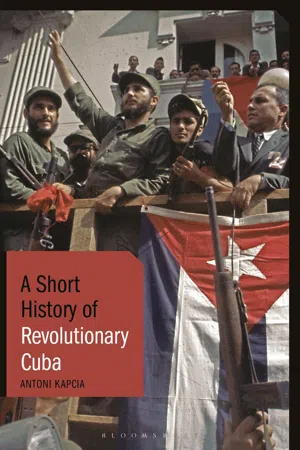
A Short History of Revolutionary Cuba
Revolution, Power, Authority and the State from 1959 to the Present Day
- 248 pages
- English
- ePUB (mobile friendly)
- Available on iOS & Android
eBook - ePub
A Short History of Revolutionary Cuba
Revolution, Power, Authority and the State from 1959 to the Present Day
About this book
Few island nations have stirred the soul like Cuba. From Hemingway's intoxicating Havana to Ry Cooder's Buena Vista Social Club, outsiders have persistently been fascinated by Cuba for its music (jazz to rumba), its rich literature, its art and dance (danzón to mambo) and perhaps above all for its bold experiment of a socialist revolution in action. Antoni Kapcia shows how the thaw in relations between Cuba and the USA now makes a fresh appraisal of the country and its modern history essential. He authoritatively explores the 'essence' of the Cuban revolution, revealing it to be a maverick phenomenon tied not so much to socialism or Communism for their own sakes but instead to an idealistic vision of postcolonial nationalism. Reassessing the Cuban Missile Crisis of 1962, the author examines the central personalities: not just the famous trio of Che Guevara, Fidel and Raúl Castro in shaping the ideas of the revolution but, still further back, the visionary ideology of José Martí. Kapcia's book reflects on the future of the revolution as aúl nd his government began to cede power to a new generation.
Information
1
The evolution of a radical nationalism
To start with the past misreadings of the Cuban Revolution to which the preface referred, we can see fairly quickly that, in its first decade, the conventional approach was often reading the process through the prism of the widespread focus on the person (and personality) of Fidel Castro, usually seeing him as the latest, if the most unusual, manifestation of a ‘typically Latin American’ personalist or populist regime (Draper 1965). As the Revolution then moved into communism and the global Cold War (from 1961–2), the alternative tendency was to read ‘the Revolution’ (by then capitalized, as in Cuba) as a ‘typical’ communist state, as a Caribbean version of the 1948–90 Socialist Bloc: monolithic under a dictator, like East Germany’s Ulbricht or Romania’s Ceausescu (Gonzalez 1974; Horowitz 2008). Sadly, both approaches remained all too visible in 2016 when the media focused on the death of Fidel (given the importance of both Castro brothers within the narrative that follows here, we have little choice but to distinguish between them henceforth by either ‘Fidel’ or ‘Raúl’). In one BBC News television interview on 26 November, after having meticulously explained his historical significance, this author was asked: ‘so would you say Castro was a typical Latin American dictator or a typical Communist dictator?’ Evidently, nothing had changed since 1968.
Therefore, what this study aims to do is to focus on what can be argued is the essence of the six-decade-long process: a long-delayed (and thus radicalized) process of post-colonial and decolonizing nation building which, given the ‘templates’ then available to such processes across the post-colonial world and based on the radicalism of many Cuban traditions, moved inexorably towards some version of ‘socialism’ as the means to achieve that goal. The importance of that alternative perspective is that it recognizes fully the strength and depth of the nationalism originally underpinning the Revolution, and also the depth and character of the transformation which that nation-building project intended, or which developed. Put simply, what we might call ‘Cuban socialism’ was always somewhat maverick, even at its most apparently ‘Sovietized’, and (despite what we are often told) was not simply attributable to Fidel but rather reflected the ideological patterns of those traditions and a range of other factors that this study addresses.
This means that, rather than forcing ‘the Revolution’ into the straitjacket of unhelpful paradigms, we might be better advised to consider it in a different context of the many post-colonial regimes of Africa and Asia in the late 1950s and early 1960s, often driven by the same priorities which preoccupied the Cuban leaders. They included an overwhelming (and often stifling) emphasis on unity; a frenetic drive to ‘catch up’ by rapid, often industrial, development; a single-party system to unite different elements of the preceding anti-colonial radicalism; and a welfare state to ensure rapid social development and popular support.
In other words, we should think of the Cuban Revolution less as a static, monolithic and ‘typical’ communist system and more as a contested, often empirical, nation-building process. Importantly, that process was initially restricted within (and often shaped by) an underdeveloped economy and then (for three decades) shaped and restricted by the Cold War, bringing prolonged isolation and active external hostility (most evidently, the US embargo and in periods of outright subversion). Of all the factors shaping the patterns and thinking of those six decades, the external context is perhaps one of the most crucial, whether that applies to sugar’s world price and market, to the role and attitude of the United States, to the role of the Soviet Union (1961–91) or to the politics and growing interpretations within the ‘Third World’ in the 1960s and 1970s. That context has served more to set the parameters for nation building than to be simply the stage on which the process has evolved.
The point here is to explain not just the Revolution’s historical context but also one of the Revolution’s most perplexing characteristics for outside observers: the system’s remarkable survival over six decades. Most obviously, it has survived six decades of US hostility: the US embargo (the longest – and, probably, the least successful – sanctions in history, formalized fully in February 1963 and still in existence in 2020), one US-backed invasion (1961), sustained funding of external sabotage (1960s and 1970s) and subversion. Secondly, it has survived repeated economic crises: in 1962–3, 1970, and, most traumatically, the disappearance in 1989–91 of the whole edifice of trade and of economic and military support which Cuba’s alliance with the Socialist Bloc and Soviet Union had meant from 1961, but especially from 1972. That crisis, which hit Cuba more severely than either the crises and recessions of 1920 or 1929–33, should have proved terminal, as predicted by many (Oppenheimer 1992). Finally, the Revolution has survived twelve years after Fidel’s retirement.
The question of survival brings us back to the literature on Cuba, which has attributed it to a range of possible explanations, often depending on the interpreter’s political position. These include the obvious assumption of systematic coercion (through either monolithic repression or Fidel’s personal(ist) control). In reality, the Fuerzas Armadas Revolucionarias (FAR, Revolutionary Armed Forces) were reduced by half in the early 1990s’ economic crisis and have never since recovered their former funding (Klepak 2005: 61), while the government briefly ceased to function effectively. Meanwhile, Fidel himself relinquished any personal control in 2007. This common explanation is related to another: the Cuban population’s presumed fatalism or passivity, assumed to result either from years of indoctrination, repression and isolation, which led to resigned acceptance, or from a grudging pragmatism (as welfare levels were partially protected) or from simple fear of the alternatives. The latter did have some justification in 1990–4, as Cubans returning from the Socialist Bloc and Soviet Union brought accounts of post-collapse falls in living standards and welfare; that argument would become less tenable after a few years, as those former Bloc countries saw economic growth and stability in the 2000s. One more obvious and convincing explanation offered was the power of Cuban national pride, and the government’s ability to exploit it, whenever US presidents acted in ways that sparked nationalist responses in Cuba, by tightening the embargo (1992, 1996 and 2004) or by raising the levels of hostility (as with Reagan and Bush).
While some of those common explanations have convincing elements, they all have flaws or only hold water for certain moments or periods. This author, in addressing survival, has elsewhere suggested other possible factors. The first is the persuasive and cohesive role of ideology: not so much Marxism–Leninism as a more complex organic, dynamic and always adaptable belief system (Weltanschaung), which succeeded in driving, uniting and offering solutions to enough Cubans most of the time (Kapcia 2000). Another is the cohesive effectiveness of what was described as a quasi-corporatist (but a post-colonial revolutionary corporatism) system, with its inclusive tendencies and comprehensive processes and mechanisms of participation and involvement (Kapcia 2014: 119–23).
In fact, summarizing all of the more convincing explanations, we can see that the most sensible approach is probably to combine several elements into an explanation rather than seek one impossible single cause. Broadly, we can summarize these as economic, social, ideological and political. The economic factors most often mentioned focus on the comprehensive rescue programme from 1992, especially measures such as the decriminalization of the US dollar (which allowed urgently needed remittances to flow to families – and the system); the imposition of a dual currency system which (for all its later problems of inequality and inaccurate accounting) ensured that the state garnered most of the hard currency, enabling it to purchase imports; the shift to tourism, soon to become Cuba’s mainstay; an agrarian reform that ensured farmers’ loyalty and better provision of food supplies; and the permission to form joint venture enterprises with foreign capital. The social factors were often related: the guarantees of free education and healthcare and the strengthening of the ration book. The ideological factors were the residual sense of solidarity among enough Cubans (often expressed as a system of low-level reciprocity between friends and neighbours) and the strength and depth of nationalism (long shaped by a sense of anti-imperialism and regularly boosted by successive US policies). Finally, the political factors were the cohesion and reconstruction of the participatory system (ensuring a degree of communication and involvement, even in the workplace); the long-standing emigration of any potentially organized and substantial opposition; the role of the churches in ensuring access to external supplies and in preventing social disintegration; and the effectiveness of new layers of local governance.
This study, however, offers yet another possible factor, related to the quasi-corporatist explanation by examining the evolution (partly based on ideology and substantially based on empirical evidence) of what will be presented as a complex and overlapping matrix of power (and within that of different kinds of power) within a constantly evolving state. In other words, it is the systemic analysis of the corporatism that was described in 2014 (with its focus on personnel and group dynamics), full of complexity but remarkably effective, characterized by multiple vertical structures of power, participation and governance, all interlocking with horizontal processes of negotiation and consultation. It will be argued that this reflects, and in turn has shaped, the evolution of the Cuban state as something less monolithic than a highly complex infrastructure for those structures and processes.
The historical context
However, before embarking on that, we need to outline the very particular historical context which so shaped modern and contemporary Cuba and the post-1959 system, a task which most observers see as essential to any understanding of why Cuba experienced such an unlikely and improbably durable radical transformation after 1959. For, while Cuba shared many of Latin America’s wider historical experiences, certain processes made Cuba’s political culture unique. It is, of course, a truism that every country is ‘unique’, no matter how similar any two might appear; moreover, recent scholarship has moved away from the traditional focus on Cuba’s apparent ‘exceptionalism’ (Hoffmann and Whitehead 2007), a reassessment that has usefully reminded us of a similar radicalized nationalism witnessed across Latin America in 1900–60. Equally, many developing countries after 1960 faced some of the same challenges as Cuba, while Cuban emigrants from the early 1980s were often little different from millions of economic migrants in search of material improvement in developed countries (Duany 2011; Krull and Stubbs 2018).
Two concepts are used repeatedly throughout this study – radicalism and nationalism – and this is an apposite moment to clarify the way that both are defined here. Broadly, when the term ‘radical’ is used, it usually refers to a political stance going beyond whatever was the norm at a given time or in a given way of thinking; that ‘beyond’ could be either on the Right (towards corporatism or fascism, or an exclusive nationalism) or towards the Left. In the latter case (more common in Latin America), radical postures usually proposed deeper or more rapid changes than reformist or gradualist stances, or, in comparing with pro-Soviet communism, seeking more fundamental and more immediate approaches to revolutionary change.
What was meant by nationalism?
Consideration of nationalism, of course, opens Pandora’s box, given its multiple and changing global meanings and manifestations, let alone in Cuba. As we will see, what can be broadly termed ‘Cuban nationalism’ has actually had many different shapes, bases, platforms and targets over some two centuries, some more recognizable for North Americans or Europeans but others either particularly Cuban or shared with other Latin American societies. Lilian Guerra has helped us considerably by convincingly examining the several different nationalisms in the early Cuban Republic, broadly distinguishing between a pro-imperialist, a revolutionary and a popular nationalism (Guerra 2005: 8–21, passim), although two other books by her have effectively taken that typology further into more dimensions (before and after 1959), but always focusing on the imagining of ‘the nation’ (Guerra 2012, 2018). Indeed, her emphasis on the essence of Benedict Anderson’s path-breaking approach, to understand nationalism as ‘imagined communities’ (Anderson 1983), takes us to the heart of the different understanding of the multiple layers and types of meaning applied to the term in Cuba over the decades.
Although Anderson’s approach insisted on taking the concept’s origins further back than the conventional starting point of the French Revolution, it is less that dimension that interests us here (since several of Cuba’s nationalisms did broadly follow from 1789) and more the imagining process. That is because the Cuban manifestations that emerged in the 1800s were all focused on imagining something new: while one might posit some nationalisms as essentially nostalgic (harking back to a real or an imagined lost identity, either a sovereignty supressed by an outsider or a cultural identity seen as threatened by ‘the other’), the many versions of Cuba Libre which we will see in this study all shared the novelty of what they imagined, since there had never been a separate or independent Cuba since the early Spanish colonization. Hence, all versions that emerged were imagining something as yet unformed, perhaps inevitably leading to the many variations. In some respects, Cuban nationalism was thus like the Left’s familiar tendency to divide since it is always easier to create a consensus on what is (the status quo) or on what used to be, based on a broad (but rarely universal) consensus, than on what should be in an as yet unrealized future.
However, this study will trace the evolution of several conflicting nationalisms (Guerra 2005) that all changed over time, according to the hegemonic powers’ ability to convince. While Spanish colonialism more or less worked (for enough interests in the emerging criollo – Cuban-born white – elite), any proto-nationalism was limited to a small intellectual minority or those driven by external ideology (often freemasonry). Once it was more widely seen as no longer effective, a reluctant separatism (rather than, yet, any clear nationalism that assumed a separate Cuban nation) posited US statehood; only when that failed as a prospect did a still reluctant separatism metamorphose into the pro-imperialist nationalism (Guerra 2005) that characterized significant parts of the white rebel constituency of 1868–98, and indeed beyond that. However, we will also see the emergence of an increasingly popular nationalism (perceiving Cuba Libre as racially equal and multicultural) which, as each rebellion evolved (and two were supressed) and as external ideas entered the equation to shape the ‘imagining’ more ideologically, became more coherent in some basic respects (the shared principles for shaping the future Cuba Libre) but still necessarily imagined, rather than rationally conceived. Guerra’s third (revolutionary) nationalism can be seen in the creation and character of the Partido Revolucionario Cubano (PRC, Cuban Revolutionary Party), infused always by explicitly leftist principles and interpretations of history, past and future.
Thereafter, we will see those nationalisms then diverge further, as the relationship with the United States complicated Cubans’ awareness of what an independent Cuba needed and could achieve, but also as one strand of nationalism began to reflect the wider radicalization of anti-US sentiment elsewhere in Latin America. Finally, of course, the quasi-redemptive nationalism (Guerra 2012) that evolved in the 1940s (confused by the 1933 ‘revolution’ and then a populism that promised much but signally failed to deliver) helped to create the context for the 1959 Revolution, which, of course, would become divided irreparably by the rapid radicalization of a more explicitly socialist form of the fusion of revolutionary and popular nationalisms, whose institutional expression over the following decades (as national pride and enforced collectivism shaped a defiant survival of a perceived imperialism) brought a deeper, but much less recognizable, version of nationalism, one that was rescued in the early 1990s and which then drove redefinitions. However, this overview of these different nationalisms remains just a summary; their fuller elaboration must await the appropriate moment of the narrative.
Modern cuba’s ...
Table of contents
- Cover
- Half-Title
- Series
- Title
- Contents
- Glossary of Spanish terms
- List of acronyms and initials
- Preface
- Chapter 1 The evolution of a radical nationalism
- Chapter 2 The project to construct a Cuban nation, 1959–61
- Chapter 3 Debate I: 1962–5
- Chapter 4 The Maverick Revolution and ‘Cuban Communism’, 1965–70
- Chapter 5 Debate II: 1970–5
- Chapter 6 Institutionalization, consolidation and greater orthodoxy, 1975–85
- Chapter 7 Debate III: 1985–9
- Chapter 8 Crisis and the special period, and debates IV and V, 1989–2005
- Chapter 9 From Fidel to Raúl: The last chapter?
- Chapter 10 Reflections on the Cuban matrix of power, governance and decision-making
- Notes
- Bibliography
- Index
- Copyright
Trusted by 375,005 students
Access to over 1.5 million titles for a fair monthly price.
Study more efficiently using our study tools.
Frequently asked questions
Yes, you can cancel anytime from the Subscription tab in your account settings on the Perlego website. Your subscription will stay active until the end of your current billing period. Learn how to cancel your subscription
No, books cannot be downloaded as external files, such as PDFs, for use outside of Perlego. However, you can download books within the Perlego app for offline reading on mobile or tablet. Learn how to download books offline
Perlego offers two plans: Essential and Complete
- Essential is ideal for learners and professionals who enjoy exploring a wide range of subjects. Access the Essential Library with 800,000+ trusted titles and best-sellers across business, personal growth, and the humanities. Includes unlimited reading time and Standard Read Aloud voice.
- Complete: Perfect for advanced learners and researchers needing full, unrestricted access. Unlock 1.5M+ books across hundreds of subjects, including academic and specialized titles. The Complete Plan also includes advanced features like Premium Read Aloud and Research Assistant.
We are an online textbook subscription service, where you can get access to an entire online library for less than the price of a single book per month. With over 1.5 million books across 990+ topics, we’ve got you covered! Learn about our mission
Look out for the read-aloud symbol on your next book to see if you can listen to it. The read-aloud tool reads text aloud for you, highlighting the text as it is being read. You can pause it, speed it up and slow it down. Learn more about Read Aloud
Yes! You can use the Perlego app on both iOS and Android devices to read anytime, anywhere — even offline. Perfect for commutes or when you’re on the go.
Please note we cannot support devices running on iOS 13 and Android 7 or earlier. Learn more about using the app
Please note we cannot support devices running on iOS 13 and Android 7 or earlier. Learn more about using the app
Yes, you can access A Short History of Revolutionary Cuba by Antoni Kapcia in PDF and/or ePUB format, as well as other popular books in Historia & Historia de Latinoamérica y el Caribe. We have over 1.5 million books available in our catalogue for you to explore.