In Muslim countries, apostasy and blasphemy laws are defended on the grounds that they are based on Islamic Shari'a and intended to protect religion. But blasphemy and apostasy laws can be used both to suppress thought and debate and to harass religious minorities, both inside and outside Islam. This book – comprising contributions from Muslim scholars, experts and activists - critically and constructively engages with the theological, historical and legal reasoning behind the most restrictive state laws around the world to open up new ways of thinking.
The book focuses on the struggle within Muslim societies in Iran, Egypt, Pakistan and Indonesia where blasphemy and apostasy laws serve powerful groups to silence dissent and stifle critical thought. The first part of the book covers the development of the law in shifting historical circumstances and surveys the interpretations of Qur'anic verses that seem to affirm freedom of religion. The second part examines the present politics and practices of prosecuting alleged blasphemers and/or apostates in Muslim countries. The third part looks to the future and where reforms of the law could be possible.
Debates on Islam and freedom of expression are often cast in polarizing terms of rights versus religion, East versus West. This volume avoids such approaches by bringing together a diverse group of Muslim scholars and activists with the knowledge, commitment and courage to contest repressive interpretations of religion and provide a resource for reclaiming the human rights to freedom of expression and belief.
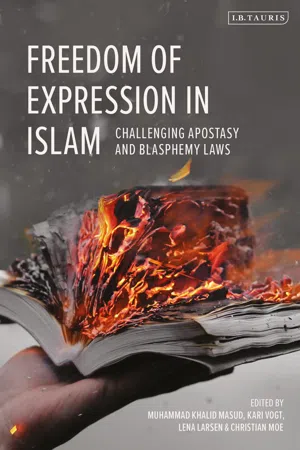
eBook - ePub
Freedom of Expression in Islam
Challenging Apostasy and Blasphemy Laws
- 272 pages
- English
- ePUB (mobile friendly)
- Available on iOS & Android
eBook - ePub
Freedom of Expression in Islam
Challenging Apostasy and Blasphemy Laws
About this book
Information
Part One
The Historical Construction
1
Blasphemy Laws in Islam
Towards a Rethinking?
Abdullah Saeed
This chapter explores the development of the concept of blasphemy in Islam, reflecting on the circumstances, including political and social contexts, surrounding its emergence. The primary focus, however, is to demonstrate that the early Islamic concept of blasphemy may not be viable today, while acknowledging the challenges that Muslim scholars face in reviewing and rethinking it. Therefore, this chapter posits that perhaps the most effective way to argue against blasphemy laws is to show that the concept of blasphemy developed in a particular social and political context and evolved as those circumstances changed. Related to this is the argument that there is no strong textual basis for the death penalty for blasphemy in either the Qurʾan or the traditions of the Prophet, and, thus, contemporary Muslims should be free to rethink the concept of blasphemy in light of their own circumstances.
Blasphemy in religious traditions
The signs and symbols of religious traditions serve as identity markers that signal the adherence of their followers to the group. Within each tradition, religious leaders, scholars and thinkers strive to distinguish the manifestation of their faith – including its rituals, beliefs, practices and customs, such as dietary and sumptuary rules – from those of others. In the pre-modern period, these distinctions were important because, in any given society, religion was often at the centre of all aspects of life. Even if there were several religious communities in a society, each tradition clearly demarcated itself from others. Individuals usually had to be part of a religious community, through which they were represented in larger society. Moreover, religious adherence was an important determinant of one’s rights and obligations. In most societies, the dominant religion exercized enormous power, and minority confessions had far less.
In the pre-modern period, a society’s dominant religion was often closely connected to the apparatus of the state and political power. Thus, religion was used to differentiate the dominant political group from other groups with alternate religious views. The most powerful group often dictated its relationships with other groups, based on the latter’s social, political and legal subordination.
Thus, the religious beliefs, symbols and practices of the dominant group often enjoyed absolute supremacy, which minority faiths were forced to recognize in order to survive. This unequal relationship determined what religious symbols were acceptable and how they could be publicly used. Blasphemy laws tended to protect the dominant religious group’s symbols and its power. If the sacred symbols of the dominant group were disrespected or denigrated, severe punishment was meted out to the offending party.1
This logic of dominance and subordination applied to intra-religious relations as well. Within a religious tradition, there often existed a dominant group with its own distinct institutions, leadership, elites and practices; this may be referred to as the ‘mainstream’ in a particular place and time. This ‘mainstream’ orthodoxy was assumed to provide necessary social cohesion. However, the existence of less powerful groups within the tradition challenged – ideologically, and sometimes in reality – the hegemonic concepts and practices of the prevailing group. When such threats were perceived, the dominant group often sought to repress them, dealing with them quickly and harshly. Such dynamics can be identified in many religious traditions, and Islam is no exception. In fact, all the Abrahamic religions (Christianity, Islam and Judaism) have some concept of blasphemy.2
However, before a religious tradition attains dominance, it does not necessarily take robust, defensive measures against those mocking, ridiculing or challenging its religious symbols. One obvious reason for this is that the followers of the religious tradition may not be powerful enough to challenge such attacks. They may be concerned with survival and lack the means to counter or repress the disparagement of their beliefs and symbols. Thus, they suffer, struggle and persevere, hoping slowly to gain greater social acceptance. This probably was the case in the first 200 to 300 years of Christianity and the first twelve years of Islam. Blasphemy laws, thus, develop within religious traditions in close connection to their rising political power. Before that power reaches a point where the elite can respond to and suppress any disparagement, blasphemy laws are neither a priority, nor even a possibility, for the group.
When a religious tradition attains political power, it begins to develop ways and means to counter attacks on its symbols. Part of this process involves erecting walls against other religious traditions and then specifying what practices and symbols of other traditions will be tolerated. Penalties, often severe, are developed to defend the dominant religion and its symbols. The charge of blasphemy then becomes a powerful tool in the hands of religious leaders and the political system. It can be used to target and counter any real or perceived threat to the status quo on which the dominant religion’s identity, existence and power depend. Therefore, blasphemy should be considered as both a theological and a political issue.
Blasphemy in Islamic tradition: An overview
Blasphemy is derived from two Greek words: blapto, meaning ‘to injure’, and pheme, meaning ‘to speak’. Thus, blasphemy is considered injurious speech or ‘speaking evil’.3 In Arabic, the term sabb is derived from the Arabic root s-b-b.4 Islamic tradition speaks of sabb allāh and sabb al-rasūl, meaning reviling God or reviling the Messenger.5 In more specific terms, it refers to ‘[a]ll utterances expressive of contempt for Allah [God] Himself, for His Names, attributes, laws, commands, or prohibitions [and] all scoffing at Muhammad or any other prophets or apostles of Allah [God]’.6 Classical Muslim jurists agreed that blasphemy was prohibited by the Shariʿa.7 Blasphemy was closely connected to the offence of apostasy, since blasphemy was seen as apostasy if committed by a Muslim.8 This means that a Muslim blasphemer is, by definition, an apostate.
Blasphemy was initially understood in the Islamic tradition as attacks on its core ideas and symbols, centring on God and the Prophet.9 The Qurʾan provided many details about the nature and quality of such criticism, including ridicul...
Table of contents
- Cover
- Half-Title Page
- Title Page
- Contents
- List of Contributors
- Acknowledgements
- A Note on Transliteration
- Introduction
- Part One The Historical Construction
- 1 Blasphemy Laws in Islam: Towards a Rethinking?
- 2 Freedom of Religion in Qurʾanic Exegesis
- 3 al-Qadi ʿIyad’s Defence of the Prophet and of Scholarly Tradition: al-Shifāʾ
- 4 Reading Ibn Taymiyya’s al-Ṣārim: Hermeneutic Shifts in the Definition of Blasphemy
- Part Two Present Practices
- 5 The Crimes of Blasphemy and Apostasy in Iran
- 6 Guarding the Mainstream: Blasphemy and Apostasy in Egypt
- 7 Plurality, Dissent and Hegemony: The Story Behind Pakistan’s Blasphemy Law
- 8 Politics of Fatwa, ‘Deviant Groups’ and Takfīr in the Context of Indonesian Pluralism: A Study of the Council of Indonesian Ulama
- Part Three New Directions
- 9 Transgressing All Bounds? Gendering Authority and Engendering Orthodoxy
- 10 Re-framing Reform: Lessons from the Apostasy Trials of Hassan Yousefi Eshkevari and Hashem Aghajari
- 11 Toward Removing the Punishment of Apostasy in Islam
- Index
- Copyright
Trusted by 375,005 students
Access to over 1.5 million titles for a fair monthly price.
Study more efficiently using our study tools.
Frequently asked questions
Yes, you can cancel anytime from the Subscription tab in your account settings on the Perlego website. Your subscription will stay active until the end of your current billing period. Learn how to cancel your subscription
No, books cannot be downloaded as external files, such as PDFs, for use outside of Perlego. However, you can download books within the Perlego app for offline reading on mobile or tablet. Learn how to download books offline
Perlego offers two plans: Essential and Complete
- Essential is ideal for learners and professionals who enjoy exploring a wide range of subjects. Access the Essential Library with 800,000+ trusted titles and best-sellers across business, personal growth, and the humanities. Includes unlimited reading time and Standard Read Aloud voice.
- Complete: Perfect for advanced learners and researchers needing full, unrestricted access. Unlock 1.5M+ books across hundreds of subjects, including academic and specialized titles. The Complete Plan also includes advanced features like Premium Read Aloud and Research Assistant.
We are an online textbook subscription service, where you can get access to an entire online library for less than the price of a single book per month. With over 1.5 million books across 990+ topics, we’ve got you covered! Learn about our mission
Look out for the read-aloud symbol on your next book to see if you can listen to it. The read-aloud tool reads text aloud for you, highlighting the text as it is being read. You can pause it, speed it up and slow it down. Learn more about Read Aloud
Yes! You can use the Perlego app on both iOS and Android devices to read anytime, anywhere — even offline. Perfect for commutes or when you’re on the go.
Please note we cannot support devices running on iOS 13 and Android 7 or earlier. Learn more about using the app
Please note we cannot support devices running on iOS 13 and Android 7 or earlier. Learn more about using the app
Yes, you can access Freedom of Expression in Islam by Muhammad Khalid Masud, Kari Vogt, Lena Larsen, Christian Moe, Muhammad Khalid Masud,Kari Vogt,Lena Larsen,Christian Moe in PDF and/or ePUB format, as well as other popular books in Social Sciences & Middle Eastern History. We have over 1.5 million books available in our catalogue for you to explore.