In the late 19th century, bicyling and motoring offered new ways for a hardy minority to travel. Escaping from the 'tyranny' of the train timetables, these entrepreneurs were able to promote private mobility when the road, technology and infrastructure were unequal to the task. With a moribund network out of town, poor roadside accommodation and few services, how could road traction persist and ultimately thrive?
Drawing on a wealth of primary sources, including magazines, newspapers and advice books on stable management, this book explores the emergence and development of bicycling and automobility in Britain, with a focus on the racing driver-cum-entrepreneur SF Edge (1868-1940) and his network. Craig Horner considers the motivations, prejudices and cultures of those who promoted and consumed road traction, providing new insights into social class, leisure, sport and tourism in Britain. In addition, he places early British bicycling and automobility in an international context, providing fruitful comparisons with the movements in France, Germany and the United States.
The Emergence of Bicycling and Automobility in Britain is an excellent resource for scholars and students interested in mobility studies, social and cultural history, and the history of technology.
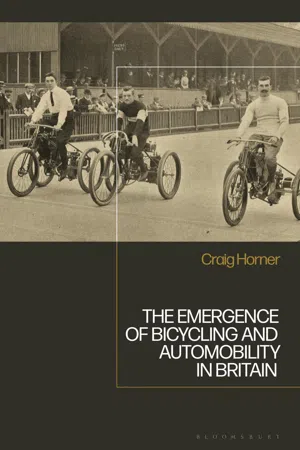
- 224 pages
- English
- ePUB (mobile friendly)
- Available on iOS & Android
eBook - ePub
The Emergence of Bicycling and Automobility in Britain
About this book
Information
1
Introduction
The appearance of the motor car – or, in the then new legal terminology, ‘light locomotive’ – on the public highways of the United Kingdom in the 1890s gave advertisers a new medium to promote their products. This happened to be particularly the case with soap. Mr Goodwin advertised Mother Shipman’s Soap as he drove his Lutzmann Benz around Manchester in about 18961 – his was probably the first motor car in the town, so he could be sure of attention. Similarly, Lever Brothers used the novelty of ‘motor vans’ around the country to advertise their Sunlight soap in 1896; this must have presented a sight sufficiently common for the Illustrated London News to feel able to publish a cartoon that same year featuring Mr and Mrs John Bull as they surveyed a passing ‘Sunlight’ van.2
In the popular imagination, then, the motor car could be little more than a freakish contraption with few uses beyond advertising. This presented a challenge for entrepreneurs trying to promote the new ‘motor traction’ as a potential new industry and practical means of transport in its own right. The journalist Henry Sturmey (1857–1930), at that time the editor of The Autocar magazine, knew this when he set out in 1897 to be the first to drive a motor car from John O’Groat’s to Land’s End. His suspicion would have been reinforced by a conversation he overheard. He was at John O’Groat’s House with his Daimler motor car when a ‘coach and four [horses]’ delivered a ‘fashionably-dressed party’ of gentlemen. Having spotted the Daimler, one said, ‘I wonder what that motor-car was doing at Groat’s today?’ ‘Oh, another beastly advertisement – Pear’s soap, or something of that kind, I suppose.’ Sturmey knew what this meant: no gentleman would ‘demean himself by being seen on one [a motor car] so long as there was a good horse about’.3
Before the turn of the twentieth century, and for some years beyond, motoring played no useful part in the lives of most of the population. For travelling beyond their locality, middle-class families might have kept a horse, or hired one as necessary, possibly with a carriage. The ‘safety’ bicycle was becoming popular, while the train was affordable, sensible and fast. The steam traction engine had been present on the public highway for half a century or more,4 but many people had yet to see a light motor car, and this remained the case into the first decade of the twentieth century. A cartoon in Punch magazine in 1902 illustrates this. With a milestone indicating they were well into the Wiltshire countryside, a girl in a horse and carriage, seeing a motor car for the first time, said, ‘Oh, papa! Look! The horses have run away, and there’s the carriage running after them! Isn’t it funny!’5 Similarly, the 1907 diary of Dr Tracey described his experiences as the first to run a motor vehicle in his Somerset village.6
Motor cars were so novel that there was no established name for them. Sturmey, once underway on his epic trip, went to put his Daimler on a ferry, only to find the ferryman at a loss to match it against his list of tariffs.7 The new motoring magazines, springing up in the 1890s, discussed what the new ‘motor-carriages’ should be called; the very titles of The Autocar (founded 1895) and the Automotor Journal (founded 1896) show two terms then in use. The latter magazine made a list of suggestions in 1896 which did not even include ‘motor car’ – although that term was probably used as early as 1891,8 it did not catch on until later. Instead, the magazine thought of, amongst others, ‘movers’, ‘autokinons’, ‘motes’ and ‘go cars’.9 Even the activity of motoring did not have an agreed term: in a letter to The Autocar in 1900, ‘Oilman’ described himself as the ‘owner of an “autocar”’, but ‘I cannot get used to call myself a “motist” yet’.10
These carefully selected moments are intended to illustrate just how niche, hobbyist, even reckless the sport of motoring was understood to be by the wider population. In the popular imagination, the motor car was dangerous and likely to blow up. The pioneer motorist Charles Jarrott (1877–1944) observed this when he took a motor car from Margate to London in 1897. The starting ritual involved creating under the bonnet ‘rather a big blaze’ with petrol just to get the ignition burners lit, a necessary prelude to attempting to turn the engine over by starter handle. Not surprisingly, the onlookers were highly agitated.11 The very term ‘petrol’ was novel, referring to a product then available by the fluid ounce and usually used as a cleaning agent. Another early motorist J. A. Koosen (c. 1860–1913) recalled, ‘My experiences as a pioneer – well, they were simply awful. For a long time I could get no petrol; nobody knew what it was. I then asked the chemists for “benzin”, and one of them had some in stock and asked did I want a two-ounce or a four-ounce bottle! When I said something about five or ten gallons he nearly had a fit.’12
Punch magazine’s 1900 ‘Roll of Fame’ was a cavalcade of all that was modern and credible in science and industry. It celebrated the bicycle and the X-Ray, but featured no motor cars. For some people, the motor cars they saw appeared to be uncontrollable: Punch in 1901 published a cartoon in which the hapless owner of the ‘violently palpitating’ motor car attempted to restrain it with a pitchfork as villagers looked on.13 Even as late as 1905 P. G. Wodehouse was publishing stories in which control of the motor car remained a dark art.14 For others, the motor car was somehow capable of ridiculous feats. The magazine The Strand published stories where motor cars were capable of heroic if implausible mercy dashes.15 The motor car also featured in the same magazines as a likely sporting replacement for the animal. ‘The newest twentieth-century game’, was, for example, according to the Harmsworth London Magazine, ‘motor polo’, where ‘nimble little racing motor cars replace the trained pony’,16 while in another tall tale in The Strand, the wealthy American Mr Hanks impressed a marquesa by bringing his 10hp Daimler into the bull ring. (After his suitable display of heroics, they married.)17 Automotive company promoters took advantage of such gullibility among the wider public; an artist’s impression of the motoring promoter Edward J. Pennington’s (1858–1911) motor-cycle in his company catalogue in 1896 featured it leaping over a ravine.18 There were no trusted brands of motor car, and so companies with other specialisms launching into motor-car production did not necessarily imbue the consumer with confidence. For example, the French company Panhard and Levassor had been a manufacturer of woodworking equipment. The German Daimler company was a manufacturer of internal-combustion engines, which were more likely to find uses as stationary engines in factories, or perhaps to power a boat, than power a motor car.19
Finding the open road
Cycling had not long before experienced a similar standing among the wider public. In the 1870s – in the form of the ‘ordinary’, or ‘penny-farthing’ – it had been a niche sport for athletic men, and while it was cutting edge in its adoption of the latest technology, when seen on the public highway it had been associated with middle-class arrogance and privilege. Cyclists then took to the roads, usually unsealed and dreadful out of towns, and absorbed abuse and missiles hurled at them by a large majority of onlookers who did not share their enthusiasm. Encroachment on the highway by cyclists and, later, motorists was real; as Denning has found, they ‘initiated a contest for the use of public space, challenging centuries of practice in which roads and streets were a public amenity meant for common use’.20 But by the 1890s, cycling was booming, and among the middle classes was now widely indulged as a fashionable leisure pursuit. The appearance of the tricycle and the tandem from the 1880s had facilitated cycling for ladies and couples. Fashion and general-interest magazines had picked up on the visibility of cycling, and members of the royal family were endorsing the activity. Cycling magazines had sprung up to cater for a wide cross-class interest; cycle racing, where spectators paid to watch, and long-distance record breaking, were reported widely. Cycling technology – in the form of the ‘safety’ bicycle, with its diamond-shaped frame – was now seen by consumers as, in a sense, mature, and cycling was now perceived as reliable and accessible.21 While cycling continued to challenge many people’s values – the ‘scorching’ (reckless cycling), going out for a ride on the Sabbath, unchaperoned female cyclists, some wearing ‘rational’ dress (divided skirts)22 – by the turn of the century, it had become an acceptable part of life. Cycling had offered something entirely novel: speed, and the freedom of the open road. Until the 1890s, the bicycle had been the fastest device on the public highway. The ‘ordinary’ by the 1870s was already averaging about 10mph despite the appalling roads. By 1880 crowds were paying to watch cycling ‘cracks’ cover twenty miles in an hour.23
By the First World War, motor traction was to experience a similar shift as it became more widely tolerated and more attractive for consumers, offering increased reliability and ease of use. Motoring adopted technology developed by the cycling industry – the spoked wheels, tubular frames, chains – and utilized the new, light petrol engines such as Daimler’s. The potential that motor traction then offered for even higher speeds than cycling on the open road was, for many, bewildering. Writing in 1900, ‘The Deserter’ said:
We live in an age of ever-hastening activity and unceasing rush. The motor-car is generally regarded as the embodiment in metal of this characteristic of the century – a monster that goes throbbing through quiet villages and snorting through busy streets with the impartiality of the plague . . . even in connection with the Great Trial [the Thousand Mile Trial of 1900, described later], which was to test the vehicle and not record its speed, chronicles of a mile in four minut...
Table of contents
- Cover
- Half-Title
- Title
- Contents
- List of figures
- Acknowledgements
- 1 Introduction
- 2 Resistance to change
- 3 Entrepreneurs
- 4 Trials
- 5 The ‘old brigade’ and the new ‘steady and careful artisan’
- 6 Tourists
- 7 Futures
- 8 Conclusion
- Bibliography
- Appendix: Biography
- Index
- Copyright
Trusted by 375,005 students
Access to over 1.5 million titles for a fair monthly price.
Study more efficiently using our study tools.
Frequently asked questions
Yes, you can cancel anytime from the Subscription tab in your account settings on the Perlego website. Your subscription will stay active until the end of your current billing period. Learn how to cancel your subscription
No, books cannot be downloaded as external files, such as PDFs, for use outside of Perlego. However, you can download books within the Perlego app for offline reading on mobile or tablet. Learn how to download books offline
Perlego offers two plans: Essential and Complete
- Essential is ideal for learners and professionals who enjoy exploring a wide range of subjects. Access the Essential Library with 800,000+ trusted titles and best-sellers across business, personal growth, and the humanities. Includes unlimited reading time and Standard Read Aloud voice.
- Complete: Perfect for advanced learners and researchers needing full, unrestricted access. Unlock 1.5M+ books across hundreds of subjects, including academic and specialized titles. The Complete Plan also includes advanced features like Premium Read Aloud and Research Assistant.
We are an online textbook subscription service, where you can get access to an entire online library for less than the price of a single book per month. With over 1.5 million books across 990+ topics, we’ve got you covered! Learn about our mission
Look out for the read-aloud symbol on your next book to see if you can listen to it. The read-aloud tool reads text aloud for you, highlighting the text as it is being read. You can pause it, speed it up and slow it down. Learn more about Read Aloud
Yes! You can use the Perlego app on both iOS and Android devices to read anytime, anywhere — even offline. Perfect for commutes or when you’re on the go.
Please note we cannot support devices running on iOS 13 and Android 7 or earlier. Learn more about using the app
Please note we cannot support devices running on iOS 13 and Android 7 or earlier. Learn more about using the app
Yes, you can access The Emergence of Bicycling and Automobility in Britain by Craig Horner in PDF and/or ePUB format, as well as other popular books in History & British History. We have over 1.5 million books available in our catalogue for you to explore.