Investigating the efforts of the Kichwa of Tena, Ecuador to reverse language shift to Spanish, this book examines the ways in which Indigenous language can be revitalized and how creative bilingual forms of discourse can reshape the identities and futures of local populations. Based on deep ethnographic fieldwork among urban, periurban, and rural indigenous Kichwa communities, Michael Wroblewski explores adaptations to culture contact, language revitalization, and political mobilization through discourse.
Expanding the ethnographic picture of native Amazonians and their traditional discourse practices, this book focuses attention on Kichwas' diverse engagements with rural and urban ways of living, local and global ways of speaking, and Indigenous and dominant intellectual traditions. Wroblewski reveals the composite nature of indigenous words and worlds through conversational interviews, oral history narratives, political speechmaking, and urban performance media, showing how discourse is a critical focal point for studying cultural adaptation. Highlighting how Kichwas assert autonomy through creative forms of self-representation, Remaking Kichwa moves the study of Indigenous language into the globalized era and offers innovative reconsiderations of Indigeneity, discourse, and identity.
eBook - ePub
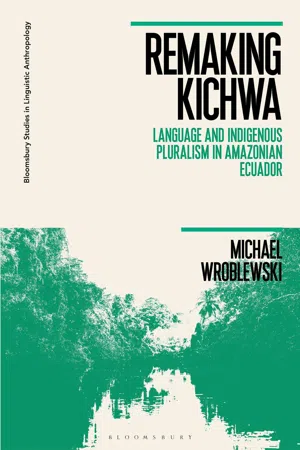
Remaking Kichwa
Language and Indigenous Pluralism in Amazonian Ecuador
- 216 pages
- English
- ePUB (mobile friendly)
- Available on iOS & Android
eBook - ePub
About this book
Information
1
The Tena Kichwa Sociolinguistic World
On weekday mornings from a small transmitter station in Tena, Ally TV—Napo Province’s public television channel—broadcasts a one-man Kichwa-language news program called Rayu Shinalla, Kichwa for “Lightning Fast.” The show is hosted by Eladio Tapuy, a late 30s local celebrity, former radio host and emcee of urban Native beauty pageants. Rayu Shinalla airs at 5:30 a.m. on screens throughout Tena, nearby towns, and rural forest communities. The show opens with the serene sounds of stringed instruments, drums, flutes, and twittering jungle birds. Transient images of rainforest fauna, Kichwa women in ceremonial face paint, men in feathered headdresses, and scenes of city people walking through central Tena cross-fade beneath superimposed Kichwa and Spanish text that reads:
Speech Sample 1. Rayu Shinalla opening credits
1 Karantutamantallakankunawakallarinchi,
2 Rayushinalla
3 Ñukanchikawsay, ñukanchiyuyay, kankunawamikan
4 Rayushinalla, ñukanchirunakichwakikinshimipi.
5 Todas las mañanas inciamos con ustedes, Rayushinalla
6 Rayushinalla, en nuestro propio idioma Kichwa ((sic))
1 ((In Kichwa:)) Each morning we begin with you,
2 Rayu Shinalla
3 With you, our way of life, our knowledge
4 Rayu Shinalla, in our own Kichwa people’s language.
5 ((In Spanish:)) Every morning we begin with you, Rayu Shinalla
6 Rayu Shinalla, in our own Kichwa language
A sheeny Rayu Shinalla logo hovers briefly above a grove of digitally rendered trees before the camera opens on Eladio, typically in a button-down collared shirt and holding the cell phone he uses to field live text messages from his viewers. He greets his audience in Napu Marka, which is in Unified Kichwa, the national standard variety, for “Napo Province.” He addresses them as mashikuna, the Unified Kichwa word for “friends.” Sometimes he offers another, more traditional, salute to mamakuna, yayakuna, and maltakuna (“mothers, fathers, and young people”). Eladio announces the day’s date and time in Unified Kichwa, usually translating these into Spanish, and he thanks his viewers for tuning in using the Unified Kichwa idiom yupaychani, or “I am grateful.” For the next thirty minutes, he delivers announcements about local happenings with classic newscaster inflection. In between segments of prerecorded Spanish-language news stories and his own bilingual commentaries, Eladio reads aloud live text messages, relays happy birthday messages to local residents, and airs Kichwa-language music videos by Ecuadorian artists from Amazonia and the Andes.
At the beginning of a typical episode of Rayu Shinalla that I recorded in the spring of 2015, Eladio switched back and forth between Kichwa and Spanish to extend a welcome to his culturally and linguistically diverse audience:
Speech Sample 2. Eladio’s greeting on Rayu Shinalla
1 Chasnami kan, mashikuna … Kushi shunkuwan, kushi ñukanchiraykunawa uraspika
2 Allimi kanta ñawpakma rinkapak mashikuna. Allimi kan, karan ayllullaktakunapi,
3 chimpachikunchi barrioskuna kay Tena llaktapi, Archidona llaktapi, Arosemena
4 Tolapurapi, alli puncha. Kankunawami kanchi karan punchalla atarisha kuintarisha
5 apankapak mashikuna. A ustedes la más cordial bienvenida amigos y amigas a esta,
6 su programación Rayu Shinalla, a través de la televisión pública Ally TV canal 34.
7 Hoy es miércoles, seis de mayo … Así es, todas las mañanas siempre nos amplifican a
8 través de nuestra programación en los diferentes sectores en nuestra provincia de
9 Napo … Saludos muy cordiales a todos los amigos visitantes quienes están aquí
10 radicados, o prácticamente vienen de turismo, no? Saludamos a todos los amigos
11 turistas quienes también nos ven a través de la pantalla chica en los diferentes
12 sectores, en los barrios, comunidades, caseríos. Allí, donde nosotros llegamos todas
13 las mañanas a partir de las 5:30 … para compartir lo mejor de la información, a
14 través de nuestra programación Rayu Shinalla. Recuerde, hoy es miércoles, seis de
15 mayo. Ustedes tienen la posibilidad de enviar sus mensajes respectivos a 099 …
16 Chasnami kan mashikuna, yupaychanchi. Kankunawami katiran munakunchi
17 imasnara tuparankichi rukumamakuna, rukuyayakuna.
1 ((In Kichwa:)) So it is, friends … With a happy heart, we are happy to be with you this
2 time as before, friends. Very well, in all of the communities, over to the barrios of
3 Tena, in Archidona, in Arosemena Tola, good morning. We are with you each
4 morning, we wake up with you, friends. ((In Spanish:)) A most cordial welcome to
5 you, friends, to your program, Rayu Shinalla, on Ally TV channel 34 public television.
6 Today is Wednesday, May 6th … So it is, every morning we grow via our program in
7 the different sectors of Napo Province … Very cordial greetings to all of the visitors
8 spread out there … to all of our tourist friends that also watch us on the small screen
9 in the different sectors, in the barrios, the communities, the rural villages. Out there,
10 where we arrive every morning at 5:30 … to share the best information on our
11 program, Rayu Shinalla. You can send text messages to 099 … ((In Kichwa:)) So it is,
12 friends, we thank you. We want to continue meeting with you as well, grandmothers
13 and grandfathers.
Continuing in Kichwa, Eladio introduced his first prerecorded Spanish-language news story, an on-the-scene piece about new tuberías petroleokunata, a mixed Spanish-Kichwa phrase meaning “oil pipes,” which had recently been donated to the government of Napo to be used as culverts in provincial road development projects.
Each weekday morning Eladio delivers the news like this, as line 4 of the aforementioned opening credits affirms, “ñukanchi Runa Kichwa kikin shimipi,” “in our own Kichwa people’s language.” As Eladio adeptly demonstrates, this “language” challenges mainstream monolingual ideas about what “a language” is supposed to look and sound like. Speaking “our own Kichwa people’s language” involves constant mixing and shifting between codes, or what Hill and Hill (1986: 100) define as “set[s] of principles for selecting variants from a range of possible choices, in order to construct an utterance.” For Eladio, these codes include what would usually be defined as multiple languages and language varieties. However, his discourse is characterized by frequent code switches or shifts between codes at phrasal and clausal boundaries. It also contains numerous code mixes or free-form blending of morphemes of multiple codes into single words and phrases. Because of this, Eladio’s codes are difficult to separate and classify. Even the show’s title, Rayu Shinalla, is a linguistic admixture: rayu (pronounced with a tap [ɾ] and a high-back [u] vowel) is a phonetically Kichwa-fied borrowing of the Spanish word rayo (pronounced with a trilled [r] and a mid-back [o] vowel), which means “lightning,” while shinalla, which literally means “just like” and in this phrase implies “fast,” is Kichwa.
Like his language, Eladio’s audience is mixed. His viewers include bilingual Kichwa urbanites in Tena, nearby towns, peri-urban barrios, and rural forest communities, and Ecuadorian and international tourists. Just as ñukanchi Runa Kichwa kikin shimi refers to a language made up of multiple codes, ñukanchi (“we”), Runa (“people”), and Kichwa together refer to a heterogeneous community of speakers who engage regularly with non-Indigenous “others.” Given a proper ethnographic examination, as I plan to show in this chapter, it turns out that Eladio’s low-tech, one-man-show is, like most examples of Tena Kichwa discourse, rich in linguistic, cultural, and political complexity. It also reveals the contested notions of what it means to be Indigenous, Runa, and Kichwa, as outlined in the Introduction. From the linguistically mixed content to the composite identity of its host, Rayu Shinalla is perfectly suited for a contemporary audience of diverse Tena Kichwas and their polycentric, or multicentered, sociolinguistic environment.
Captivating an Audience
Eager to learn more about how he came to host Tena’s only “Kichwa-language” news show, I convinced Eladio to take a brief break from his scheduled editing duties to sit down with me for a recorded conversation. On a hallway bench just outside the newsroom where he records Rayu Shinalla, I began our metalinguistic interview, an open-ended, interviewer-guided talk-about-talk, as I usually do, with questions about his linguistic background—“What languages do you speak?” “Where did you learn them?” “When and where do you speak [language X]?” Eladio began his account with a familiar lament among Kichwas of his generation: “When I was little, my parents didn’t instruct me very well in Kichwa.” Though he spent his early home years speaking Kichwa, he was sent to Spanish-monolingual schools, where, as he recalled, he began to “lose” his Kichwa. Despite this shift to Spanish as his dominant language, Eladio continued to identify with his Indigenous heritage and sought out roles where he could act as a community leader. He found his way into grassroots community media, which he saw as an emerging arena for promoting endangered Kichwa language and culture. He got his first foothold as a co-host of a Kichwa-Spanish radio revista (“radio revue”) program directed by Napo’s local Indigenous Federación de Organizaciones Nacionales Kichwas de Napo (“Federation of Indigenous Kichwa Organizations of Napo”), or FONAKIN. He worked for several years as a Kichwa music DJ and talk-show host covering cultural, political, and economic issues affecting Indigenous Napo communities. As part of his training for the position, he relearned Kichwa through the help of FONAKIN and DIPEIB-N instructors who taught him to read and write in Unified Kichwa, the standardized Ecuadorian variety. “For that reason,” he recounted,
Speech Sample 3. Metalinguistic interview with Eladio
1 I was better at Unified Kichwa than my friends who speak the other Kichwa, the
2 one from here. There was a conflict too. When they listened to the radio, they
3 said “Why?” The grandparents, for example. Because ((Unified Kichwa)) changes
4 the meaning of what is being said … So now I try not to speak too much Unified
5 Kichwa, although sometimes, I get lost. So, I try to explain it, you know? What is
6 said commonly and what it means in Unified Kichwa … Before, they used to urge
7 us to speak Unified Kichwa. For example, in the Native beauty pageants they
8 urged us to speak in Unified Kichwa. But now, no, they say speak however you
9 can.
Throughout our conversation, Eladio kept coming back to this struggle to appeal to different Kichwa-speaking audiences. And there always seemed to be two opposing sectors: (1) his dialect-speaking kin and friends in rural communities and peri-urban barrios and (2) his Unified Kichwa-literate colleagues working in Tena. In order to have a successful career as a Kichwa spokesperson, Eladio has to constantly check in with both of these subsets of his audience to make sure his TV performances are being favorably received. One particularly interesting example of this ongoing struggle was revealed in his story of searching for the show’s title. “Choosing a title was difficult,” he recalled,
10 I mean, to capture the public I needed a title … that would have an impact.
11 ‘Information’ means giving knowledge of day-to-day occurrences
12 to the community, right? So, I mean, I wanted something from nature. I looked
13 for ...
Table of contents
- Cover
- Half-Title
- Series
- Title
- Contents
- List of Illustrations
- Acknowledgements
- Notes on Orthography and Transcription
- Introduction: Language, Indigeneity, and Pluralism in Amazonian Ecuador
- 1 The Tena Kichwa Sociolinguistic World
- 2 Language Revitalization, Nation-Building, and Code Choice
- 3 Bilingualism, Racialization, and “Poorly Spoken Spanish”
- 4 Intercultural Memories : Ritual Activism in Discourses of the Past
- 5 Intercultural Futures : Urban Media and the Predicaments of Translation
- Conclusion: Discourse and the Remaking of Indigeneity in Amazonia
- Notes
- References
- Index
- Copyright
Trusted by 375,005 students
Access to over 1.5 million titles for a fair monthly price.
Study more efficiently using our study tools.
Frequently asked questions
Yes, you can cancel anytime from the Subscription tab in your account settings on the Perlego website. Your subscription will stay active until the end of your current billing period. Learn how to cancel your subscription
No, books cannot be downloaded as external files, such as PDFs, for use outside of Perlego. However, you can download books within the Perlego app for offline reading on mobile or tablet. Learn how to download books offline
We are an online textbook subscription service, where you can get access to an entire online library for less than the price of a single book per month. With over 1.5 million books across 990+ topics, we’ve got you covered! Learn about our mission
Look out for the read-aloud symbol on your next book to see if you can listen to it. The read-aloud tool reads text aloud for you, highlighting the text as it is being read. You can pause it, speed it up and slow it down. Learn more about Read Aloud
Yes! You can use the Perlego app on both iOS and Android devices to read anytime, anywhere — even offline. Perfect for commutes or when you’re on the go.
Please note we cannot support devices running on iOS 13 and Android 7 or earlier. Learn more about using the app
Please note we cannot support devices running on iOS 13 and Android 7 or earlier. Learn more about using the app
Yes, you can access Remaking Kichwa by Michael Wroblewski in PDF and/or ePUB format, as well as other popular books in Languages & Linguistics & Sociolinguistics. We have over 1.5 million books available in our catalogue for you to explore.