Personal, social, health and economic education (PSHE) and relationships, (sex) and health education (R(S)HE) are often undervalued in school and are frequently seen as an add-ons. But when taught well, PSHE and R(S)HE can enhance not only other subjects but strengthen school safeguarding, develop pupil well-being and improve pupils' progress and resilience in learning.
Underpinned by a range of contemporary research and illustrated through examples of classroom practice, the expert team of teacher educators look at a range of curriculum areas and contemporary issues to explore how PSHE and R(S)HE education can enhance other curriculum areas. As well as showing how pupils' life skills can be developed, they also explore how teachers' understanding of how PSHE and R(S)HE can be implemented without additional planning or expensive resources.
The book takes an inclusive understanding of both diverse families and relationships throughout. Topics covered include:
-social media, online presence and critical literacy skills
-mental health coping strategies
-plastic reducing
-topical, sensitive, controversial issues (TSCIs)
Covering the whole primary spectrum from Early Years to Key Stage 2, case studies from each phase are included within each chapter to help practitioners to relate the material to their own classroom. Points to consider for your setting are included and guidance on further reading provides reliable direction for additional information.
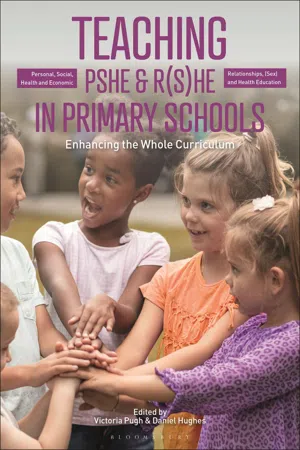
eBook - ePub
Teaching Personal, Social, Health and Economic and Relationships, (Sex) and Health Education in Primary Schools
Enhancing the Whole Curriculum
- 216 pages
- English
- ePUB (mobile friendly)
- Available on iOS & Android
eBook - ePub
Teaching Personal, Social, Health and Economic and Relationships, (Sex) and Health Education in Primary Schools
Enhancing the Whole Curriculum
About this book
Information
1
We’re All in this Together!
Victoria Pugh
This chapter explores:
•A whole school approach to PSHE and R(S)HE;
•It will highlight the importance of strong leadership and coordination in this area and where to begin if a teacher is new to the role, including key elements to policy writing;
•It will explore the ways in which PSHE and R(S)HE can be assessed effectively to support pupils and highlight progress.
Leadership and coordination
The coordination and leadership of PSHE can be a dauting task, particularly in light of the new guidance for Relationship, (Sex) and Health education, (R(S)HE), however it should be viewed as an opportunity rather than a struggle. The recent changes in legislation allow for a focus on the evaluation, revision and implementation of an updated, engaging curriculum, which can be adapted to meet the needs of both the pupils and the local community.
The Department for Education (DfE) guidance on R(S)HE (2019: 16) states that governors and school management must ensure strong leadership and that the subject is, ‘resourced, staffed and timetabled in a way that ensures that the school can fulfil its legal obligation’. In accordance with this, it is vital that schools prepare for R(S)HE and other areas of PSHE such as economic education utilizing a whole-school approach. This approach must consider training for governors, headteachers, teachers and support staff as well as a comprehensive policy which encompasses the voice of all stakeholders. This is made clear in the government guidance which states ‘All schools must have in place a written policy for Relationships Education and RSE. Schools must consult parents in developing and reviewing their policy.’ (2019:11)
There have been a number of studies exploring a whole-school approach to PSHE including work by Public Health England which discusses the benefits as:
taking a whole-school approach to health and well-being is linked to pupils’ readiness to learn. A review of the links between pupil health and well-being and attainment advocated promotion of health and well-being as an essential element of a school’s effectiveness strategy.
Public Health England, 2014: 10
The need for a well-structured and robust whole-school approach can also be seen from Ofsted guidance regarding the statutory elements of Relationship and health education with Roary Pownall, Ofsted’s National Lead for PSHE and for Citizenship reminding schools of paragraph 220 and 221 of the school inspection handbook (2019: 220) which states:
From September 2019, schools are able to follow a new relationships and sex education and health education curriculum. Primary-age children must be taught about positive relationships and respect for others, and how these are linked to promoting good mental health and well-being … And If a school is failing to meet its obligations, inspectors will consider this when reaching the personal development judgement.
It, therefore, goes without saying that providing a quality PSHE and R(S)HE curriculum within schools can strongly enhance safeguarding by both empowering pupils to be able to keep themselves safe as well as knowing where to go for help or assistance if needed. As already discussed in the introductory chapter of this book, a quality whole-school approach to PSHE and R(S)HE which takes into consideration school priorities such as safeguarding, SMSC, British Values and quality can support schools in ensuring an ‘outstanding’ personal development, behaviour and attitudes and leadership and management judgements by Ofsted.
Case Study 1

Ahmed is a Year 1 teacher and works in a large three-form entry primary school which is a values-led school. He is new to the role of PSHE coordinator and is feeling very overwhelmed by the new statutory guidance as well as the fact that R(S)HE and Health education are part of the school improvement plan. He has some experience of teaching PSHE, however there has never been a planned, assessed and monitored programme of study and the school are keen to have some consistency across the school to ensure they are meeting the statutory objectives. He has carried out an initial audit of the schools PSHE lessons and found that a number of classes are focusing mainly on circle time to deliver PSHE and other classes are not carrying out any PSHE at all with some teachers stating that there just isn’t time for PSHE particularly in upper KS2 where they are concentrating on SATS preparation. Ahmed cannot monitor pupil’s progression in PSHE and R(S)HE skills as the teaching seems to be done in an ‘ad hoc’ fashion. Ahmed hasn’t received any PSHE or R(S)HE training and is finding it difficult to work out where to start in relation to a whole-school approach.
Where to start?
It can be easy for teachers, regardless of experience, to feel overwhelmed when taking over the coordination of a subject across a key stage or school particularly if the coordinator themselves doesn’t feel confident with the subject area. It can often be the case that recently qualified teachers are given the role of PSHE coordinator or those who are deemed as more ‘pastoral’ in nature; however given the complexity of the topics which PSHE and R(S)HE covers this can often leave coordination of the subject in the hands of teachers who do not have the training or experience to feel they can confidently manage the subject. Nevertheless, coordination should not be seen as an unmanageable task, instead a good place for Ahmed to start would be to find out what PSHE and R(S)HE is being delivered at present and how. This information can be collected through the use of simple teacher/support staff questionnaires which ask questions such as:
•What PSHE and R(S)HE topics or issues are you currently teaching within your year group or class?
•In what ways is PSHE and R(S)HE taught within your year group or class? E.g. whole-class discussion, separate PSHE lesson, through cross-curricular units.
•How confident do you feel teaching PSHE?
•What training would you like to receive in order to feel more confident when planning, delivering and assessing PSHE and R(S)HE?
•What resources do you feel would be beneficial to support the teaching of PSHE and R(S)HE?
Feedback from staff can allow the coordinator to gain a picture of the current climate of PSHE and R(S)HE within the school quickly, assess where the gaps are and begin to put in place an action plan for curriculum development, training and resourcing. This information can also be used to inform the development of a school PSHE and R(S)HE policy (these can be separate or combined) which includes the voice of governors, senior leadership team, teachers, support staff, parents, current and past pupils. Forming a working party to discuss key areas (see Table 3) can lead to the formation of a cohesive, inclusive and accessible policy ensuring that the voices of all stakeholders are united. It can be powerful to invite both current and past pupils to contribute to these discussions as often past pupils will be able to give honest feedback about the quality of PSHE and R(S)HE education they received and whether or not they felt this was adequate enough to support them with the transition to their next phase of schooling such as junior school or high school.
Once Ahmed has a clear picture of the current provision for PSHE and R(S)HE within the school he can begin to look at policy writing. According to the PSHE Association (2018: 12), a PSHE policy serves a number of purposes:
•It offers a whole-school statement of inten...
Table of contents
- Cover
- Half-Title Page
- Series Page
- Title Page
- Contents
- How to Use This Book
- List of Figures
- List of Tables
- Notes on Contributors
- Introduction: PSHE and R(S)HE: Why Bother?
- 1 We’re All in this Together!
- 2 Controversial Issues in PSHE and R(S)HE
- 3 Little Learners in a Big World
- 4 Picture-perfect Drama
- 5 Developing the ‘E’ in PSHE
- 6 Super Science and the ‘Health’ in PSHE and R(S)HE
- 7 There’s More to RE
- 8 Tackling PSHE and R(S)HE through PE
- 9 ‘Being’ and the Outdoors
- 10 Global Learning as a Vehicle for PSHE
- 11 The Movement of People and PSHE
- 12 Supporting Children’s Mental Health through PSHE and R(S)HE
- 13 R(S)HE – More Than Just the Sex Bit!
- 14 Resilience in an Online World
- 15 R(S)HE and Faith Schools
- Conclusion – The Future of PSHE and R(S)HE
- Index
- Copyright
Trusted by 375,005 students
Access to over 1.5 million titles for a fair monthly price.
Study more efficiently using our study tools.
Frequently asked questions
Yes, you can cancel anytime from the Subscription tab in your account settings on the Perlego website. Your subscription will stay active until the end of your current billing period. Learn how to cancel your subscription
No, books cannot be downloaded as external files, such as PDFs, for use outside of Perlego. However, you can download books within the Perlego app for offline reading on mobile or tablet. Learn how to download books offline
Perlego offers two plans: Essential and Complete
- Essential is ideal for learners and professionals who enjoy exploring a wide range of subjects. Access the Essential Library with 800,000+ trusted titles and best-sellers across business, personal growth, and the humanities. Includes unlimited reading time and Standard Read Aloud voice.
- Complete: Perfect for advanced learners and researchers needing full, unrestricted access. Unlock 1.5M+ books across hundreds of subjects, including academic and specialized titles. The Complete Plan also includes advanced features like Premium Read Aloud and Research Assistant.
We are an online textbook subscription service, where you can get access to an entire online library for less than the price of a single book per month. With over 1.5 million books across 990+ topics, we’ve got you covered! Learn about our mission
Look out for the read-aloud symbol on your next book to see if you can listen to it. The read-aloud tool reads text aloud for you, highlighting the text as it is being read. You can pause it, speed it up and slow it down. Learn more about Read Aloud
Yes! You can use the Perlego app on both iOS and Android devices to read anytime, anywhere — even offline. Perfect for commutes or when you’re on the go.
Please note we cannot support devices running on iOS 13 and Android 7 or earlier. Learn more about using the app
Please note we cannot support devices running on iOS 13 and Android 7 or earlier. Learn more about using the app
Yes, you can access Teaching Personal, Social, Health and Economic and Relationships, (Sex) and Health Education in Primary Schools by Victoria-Marie Pugh, Daniel Hughes, Victoria-Marie Pugh,Daniel Hughes,Victoria Pugh, Victoria Pugh, Daniel Hughes in PDF and/or ePUB format, as well as other popular books in Education & Elementary Education. We have over 1.5 million books available in our catalogue for you to explore.