This book explores the hitherto neglected history of the campaign for state funding of the arts. By focusing on the important but forgotten movements for music and drama subsidy before and during WWII, Howard Webber makes an important contribution to the history of arts subsidy.
Before the Arts Council rediscovers three forgotten but influential campaigns for state support of the arts in Britain in the 1930s and wartime. Webber's impressive historical excavation challenges existing scholarship, which argues that arts subsidy was the result of the war, and instead re-situates the campaign's origins in the pre-war years. Webber does so by drawing on correspondence from influential figures including Ralph Vaughan Williams, John Maynard Keynes and J.B Priestley, along with extensive use of government papers.
Before the Arts Council is a lively, compelling and scrupulously researched account of a subject consistently misunderstood and misrepresented. It changes our understanding of an aspect of British cultural history we thought we knew well. It will appeal to students of twentieth century social and political history and to anyone with a general interest in the arts and in this period.
eBook - ePub
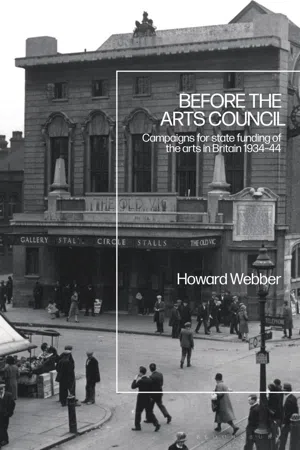
Before the Arts Council
Campaigns for State Funding of the Arts in Britain 1934-44
- 264 pages
- English
- ePUB (mobile friendly)
- Available on iOS & Android
eBook - ePub
About this book
Information
1
The Creation Myth of the Arts Council
Introduction
In 1930s Britain, the relationship between the state and the arts was a subject of intense debate and substantial press and public interest. There were active campaigns to gain government subsidy for live music and theatre, attracting support from those with otherwise deeply opposed political views. Conferences were held at which some of the best-known figures in the arts first debated issues which were to preoccupy the Arts Council of Great Britain for decades. Ministers, despite objections from their civil servants, gave tax breaks for live performances. And the debate continued in wartime: for years after 1940, when CEMA – the Council for the Encouragement of Music and the Arts – was set up, it was widely seen as an improvised short-term expedient, rather than as the basis of a permanent peacetime funder of the arts.
None of this is apparent from what has been written about the origins of government arts subsidy in Britain. Instead there has been largely unbroken consensus on four points:
–The British government in the 1930s provided no financial support for live music and theatre, and had no interest in doing so.
–In the 1930s there was little demand for subsidy. In various forms this view is almost universal in work published on the subject. Some writers choose, without explanation, not to look back before the founding of CEMA. Others regard it as so settled that government arts subsidy in Britain was not a live issue in the 1930s that they report it as a fact, cite no evidence and move on. Others again argue that on the relatively rare occasions before the war when state subsidy was discussed, it was generally opposed: the examples of Nazi Germany, Fascist Italy and Soviet Russia caused government funding of music and theatre to be seen as a route to state control of these arts.
–The coming of war changed all this. CEMA, initially a private charitable initiative, received from the start government help in kind. After a few months, Treasury funds, channelled via the Board of Education, made the government a co-funder. The general view is that this was due wholly to the war.
–The creation of the Arts Council of Great Britain in 1945 was the natural, almost inevitable, development of CEMA’s wartime work.
This book considers the evidence behind each element of this consensus. It concludes that none of them withstands scrutiny.
Debunking an established myth becomes particularly worthwhile when it reveals more interesting truths behind the myth. That is the case with government funding of theatre and music in Britain. Three stories from the 1930s and wartime have been forgotten or untold: those of Alfred Wareing’s League of Audiences, John Christie’s ‘Council of Power’/National Council of Music and Geoffrey Whitworth’s Stage and Allied Arts Defence League. The names are redolent of their period; their history, individually and collectively, casts an unexpected light on the cultural politics of the time and on the personalities of those, famous and less famous, in the arts, politics and the church, who supported or opposed them.
The Creation Myth and Its Persistence
John Maynard Keynes made probably the earliest, and certainly the most influential, statement of the Arts Council’s ‘creation myth’. Keynes, its founding Chairman, had also chaired CEMA. In July 1945 he gave a radio talk setting out his aims for the new organization and describing the origins of CEMA and the Arts Council:
… in the early days of the war, when all sources of comfort were at a low ebb, there came into existence … a body officially styled the ‘Council for the Encouragement of Music and the Arts’ .… one of the last acts of the Coalition Government was to decide that C.E.M.A., with a new name and wider opportunities, should be continued in time of peace.1
Keynes presented CEMA as arising, without pre-war roots, from the early wartime landscape, and implied that the Arts Council was CEMA’s almost inevitable successor. On both points he has been followed by almost all later commentators.
The most succinct – indeed, elliptical – statement of this view came fifty years later, in Andrew Sinclair’s 1995 history of the Arts Council. It was a seven-word slogan: ‘War was the foundation of the arts.’2 Sinclair’s 500-page account of the Council’s first fifty years, Arts and Cultures, was commissioned by the Arts Council itself. His opening twenty-four pages are a prologue ambitiously covering the period from Gilgamesh and Nebuchadnezzar to 1939. The prologue’s penultimate page lists a number of ‘bodies interested in adult education and the arts in the nineteen-thirties’.3 Despite casting his net so widely as to include the Women’s Institutes and Townswomen’s Guilds, Sinclair mentioned no 1930s campaigns for arts subsidy. Indeed he made two assertions which suggested that there was none of any significance. The first is the quotation above. The second is that ‘the rise of Fascism and Communism’ meant that the 1930s ‘was no climate for the patronage of threatened cultures’.4 In the context of a chapter on what preceded CEMA, the meaning is clear: the cause of public funding of the arts was neglected or actively unpopular in the 1930s and it took the war to change this. Having disposed of the pre-war period, Sinclair began Chapter 1 with an account of the December 1939 conference which led to CEMA’s establishment. This, Sinclair suggested, resulted from the insight that ‘There would be no victory without uplift as well as entertainment’.5
It is not only those associated with the Arts Council who have followed Keynes’ lead in this respect; it is difficult to find anywhere a modern commentator expressing a contrary view. A few examples illustrate this.
The subtitle of Robert Hewison’s Culture and Consensus (1995)6 is England, art and politics since 1940. Hewison explained in his introduction why he chose this starting date: ‘To understand how the present status and condition of the arts were arrived at in the British – or more specifically English – context, it is necessary to go back to the point when a British government first took on a formal and general responsibility for the arts in January 1940.’7 It seems that no purpose would have been served by going back before 1940.
John S Harris’ Government Patronage of the Arts in Great Britain (1970)8 contains a chapter about public subsidy up to 1945. It begins by discussing British government support for museums and galleries from the eighteenth century. The following section, headed ‘World War II and the Emergence of Government Support’, places government subsidy in this context: ‘When Britain declared war on Germany in 1939, few observers of the contemporary scene could have predicted that the six years of bitter conflict and privation would induce the nation to undertake a new and significant activity – public patronage of the arts.’9 Harris’ view was, clearly, that this public patronage was a conseq...
Table of contents
- Cover
- Half-Title Page
- Dedication
- Title Page
- Contents
- Acknowledgements
- 1 The Creation Myth of the Arts Council
- 2 Theatre and Classical Music in 1930s Britain
- 3 The League of Audiences: (i) ‘I am progressing almost beyond my hopes’
- 4 The League of Audiences: (ii) Fear of the Machine and Distrust of the State
- 5 The League of Audiences: (iii) Decline, Fall and Legacy
- 6 John Christie and the ‘Council of Power’: 1936–9
- 7 ‘CEMA is already broken down’: John Christie and the National Council of Music 1939–41
- 8 Butler, Keynes and the End of Christie’s National Council of Music: 1941–4
- 9 ‘No Levy on Laughter – and No Fine on Fun!’: The Campaign against Entertainments Duty
- 10 Restoring the Picture
- Bibliography
- Index
- Copyright
Trusted by 375,005 students
Access to over 1.5 million titles for a fair monthly price.
Study more efficiently using our study tools.
Frequently asked questions
Yes, you can cancel anytime from the Subscription tab in your account settings on the Perlego website. Your subscription will stay active until the end of your current billing period. Learn how to cancel your subscription
No, books cannot be downloaded as external files, such as PDFs, for use outside of Perlego. However, you can download books within the Perlego app for offline reading on mobile or tablet. Learn how to download books offline
Perlego offers two plans: Essential and Complete
- Essential is ideal for learners and professionals who enjoy exploring a wide range of subjects. Access the Essential Library with 800,000+ trusted titles and best-sellers across business, personal growth, and the humanities. Includes unlimited reading time and Standard Read Aloud voice.
- Complete: Perfect for advanced learners and researchers needing full, unrestricted access. Unlock 1.5M+ books across hundreds of subjects, including academic and specialized titles. The Complete Plan also includes advanced features like Premium Read Aloud and Research Assistant.
We are an online textbook subscription service, where you can get access to an entire online library for less than the price of a single book per month. With over 1.5 million books across 990+ topics, we’ve got you covered! Learn about our mission
Look out for the read-aloud symbol on your next book to see if you can listen to it. The read-aloud tool reads text aloud for you, highlighting the text as it is being read. You can pause it, speed it up and slow it down. Learn more about Read Aloud
Yes! You can use the Perlego app on both iOS and Android devices to read anytime, anywhere — even offline. Perfect for commutes or when you’re on the go.
Please note we cannot support devices running on iOS 13 and Android 7 or earlier. Learn more about using the app
Please note we cannot support devices running on iOS 13 and Android 7 or earlier. Learn more about using the app
Yes, you can access Before the Arts Council by Howard Webber in PDF and/or ePUB format, as well as other popular books in Art & Histoire de l'art. We have over 1.5 million books available in our catalogue for you to explore.