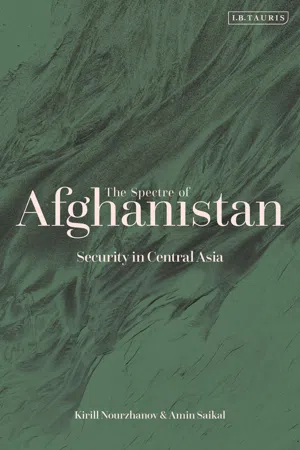
Aiming to connect a number of divergent perspectives on the current state of Afghanistan, this book outlines the country's past and present instability and how this impacts and is conceptualised by its neighbours as well as by international heavyweights such as Russia, China and the United States. Given Afghanistan's extensive cross-border ethnic, linguistic, sectarian and cultural ties with its neighbours – whatever transpires in the war-torn country is bound to have regional and global security implications. This study focuses on the current formal and informal defensive policies the states of Central Asia may or may not have in place in the event of the Afghan situation deteriorating further or the Taliban-led insurgency substantially widening their influence.
The book also considers the positions and policy responses of three influential actors in the region: Russia, China and the United States. It assesses the convergence of interests between these great powers in stabilising Afghanistan, and their divergence of geopolitical objectives in the region. With President Donald Trump unpredictably upheaving American policy in Afghanistan, an assertive Russia continuing to expand its influence across Central Asia and China seeking to have a wider economic and security role in the region, this book offers a timely assessment of an internationally-important topic.
- 248 pages
- English
- ePUB (mobile friendly)
- Available on iOS & Android
eBook - ePub
About this book
Information
1
The Afghanistan Threat
The 2001 US-led invasion of Afghanistan, as part of what Washington declared to be a wider ‘war on terror’, initially generated much optimism about the future of the country and the wider region. Yet as the campaign progressed, this initial optimism gave way to disillusionment and despair among many Afghans and democratic forces across the Muslim world. Afghanistan is today confronted with serious domestic challenges and foreign policy complications; its future hangs in the balance. Whether one observes the prevailing situation from the perspective of the Afghans, or assesses it from the vantage point of seasoned analysts of the Afghan conflict and the vagaries of the war on terror, the story so far is one of disappointment.
The Afghan people have many reasons to feel duped. They have been failed by their leaders, and by the foreign actors that have supported those leaders. Upon launching the war on terror, then-US President George W. Bush (2001–2009) vowed to bring peace, stability, security, prosperity and democracy to Afghanistan (and later to Iraq), and to free the world from what he called the terror wreaked upon it by those elements who used and abused Islam. Today, this promise rings more hollow than ever before. After so much investment in blood and resources on the part of the United States and its NATO and non-NATO allies, not to mention the incalculable loss of lives and property suffered by the Afghan people, the situation in Afghanistan bears no resemblance to the future that Bush promised to deliver.
This chapter has three main objectives: The first is to place the 2001 US invasion of Afghanistan in its historic context, recognizing that it occurred at a moment when the country had been shattered by over twenty years of devastating war. The second is to analyse the evolution of the Afghan situation under the US presidencies of Bush, Barack Obama (2009–2017) and Donald Trump (2017–present). The third is to evaluate the overall security profile of Afghanistan after seventeen years of US-led NATO and non-NATO civilian and military efforts to stabilise and secure Afghanistan, and to democratise the country.
The Context
In October 2001, the United States invaded the largely Taliban-controlled Afghanistan in a military intervention called ‘Operation Enduring Freedom’ under the aegis of the ‘war on terrorism’ which Bush declared on 16 September. Ostensibly, the invasion and subsequent occupation of the country aimed to remove a regime that Washington believed to be harbouring the terrorist network Al Qaeda, led by Osama bin Laden, which had attacked the United States at the cost of some 3,000 lives on 11 September 2001. However, as the operation’s moniker suggests, the Bush administration presented the invasion as more than a purely military and strategic exercise. Quickly following on the tail of security concerns regarding the removal of the Taliban was the notion that the invasion would allow the United States and its international backers (including the United Nations) to turn this seriously ‘disrupted state’1 into ‘a stable, free and peaceful’ state,2 so that it would never again become a hub for international terrorism. By implication, then, the aim of the operation was also to contribute to regional stability and security. As a result, despite having initially disavowed any interest in nation-building, Washington committed itself incrementally to the reconstruction of Afghanistan through substantial military, economic and humanitarian involvement.
The Taliban seized power in September 1996 after four years of internecine conflict between various Afghan Islamic resistance forces known as the mujahideen, who themselves had waged a protracted war against the Soviet occupation of Afghanistan from late December 1979 until the Soviet army was forced to retreat almost a decade later.3 The main mujahideen groups, who represented the majority Sunni Muslim population of Afghanistan, were backed by the United States and its Western and regional allies, most importantly Pakistan, which served as a frontline state against the expansion of Soviet communism through Afghanistan.4
The Taliban, a group made up of former religious students from the madrasas of southern Afghanistan and northern Pakistan, were (and are) largely an ethnic Ghilzai Pashtun group of militant fighters who espoused a rigid and medievalist doctrine of Sunni Islam and claimed moral and religious superiority over the mujahideen groups in Afghanistan.5 They initially attracted popular support through a promise to bring justice, rule of law and peace to Afghanistan through a strict imposition of their brand of Islamic law and governance. Nasreen Ghufran writes that they were perceived as a ‘peaceful, neutral, and nongreedy [sic] force’, whose promises of ‘[disarming] local militia and [enforcing] Islamic law’ were ‘clear and convincing for the war-weary public’.6 The group was set up and funded by Pakistan’s powerful Interservices Directorate (ISI) in the early 1990s, when the ISI had realised that maverick mujahideen leader, Gulbuddin Hekmatyar’s Hezb-e Islami (the Islamic Party of Afghanistan), which they had previously supported, was an ineffective medium through which to influence Afghan politics.7
After the Soviet withdrawal and three years of fighting an insurgency war against the unstable first mujahideen government of Burhanuddin Rabbani, in September 1996, the Taliban took over Kabul and with it nominal control of most of the country.8 Within two years, the Taliban were able to gain control of an estimated 85 per cent of Afghanistan, renaming the country ‘the Islamic Emirate of Afghanistan’. However, only Pakistan, Saudi Arabia and the United Arab Emirates officially recognised the Taliban as the legitimate rulers of Afghanistan. Despite the Taliban’s ongoing demands for international recognition and Islamabad’s strenuous lobbying on their behalf, widespread international criticism of the group’s hard-line policies, as well as its harbouring of bin Laden and other Al Qaeda operatives, led to several rounds of UN sanctions.9 Afghanistan became, in the eyes of the rest of the world, an international pariah, officially condemned and largely ignored in the post-Cold War world order.10
The US government, while mistrustful of the Taliban, did not, at first, pay it much attention. It continued the policy of disengagement that it had pursued in Afghanistan following the Soviet withdrawal from the country.11 Strategically, the only interest that the United States had in Afghanistan in this period was as a potential host of a Trans-Caspian oil pipeline.12 However, this ambivalence evaporated once it became evident that the Taliban had permitted bin Laden, a Saudi Arabian Islamic militant who had organised terrorist attacks against the United States, to establish the bases of his Al Qaeda network in Afghanistan.13 In August 1998, then-President Bill Clinton ordered cruise missile attacks on suspected Al Qaeda bases in Afghanistan in response to the group’s orchestration of two bombings at US embassies in Nairobi and Dar es Salaam.14 With bin Laden becoming a crucial target for the United States, Washington began placing increasingly tight sanctions and restrictions on the Taliban government in Kabul in an effort to coerce it into handing over bin Laden.15 These attempts had little effect as the United States could not enlist the support of Pakistan. Whilst the new Bush government was still trying to develop a more effective strategy for dealing with the Taliban and with bin Laden and his organisation, Al Qaeda executed its most spectacular and devastating attacks on New York and Washington on 11 September 2001.
In response, the United States undertook the invasion of Afghanistan. At first, the United States went ahead largely on its own, with some help from Canada and the United Kingdom, and with the endorsement of the United Nations Security Council. However, as it met rapid success in bringing down the Taliban regime (assisted by certain anti-Taliban Afghan groups), its NATO allies quickl...
Table of contents
- Cover
- Half-Title Page
- Title Page
- Contents
- Preface
- Glossary of Terms
- Introduction
- 1 The Afghanistan Threat
- 2 Afghanistan and Regional Security: The Views from Central Asia
- 3 The Central Asian Policy Response to Security Threats from Afghanistan: Development, Defence and Diplomacy
- 4 Great Powers and the Central Asia–Afghanistan Equation
- 5 Central Asia’s Contribution to Peace in Afghanistan: Mission Impossible or the Dawn of Hope?
- Conclusion
- Bibliography
- Index
- Copyright
Trusted by 375,005 students
Access to over 1.5 million titles for a fair monthly price.
Study more efficiently using our study tools.
Frequently asked questions
Yes, you can cancel anytime from the Subscription tab in your account settings on the Perlego website. Your subscription will stay active until the end of your current billing period. Learn how to cancel your subscription
No, books cannot be downloaded as external files, such as PDFs, for use outside of Perlego. However, you can download books within the Perlego app for offline reading on mobile or tablet. Learn how to download books offline
Perlego offers two plans: Essential and Complete
- Essential is ideal for learners and professionals who enjoy exploring a wide range of subjects. Access the Essential Library with 800,000+ trusted titles and best-sellers across business, personal growth, and the humanities. Includes unlimited reading time and Standard Read Aloud voice.
- Complete: Perfect for advanced learners and researchers needing full, unrestricted access. Unlock 1.5M+ books across hundreds of subjects, including academic and specialized titles. The Complete Plan also includes advanced features like Premium Read Aloud and Research Assistant.
We are an online textbook subscription service, where you can get access to an entire online library for less than the price of a single book per month. With over 1.5 million books across 990+ topics, we’ve got you covered! Learn about our mission
Look out for the read-aloud symbol on your next book to see if you can listen to it. The read-aloud tool reads text aloud for you, highlighting the text as it is being read. You can pause it, speed it up and slow it down. Learn more about Read Aloud
Yes! You can use the Perlego app on both iOS and Android devices to read anytime, anywhere — even offline. Perfect for commutes or when you’re on the go.
Please note we cannot support devices running on iOS 13 and Android 7 or earlier. Learn more about using the app
Please note we cannot support devices running on iOS 13 and Android 7 or earlier. Learn more about using the app
Yes, you can access The Spectre of Afghanistan by Amin Saikal,Kirill Nourzhanov in PDF and/or ePUB format, as well as other popular books in Politics & International Relations & International Relations. We have over 1.5 million books available in our catalogue for you to explore.