As a teacher, what are a teacher's personal, social and emotional responsibilities in supporting pupils with diverse learning needs? There is no longer a place for a teacher who denies their role in the education of pupils with diverse needs. But understanding how to meet these challenges, particularly in amongst the other challenges of teaching and the classroom, can seem daunting. Drawing on examples from early years to college, this book looks at what inclusion and inclusive practice means in practice and how it relates to different aspects of teaching. Covering issues related to teacher well-being, resilience and other professional skills this book offers the reader the opportunity to use case studies and research to reflect on their own professional practice. Expertly crafted by Sue Soan, drawing on the expertise of a team of practitioners and academics, this book brings together the latest research and current practice. International case studies showcase examples of practice and reflexive questions encourage the reader to explore their experiences, knowledge and expectations to help them to develop as a practitioner.
eBook - ePub
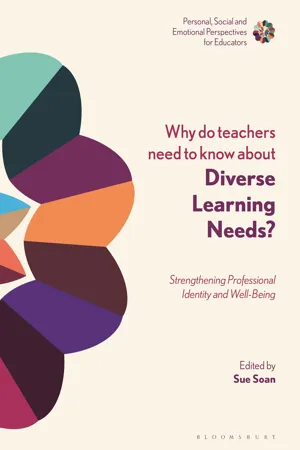
Why Do Teachers Need to Know About Diverse Learning Needs?
Strengthening Professional Identity and Well-Being
- 200 pages
- English
- ePUB (mobile friendly)
- Available on iOS & Android
eBook - ePub
Why Do Teachers Need to Know About Diverse Learning Needs?
Strengthening Professional Identity and Well-Being
About this book
Information
1
Setting the Context
Introduction
This first chapter briefly outlines the key conversations and debates that teachers will be able to engage with when working with pupils with diverse learning needs. First, globalization of learning will be explored, followed by a case study reminding us that global does not mean forgetting about individual pupil need. Teaching inclusively is then introduced, before moving on to discuss pupil learning needs, special educational needs and ‘gifts and talents’. Finally, the contents of each chapter in this volume are described for you.
Globalization of learning
The design and wide distribution of the internet has meant people across the world have in recent years gained greater personal connectivity via rapid distribution of cellular networks and mini-satellites. This ever-evolving technological change must influence our understanding of the world; of work, play and learning. In the past the purpose of teaching and intended learning was to train a future workforce for known employment in the near future. Subjects and curriculums were designed to provide a graduated skills development for a known end job.
More recent global reforms are changing educational curriculums to a lesser or greater degree in countries, with greater focus on growing competencies for lifelong learning, for ongoing adaptation and sustainability of employment options that can evolve with whatever the future economies of the world may depend on. Change occurs fast and is of course affected by the actions of humans, intended and unintended, as we have found out with the 2020 pandemic and climate change. Hence whilst individual home and virtual schooling can positively support learning, it cannot provide a level of consistency, inclusion and scale for a government, or governance philosophy. It is therefore considered that schools will remain relevant for state education, but the role and responsibilities of teachers will most likely need to be more fluid and adaptive with collaboration as a key element required to enable effective responses to rapidly changing agendas and personal and professional well-being.
Schwartz et al. (2019) predict that a world of human-machine collaboration will emerge quickly and that it is skills of problem-solving, communication, listening, interpretation and design that will be required to ‘get the work done’ and thus need to be nurtured and valued in school education. Little did we know that the coronavirus pandemic in 2020 would make this prediction a reality so quickly.
Cognizant of fast developing markets, schools, through their teachers and with their pupils, are making changes to curriculums to refocus on developing easily transferable skill sets and capacities to continue learning beyond the schools that will support the evolution of this new workforce. All of this is likely to influence the role and responsibilities of a teacher and more specifically for this volume how pupils’ differences and strengths are viewed. This is the global and national influence on schools and teachers, but of course the role of a teacher incorporates not only meeting global and national aspirations, but local and individual pupil ones as well. The following case study illustrates an example of a teacher meeting the social and emotional needs of one pupil impacting significantly on the pupil’s experiences and life chances. Teaching is a complex profession, but one I have personally felt a privilege to be part of: being trusted to help educate our future generations.

What we can learn
This extract shows how Sue undertook her teaching and learning responsibilities seriously as evidenced by Graham’s academic progress. But there was much Sue had to consider, plan and evaluate to enable that success, over and above implementing that required for regular pupils. Unravelling the complexities of Graham’s needs, it can be seen he had what is currently termed ‘Dual and Multiple Exceptionalities (DME)’ as he had high mathematical ability, and a special educational need (dyslexia), combined with attachment and experiences of severe abuse (physical and emotional). He was also a ‘Looked after Child’ (a child living outside of his family home) and therefore the Local Authority was responsible for his care and well-being. In this one situation the following elements of a teacher’s role can be identified:
• The importance of relationships
• Pupil-centred holistic approach
• Knowledge of DME (Special and Able education)
• Collaboration skills and abilities
• A positive personal and professional attitude towards difference and Looked after Children
• An understanding of the impact of abuse on the cognitive, emotional and social life of a pupil
• The priorities of a Local Authority
• A pupil’s life opportunities.


Becoming a teacher for ALL pupils: Inclusion
There are a number of views about what encourages a person to become a teacher. Some will become a teacher because it is what the ‘family do’ and some see the profession as a vocation, whilst in England it has also been said ‘If you can’t do anything else – teach’. Equally varied are thoughts about what makes a competent or great teacher with views varying about the importance of subject knowledge, good management/behaviour skills and the wish to make a difference. The reality however is not linear, but complicated and multifaceted with impactful government directives, funding and resources issues all playing a role in what and how a teacher teaches.
Arguably though international education policy has for a number of decades been moving towards one of inclusive education with the role of the teacher at the foreground of managing and achieving this, forging a route through all the complexities that this requires. This internationally accepted inclusive education viewpoint can best be understood through the Dakar Agreement and its Framework for Action for an ‘Education for All’. A lengthy and broad action plan it distinctly recognizes the vital role teachers need to play to enable such work to be achieved. It says:
Teachers are essential players in promoting quality education, whether in schools or in more flexible community- based programmes; they are advocates for, and catalysts of, change. No education reform is likely to succeed without the active participation and ownership of teachers.
(UNESCO, 2000, pp. 20, 69)
It continues by emphasizing that ‘teachers must also accept their professional responsibilities and be accountable to both learners and communities’ (UNESCO, 2000, pp. 20, 69), the underlined words of which the most recent English SEND code of practice: 0–25 (DfE and DoH, 2015) also adopted. Importantly, the ‘Education for All’ title is also demonstrated in the following section highlighting the thought that all teachers need to be able to work with and provide for the educational needs of all their pupils:
Teachers must be able to understand diversity in learning styles and in the physical and intellectual development of students, and to create stimulating, participatory learning environments.
(UNESCO, 2000, pp. 20–1:70)
But what knowledge, interpersonal and professional skills, and ongoing continuing training and development do teachers need in order for them to manage the role and the responsibilities alongside ensuring their own professional values and beliefs and well-being are maintained?
Meeting pupil need
It is suggested that every pupil will at some point in their school education experience a time when they find learning more difficult than other pupils, resulting in learning plateauing or not progressing as ‘expected’ even if they are not formally labelled as requiring a special educational needs (SEN) intervention. Such need might be identified in a specific area of a curriculum programme, a subject itself or seen to be a mental health, physical, emotional or social difficulty.
Likewise, pupils with high ability or specific talents in one or more subjects or fields of study may well find they need additional and different intervention or provision to their peers either constantly during their school life or at various points in their education. Often neglected or unobserved, these needs can have equal if not more impact on the ...
Table of contents
- Cover
- Halftitle Page
- Title Page
- Dedication Page
- Contents
- List of Figures
- List of Tables
- Series Editor’s Preface
- Series Editor’s Introduction to the Personal, Social and Emotional Perspectives for Educators Series
- Using This Book
- About the Editor
- About the Contributors
- Acknowledgements
- List of Abbreviations
- 1 Setting the Context Sue Soan
- 2 The Professional Self and Diverse Learning Needs Conor Mc Guckin and Carol-Ann O’Síoráin
- 3 Health and Well-Being Alan Bainbridge and Alison Ekins
- 4 The Learning Environment Lorna Hughes and Nicola Elson
- 5 Technology John-Paul Riordan and Mark Roberts
- 6 Empowerment – The Power of Observation and Listening Joy Mower and Teresa Dowling
- 7 Working Together Christian Couper and Sue Soan
- 8 Resilience, Reflection and Reflexivity Geraldene Codina and Jon Fordham
- 9 The Role of Teachers and Teaching Sue Soan and Christian Couper
- References
- Index
- Imprint
Trusted by 375,005 students
Access to over 1.5 million titles for a fair monthly price.
Study more efficiently using our study tools.
Frequently asked questions
Yes, you can cancel anytime from the Subscription tab in your account settings on the Perlego website. Your subscription will stay active until the end of your current billing period. Learn how to cancel your subscription
No, books cannot be downloaded as external files, such as PDFs, for use outside of Perlego. However, you can download books within the Perlego app for offline reading on mobile or tablet. Learn how to download books offline
Perlego offers two plans: Essential and Complete
- Essential is ideal for learners and professionals who enjoy exploring a wide range of subjects. Access the Essential Library with 800,000+ trusted titles and best-sellers across business, personal growth, and the humanities. Includes unlimited reading time and Standard Read Aloud voice.
- Complete: Perfect for advanced learners and researchers needing full, unrestricted access. Unlock 1.5M+ books across hundreds of subjects, including academic and specialized titles. The Complete Plan also includes advanced features like Premium Read Aloud and Research Assistant.
We are an online textbook subscription service, where you can get access to an entire online library for less than the price of a single book per month. With over 1.5 million books across 990+ topics, we’ve got you covered! Learn about our mission
Look out for the read-aloud symbol on your next book to see if you can listen to it. The read-aloud tool reads text aloud for you, highlighting the text as it is being read. You can pause it, speed it up and slow it down. Learn more about Read Aloud
Yes! You can use the Perlego app on both iOS and Android devices to read anytime, anywhere — even offline. Perfect for commutes or when you’re on the go.
Please note we cannot support devices running on iOS 13 and Android 7 or earlier. Learn more about using the app
Please note we cannot support devices running on iOS 13 and Android 7 or earlier. Learn more about using the app
Yes, you can access Why Do Teachers Need to Know About Diverse Learning Needs? by Sue Soan in PDF and/or ePUB format, as well as other popular books in Education & Elementary Education. We have over 1.5 million books available in our catalogue for you to explore.