As a teacher, what are my personal, social and emotional responsibilities in supporting child development? Going beyond simply recognising child development as the cornerstone of education and drawing on examples from rural early years settings to large urban secondary schools, this book looks at what child development means in practice and how it relates to different aspects of teaching. Covering relationships, environment, subject knowledge and more, this book develops the readers understanding of education and child development, as a professional and day-to-day in the classroom. Expertly crafted by Daryl Maisey and Verity Campbell-Barr, drawing on the expertise of practitioners and academics, this book draws together the latest research and current practice. Reflexive questions encourage the reader to explore their knowledge and expectations, helping them to develop as a practitioner.
eBook - ePub
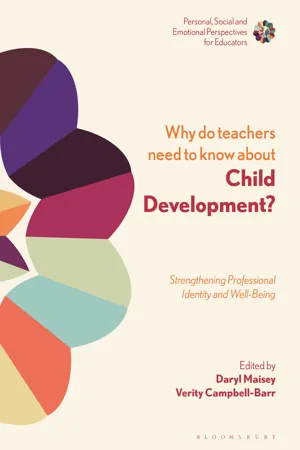
Why Do Teachers Need to Know About Child Development?
Strengthening Professional Identity and Well-Being
- 192 pages
- English
- ePUB (mobile friendly)
- Available on iOS & Android
eBook - ePub
Why Do Teachers Need to Know About Child Development?
Strengthening Professional Identity and Well-Being
About this book
Information
1
Setting the Context

Case study: Being a penguin
Country: UK
Age group: Mixed
Setting: University
Participants involved: Daryl and one of her students
When discussing experiences of child development Daryl recalled,
I remember once sitting in a lecture theatre next to a mature student who was employed as an unqualified teacher at the time and was studying to gain her qualified teacher status. As we were listening to the lecturer discuss the methodology of action research, she nudged me, smiled and said, ‘who’d have thought that an hour ago I was a penguin!’ For me this was one of those defining moments in my career; a moment that I would never forget and one that I would recall time and time again. It was a powerful statement that might have been said in jest but was loaded with meaning. Let me explain. In that statement she captured the very multiplicity of the teacher’s role and, as she saw it at the time, the sometimes absurdity of what teachers might do or experience in one day. She had indeed been working with the children in her primary school on project work involving penguins. Over the weeks they had investigated the conservation of penguins, their habitat, their food and their behaviours. They had sung songs, shared stories and written poetry. They had made penguin costumes that culminated in a dressing up fun day for a local community charity. In her recall of events she became animated and disclosed several examples of individualised provision for some of the children in her class who might have struggled with different aspects of the activities experienced. I was struck by her in-depth knowledge of the children and their families, her understanding, her compassion and her ability to adapt to make learning enjoyable for all. And here she was at the end of a tiring day, engaging in learning about action research methodology and looking forward to finding out more about her chosen focus in order to transform practice. Over the course of our conversation I became aware that she had extensive knowledge and understanding of child development but not in the sense of measuring a child’s progress against a set of developmental milestones. She was aware of progress charts and standardised markers, but she used these as indicators and not as definers of children or definers of her practice. Her understanding of child development was shaped by theory, research and experience, through which she had come to know the children and herself.
Introduction
This book is all about coming to know the children that you work with, and yourself. It is a presentation and celebration of shared knowledge and experience from theorists and practitioners from across and beyond the education continuum. It does not present milestones and standardized progress charts to follow, but explores and examines some of the many different elements of a teacher’s role that can have a significant impact and/or influence on the development of children and young people. In the chapters, authors have deliberately avoided prescriptive directives and assertions, instead providing informed positions on a number of matters for your consideration. Each chapter has been written in collaboration between teachers, practitioners and lecturers, drawing on theoretical, practical and experiential expertise. The knowledge and experience of those involved provide insights into the complexity of the teacher’s role and offer new and experienced teachers’ suggestions for enhancing and evolving practice for the benefit of children’s learning and development.
Chapter 2 addresses the notion of knowledges and the different ways in which those working with children in educational settings come to ‘know’ from the theoretical to the experiential. Drawing on sociological perspectives of professional knowledge, the chapter combines this theoretical framing with Julie’s journey in becoming a knowledgeable early childhood professional. The focus on early childhood education illustrates that in the book there is a consideration of different ‘teachers’, who will have undertaken a range of initial and continued professional development journeys in the shaping of their professional self. It is important for us to highlight that we recognize that there are different training trajectories for those who work in education. For example, in early years education the Early Years Initial Teacher Training (EYITT) is a degree-level qualification for those working in the private, voluntary and independent sectors. The EYITT is distinct, for example, to a BEd: Early Years that comes with Qualified Teacher Status. While in both instances the term ‘teacher’ is used, the two different training routes have different foci and can lead to different employment trajectories, with varying pay and conditions. The use of the term ‘teacher’ is not to amalgamate all teachers, with a failure to recognize the subtle differences in how one becomes a teacher, but as shorthand for someone who works with children in an education setting. Thus, throughout the chapters, the term ‘teacher’ is used with an underlying recognition of the differences in who is a teacher and how they have become a teacher.
Education lenses
To fully appreciate the complexity of education, it is important to recognize that education is entwined with the personal, social, political and economic. Each of these perspectives provides a different lens through which to view education and the role of the teacher, which will have implications for what it is that teachers need to ‘know’. As discussed in Chapter 2, everyone has an empirical theory of the world based on their experiences. As such, an individual’s experiences of education and teachers will shape what it is that they expect of both. Remember playing ‘schools’ as a child – did you line the teddies up in front of you, take a register and then guide them through a lesson while they sat obediently, listening and not moving? Although a rather simplistic example, it illustrates how even from a young age we hold assumptions about education, teachers and schools. Further personal experiences will guide you in developing more specific illustrations of education and teachers. For example, memories of outdoor play as a child may ignite a passion for outdoor learning as a teacher (Parker-Rees, 2015). Throughout the book there are opportunities to reflect on your personal empirical theory to consider what it is that you, as a teacher, need to know in support of children’s development.
Throughout all of the chapters you will note how the concept of a teacher and what it is that teachers are expected to know is inherently political. Education is the object of policy in many different guises, from curriculums to inspections. However, it is also something of a political tool, often presented in election campaigns as a way in which to right the ills of society. Steven Ball (2008), in his book the Education Debate, explores how education is a key political issue, with a continual flow of government initiatives and policies that concern all stages of education. Ball considers how these policies shape not only the nature of education, but also the role of teachers. In his book, Ball highlights how education policy does not occur in a vacuum, but interacts with other areas, such as the use of research evidence to guide the direction of policy – albeit, at times, a selective reading of research evidence. The use of research is frequently on the basis of seeking to find the answer to ‘what works’, whereby the educating of children is a problem that needs to be fixed. For example, child poverty becomes a problem to be fixed on the basis that it is a cost to society, rather than on a humanist principle that children should not live in poverty (Penn, 2012).
Ball also highlights the economics of education, both in relation to the ‘business’ of education, whereby education is increasingly delivered based upon a market model of parental choice, but also how education (like other areas of policy) is subject to the impact of austerity. The economic perspective on education is not just in relation to how education is delivered on a structural level or the level of funding that is allocated, the economics of education is also about the economic argument as to why education is important. As touched upon briefly in Chapter 6, the economic argument is premised on human capital theory, whereby investments in education are seen to yield an economic return on children entering adulthood. Human capital represents the knowledge, skills and other attributes that an individual obtains that can then be sold in the employment marketplace for an economic return. In essence, the higher a person’s human capital, the higher their economic return. High personal economic returns are good for society as higher wages mean people paying higher taxes, alongside fewer people in unemployment, but also the collective capital of a country helps ensure competitiveness in the global knowledge economy (Campbell-Barr, 2009).
Human capital is framed as developing the economic competitiveness of countries as part of a lifelong learning agenda. Beginning with children in their earliest years, early years education has been positioned as laying the foundation to children’s later learning. Each stage of education has been positioned as a means to prepare for the next – early years to primary, primary to secondary and so on. Even on entering adulthood, human capital is premised on notions of personal responsibility and a commitment to one’s continued lifelong learning.
The consequence of an economic perspective of education for teachers is that it can have implications for shaping their professional role. Approaches to education, and teaching and learning, become shaped by the ‘what works rhetoric’ of applying the right techniques at the right times in order to achieve the right outcomes. Not only does this have consequences for the professional practice of a teacher and perceptions of their role, whereby they are frequently positioned as an answer to fixing social ills, but it also has consequences for understandings of the child as a learner, pupil and member of society.
The ‘what works’ rhetoric has consequences for how the child is constructed, particularly in relation to their development. Debates in early years education serve well in highlighting the way in which policy upholds normative expectations of child development. A mythical normal child, who develops at a prescribed linear rate, acts as a benchmark against which to judge all other children. Those children who do not meet the expectations of the ‘normal child’ are often labelled as deficient in some way. For example, in early years education children are anticipated to achieve a ‘good level of development’ in relation to the Early Learning Goals. While there is a well-meaning intention to identify those children who may require additional support, there is also something of a deficit model. Consider the wording of ‘good’ – is a child who has not met the Early Learning Goals therefore ‘bad’? There is also a risk that the failure to achieve ‘good’ becomes a label that stays with the child throughout their education. An alternative perspective would be to celebrate what children have achieved rather than what they are yet to achieve. While there is inevitably a need to identify children who do require additional support, it is also important not to think that child development is a one-size-fits-all approach. There are commonalities in how children develop, but there are also nuances that reflect the uniqueness of children.
Embedded within political, economical and social discourse are the child and their childhood. Consider for a moment that it is adults that construct notions of childhood and determine the ways in which children are perceived, portrayed, privileged and protected. Consider also how childhood is constantly changing as it is temporal in its reflection of adults in their unique and diverse societies. Childhood is essentially context and time affected. As Smidt (2013, p. 5) explains, childhood is a social construct, ‘which means that the idea of what childhood is and what children are like are created by adults’, responding to the economic, political, religious and cultural influences of the time. Assuming Smidt’s position, as teachers you will have formed ideals of childhood based upon personal biographical histories, knowledge and experiences that are situated within the political, economic and social states of your time. An awareness of your ideals of childhood may reveal some of the underlying values that shape your behaviours in professional practice (Campbell-Barr, 2019). This alertness to influences affecting personal reactions and responses to children and their families is discussed in Chapter 8, where reflection and reflexivity are examined. The chapter explores why teachers may think and behave in the ways they do, and how responses from children and their families may not always be those anticipated or intended, affecting a teacher’s resilience. In light of childhood as a social construct and dependent upon context and time, it is perhaps essential that teachers recognize that they cannot know the constructs of childhood formed or experienced by others. What is possible is for teachers to acknowledge that childhood differs for every child. Each child’s reality belongs to them in their context and in their time. The constructs of childhood (what it should look like and what it should be) differ for every adult. Each adult’s ideal of childhood belongs to them in their context and in their time. Just reflecting upon the difference between your own childhood, your ideal of childhood and the technologically advanced context in which many children are now exposed illustrates difference and diversity that is present and ever changing.
A child entering your educational establishment will be experiencing their unique childhood and this will influence their expectations of you (as their teacher), expectations of whom they might meet, expectations of what they might do, expectations of what they might eat and expectations of how they might be treated (Charlesworth, 2017). They may well be expecting something very different to that devised by you and other adults with influence over what is provided and offered in the educational setting. In preparation and planning for development and learning, a pupil needs to be considered in the context of their childhood influences, including their family, culture and community that are socially, politically and economically situated. In Chapter 7, Johnson and Goodyear present a series of case studies that reveal insights into different relationships that teachers make and their potential influences on pupils’ development and learning. The chapter explores how you, as the teacher, should come to know yourself, know your pupils, know your families, know your colleagues, know your professionals and know your collaborative professional communities. There is an emphasis on teachers being tasked with recognizing their own ideals of ‘parenthood’: acknowledging that judgements might be made without appreciation of the pupils’ and their families’ unique and diverse lives. It reveals examples where the notion of what might constitute effective parenthood might challenge previously held assumptions and draws attention to expectations that parents might have of teachers. The chapter offers you examples from practice to illustrate how effective relationships can enable pupils a sense of belonging, whilst acknowledging the uniqueness of their childhood and the uniqueness of their families. The chapter concludes with suggestions for how a teacher might ensure that they create the conditions from which respectful ‘relational pedagogy’ can prosper to enable pupils to learn.
In considering the relationship that teachers make with their children it is equally important to consider how educators listen to children in order to form that relationship. In Chapter 6 Graham and Campbell-Barr explore the concept of listening and the conditions within which this happens. Drawing on experiences of working in early years education, Graham analyses how the notion of listening can often be framed by adult agendas, rather than really considering the perspective of the child. Offering an example from a small-scale research project of taking the time to really listen to a child, Graham highlights how it is more than just listening, but also really hearing the child within the pedagogic relationship. Hearing enables a different relationship to emerge between a child and adult.
Pedagogy is sometimes referred to as the act or the art of teaching. Essentially, it might be viewed as the approaches teachers take when teaching: the methods and practices adopted by you in the delivery of the curriculum. Pedagogy therefore involves an element of personal preference. As such, theories, research and experiential learning from education and from other disciplines inhabit teachers’ choices. Political, social and cultural influences will also manifest in different pedagogical approaches. Some of these might be culturally situated (community expectations) and others might be age and curriculum content dependent. For example, younger pupils may be more actively engaged in learning with concrete materials, whereas older pupils may be learning about the abstract. In either context teachers’ pedagogical choices will be informed by what is known about these approaches from theory, research and experience (see Chapter 1). Theories in this context can be understood as ideas that try to explain what might be considered developmentally appropriate for different pupils of different ages. Theories might provide some understanding of how children learn and develop. However, it is important to note that theories and theorists attend to the study of child development and learning from different perspectives and in different contexts. Teachers should be aware that there is criticism of some prevailing and widely referenced theories. These not only question the relevance of the context in which the theory was originally devised, but also suggest that some theories might result in pressures to make all pupils conform to universally presented developmental goals, whilst not acknowledging diversity (Lubeck, 1998). Some theories are presented as linear developments without acknowledgement of potential impact from other factors present and affecting the child. As a cautionary note, theories can support teachers in helping to make sense of teaching and learning, but they should always be critically appreciated within their historical, political and social contexts.
There are different theories that are often referred to in the study of child development such as maturation and developmental theories, including behaviourism. Maturation is typica...
Table of contents
- Cover
- Halftitle Page
- Title Page
- Dedication Page
- Contents
- Series Editor’s Preface
- Series Editor’s Introduction to the Personal, Social and Emotional Perspectives for Educators Series
- Using This Book
- About the Editors
- About the Contributors
- Acknowledgements
- List of Abbreviations
- 1 Setting the Context
- 2 The Professional Self
- 3 The Need for Health and Well-Being
- 4 Child Development
- 5 Technology Education
- 6 Listening to Children
- 7 Professional Relationships and Collaboration
- 8 Resilience, Reflection and Reflexivity
- 9 The Role of the Teacher
- Bibliography
- Index
- Imprint
Trusted by 375,005 students
Access to over 1.5 million titles for a fair monthly price.
Study more efficiently using our study tools.
Frequently asked questions
Yes, you can cancel anytime from the Subscription tab in your account settings on the Perlego website. Your subscription will stay active until the end of your current billing period. Learn how to cancel your subscription
No, books cannot be downloaded as external files, such as PDFs, for use outside of Perlego. However, you can download books within the Perlego app for offline reading on mobile or tablet. Learn how to download books offline
Perlego offers two plans: Essential and Complete
- Essential is ideal for learners and professionals who enjoy exploring a wide range of subjects. Access the Essential Library with 800,000+ trusted titles and best-sellers across business, personal growth, and the humanities. Includes unlimited reading time and Standard Read Aloud voice.
- Complete: Perfect for advanced learners and researchers needing full, unrestricted access. Unlock 1.5M+ books across hundreds of subjects, including academic and specialized titles. The Complete Plan also includes advanced features like Premium Read Aloud and Research Assistant.
We are an online textbook subscription service, where you can get access to an entire online library for less than the price of a single book per month. With over 1.5 million books across 990+ topics, we’ve got you covered! Learn about our mission
Look out for the read-aloud symbol on your next book to see if you can listen to it. The read-aloud tool reads text aloud for you, highlighting the text as it is being read. You can pause it, speed it up and slow it down. Learn more about Read Aloud
Yes! You can use the Perlego app on both iOS and Android devices to read anytime, anywhere — even offline. Perfect for commutes or when you’re on the go.
Please note we cannot support devices running on iOS 13 and Android 7 or earlier. Learn more about using the app
Please note we cannot support devices running on iOS 13 and Android 7 or earlier. Learn more about using the app
Yes, you can access Why Do Teachers Need to Know About Child Development? by Daryl Maisey, Verity Campbell-Barr, Daryl Maisey,Verity Campbell-Barr in PDF and/or ePUB format, as well as other popular books in Education & Elementary Education. We have over 1.5 million books available in our catalogue for you to explore.