Brimming with mythical imagination, poetic sallies, and often ferociously witty remarks, the Zhuangzi is one of China's greatest literary and philosophical masterpieces. Yet the complexities of this classical text can make it a challenging read. This English translation leads you confidently through the comic scenes and virtuoso writing style, introducing all the little stories Zhuangzi invented and unpicking its philosophical insights through close commentaries and helpful asides. Romain Graziani opens up the text as never before, showing how Zhuangzi uses the stories as an answer to Mencius's conception of sacrifice and self-cultivation, restoring the critical interplay with Confucius' Analects, and guiding you through the themes of the animal world, sacrifice, political violence, meditation, illness, and death.
In Graziani's translation, the co-founder of Taoism emerges as a remarkable thinker: a dedicated disparager of moral virtues who stubbornly resists any form of allegiance to social norms and the only Warring States figure to improvise with the darkest irony on the weaknesses of men and their docile subservience to the unquestioned authority of language. For anyone coming to Chinese philosophy or the Zhuangzi for the first time, this introduction and translation is a must-read, one that reminds us of the importance of thinking beyond our limited, everyday perspectives.
eBook - ePub
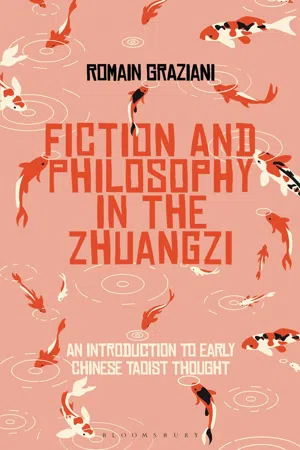
Fiction and Philosophy in the Zhuangzi
An Introduction to Early Chinese Taoist Thought
- 216 pages
- English
- ePUB (mobile friendly)
- Available on iOS & Android
eBook - ePub
Fiction and Philosophy in the Zhuangzi
An Introduction to Early Chinese Taoist Thought
About this book
Information
PART ONE
Humans
versus Animals
1
Carving up a Myth in the Kitchens of Power
Here is the famous tale of the encounter between the prince and the butcher in Chapter 3 “The Key in nourishing one’s vital principle.
Butcher Ding was cutting up an ox for Prince Wenhui. As he seized the beast with a clap! he shouldered its weight and stood firm with his knees braced against it; his knife replied with a melodious chop! to a rhythm that seemed to echo the ancient dances of Mulberry Grove, responding to the dynastic tune of “The Lynx’s Head.”1
“Ah! how admirable!” exclaimed the Prince. “To say that one can attain such heights in technique!”
Putting down his knife, the butcher replied, “What your servant values in his task is the way things work, beyond pure technique. When I was learning my trade, I only had eyes for the ox. After three years, I stopped seeing it as a whole. Now I perceive it by the spirit, without using my eyes: knowledge of the senses is brought to a halt and I give free rein to the powers of the spirit, which finds its way around the inner structure of the beast. My knife slices between the intervals, runs through the cavities following what is inherent to it. The blade moves without ever catching in the veins or the arteries,2 in the ligaments or the tendons, or of course in the bones. A good butcher changes his blade once a year because he cuts. An ordinary butcher changes his blade every month, because he chops. The knife you see here is already nineteen years old: it has carved thousands of oxen and its blade is still as sharp as if it came straight from the whetstone. The thing is, there is a space between all the joints, but the knife-edge itself has no thickness. If you penetrate these empty spaces with a blade that has no thickness, then it has the freedom to move around inside: you even have room for maneuver! That is why although I have been using my knife for nineteen years, it is still as good as new. Nevertheless, when I get near a complex joint I consider how the difficulty presents itself; I stop still, observe attentively and proceed, step by slow step. I ply the knife with infinite care, and slap! the cuts of meat fall to the ground like clods of earth and the ox passes from life to death without even realizing what has happened!3 Then I remove the instrument, stand up straight, look around, elated and fulfilled, and clean and sheath my knife.”
“Excellent!” said the Prince. “By listening to the words of Butcher Ding, I have learned the art of nurturing life.”
This story is still one of the most popular ones in Chinese culture, though people never agree on what exactly makes it so pleasant. Moreover, oddly enough, the internal structure of the story has never been unpacked (unlike the butchered ox). It draws on four main points: the culinary activity in question, namely the dismembering of an ox, a sacrificial animal par excellence; the political and ritual values of food and their synthesis into the theme of “nurturing the vital principle” (yang sheng); the supposed location of the scene, probably in the kitchens of Prince Wenhui4 or perhaps on sacrificial hallowed ground; and finally, superimposed upon the account of the animal’s dismemberment, the joyful dismantling by Zhuangzi of a political fable based on a cliché that circulated during the Warring States period, namely the scenario of an edifying encounter between a king and his master-chef, whose evocative discourse introduces the sovereign to the “recipes of power.”
The culinary and sacrificial background, which is infused with political overtones, is generally neglected by readers and scholars who tend to select only certain morsels, that can then be served up with a ready-made sauce created for similar pieces about fabled craftsmen in the Zhuangzi, in particular the story of Bian, the wheelwright. The chosen elements then become side dishes to accompany personal ruminations, leaving aside the less noble segments, such as the carving of the meat or the restoration of the body, which give this its most singular flavors. It is time to enjoy every part of the ox, reaching the heart and the goodness, instead of lapping directly at its philosophical coating.
Rather than reducing this story to a pleasant lesson for living by means of a craft analogy, I recommend a second reading of the aggressive dialectics which associate it, as is the case with all great writings of the Warring States, in an overt or covert fashion, with questions of government and domination.
Although the reader is in the presence of two characters who represent, in an extreme form, the structural polarity of society, namely its highest station and lowest rung, it is easy to see how these two men represent two types of sovereignty: one over the subjects of a state, and the other over the interior state of the subject. Here, as in many other similar tales in the Zhuangzi, a servant reveals the secret of inner strength to his so-called master.
To reposition this commonplace scenario, which would otherwise run the risk of simply reiterating a well-worn theme in Chinese philosophical literature, i.e., inner wisdom versus outer royalty (nei sheng wai wang)—let us pause for a moment to consider the fact that the meeting between the two men begins with the topic of food preparation. Butcher Ding is cutting up an ox, which we can presume is destined for the prince’s table. However, the illustration of social hierarchy through culinary activity is deliberately distorted here. As a butcher, Ding is supposed to nourish his prince, but the gestures he uses to carry out the work contribute to the nurturing of his own vital principle and thus liberate him from the servitude of his main task, which becomes the occasion, rather than the goal, of his activity. This activity carries him far beyond the task of satisfying his master’s appetite. The rhythmic beat of the movements and postures used for handling the animal, the joyous atmosphere emanating from the pas de deux with the body he is carving, give this exacting, strenuous, and bloody task the wider dimensions of a healing and inspiring spectacle. Even if Ding fulfils his role by preparing nourishment for the prince, he is not preoccupied with his master’s stomach, unlike the prestigious shan fu, the royal steward in charge of preparing tasty and dainty dishes for his lord. When Prince Wenhui questions him enthusiastically, Ding confesses in plain terms that he is not interested in the technical aspects of his task but in the modus operandi of reality itself, or the Tao. Contrary to the various officials assigned to oversee the diet of their sovereign, the butcher has no need for niceties to morally transform his interlocutor. Rather than rehearsing the common theme that carefully prepared foodstuffs exert a moral influence on the body of the sovereign, the Zhuangzi portrays a character who affects the mind of his master directly by using the description of his work as a butcher.
The tale of the butcher freeing himself from the servitude of his social status affirms the true independence of the individual from the mechanisms of subjection through food. It would still be improper to say that the butcher is enjoying autonomous activity in spite of the drudgery he is assigned: rather, he uses the very task of carving as a springboard toward emancipation.
The meeting between the butcher and the prince is all the more striking for its blithe disregard of all the usual social and ritual mediation between these two extremes of the hierarchy governing culinary activity. The butcher was one of the lowest professions in the long chain of activities that began with the slaughter of animals and culminated in sacrifices to honor ancestral spirits. Many texts relating to the organization of culinary activities at court and sacrificial rites assert the need to isolate the cook and those involved in the preparation of food from the servants in charge of the ritual ceremonies. This division of tasks, as stipulated by convention, situates the cook at an impossible distance from his prince. In this passage, however, the conversation is informal and Ding launches confidently into a speech on the subject of acquiring his art.
Among the officers in charge of catering for the sovereign, Ding is charged with the lowest of material activities; his task is also the most deadly, as he has to dismember an animal rather than cooking and flavoring its parts. And yet, this craft as practiced by Ding has a dynamic and a subtlety unseen elsewhere. While cutting up the carcass, the humble butcher acquires spiritual potency and is able to find the vital nourishment that the officers of the royal household are trying to instill in the body of their sovereign.
In other words, the tale of butcher Ding should be read as a polemical re-writing of a literary classic of Zhuangzi’s era: the interview between the sovereign and his head cook. The manner in which Zhuangzi recycles this theme discreetly awakens the tensions between ritual values and spiritual values, which in many moral tales appear in continuity. In early literature, the character of the cook is often presented during an encounter with his sovereign, where he delivers a discourse of a political nature on the art of feeding oneself the reader will find the best introduction to the political meaning of stories about cooks and butchers in Roel Sterck’s book “Food, Sacrifice and Sagehood in Early China” (2011), chapter 2 “Cooking the world”. Simply by virtue of his discernment, the cook is then promoted to high office or entrusted with ministerial responsibility. At a time when rival heads of State were vying to attract talented men in all domains to their courts, from military strategists to jesters, the theme of the gratifying interview between the cook and the sovereign honored the meritocratic ideal that a man of humble background could rise in the world on the strength of his talents.5
Given the symbolic value of the portioning of food and its offering to the ancestors in sacrificial religion, but also due to the lack of a clear distinction between the cosmological, dietary, ritual, and purely nutritional values of foods, from a very early date the figure of the head cook was associated with royal power. The story of the exceptional career of the head cook Yi Yin, promoted by Cheng Tang, the founder of the Shang dynasty (c. 1765–1122 BCE), to a ministerial post after having demonstrated his political acumen, is a good example of a narrative that pairs the art of government with the art of cookery. Since different versions appear in various works from the late Warring States and Han periods, the story most likely already circulated in Zhuangzi’s time, during the first three decades of the third century.6
Unlike the legend of Yi Yin the cook, the story of butcher Ding7 is not used as a transparent analogical prop for ruling the world; it does not take the task of perfecting the bodily self as preparation for governing men. Instead of seasonal harmonies of flavors contributing to the equilibrium of the kingdom, the carving of an animal directly influences the prince’s vitality and inspires in him the true art of nourishing the self. As these were the edifying themes circulating in the different traditions of thought during the Warring States, it is significant that the speech of butcher Ding does not mention the meaty delicacies prepared for the pleasure of the prince.
Confucian gastronomy and the re-appropriation of the slogan “nurturing life”
The polemical meaning of the encounter between the prince and the butcher becomes clearer if we compare it to an episode in the Mencius the author probably had in mind when writing this tale. It concerns a discussion between the eponymous philosopher and the sovereign Hui (self-proclaimed king of the state of Wei during the twenty-sixth year of his reign), about issues of supplies and resources. An illustrious figure during the Warring States period, Hui was born in 400 BCE, the son of Lord Wu of Wei, and he enjoyed an exceptionally long half-century reign (369–319 BCE). He was thus a contemporary of Mencius and also of Zhuangzi, who was probably born around 369 BCE. After Hui had established himself as sovereign of the most powerful of the states, he suffered a series of crushing military defeats, first by the rival kingdom of Qi and then by that of Qin, forcing him to form alliances with his enemies; he subsequently abandoned his ambitions, adopted a more humble stance and dangled generous stipends to attract the best minds of his time to his court, such as Zou Yan, Chun Yukun and of course, Mencius himself.8
The Mencius opens with a famous interview between the renowned philosopher and King Hui of Liang (another name for the state of Wei after the transfer of the capital to Daliang).9 The king swears he has used up all the resources of his mind (jin xin)10 and adduced all possible means to manage his kingdom in the best possible way but is sorry to observe that, for all his efforts, the number of his subjects has hardly risen. He then asks Mencius how to find ways to enrich his state, assuming that the words of the prestigious court adviser might be profitable. But Mencius immediately delivers a moral harangue, admonishing him to abandon the search for personal benefit (li) in order to cultivate the virtues of humanity and justice (ren yi). In fact, Mencius’ entire speech refers to the correct way to manage supplies and foodstuffs by practicing the virtues evoked above. In this way Mencius makes the theme of nurturing life (yang sheng) his motto: he gives the discouraged sovereign recommendations on the management, development and use of vital resources (fish, grain, wood, husbandry) in order to satisfy his subjects’ needs. He then vehemently reproaches King Hui for keeping go...
Table of contents
- Cover
- Half-Title Page
- Series Page
- Title Page
- Contents
- Foreword
- Introduction
- Part One Humans versus Animals
- 1 Carving up a Myth in the Kitchens of Power
- 2 Zoocide: Zooming out for the Wild in the Zhuangzi
- Part Two Humans versus Death
- 3 One Monster, Two Mortals, and Myriad Metamorphoses
- 4 Fun at the Funerals
- Part Three Human versus Heaven
- 5 Ascesis and Ecstasy
- 6 The Way of the True Men
- Conclusion
- Notes
- Bibliography
- Index
- Copyright
Trusted by 375,005 students
Access to over 1.5 million titles for a fair monthly price.
Study more efficiently using our study tools.
Frequently asked questions
Yes, you can cancel anytime from the Subscription tab in your account settings on the Perlego website. Your subscription will stay active until the end of your current billing period. Learn how to cancel your subscription
No, books cannot be downloaded as external files, such as PDFs, for use outside of Perlego. However, you can download books within the Perlego app for offline reading on mobile or tablet. Learn how to download books offline
We are an online textbook subscription service, where you can get access to an entire online library for less than the price of a single book per month. With over 1.5 million books across 990+ topics, we’ve got you covered! Learn about our mission
Look out for the read-aloud symbol on your next book to see if you can listen to it. The read-aloud tool reads text aloud for you, highlighting the text as it is being read. You can pause it, speed it up and slow it down. Learn more about Read Aloud
Yes! You can use the Perlego app on both iOS and Android devices to read anytime, anywhere — even offline. Perfect for commutes or when you’re on the go.
Please note we cannot support devices running on iOS 13 and Android 7 or earlier. Learn more about using the app
Please note we cannot support devices running on iOS 13 and Android 7 or earlier. Learn more about using the app
Yes, you can access Fiction and Philosophy in the Zhuangzi by Romain Graziani in PDF and/or ePUB format, as well as other popular books in Philosophy & Eastern Philosophy. We have over 1.5 million books available in our catalogue for you to explore.