Showing the ontological importance of eros within the philosophical systems inspired by Plato, Dimitrios A. Vasilakis examines the notion of eros in key texts of the Neoplatonic philosophers, Plotinus, Proclus, and the Church Father, Dionysius the Areopagite.
Outlining the divergences and convergences between the three brings forward the core idea of love as deficiency in Plotinus and charts how this is transformed into plenitude in Proclus and Dionysius. Does Proclus diverge from Plotinus in his hierarchical scheme of eros? Is the Dionysian hierarchy to be identified with Proclus' classification of love? By analysing The Enneads, III.5, the Commentary on the First Alcibiades and the Divine Names side by side, Vasilakis uses a wealth of modern scholarship, including contemporary Greek literature to explore these questions, tracing a clear historical line between the three seminal late antique thinkers.
eBook - ePub
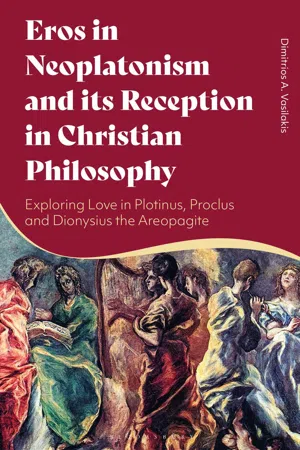
Eros in Neoplatonism and its Reception in Christian Philosophy
Exploring Love in Plotinus, Proclus and Dionysius the Areopagite
- 232 pages
- English
- ePUB (mobile friendly)
- Available on iOS & Android
eBook - ePub
Eros in Neoplatonism and its Reception in Christian Philosophy
Exploring Love in Plotinus, Proclus and Dionysius the Areopagite
About this book
Information
1
Plotinus and Enneads III.5.[50]: ‘On Love’
1.1 The ontological status of Soul’s Eros
1.1.1 Synopsis of III.5
Plotinus starts his enquiry concerning Eros,1 by posing the following question: ‘Is it a divinity (god or daimon) or is it an affection of the soul?’2 The formulation of this problem foreshadows the structure of the whole treatise; hence, III.5 can be divided into two parts. In the first section (§1) Plotinus examines Eros as affection («πάθος») of the human soul. He distinguishes three types: (a) a pure («καθαρός») eros of Beauty without any connection to bodily affairs. People having such appreciation of the beautiful in the world may, or may not, recollect the true intelligible Beauty. (b) Mixed («μικτός») eros is love which embodies the veneration of Beauty via sexual affairs, the aim of which is the generation of offspring, as a path towards immortality. It is noteworthy that for Plotinus both instances of love are legitimate, although pure Love, as more self-sufficient, is ranked higher than the mixed. (c) It is the third instance that represents a deviation, since, in this category, eros is a desire contrary to nature («παρὰ φύσιν»).3
The remaining chapters (§§2–9) constitute the second section of the treatise, the ‘theology’ of love. Plotinus has to reconcile two traditions: (a) the idea that Eros is a god, son and follower of Aphrodite, a view found not only in ‘divine’ Plato’s Phaedrus,4 but also in ‘theologians’ such as Hesiod. (b) The other fundamental text is, of course, the Symposium, in which Diotima proclaims the daimonic nature of Eros. Plotinus succeeds in combining these two notions by exploiting the distinction that Pausanias [sic] makes in the Symposium between Heavenly («Οὐρανία») and Common («Πάνδημος») Aphrodite.5 Thus, in his interpretation, Eros-god is the offspring of Heavenly Aphrodite, i.e. of the Undescended Soul, which is pure and free from the interfusion with matter6 (cf. §2), whereas Eros-daimon is descendant of the World-Soul, which is represented by Common Aphrodite(cf. §3). In other words, both of the divine instances of Eros correspond to the first section’s legitimate affections of human souls7: pure and mixed eros.
There is, however, another problem. The reconciliation of the two Platonic versions of love is not yet complete, since Plotinus has to account for the different mythical genealogies, too. Whereas according to the tradition expressed in the Phaedrus Eros is son of Aphrodite («ἐξ αὐτῆς»),8 in the Symposium he is said to be born by Poverty’s («Πενία») intercourse with Plenty («Πόρος») on the day of Aphrodite’s birth («σὺν αὐτῇ»).9 Hence, from §5 and onwards Plotinus’ comes to his main exegetical task. This part, which deals with the interpretation of the Symposium’s myth, forms the second subdivision of the general theological section. In §5 the Neoplatonist rebuts Plutarch’s cosmological interpretation of the same myth, although, interestingly enough, Plotinus himself had subscribed to a similar cosmological allegory in his earlier treatise ‘On the impassibility of things without body’.10 In §6 Plotinus relates Eros’ genealogy to a general survey on the nature of daimons. According to §7 what differentiates Eros from the rest of the daimons is that Eros is the desire for the absolute Good, whereas the others crave partial goods.11 So, after an explanation of Eros’ insatiability due to his parents’ traits, in §8 Plotinus figures out what ‘Zeus’ stands for in the myth, and in the first half of the concluding §9 the Neoplatonist elaborates on the identity of Poros with other elements of the myth. Finally, after some succinct, but crucial, methodological remarks on the interpretation of myths (and rational discourses), Plotinus gives us a synopsis of his interpretation, according to which the different mythical elements (e.g. Poros and Penia) are reduced to aspects of Soul. In that way, Plotinus completes his survey by showing the continuity of the aforementioned two parts of his erotic theology: as in the first part Soul was said to be Eros’ mother, so too in the second one, since Penia, as well as Poros, represent Soul.
1.1.2 The main issue
As can be seen from the above brief account of III.5, this treatise raises a host of interesting subjects which have preoccupied the commentators. The vindication of sexual love, the complicated psychology depicted in the two Aphrodites, Plotinus’ version of ‘daimonology’ and, most importantly, his attitude towards the interpretation of myths are only some aspects that deserve the reader’s attention. I would like, however, to focus on the most crucial issue that arises from this tractate, namely the question of the ontological status of Eros, as depicted in the ‘theological’ part of the treatise. In §2 Plotinus states that (Heavenly) Aphrodite’s, i.e. Soul’s, intellectual activity towards her progenitor, Nous,12 produced «ὑπόστασιν καὶ οὐσίαν»,13 which is none other than ‘the beautiful Eros, he who is born as an ὑπόστασις that is eternally set towards Another that is beautiful’.14 Ascribing «ὑπόστασις» and/or «οὐσία» to Eros is something frequently met in both parts of the theological section.15 This fact seems to suggest that Plotinus sees Eros as an entity in its own right, which, despite being dependent upon Soul as source of its existence, is external to Soul, just as Soul is generated but still different to Intellect (Nous). Furthermore, Plotinus ascribes these very substantives to Heavenly Aphrodite-Soul itself, calling her ‘a kind of separate ὑπόστασις, that is οὐσία not participating in matter’.16 Thus, since Heavenly Aphrodite stands for the proper ‘Hypostasis’ of Undescended Soul, it seems that Plotinus suggests that its offspring is itself a Hypostasis, although a degraded one, just as Soul, being an offspring of Nous, is an ‘ousia’, albeit inferior to Nous’ «ὄντως ὄντα».17 Indeed, in §3 Plotinus writes: ‘That Eros is an Ὑπόστασιν, however – οὐσίαν sprung ἐξ οὐσίας – there is no reason to doubt. It may be inferior to the one that produced it, but οὖσαν nevertheless.’18 Finally, in the following lines he compares Eros’ generation with Soul’s emanation from Nous.19
Do these straightforward statements suggest ‘the emergence of Eros as a separate Hypostasis’20 and ‘the incipient break-up of the “traditional” Plotinian system of hypostases into something more elaborate and scholastic’, as some commentators have suggested?21 If so, we would seem to be faced by two serious difficulties: (a) Plotinus does not seem to embrace such a ‘more elaborate’ view of reality in his remaining four treatises, written after III.5; (b) in previous treatises, Plotinus has ardently condemned any attempt to introduce more entities outside the austere ‘numerus clausus’ of the three Principal Hypostases, i.e. One, Nous, Soul.22 A relatively easy way out of this problem is to emphasize, with many commentators, that, although Plotinus uses in his writings the term ‘hypostasis’, it never has the technical meaning that was ascribed to it by Porphyry, when the latter was giving the titles to Plotinus’ treatises.23 Hence, when the term «ὑπόστασις» is used by Plotinus, it does not denote any of his three principles («ἀρχαί»), but merely ‘existence’, i.e. something that exists.24 Αn equivalent story could be said about «οὐσία». Strictly speaking, it applies to the realm of «ὄντως ὄντα», i.e. the world of Forms. However, Plotinus can speak qualifiedly about an ‘ousia’ in the physical world, as a degradation of the ‘noetic ousia’.25 In this flexible use, ‘ousia’ can have an equivalent meaning to hypostasis.26
Still, although this response saves us from the insertion of more Principal Hypostases in the Plotinian system, it leaves Eros as a substantial entity27 which is distinct from and external to Soul.28 I think on the contrary that a closer reading of III.5 gets us further than that in making Eros internal to Soul. I am going to argue that eros is the activity that constitutes Soul as a proper entity. In another formulation, eros is Soul itself, seen from the perspective of its upwards orientation. I will defend my proposal by drawing on representative passages from both theological sections of III.5, but in an inverse order, starting from the end, as Plotinus would urge us to do.
1.1.3 Eros and myth
The first passage that will concern us is in §9, the final synopsis of Plotinus’ interpretation of the Symposium-myth. To this Plotinus applies the hermeneutical principles he has laid down earlier in the same chapter; hence, I need to begin with them29:
Now myths, if they really are such, must do two things: split up temporally the things they refer to, and divide from one another many of the Entities’ aspects which, while existing as a unity, are yet distinct as regards rank and functions. After all, even reasoned discourses, like myths, on the one hand assume ‘births’ of things which are unbegotten,30 and, on the other, divide things which exist as a unity. When the myths have fulfilled their didactic function to the best of their ability, they make it possible for the perceptive learner to come to a re-integration.31
According to our Neoplatonist, two elements are present in the interpretative process. The first one is that of ‘διαιρεῖν/διαίρεσις’32 and has two aspects: a temporal and a systematic. That is, myth and rational discourse describe in a linear-temporal fashion realities that are atemporal and eternal. In fact, division into temporal parts denotes onto-logical relations. This is also what the second aspect tries to elucidate by discriminating things that are not in fact distinct from each other. Such distinctions help discursive thought to see the same reality from different points of view. The hermeneutical approach is completed by the act of ‘συναιρεῖν/συναίρεσις’33: what the mytho-logical narrations have split in terms of time and structure, the ‘synairetic’ act of the philosopher-interpreter comes to re-unify, so that we can contemplate the depicted reality in its genuine, pure and complete state, i.e. as a part of the non-discursive, atemporal realm of ὄντως ὄντα, the kingdom of Nous.34 In other words, mythical allegories and philosophical illustrations come to life in the stage of «διαίρεσις». These narrations analyse a unified reality into various kinds of parts and take place ‘for the sake of exposition (/teaching) and clarity’.35 Still, since every allegory calls for de-allegorization, the crucial hermeneutical step is that of the second level of interpretation, «συναίρεσις», where the philosophical mind brings the separated elements into their primary unity again.36 Take as an example the issue of Timaeus’ cosmogony.37 In Plato’s ‘diairesis’ which depicts the ordering of the cosmos taking place in time, due to a Demiurge who contemplates the Forms, Plotinus responds ‘synairetically’: the function of the Demiurge (efficient cause) is to be contracted/identified with that of the Forms (formal cause), while this procedure is eternal; that the cosmos has a beginning in time means only that it depends ontologically upon its intelligible pattern.
Let us see now Plotinus’ application of this methodology in the synopsis of his mythical exegesis.38 He synairetically reduces to aspects of the soul all the different elements that the myth has depicted as separated, since in the myth the events of Eros’ conception take place contemporaneously with Aphrodite’s birth. From this point of view, Πενία comes to represent Soul’s indefiniteness, a kind of psychic substrate, before it is informed by the emanated λόγοι from Nous. In an analogous way intelligible matter reverts upon the One and becomes proper Nous,39 who has been identified with Zeus in §8, contrary to Plotinus’ standard identification of it with Kronos.40 These emana...
Table of contents
- Cover
- Halftitle Page
- Title Page
- Dedication
- Epigraph
- Contents
- Acknowledgements
- Introduction
- 1 Plotinus and Enneads III.5.[50]: ‘On Love’
- 2 Proclus on the First Alcibiades
- 3 Dionysius and the Divine Names
- Epilogue
- Bibliography
- Index
- Imprint
Trusted by 375,005 students
Access to over 1.5 million titles for a fair monthly price.
Study more efficiently using our study tools.
Frequently asked questions
Yes, you can cancel anytime from the Subscription tab in your account settings on the Perlego website. Your subscription will stay active until the end of your current billing period. Learn how to cancel your subscription
No, books cannot be downloaded as external files, such as PDFs, for use outside of Perlego. However, you can download books within the Perlego app for offline reading on mobile or tablet. Learn how to download books offline
We are an online textbook subscription service, where you can get access to an entire online library for less than the price of a single book per month. With over 1.5 million books across 990+ topics, we’ve got you covered! Learn about our mission
Look out for the read-aloud symbol on your next book to see if you can listen to it. The read-aloud tool reads text aloud for you, highlighting the text as it is being read. You can pause it, speed it up and slow it down. Learn more about Read Aloud
Yes! You can use the Perlego app on both iOS and Android devices to read anytime, anywhere — even offline. Perfect for commutes or when you’re on the go.
Please note we cannot support devices running on iOS 13 and Android 7 or earlier. Learn more about using the app
Please note we cannot support devices running on iOS 13 and Android 7 or earlier. Learn more about using the app
Yes, you can access Eros in Neoplatonism and its Reception in Christian Philosophy by Dimitrios A. Vasilakis in PDF and/or ePUB format, as well as other popular books in Philosophy & Ancient & Classical Philosophy. We have over 1.5 million books available in our catalogue for you to explore.