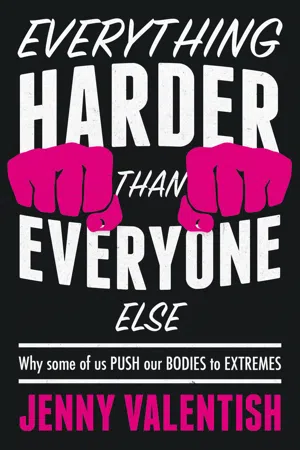
From acclaimed journalist Jenny Valentish comes a wildly entertaining venture into the psychology of extreme behaviour. We all have our limits – what are yours? It's human nature to test our limits. But what happens when this comes to define you? When Jenny Valentish wrote a memoir about addiction, she met some who treated drug-taking like an Olympic sport, forcing their bodies to the edge, enjoying the notoriety. When they got sober, the obsession just changed form: they took up marathon running, or freediving, or rock-climbing, Instagramming from mountaintops. What stayed constant was the need to push their boundaries.In this wildly compelling read, Jenny's fascination with what drives some to obsession leads her on her own compulsive journey. Speaking to those who live for the extreme, she finds a curious Venn diagram can be drawn: retired porn stars put on wrestling leotards, neuroscientists become extreme eaters; dog-tired MMA fighters roleplay BDSM. Is this need for adrenaline hard-wired, or is the sense of self so shaky that letting go of one persona requires throwing on another? And what does this mean for Jenny's new obsession?From abstinence to ego, mastery to addiction, rage to reinvention, our compulsions are intertwined with our personas. Darkly funny and vividly penetrating, Everything Harder Than Everyone Else explores our deeper selves and asks: what are your limits?
eBook - ePub
Everything Harder Than Everyone Else
Why Some of Us Push Our Bodies to Extremes
- 272 pages
- English
- ePUB (mobile friendly)
- Available on iOS & Android
eBook - ePub
About this book
Information
Chapter One
DON’T KNOW WHEN TO STOP
Endurance Athletes
CHARLIE ENGLE WAS eleven years old when he swung himself into a boxcar on a moving freight train, having tired of stacking pennies on the rails. He landed hard on his stomach, then rolled onto his back, his senses assaulted by the smell of urine.
After five or so minutes of trundling through the suburbs, the adrenaline rush wore off. Empty boxcars, as it turned out, were boring. Still, there would be another rush when it came time to dare to leap onto the blurry ground beyond the wheels, and then make the two-hour run home through unfamiliar terrain.
So began a life of running that no destination could ever satisfy.
Charlie, an ultrarunner two years shy of his sixtieth birthday, says something early in our conversation about validation that I wind up repeating to everyone I interview after him, to see if they nod in recognition. They generally do. We’re talking about his crack-addiction years, before he pledged his life to endurance races – the six-day benders in which he’d wind up in strange motel rooms with well-appointed women from bad neighbourhoods, and smoke until he came to with his wallet missing.
‘Part of ultrarunning is a desire to be different,’ he says. ‘And for the drug addict, too, there is a deep need to separate ourselves from the crowd. It sounds crazy to say this, but street people would tell me, “You could smoke more crack than anybody I’ve ever seen,” and there was a weird, “Yeah, that’s right!” There’s still a part of me that wants to be validated through doing things that other people can’t.’
When we speak, Charlie – a deeply affable chap – is bustling around his kitchen in Raleigh, North Carolina, reheating his coffee. It’s a fair guess to say he’s the sort of guy who’d have to reheat his coffee a lot. He’s in planning mode for what will be an epic mission even by his standards: the 5.8 Global Adventure Series. The idea is to be the first athlete to run from the lowest land point to the highest summit on every continent, and it’s so named because the lowest place on Earth, the shore of the Dead Sea, is 5.8 vertical miles from the highest peak, Mount Everest. His first stop is Africa, to trek from the depths of Lake Assal in Djibouti to the peak of Mount Kilimanjaro in Tanzania.
Charlie has already completed some of the world’s most inhospitable adventure races. He’s been chased by crocodiles, hung off a cliff tangled in climbing ropes and had a tarantula squat in his sleeping bag – although none of that comes close to the actual running component in terms of endurance. Matt Damon was the executive producer and narrator of a documentary about Charlie, Running the Sahara, and he’s been profiled in countless media stories. If his biggest fear is being ‘average, at best’, then he’s moving mountains to avoid it.
It helps that he’s goal-oriented in the extreme. In fact, you might call him a high achiever. Even in his drug-bingeing years, which culminated in his car being shot at by dealers, Charlie was the top salesman at the fitness club where he worked. At fifty-six, he ran twenty-seven hours straight to celebrate his twenty-seven years of sobriety.
About a decade earlier, when he did time for mortgage fraud for filing an inaccurate stated-income loan under the alleged guidance of his broker (which, as a columnist in The New York Times sympathised, was something millions of Americans were doing), he immersed himself in Jack London’s The Star Rover (1915), a story of an imprisoned professor who is further punished by being made to wear a constraining jacket, and so escapes mentally by going into a trance state and walking among the stars.
Charlie’s version of this was to recreate the infamous Bad-water Ultramarathon, held annually in California, inside the jail. Badwater is described as the world’s toughest footrace, as contestants run in the summer heat from Badwater Basin, the lowest point in North America, to the trailhead to Mount Whitney, the highest point in the continental United States. Competitors’ shoes have melted while running it, and only 932 people have ever finished. To mimic this, Charlie ran 135 miles on the jailhouse exercise track, mentally picturing the landmarks of the course, such as the waystation Stovepipe Wells and Mount Whitney. ‘You don’t belong in prison,’ said an inmate called Butterbean, who’d watched him go around and around and around, 540 times. ‘You belong in a fucking insane asylum.’
Perhaps belonging – or, more accurately, not belonging – is a key to Charlie’s story. When he was a kid, his parents divorced. So far, so ordinary. But his parents were very different cats, whose conflicting ideas of child-rearing brought out particular traits in their son. Living with his free-spirited mother, who threw wild parties and was immersed in the local theatre scene, meant having to be self-sufficient and to expect the unexpected. Moving on to live with his exacting and athletic father, in whose eyes he could never do anything right (and in any case, praise was for sissies), Charlie adopted that critical voice as his own.
When he began using drugs – before he’d even hit his teens – he temporarily found something to distract himself from his antsiness, which he likens to squirrels in the brain. It doesn’t take much prompting for Charlie to draw parallels between drug use and running – in fact, the tagline of his website is ‘I’m an addict who runs and I’m a runner who writes’. He says he’s noticed a certain restlessness common to endurance athletes that comes from a fear of missing out, which might work in a similar way to chasing a high. If there’s a race he doesn’t take part in, he tortures himself that it was surely the best ever. He took control of this fear by starting to plan his own expeditions, which couldn’t be topped.
‘And hey, I freely admit there’s ego involved,’ he says. ‘There’s now a weird normalisation of running marathons – there’s always somebody’s grandmother who’s done it – so I remember when I started running ultras that I definitely dug telling people, “Oh yeah, I’m getting ready to run a seven-day race across the Atacama Desert.” That can’t be anything but ego. It doesn’t necessarily mean bad ego; it just says “I don’t want to be normal”.’
Even before he quit drugs and alcohol, Charlie Engle ran. He ran to prove to himself he could. He ran to shake off the day. He ran as a punishment of sorts. In fact, he says, he craved depletion. ‘Running was a convenient and reliable way to purge. I felt badly about my behaviour, even if very often my behaviour didn’t technically hurt anybody else. It wasn’t like I was coming into the house and doing crazy stuff. I was a disappearer, so I would just go away for a while and then come back.’
Which he still does, for months at a time, but for expeditions rather than benders. ‘Yeah, well, that’s true.’
Charlie’s first wife, Pam – with whom he had two children – only saw a fraction of his blowouts, but his sudden, days-long disappearances indicated the depth of his dependence. Once he got sober and started going to Alcoholics Anonymous meetings, his races interstate and overseas became more frequent, so that he was absent for even longer spells. His second wife, Astacianna, who is a wildlife biologist and an athlete, is often a crew member on his races.
A common hypothesis is that former drug users who hurl themselves into sport are simply trading one addiction for another. Maybe so – both behaviours are goal-oriented and activate the same reward pathways, and when a person gives up one dopaminergic behaviour, such as taking drugs, they are likely to seek the same sense of stimulation elsewhere. In the clinical field, it’s known as ‘cross-addiction’. But plenty of people achieve both in tandem, grimly determined to prove they have their drug use under control by forcing their bodies through their paces. In fact, Charlie did his first marathon wasted.
Whether they have a history with the sport or not, marathon running – and particularly ultramarathon running, which means a distance of at least 42.2 kilometres – seems to be a prevalent pursuit for that incredibly driven breed of drug user. High-wire memoirs about this lifestyle swap include Charlie’s Running Man (2016), Rich Roll’s Finding Ultra (2012), Catra Corbett’s Reborn on the Run (2018) and Caleb Daniloff’s Running Ransom Road (2012). Perhaps it’s the singularity of the experience: the solitary pursuit of a goal, the intoxicating feeling of being an outlier, the meditative quality of the rhythmic movement, the adrenaline rush of triumph; and on the flipside, the self-flagellation that might last as long as a three-day bender. Running such long distances can result in macerated feet, blisters, muscle cramps, gastrointestinal upset, respiratory distress, stress fractures, hyponatremia and hypothermia, and even rhabdomyolysis – a breakdown of muscle tissue that can lead to renal failure, also associated with CrossFit training. The risks are not entirely dissimilar to those of the prolific drug user: the long-term effects can shorten the lifespan, and there have also been plenty of fatalities mid-race. It makes me wonder, where does hedonism end and endurance begin?
This sling-shotting into a new identity can be intoxicating in itself. In their memoirs, both coincidentally titled The Long Run, Australian journalist Catriona Menzies-Pike and American writer Mishka Shubaly describe having once scoffed at morning joggers as they themselves staggered home curly after a bender.
‘Becoming a runner was so antithetical to my idea of who I was,’ Catriona tells me. After a decade of grief over the death of her parents in a plane crash, she gave up gin in favour of becoming ‘speedy gristle’, and would eventually run five marathons. But in the early stages of her transition, her enthusiasm reminds me of an adage my mother would use, ‘somebody’s eyes are bigger than their stomach’. The persona was forming faster than the athletic ability, illustrated by all the sportswear newsletters she subscribed to in a heady rush. She was now officially a Runner – the marketing departments of Nike and ASIS recognised her as such.
‘Trying that new person on made me feel really gleeful,’ she confesses. ‘As a way of social interaction, I found the novelty was delightful. Even now, if I run into people that I haven’t seen for ten years and tell them I wrote a book about running marathons, I watch their surprise register and it gives me a real kick.’
As a former anarcho-boozehound-come-musician, Mishka’s lyrics include ‘I’m never gonna quit until the day that I die / I’ll be snorting fat lines of vodka, eating a big cocaine pie.’ He admits that the question of whether abandoning substances for the healthy high is ‘selling out’ is something he’s devoted far too much time to in his head. ‘Here’s the thing: selling out is real and it’s shitty … but almost every single factor we use to evaluate whether we’re selling out or not is an illusion,’ he tells me. ‘It’s a hard life being a penniless drunk raging against the status quo; it’s also a hard life being a parent in the suburbs, getting up early and trying to get a run in before the job you battle through in order to pay your mortgage to provide a home for your family.’
A sometime comedian as well as a musician, he had built his entire identity around being what he calls an alcoholic burnout. ‘And when I stopped drinking, I felt the person I had been was entirely erased. Or worse – only the bad shit remained, my rages and my depression and my weakness and my poor impulse control and my shitty reputation,’ he says. ‘The further along I get in my sobriety, the more I see that’s not quite accurate. It’s more like a cheap, dangerous, illegal apartment building was erected on top of a historical structure, and as I tore the crap away, I kept finding pillars that were still incredibly strong or just needed some shoring up, and occasionally artefacts of great value.’
Mishka recognises garden-variety runners – let’s say people who log five kilometres four times a week – as being balanced individuals making good, healthy decisions, but ultrarunners … now, they’re a different breed. ‘Whenever I was lining up at five in the morning with these other maniacs, I would look around and wonder, “What secret shame is fuelling this for you?”’ he says. ‘Every once in a while, I would encounter someone who just came to ultrarunning for sheer love of running and that blows my mind, even creeps me out. It’s like … we’re all here because we’re addicts or alcoholics or survivors of eating disorders or molestation or cancer, but if you’re just out here for kicks … man, then you are really messed up.’
THESE DAYS, CHARLIE goes to AA meetings very occasionally, but it’s more for the fellowship aspect than as a white-knuckle need to stay sober. When he first quit drugs and alcohol, he felt like taking a knife and surgically removing the addict, so strong was his rejection of that part of his identity. It took three years to figure out that the ‘addict self’ had plenty to offer: tenacity, ingenuity, problem-solving, stamina and that restless drive, forever in search of satisfaction. Perfect for the all-or-nothing world of extreme-long-distance running.
‘I get a lot of questions from people who’ve read the book and they want running to be the answer,’ he says. ‘There is no one answer. For me, it took both. I needed the AA community and I needed the physical release of running and the burning off of extra fuel. I am that guy with a ball for every space on the roulette wheel. When I start running, all the balls are bouncing and spinning and making that chaotic clattering noise. Somewhere three or four miles into the run, they all find their slot. I always carry a recorder – either just my phone or something else – when I’m running because, for real, my best ideas float to the top.’
For Charlie, part of the attraction of entering races, just as with taking drugs, is the pursuit of novelty and the chasing of firsts, even though he knows by now that the intensity of that initial high can never be replicated. That explains why he takes such pleasure in the planning of his expeditions. ‘The absolute best I ever felt in relation to drugs was actually the acquisition of the drug,’ he says. ‘There’s nothing more powerful than having the drugs in my pocket; the idea of what it can be. Once the binge starts, it’s all downhill from there. But the idea of what it can be is huge. In a way, running is the same because there’s this weird idea that you’re going to enter a hundred-miler and this time it’s going to be different. This time it’s not gonna hurt so much, and everything’s going to be perfect.’
It’s like the old adage, often heard in AA, that the definition of insanity is doing the same thing over and over again and expecting a different outcome. Haruki Murakami, in his book What I Talk About When I Talk About Running (2007), explains his thought processes in the period after an epic race is run, with all the agony that entails. ‘I forget all the pain and misery and am already planning how I can run an even better time in the next race,’ he writes. ‘The funny thing is, no matter how much experience I have under my belt, no matter how old I get, it’s all just a repeat of what came before.’
My own aversion to running far outweighs any penance I might feel it necessary to pay, though I’ll happily endure other forms of exercise. With weights, you exert yourself for a short period and can count down the reps till you get to stop. With combat sports, you smash through stray thoughts before they have time to take root. The problem with running is there’s no escaping the monotony. You can’t outrun the infernal looping of your mind. In fact, circular breathing becomes a backing track, a form of percussion for your horrible mantras, whether they are as blandly tedious as, You could stop. You could stop. You could stop or something more castigating. No wonder runners’ bodies look like anxiety made flesh. No wonder their eyes have the jittery look of whippets.
Charlie hears the ‘I hate running’ sentiment all the time. ‘I myself don’t like it as much as you think I might,’ he says. ‘It’s the results of running I like. It’s the stopping – because that’s when the endorphin release comes.’
The endorphin release is more colloquially known as a ‘runner’s high’. Some researchers think there’s also a boost in anandamide, an endocannabinoid that scientists Lumír Hanuš and William Devane, who discovered it in the human brain in 1992, named for the Sanskrit word ananda, meaning ‘bliss’. And there’s the serotonin, which might be what calms Charlie’s squirrels somewhat.
Perhaps this heady cocktail evokes the kind of purifying experience more commonly described in episodes of religious transcendence. Actually, the world’s longest footrace is called the Self-Transcendence 3100 Mile Race, founded by Indian spiritualist and long-distance runner Sri Chinmoy. He believed that athletic accomplishment could lead to deeper meditative consciousness and spiritual growth. Chinmoy wrote, in what the Sri Chimnoy Library claims was his 1565th book: ‘These long-distance races remind me of our Eternity’s race. Along Eternity’s Shore we are running, running, running. We are running and running with our birthless and deathless hopes. We are running and running with the ever-transcending Beyond.’
Cruelly, the Self-Transcendence Race demands that participants run 5649 laps around a single New York City block. But Episcopal priest Christian Hawley wrote in Trail Runner magazine that connecting with nature through running is key – a revelation he had when he studied Buddhism in Nepal for a summer and witnessed Tibetan monks reading sacred texts in caves and scaling mountains to offer prayers. ‘We need to feel small,’ he wrote. ‘We need to recognise we are part of something grander, and bridge the ever widening gap between a vague spirituality focused on the self, and Bible idolatry obsessed with a calcified point-of-view.’ He describes one of his own trail runs: ‘The creation story plays out in real time before me as the sun casts hues of burns and bruises, millions of years flashing by in the exposed faces of the mountains.’ As he admits, he was saturated with endorphins.
When writer Adharanand Finn travelled to Japan to meet the monks of Mount Hiei, some of whom run a thousand marathons in a thousand days as part of their quest for enlightenment, a priest at the temple tells him that the idea behind the constant movement is to exhaust the mind and the body until nothing is left. ‘When you are nothing, then something, pop, comes up to fill the space,’ he says. This ‘something’ is the vast consciousness that lies below the surface of our lives. A sense of oneness with the universe.
Catriona Menzies-Pike explores this link between endurance and reb...
Table of contents
- Cover Page
- Title Page
- Copyright
- Contents
- Introduction
- 1. Don’t Know When to Stop: Endurance Athletes
- 2. Tasting the Limits: Performance Artists and Rogue Scientists
- 3. Bringing Order to Chaos: Bodybuilders
- 4. Engaging in Edgeplay: BDSM
- 5. Levelling Up: Belts and Iron
- 6. This Is Hardcore: Porn Stars
- 7. The Art of Suffering: Wrestlers
- 8. Anger Is an Energy: Fighters
- 9. The First Death: Retirement and Reinvention
- Acknowledgements
- Back Cover
Trusted by 375,005 students
Access to over 1.5 million titles for a fair monthly price.
Study more efficiently using our study tools.
Frequently asked questions
Yes, you can cancel anytime from the Subscription tab in your account settings on the Perlego website. Your subscription will stay active until the end of your current billing period. Learn how to cancel your subscription
No, books cannot be downloaded as external files, such as PDFs, for use outside of Perlego. However, you can download books within the Perlego app for offline reading on mobile or tablet. Learn how to download books offline
Perlego offers two plans: Essential and Complete
- Essential is ideal for learners and professionals who enjoy exploring a wide range of subjects. Access the Essential Library with 800,000+ trusted titles and best-sellers across business, personal growth, and the humanities. Includes unlimited reading time and Standard Read Aloud voice.
- Complete: Perfect for advanced learners and researchers needing full, unrestricted access. Unlock 1.5M+ books across hundreds of subjects, including academic and specialized titles. The Complete Plan also includes advanced features like Premium Read Aloud and Research Assistant.
We are an online textbook subscription service, where you can get access to an entire online library for less than the price of a single book per month. With over 1.5 million books across 990+ topics, we’ve got you covered! Learn about our mission
Look out for the read-aloud symbol on your next book to see if you can listen to it. The read-aloud tool reads text aloud for you, highlighting the text as it is being read. You can pause it, speed it up and slow it down. Learn more about Read Aloud
Yes! You can use the Perlego app on both iOS and Android devices to read anytime, anywhere — even offline. Perfect for commutes or when you’re on the go.
Please note we cannot support devices running on iOS 13 and Android 7 or earlier. Learn more about using the app
Please note we cannot support devices running on iOS 13 and Android 7 or earlier. Learn more about using the app
Yes, you can access Everything Harder Than Everyone Else by Jenny Valentish in PDF and/or ePUB format, as well as other popular books in Social Sciences & Cultural & Social Anthropology. We have over 1.5 million books available in our catalogue for you to explore.