This edited collection gives voice to neglected public intellectuals in the arts, humanities, and journalism in South Africa who gave voice and presence to those who have been marginalized and silenced in South African history
Edward Said described a public intellectual as someone who uses accessible language to address a designated public on matters of social and political significance. The essays in Public Intellectuals in South Africa apply this interpretive prism and activist principle to a South African context and tell the stories of well-known figures as well as some that have been mostly forgotten. They include Magema Fuze, John Dube, Aggrey Klaaste, Mewa Ramgobin and Koos Roets, alongside marginalized figures such as Elijah Makiwane, Mandisi Sindo, William Pretorius and Dr Thomas Duncan Greenlees.
The essays capture the thoughts and opinions of these historical figures, who the contributors argue are public intellectuals who spoke out against the corruption of power, promoted a progressive politics that challenged the colonial project and its legacies, and encouraged a sustained dissent of the political status quo. Offering fascinating accounts of the life and work of these writers, critics and activists across a range of historical contexts and disciplines, from journalism and arts criticism to history and politics, it enriches the historical record of South African public intellectual life.
This volume makes a significant contribution to ongoing debates about the value of research in the arts and humanities, and what constitutes public intellectualism in South Africa.
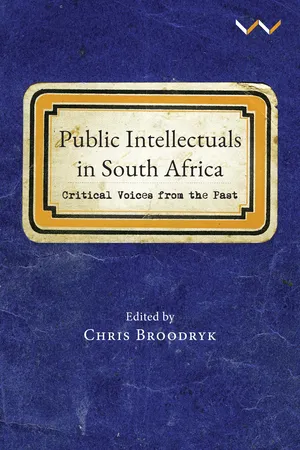
eBook - ePub
Public Intellectuals in South Africa
Critical voices from the past
- 272 pages
- English
- ePUB (mobile friendly)
- Available on iOS & Android
eBook - ePub
Public Intellectuals in South Africa
Critical voices from the past
About this book
Information
Subtopic
African HistoryIndex
Social SciencesCHAPTER
1
Recalibrating the Deep History of Intellectual Thought in the KwaZulu-Natal Region
Carolyn Hamilton
In the literature that deals with public intellectual activity in South Africa there is a tacit understanding that one of its defining features is sustained reading and writing.1 The literature shares this feature with European understandings of public intellectual activity and has not, to my knowledge, actively considered the possibility of intellectual life in settings without writing. There is further implicit agreement that ‘public’ in the phrase ‘public intellectual’ refers to the public of the ‘public sphere’, one of the social imaginaries of a modern democracy. It is the public called into being by the wide circulation of printed texts, the public that must read, consider and debate its options and make political choices then realised through the ballot box.2
In South Africa these assumptions about public intellectualism combine with deeply entrenched ideas about pre-colonial societies as practising timeless tribal culture and relaying oral traditions, the combination thereby precluding any exploration of pre-colonial intellectual currents and activities. These combined assumptions foreclose any investigation of how intellectual engagements in oral forms sought to persuade people and to shape political futures, both deep within the eras before colonialism and persisting into the colonial era. They obscure how such modes of debate and discussion overlapped and intersected with early literate forms of public intellectual activity.
This chapter challenges the assumptions that position thinkers of the nineteenth and early twentieth centuries, who expressed their ideas orally and who did not write, as atavistic relayers of oral tradition, and their literate counterparts – often their very own kin – as modern thinkers engaged in public intellectual life. Members of both seemingly distinct categories, I argue, were deeply cognisant of the immense changes of their times and both attempted to reconcile the past with the present. People in both categories were critically concerned with the navigation of change and the nature of the brokering of the past into the present that each saw as necessary to navigate that change. This involved drawing on banks of inherited knowledge, reconciling the old with the new, testing ideas and deliberating in multiple settings.
The chapter shows that deliberative activity of this kind was also a feature of life before colonialism. Such activity shows up in the historical record wherever significant change had to be navigated. For too long, colonialism and literacy have been allowed to constitute the effective beginning of South African history, with any earlier cognitive activity consigned to ‘tradition’. Where what went before is historicised at all, it is, at best, only ever a background chapter to the rest of history, or situated in the field of archaeology, which draws heavily on ethnographies from later eras to interpret its findings.3 However, it is more than possible to begin to undertake research into political praxis in the eras before colonialism and to follow currents of political thought changing in response to changing circumstances within the pre-colonial world and across the pre-colonial/colonial divide. It is indeed possible to watch ideas travel across oral forms, from oral forms into written ones, and into ones with the oral and written inextricably entangled. To accomplish this, the pervasive distinction between literate, modern, hybrid and synthesising intellectuals and illiterate, authentic tribal informants relaying handed-down tradition requires robust interrogation.
In the rest of this chapter I attempt such an interrogation in relation to one region of southern Africa – KwaZulu-Natal – where sufficient research already exists to make it possible to pursue these issues across the pre-colonial/colonial temporal boundary. Furthermore, the era immediately before colonialism saw the rapid rise of new power in this area, the kingdom under Shaka (c.1816–28). Shaka’s reign was short-lived and ended with a palace coup that saw a dramatic shift of power away from his closest allies, to supporters of the new incumbent, his brother, Dingane. These changes and realignments in the late independent era required political and intellectual agility, which has left discernible traces in the historical record that allow us to research how change was navigated in the late independent period and across the pre-colonial/colonial divide.
My interrogation proceeds in four steps. First, I consider the now substantial scholarly work on two prominent intellectuals, Magema Magwaza Fuze and John Langalibalele Dube. Their writings in isiZulu in the late nineteenth and early twentieth centuries made use of existing, and presumably long-standing, concepts – about, among other things, the nature of rule, government and nation, as well as gender roles – to discuss how things were in the past, as well as to discuss present changes and to imagine new futures. My aim is to highlight the extent to which their use of such concepts was rooted in earlier, pre-colonial currents of political thought and in inherited conceptual language that they were able to invoke, or where necessary, to refurbish to meet new needs.
Second, I consider a range of other places where such discussions were going on, also in isiZulu, about the same and related topics, but which happened orally and were written down by people other than those doing the speaking. The point of this is to register the existence of a wide and rich discursive environment in which isiZulu speakers were deliberating about the key questions of the day and, like the literate intellectuals, were exploring a variety of ways of brokering the past into the present, but doing so orally. These points are not well established in the relevant literature.
Third, I set out an argument for recognising that what these speakers offered was not relayed, formulaic oral tradition, but thoughtful disquisitions on the past. These sometimes engaged with the past in its own right, but in many instances, the past was drawn on for the intellectual resources and insights it offered for navigating contemporary changes and envisaging the future.
The final step in my argument is to show that both the written and oral political discourses, and the intellectual activity that they involved, which drew thoughtfully on the past, were not new features in the region in the late nineteenth century. There are clear indications of similar debates and forms of brokering of the past into the present in the eras before colonialism, especially in circumstances of dramatic political changes.
THE WRITINGS OF THE MODERN INTELLECTUALS
There is now considerable scholarly work on early black intellectuals writing in both isiZulu and English, which offers rich insights into the multiple ways in which they navigated the enormous changes that came with colonialism.
Hlonipha Mokoena’s study of Magema Fuze offers a detailed examination of the thinking and writing of one of the earliest writerly intellectuals of the region.4 From the late 1860s Fuze played an increasingly important role in the complex intersecting spheres of royal Zulu, local chiefly and colonial politics.5 This entailed missions to the Zulu king, writing and printing political commentary, involvement in the trials of Zulu leaders and even joining King Dinuzulu in exile on the island of Saint Helena in 1896. While Fuze was distinctively a product of a mission education, he operated in close proximity to Zulu royalty over a long period and during his sojourn on Saint Helena he developed a cosmopolitan and pan-African consciousness. Central to his work across some 50 years was an extended engagement with questions of sovereignty, the rights, responsibilities and reach of king-and chiefship, and how their forms in previous eras would be reconfigured under colonialism.6
Diverse political and intellectual networks shaped his thought and writing, much of it expressed in isiZulu, in letters, articles in the British and local press (Macmillan’s Magazine, Ipepa lo Hlanga, Inkanyiso and Ilanga lase Natal) and in his 1922 book on the history and origins of the black inhabitants of the region, Abantu Abamnyama Lapa Bavela Ngakona.7 Mokoena argues that the picture of his thinking and writing that emerges is of a bricoleur, combining strands of thought drawn from diverse places – Christian, indigenous, Darwinian, scientific – and employing a collage of ideas and arguments, in which the history of the region loomed large.8 Not only did he have much to say about the nature of the Zulu kingship and questions of sovereignty, he also tackled numerous other aspects of what has been termed ‘custom’, including its misappropriations under colonialism, and did so in a manner that fostered a knowledge and appreciation of the past.9 As Mokoena puts it, the Christianised educated elite, or amakholwa, were paradoxically ‘champions of modernity’s enlightenment, while at the same time rejecting its colonial form’. Her argument is that the rejection took the form of a reach into the past: ‘Fuze's notion of history as discourse was based on the assumption that reviving the past was the first step in the construction of Africanist knowledge.’10
By the 1890s a new generation of young literate intellectuals was making their presence felt in Natal, including John Langalibalele Dube, who was to become a leading figure. Dube is probably best known as the founding president of the African National Congress, but arguably his greatest legacy lies in the dynamism he brought into African intellectual life. He was responsible for the establishment of Ohlange, which was to become the leading school for Africans in the region, and in 1903 he began publishing the newspaper Ilanga lase Natal, which engaged with the pressing debates of the day about, among other things, citizenship, discrimination and government policies. Heather Hughes’s biography of Dube tracks his life and work in detail.11
Dube was the author of a number of historical texts, ranging from his 1890 pamphlet published in English in the United States, ‘A Talk upon My Native Land’ (which included discussion of the rise of Shaka and the massacre of the Qadi people under Shaka’s successor, Dingane), to what is most often referred to as the first novel in isiZulu, set in the reign of Shaka, Insila kaShaka, published in 1930. He was a writer of letters to prominent people, including the Zulu king, and to newspapers, such as Inkanyiso and the Missionary Review of the World. He also solicited letters and opinion for his newspaper. As editor of Ilanga, he would have had a significant say in what was reported in the paper – such as the trials of the rebels involved in the anti-poll tax uprising of 1906 and the subsequent trial of the then Zulu king, Dinuzulu.
More squarely still than Fuze, Dube was a thoroughly modern figure, but he too operated across the full spectrum of Natal politics. It was a field shaped by the concerns of not only the educated intelligentsia whose interests Dube promoted, but also Zulu royals, local chiefs (including kholwa chiefs), missionaries, governors and native administrators, large-and small-scale farmers and many others. As in Fuze’s work, historical consciousness was a locus of his critique of the particular form that colonial modernity took. Like Fuze, Dube was active in navigating the enormous changes of the time, engaging with pressing questions, and brokering the past into the present. The bricolage and cobbling from multiple sources that a scholar like Mokoena sees as a distinctive feature of Fuze’s 1922 book, were also present in Dube’s writing. We can see him reaching in many places into the world of so-called tradition and, indeed, late in life, in 1936, he even became a founding member of the rather arcane Zulu Society, which focused on preserving Zulu heritage and customs.
Fuze and Dube had plenty of reasons to reflect on and discuss the nature of the Zulu kingship and the nature of colonial government. The early decades of the twentieth century saw the rise of a form of nationalism centred on the Zulu kingship. Such nationalist impulses affected the various ways in which thinkers and writers like Fuze and Dube interacted with the Zulu royal house and engaged with the long history of the region.12 That new nationali...
Table of contents
- Cover
- Halftitle
- Title Page
- Copyright
- CONTENTS
- ACKNOWLEDGEMENTS
- INTRODUCTION The Prismatic Nature of Public Intellectualism
- CHAPTER 1 Recalibrating the Deep History of Intellectual Thought in the KwaZulu-Natal Region
- CHAPTER 2 Elijah Makiwane and Early Black South African Public Intellectualism
- CHAPTER 3 Black Art Criticism in The Bantu World during the 1930s
- CHAPTER 4 In Conversation with the Nation: Sowetan’s Maverick Editor Aggrey Klaaste
- CHAPTER 5 William Pretorius and the Public Intellectualism of the Film Critic
- CHAPTER 6 Cultural Policy and the Arts: Mewa Ramgobin and Public Dialogue
- CHAPTER 7 ‘Kaalgat Critique’: The Public Intellectualism of Koos Roets as Afrikaans Satirist
- CHAPTER 8 The Public Intellectualism of Artivist Mandisi Sindo
- CHAPTER 9 The Janus-Faced Public Intellectual: Dr Thomas Duncan Greenlees at the Institute for Imbecile Children, 1895–1907
- CONTRIBUTORS
- INDEX
Trusted by 375,005 students
Access to over 1.5 million titles for a fair monthly price.
Study more efficiently using our study tools.
Frequently asked questions
Yes, you can cancel anytime from the Subscription tab in your account settings on the Perlego website. Your subscription will stay active until the end of your current billing period. Learn how to cancel your subscription
No, books cannot be downloaded as external files, such as PDFs, for use outside of Perlego. However, you can download books within the Perlego app for offline reading on mobile or tablet. Learn how to download books offline
Perlego offers two plans: Essential and Complete
- Essential is ideal for learners and professionals who enjoy exploring a wide range of subjects. Access the Essential Library with 800,000+ trusted titles and best-sellers across business, personal growth, and the humanities. Includes unlimited reading time and Standard Read Aloud voice.
- Complete: Perfect for advanced learners and researchers needing full, unrestricted access. Unlock 1.5M+ books across hundreds of subjects, including academic and specialized titles. The Complete Plan also includes advanced features like Premium Read Aloud and Research Assistant.
We are an online textbook subscription service, where you can get access to an entire online library for less than the price of a single book per month. With over 1.5 million books across 990+ topics, we’ve got you covered! Learn about our mission
Look out for the read-aloud symbol on your next book to see if you can listen to it. The read-aloud tool reads text aloud for you, highlighting the text as it is being read. You can pause it, speed it up and slow it down. Learn more about Read Aloud
Yes! You can use the Perlego app on both iOS and Android devices to read anytime, anywhere — even offline. Perfect for commutes or when you’re on the go.
Please note we cannot support devices running on iOS 13 and Android 7 or earlier. Learn more about using the app
Please note we cannot support devices running on iOS 13 and Android 7 or earlier. Learn more about using the app
Yes, you can access Public Intellectuals in South Africa by Chris Broodryk,Katlego Chale,Luvuyo Mthimkhulu Dondolo,Rory du Plessis,Carolyn Hamilton,Anna-Marie Jansen van Vuuren,Pfunzo Sidogi,Keyan Tomaselli, Chris Broodryk,Lesley Cowling, Lesley Cowling in PDF and/or ePUB format, as well as other popular books in Social Sciences & African History. We have over 1.5 million books available in our catalogue for you to explore.