CHAPTER 1
Philomena and the Erotics of Privilege in the Middle Ages
Darkling I listen; and, for many a time I have been half in love with easeful Death
—Keats, Ode to a Nightingale
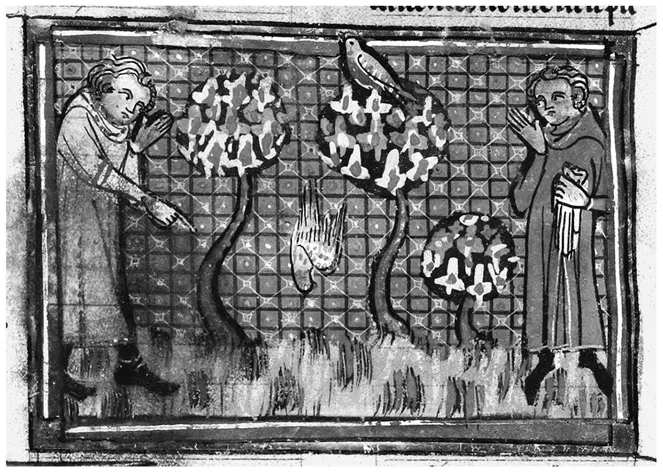
The Romance of the Rose, widely regarded as the most encyclopedic treatise on medieval love, in which “l’art d’aimer est toute enclose,” opens with a dreamer who is often illuminated in a sumptuous bed surrounded by birds, specifically nightingales, and devolves into a tale of violent desires. What would medieval people have seen in these nightingales, a visual addition totally absent from the text and its complex discussion of the relation between love, desire, and power? What would they have understood by the nightingale’s warbles in so many other medieval texts about desire, from Marie de France’s Laüstic to the plaints of the troubadours? Did they hear what Homer constructed as a hymn of sorrow in his Odyssey, what Shakespeare called a “mournful hymn?”1 Or, what, even later, Keats would interpret as death’s call to poetic inspiration? Did they feel gratitude at the beautiful, commemorative song, as Christine de Pizan suggests in the fourteenth century?2 Annoyance at the nocturnal disruption? Did they, as the miniatures from many a medieval bestiary would suggest, associate the nightingale with a fatal contest, a bird whose pleasure in singing led inevitably to its death in the throes of song, as in figure 1.1?3
FIGURE 1.1 Nightingale sings competitively to its death (BNF Fr. 15213, fol. 61v, Faune)
Or would a separate shiver have gone down their spine, a frisson of fear for their own daughters’ well-being as they recalled the association between the bird and the transmogrified, tongueless screams of Philomela, in the Ovidian tradition? Did the nightingale’s midnight trill, lauded by lovers such as Tristan and Yseut, spur them on with twinges of the erotic?4 Was it a song both hauntingly revolting and shamefully titillating? A song of death sung in the midnight moment of love?
So often are nightingales present in scenes of tragedy that Aara Suksi has asked, “What are these nightingales, so markedly featured, doing?”5 Com peting responses seem to pit love against death, as one school hears the nightingale’s sweet melodies and thinks of lovers’ trysts (as in the Occitan tradition),6 while the other hears a mournful lament and associates it with death and destruction (as in Marie de France). As Sarah Kay has pointed out, in Occitan poetry, it is a bird associated with lyrical productivity and creativity.7 And, according to Bruce Holsinger, in a religious context, it is most often associated with liminality, a bird able to “negotiate the boundary between life and death.”8 Perhaps the polyphony of the nightingales’ voices points away from the need to dichotomize and instead toward a complex and multilayered poetics of both death and desire.
In this chapter, I read the nightingale’s polyvalency as a fruitful way to approach the thematization of desire through suffering, as the nightingale highlights the interconnectivity of two seemingly dichotomous emotions—love and grief—as a way of exploring how emotional exceptionalism constructs stories of noble power. Here, I focus on Chrétien de Troyes’s twelfth-century Old French Philomena, a retelling of an Ovidian story of the nightingale that explains the eponymous protagonist’s transmogrification and metamorphosis and that offers a mythicized etymology of the Old French word philomèle. Philomena, I argue, offers an early test case for an erotics of grief developed more extensively in later romances, and it investigates the relation between the performance of elite emotions and the construction of noble power. In this chapter, I read the valences of love and desire, grief and death that enshroud the nightingale as synecdochal of the complex emotional community of privilege within romance.
The Lovers’ Lament: A Mediterranean Song of Death
Whether interpreted as desire or despair, the cry of the nightingale has a long and haunted Mediterranean history.9 Early naturalists focused on the nightingale’s diurnal rhythms as well as its noteworthy song. For Hesiod, the nightingale’s melody is poetry, whereas for Sappho, the nightingale is a “lovely-voiced . . . messenger of Spring.”10 Antigone calls out to the nightingale to be her companion in an endless life of tears.11 Later, in his Natural History, Pliny the Elder writes of nightingales’ association with excess and death: “They vie with one another, and the spirit with which they contend is evident to all. The one that is vanquished, often dies in the contest, and will rather yield its life than its song.”12 In his eight-century Etymologies, Isidore of Seville accentuates the bird’s etymological underpinnings as the giver of light, luscinia.13 Hugh of Fouilloy builds off of Isidore in his medieval Aviarium, contained in the Aberdeen Bestiary (MS 24, fol. 52v–53r), where he draws a comparison between its lighthearted, incessant singing and the sustaining qualities of exemplary motherhood:
It is an ever-watchful sentinel, warming its eggs in a hollow of its body, relieving the sleepless effort of the long night with the sweetness of its song. It seems to me that the main aim of the bird is to hatch its eggs and give life to its young with sweet music no less than with the warmth of its body. The poor but modest mother, her arm dragging the millstone around, that her children may not lack bread, imitates the nightingale, easing the misery of her poverty with a night-time song, and although she cannot imitate the sweetness of the bird, she matches it in her devotion to duty.14
Other classical authors underscore the darkest associations between the nightingale and death.15 The most famous myth is that of Philomela, a tale first spun in The Odyssey, where one of the daughters of King Pandareos “pours out the melody, mourning / Itylos . . . her own beloved / child, whom she once killed with the bronze when the madness was on her” (Odyssey 19.518–24). In Homer’s account, mourning and longing are entwined with this bird, and the mother sings her heart out in desperation for her dead child, inviting a reading of wayward motherhood as an unforgivable transgression even in the face of extraordinary violence.16 Subsequent ancient Greek texts associate the nightingale almost uniquely with death. In Aeschylus’s Suppliant Women, for example, the nightingale is described as “hawk-chased,” depicting femininity as persecuted prey; other iterations include passages within Aeschylus’s Agamemnon, Sophocles’s Trachiniae, Euripides’s Hecuba and Rhesus, Aristophanes’s Frogs, and Apollodorus’s Library.17 Likely one of the first complete rewritings, Sophocles’s now fragmentary play Tereus follows out Homer’s myth about the maiden to imagine Procne as transformed into a nightingale commonly read as a “powerful symbol of death.”18 In all these renderings, the nightingale is used to depict desire as coupled with death, singing the song of love through grief.
Ovid offers the best-known story of the nightingale in Philomela, contained in book 6 of his Metamorphoses. Though overtly about the metamorphosis of three wrongdoers into birds, Ovid’s tale can also be read as an exploration of the nature of emotions, specifically desire. Philomela characterizes desire and love as entwined with grief and death, creating what I characterize in this book as an erotics of grief. Transgression, taboo, and violation are all at the heart of this Ovidian transformation imagining that no boundaries—social or religious, moral or legal—can contain the expressions of elite emotions, and in particular, erotic love.
Philomela is a horrific story of torture, sexual violence, infanticide, and cannibalism. It details the lust of Tereus for Philomela, his virginal sister-in-law. Tereus convinces Philomela’s father to let her visit her sister, Procne, and then abducts her mid-journey, rapes her, and cuts out her tongue before installing her in a forest hut. Imprisoned and mutilated, she subsequently weaves a tapestry narrating her assault and confinement, and her sister Procne comes to save her. The sisters plot revenge against Procne’s husband, and they murder his son and prepare him as a cannibalistic feast for his father. The three are metamorphosed into birds, enraged and squawking for eternity. Depending on the version, it is either Procne or Philomela whose song is destined to haunt lovers for eternity as the plaintive nightingale.
Beyond its obvious questions about violence and maternity, the story is also about the nature of emotions: Are they biological drives that leave us incapable of resisting, pre-cognitive and unmediated by social norms, or are they instead constructed and expressed in the boundaries of community?—questions mediated by examining culpability. Specifically, Philomela explores culpability by imagining a divide between naturalized and socialized performances of emotion, and it invites readers to assess whether the horrible deeds of its protagonists can be explained as the force of nature or reason, a biological drive or a social performance.
From the outset, dark forces frame Philomela’s exploration of emotion, which is situated in the marriage between Procne, a royal Athenian princess, and Tereus, her Thracian suitor. It is a match that in other texts might represent a joyful resolution to political and military conflict. Instead, the Furies seize mourners’ torches to light the moment of their matrimony, a baleful entwining of desire and darkness that presages doom. After several seemingly successful years of marriage that see the production of one male heir, Procne sends for her sister Philomela to visit, and Tereus sets sail to fetch her.
When he meets his sister-in-law, Tereus becomes inflamed with uncontrollable lust. Ovid uses nature to explain Tereus’s desire; he not only underscores Philomela’s natural beauty through comparisons with nymphs but also overtly maligns Tereus’s own predisposition to lust, what he calls a “natural” feature of Thracian men. Ovid’s text naturalizes an unmitigated bodily response to Thracian desire, and it imagines Thracian emotion as biological, a force of nature unmediated by human conditioning:
Digna quidem facies: sed et hunc innata libido
exstimulat, pronumque genus regionibus illis
in venerem est: flagrat vitio gentisque suoque.19 (458–60)
It’s true she’s fair, but he is also spurred
By venery, an inborn tribal urge.
The vice inflaming him is both his own
And that dark fire which ...