Hidden hunger is not about providing enough calories, it is about a lack of micronutrients, which has life-long consequences for the children who are mostly affected. This begins with physical and cognitive developmental disorders and continues with an increased risk of non-communicable diseases and the occurrence of obesity. The book compiles the contributions of the Fourth Congress on Hidden Hunger 2019 as original articles. The focus of the congress was the problem of malnutrition and overweight, which can coexist and is termed a "double burden". Part of the book deals with the causes of malnutrition and the challenge of achieving an agricultural system that is more focused on food quality. Another part discusses the causes and intervention approaches to tackling childhood obesity, especially in connection with malnutrition. All in all, this publication is a summary of important work by highly renowned authors on the topic of the congress: "Hidden Hunger and the Transformation of Food Systems: How to Combat the Double Burden of Malnutrition?" Like its two predecessors, the book fills an important gap by summarizing the essential aspects for science, applied research, and politics at a high level.
Biesalski HK (ed): Hidden Hunger and the Transformation of Food Systems. How to Combat the Double Burden of Malnutrition? World Rev Nutr Diet. Basel, Karger, 2020, vol 121, pp 193–211 (DOI:10.1159/000507498)
______________________
The Push, Pull, and Enabling Capacities Necessary for Legume Grain Inclusion into Sustainable Agri-Food Systems and Healthy Diets
Marta W. VasconcelosaAna M. Gomesa Elisabete PintoaHelena FerreiraaEvla D.F. VieiraaAna P. MartinsaCarla S. SantosaBálint BalázsbEszter KelemenbKaren T. HamanncMichael WilliamsdPietro P.M. Iannettae
aCBQF – Centro de Biotecnologia e Química Fina, Laboratório Associado, Escola Superior de Biotecnologia, Universidade Católica Portuguesa, Porto, Portugal; bEnvironmental Social Science Research Group (ESSRG), Budapest, Hungary; cInstitute for Food Studies and Agroindustrial Development (IFAU), Hoersholm, Denmark; dDepartment of Botany, School of Natural Sciences, Trinity College Dublin, Dublin, Ireland; eEcological Sciences, James Hutton Institute, Dundee, UK
______________________
Abstract
Legume grains are traditional crops that have been modernized as processed foods and animal protein alternatives in recent years. This modernization has largely been fueled by new technological developments driven by increased consumer demands for plant protein and gluten-free options. However, consumers must be mindful that legumes have other nutritional attributes besides protein that help achieve healthier diets, and recent evidence suggests that consuming 100 g of legume grains per day would promote nutrient-dense diets and could be a target level to harmonize international strategies for recommended daily allowances. The nutritional richness of legumes has been associated with a decrease in numerous disease risk factors and, given their long shelf life, legumes are excellent choices to combat food waste and may have a role to play in countries where cold storage is often a limitation in food preservation. Besides their inclusion in global diets, legumes should be included in sustainable cropping systems. The high number of edible species and cultivars available render them excellent contributors to biodiverse food and feed systems. Legume cultivation allows reducing environmental impacts by means of the ability of legumes to fix atmospheric nitrogen via a symbiosis with nitrogen-fixing bacteria, making them natural fertilizers. Still, despite the well-known health, nutritional, and environmental benefits, legumes are underrepresented in global agri-food systems. Efforts must be made to make legumes more attractive to the farmer, the industry, and ultimately the consumer, and for this proper local, regional, national, and global policy frameworks must be in place. Here, the local scenario of legumes is showcased, and the most relevant push, pull, and enabling capacities required to achieve sustainable diversified agri-food systems with legumes are discussed.
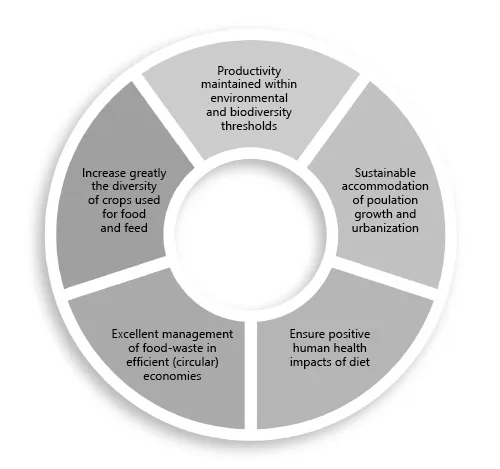
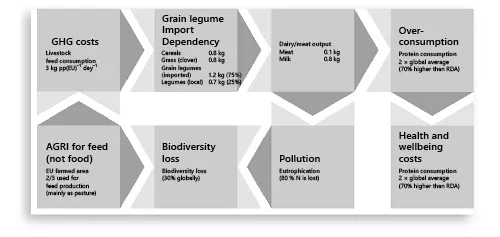
When looking at our current food systems, five main, interlinked challenges are envisioned: (1) changed demographics, with population growth and decline in different countries, combined with an ageing population around the world; (2) diets that are too rich in fat, refined carbohydrates, salt, and animal protein having impacts on health (e.g., increased risk of heart disease); (3) a lack of crop (and therefore food) diversity, since 75% of food consumed is provided by only 12 crop species and 5 different animal types; (4) insufficient food recovery and redistribution, not integrated in circular, resource-efficient systems; (5) food production that is surpassing environmental (and biodiversity) thresholds, driving climate change and biodiversity loss (Fig. 1) [1]. In fact, the way the 7.6 billion people on our planet feed today, particularly in developed countries, has been particularly damaging and would leave both challenges and opportunities were we able to resolve the “paradox, puzzle, and problems” (Fig. 2) generated by the current legume-use paradigm that dominates in Europe (and other regions of the world). A change in food behaviors that favor “home-grown” high-protein plant food sources that are rich in fiber and resistant starches is needed, and here legume grains have a major role to play. It is now scientifically clear that legumes have remarkable health benefits. Still, although possessing a valuable nutritional composition, legumes are often rejected by farmers, consumers, public and private caterers, large retailers, and are largely overlooked in health and environmental policies. For legumes to play an actual role in any dietary transition (regardless of flexitarian, demitarian, vegetarian, vegan, or “planetary” labels), a transdisciplinary approach must be created that implements concrete actions simultaneously at multiple levels. In the shift towards sustainable diets, thinking must be given to the multidimensional continuum of food systems, and to breaking down hurdles all along the supply and value chains, including historical or cultural aspects. Here we will focus upon current knowledge of the role that legumes have in traditional and modern diets, for different age groups and in different cultural backgrounds. We also present recent evidence on their health benefits, strategies for increased intake, as well as known barriers to doing so.
Legume Grains Are “Old”
Legume grains are low-cost and highly nutritious foods from the Fabaceae family, having been one of the earliest food crops cultivated by man [2], and are second only to the Gramineae in their importance to humans. The word “legume” comes from the Latin term “legumen,” which stands for “seeds harvested in pods” and the term “pulse” derives from the Latin term “puls,” meaning pottage or pulp. Pulse is a more restrictive definition, since it excludes legume grains which are traditionally eaten fresh (e.g., green peas) or used for oil extraction (e.g., peanut and soybean). Domestication for human food and animal feed have been reported back to as early as 10,000 years ago when common bean (Phaseolus vulgaris L.) seeds were identified in archaeological sites in Mexico and Peru [3]. Grass pea (Lathyrus sativus L.) seeds were found in excavations in the Balkans (8000 BC) and India (2500 BC) [4]. Chickpea (Cicer arietinum L.) remains as old as 7,500 years were found in the Middle East, with possible origin in the fertile crescent of the Mediterranean [5]. Remains of cultivated peas (Pisum sativumL.) have been found from as early as 4500 BC in a Neolithic lake village in Switzerland [2], and in the coastal valleys of Peru reports of domesticated lima beans (Phaseolus lunatus L.) from about 3500 BC have been described [3]. Despite the rich variety of legumes once cultivated around the world, since the beginning of the 20th century there has been a consistent decline in the number of species cultivated for food systems. Even though agricultural productivity witnessed significant increases in the second half of the 20th century, just over 12 crops provide 75% of the world’s food supplies, and 3 major crops – rice, wheat, and maize – provide 50% of global dietary requirements [6]. Reliance on a handful of “major” crops has led to decreased diversity in crop species, agricultural systems, and human diets, and the time has come to reverse the labeling of legumes as “poor man’s meat.” Legumes should be considered as a “one species low-cost supermarket” for their provision of nutrients in the form of green pods, immature seeds, tubers, leaves, and mature seeds. Aligned with their widespread geographical distribution in Africa, Latin America, Asia, and Mediterranean regions, plus their proven health and environmental benefits (described below), legume grains may hold important answers towards resolving the characterization of the worlds food systems as the “double burden of malnutrition,” which is the global coexistence of undernutrition and non-communicable diseases related to overconsumption of specific food groups (and underactivity).
Fig. 1. This schematic diagram illustrates five interconnected priorities which need to be addressed simultaneously to ensure rapid transformation of food systems to a state which is sustainable across all three pillars of sustainability (environment, social, and economic [95, 96]). The transformations need to be achieved at multiple levels within each priority area via adoption of the transdisciplinary approach by stakeholders across the full length of the food and feed networks [93].
Fig. 2. This illustration is adapted from Westhoek et al. [97], “The Protein Puzzle,” and is to emphasize the modern European food and feed value network paradigm as one of “legume-puzzle, paradox-, and problems.” The illustration aims to re-highlight that any attempted resolution to the current state of food and feed systems should be multifunctional (and therefore transdisciplinary), in its nature. Policies aimed at, for example, animal-feed self-sufficiency (in Europe), will fail to redress the urgent environmental and human nutritional shortcomings which characterize modern agri-food paradigms globally.
Legume Grains Are Nutrient-Rich Foods
Legumes display an array of nutritional benefits with impact on human health. Many health organizations, including the Food and Agriculture Organization of the United Nations [7] and the World H...
Table of contents
Cover Page
Front Matter
Editorial
Unravelling the Food-Health Nexus to Build Healthier Food Systems
“Fit for Life” – German Perspectives on How to Tackle the Double Burden of Malnutrition: Healthy Start – Young Family Network
Unlocking the Hidden Hunger Crises: The Power of Public-Private Partnerships
Addressing Hidden Hunger in School-Aged Children and Adolescents within the Context of the Food System
Africa’s Changing Food Environments and Nutritional Effects on Adults and Children
Fruits and Vegetables in International Agricultural Research: A Case of Neglect?
Gender Discrimination: Contribution to the Burdens of Malnutrition in Communities in Buea, the South-West Region of Cameroon
The Importance of Food Supplements for Public Health and Well-Being
From Individual Nutrients to Sustainable Nutrition
Market-Driven Food Fortification to Address Dietary Needs
The Double Burden of Malnutrition Calls for Better Diet Quality Worldwide
Food Insecurity, Social Inequity, and Sustainability
Programming towards Improved Nutrition: Welthungerhilfe’s Approach to the Prevention of Malnutrition – In All Its Forms
The Role of Food Systems in Shaping Diets and Addressing Malnutrition: Delivering on the Sustainable Development Agenda
The Impact of Global Development Pathways on Food Security and Diet Quality: Results of a Global Economic Model
The Double Burden of Malnutrition in Bangalore, India
How the Smart Food Concept Can Lead to the Transformation of Food Systems and Combat Malnutrition: Different Approaches in Africa, Globally, and a Case Study from Myanmar with Lessons Learnt for Creating Behavior Change in Diets
Food Taxation and the Double Burden of Malnutrition
Nutrition Labeling for Foods: Which Approaches Are Useful?
Seed Village Program: A Practical Approach for Combating Malnutrition and Nutritional Security in an Arid Zone
The Challenge of Food Security and the Water-Energy-Food Nexus: Burundi Case Study
The Push, Pull, and Enabling Capacities Necessary for Legume Grain Inclusion into Sustainable Agri-Food Systems and Healthy Diets
Influence of Social Inequalities on Dietary Diversity and Household Food Insecurity: An In-Depth Nutrition Baseline Survey Conducted in Madhya Pradesh, India
The Nutrition and Health Communication Education Program and For Accurate Science Project of Sabri Ülker Foundation: Initiatives from Turkey
Author Index
Subject Index
Trusted by 375,005 students
Access to over 1.5 million titles for a fair monthly price.
Study more efficiently using our study tools.
Frequently asked questions
Yes, you can cancel anytime from the Subscription tab in your account settings on the Perlego website. Your subscription will stay active until the end of your current billing period. Learn how to cancel your subscription
No, books cannot be downloaded as external files, such as PDFs, for use outside of Perlego. However, you can download books within the Perlego app for offline reading on mobile or tablet. Learn how to download books offline
Perlego offers two plans: Essential and Complete
Essential is ideal for learners and professionals who enjoy exploring a wide range of subjects. Access the Essential Library with 800,000+ trusted titles and best-sellers across business, personal growth, and the humanities. Includes unlimited reading time and Standard Read Aloud voice.
Complete: Perfect for advanced learners and researchers needing full, unrestricted access. Unlock 1.5M+ books across hundreds of subjects, including academic and specialized titles. The Complete Plan also includes advanced features like Premium Read Aloud and Research Assistant.
Both plans are available with monthly, semester, or annual billing cycles.
We are an online textbook subscription service, where you can get access to an entire online library for less than the price of a single book per month. With over 1.5 million books across 990+ topics, we’ve got you covered! Learn about our mission
Look out for the read-aloud symbol on your next book to see if you can listen to it. The read-aloud tool reads text aloud for you, highlighting the text as it is being read. You can pause it, speed it up and slow it down. Learn more about Read Aloud
Yes! You can use the Perlego app on both iOS and Android devices to read anytime, anywhere — even offline. Perfect for commutes or when you’re on the go. Please note we cannot support devices running on iOS 13 and Android 7 or earlier. Learn more about using the app
Yes, you can access Hidden Hunger and the Transformation of Food Systems by Hans Konrad Biesalski,H.K. Biesalski,Hans Konrad, Biesalski, Berthold Koletzko,Berthold, Koletzko,Hans Konrad , Biesalski in PDF and/or ePUB format, as well as other popular books in Medicine & Nutrition, Dietics & Bariatrics. We have over 1.5 million books available in our catalogue for you to explore.