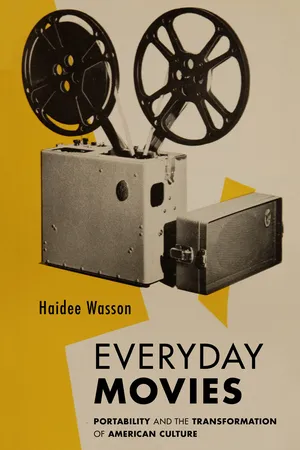
Everyday Movies documents the twentieth-century rise of portable film projectors. It demonstrates that since World War II, the vast majority of movie-watching did not happen in the glow of the large screen but rather took place alongside the glitches, distortions, and clickety-clack of small machines that transformed home, classroom, museum, community, government, industrial, and military venues into sites of moving-image display. Reorienting the history of cinema away from the magic of the movie theater, Haidee Wasson illustrates the remarkable persistence and proliferation of devices that fundamentally rejected the sleek, highly professionalized film show. She foregrounds instead another kind of apparatus, one that was accessible, affordable, adaptable, easy to use, and crucially, programmable. Revealing rich archival discoveries, this book charts a compelling and original history of film that brings to light new technologies and diverse forms of media engagement that continue to shape contemporary life.
eBook - ePub
Everyday Movies
Portable Film Projectors and the Transformation of American Culture
- 288 pages
- English
- ePUB (mobile friendly)
- Available on iOS & Android
eBook - ePub
About this book
Information
1. Engineering Portability
The Rise of Suitcase Cinema
Small wonder that a number of manufacturers, in their eagerness to meet the uncompromising public demand, are supplying portable projectors disguised as sample cases, lunch boxes and violin cases. What cannot be done with safety, according to official requirements, is always accomplished by stealth.
ALEXANDER VICTOR, “The Portable Projector: Its Present Status and Needs,” 1918
Few consider movie theaters as impediments to cinema’s vitality. Quite the contrary, the theater has long been the privileged and often idealized site for understanding the specificities of cinema, whether conceived as a mass medium, a popular commercial form, or as art.1 It occupies an essential place in histories of the growing and powerful film industry, changing leisure patterns, and aesthetic ideals. The centrality of the picture house is further demonstrated by its sometimes quiet but steady presence in theories of film that seek to assess the ways that projected moving images make us think, feel, desire, and experience.2 We often simply assume that throughout the twentieth century, movies happened in theaters. There are many good reasons for this. Movie theaters have long provided a powerful and dominant stage for the encounter between moving images and those who watch them; between an industry and its paying customers; between artists and their interlocutors. Yet I contend that the theater remains a rather curious institution, an unlikely flagship for a cultural form heralded as defiantly mobile, malleable, reproducible, and accessible. When compared to the venues that typify the “fine arts” such as the stately art museum or the grand opera house, movie theaters are indeed relatively affordable and predicated on the far more democratic ideals of an inclusive, polyglot, popular culture. Seen from the perspectives of print or sound cultures, the theater exercises a strangely tenacious restraint on the circulation, access, and use of moving images. It is, after all, an immobile, brick-and-mortar, professionalized venue that was precisely designed to direct and otherwise contain the wily logics of easily portable film prints. Theaters operate on fixed schedules and in specific locations. Management teams decide what will be shown and for how long. In contrast to the innumerable viewing scenarios that offer significant choice over not just when or what we watch but also how we watch, theaters have steadfastly hosted efforts to control or at least delimit the behavior of those watching. From today’s purview, the movie theater can easily seem like a weighty anachronism.
Incongruous with the immobility of the movie theater, portability—while largely a neglected term—allows us to see the ways that many technological, legal, and cultural practices have come together to shape a very different kind of cinema. In the most general sense, the term indexes a paradigmatic quality of twentieth century media. Portability refers to a set of foundational capacities that transformed both recording and playback devices and thus affected the ways in which words, sounds, and images have been inscribed, stored, and then circulated and accessed. Portable media have undeniably had an impact on what are variously called reading, looking, listening, playing, and making.3 The case of portable film projection is but one example of this complex history. Focusing on portable projectors specifically enables us to discover cinema’s similarities to other media technologies, particularly those that severed making and inscription from watching and listening. Like the printing press and the distributive function of paper, or the television set and its electronic signals, camera, projector, and celluloid have endured as essential elements of a complex system whereby pictures of the world were made in one place and then traveled to various sites to be brought to life again by viewers, listeners, and often an audience. For films, this entailed special technical processes, including amplification, illumination, and enlargement, as well as techniques of performance, all transpiring somewhere other than the locations of initial recording and independent of the creative intentions of a camera operator or director. Making movies is one thing; showing them and watching them have persistently been part of dedicated presentation and viewing platforms. Highly varied interfaces or performance scenarios have long connected dispersed audiences to a multitude of technologically mediated encounters that might be entertaining, spectacular, wondrous, educational, governmental, or artistic; sometimes, they might be all of these at once.
This chapter shows that as movie theaters rose to become the American film industry’s primary retail outpost, the ideals, practices, and technological capacities of a distinct and portable film-viewing apparatus persisted alongside the theater’s centrality and the vertically integrated business model adopted by the studios. Film projection technologies intended for use far beyond the movie theater were not primarily conceived as oppositional to the theater; they emerged more as distinct and complementary formats. Moreover, the fact of cinema’s portability initially evolved not as part of a renegade, radical, anticorporate impetus or as a technological aberrance to a widely accepted natural technological ideal. Rather, it arose at the behest of a maturing industry, reconceived here not simply as the film studios but more broadly as the family of technological and industrial concerns that collectively supported cinema’s rise.
Portability in film history has largely been discussed through the lens of minoritarian filmmaking—in particular, under the category of amateurism.4 Yet the association of small-gauge technologies with amateur and hobbyist filmmaking has effectively distracted us from a far more important set of phenomena. If we reframe small-gauge machines to align with a broader imperative to portability—in making and more importantly showing films—then we can see how the drive to create the technological conditions for this other kind of cinema was expansive and taking place in the light of day. Amateurism and hobbyism were but one part of this transformation toward crafting cinema technologies as everyday machines, integral to a new understanding about the use of moving images in business, military, industry, science, and more. In the early decades of the century, Hollywood’s engineers beheld a powerful vision of a dynamic, adaptable apparatus, amply evident in the bulletins and journals documenting their society’s first and subsequent meetings across the ensuing decades. This chapter will map its evolution and institutionalization within the film industry itself. By following the publications of the Society of Motion Picture Engineers (SMPE), we witness that a family of film technologies was not just being debated or manufactured but also imagined as a set of widening capacities, enlarging cinema’s applications and presence in proliferating sites. These technologies were not necessarily driven by—but did often mirror—demands from film theorists, activists, artists, civic organizers, and amateurs, many of whom were also calling for an adaptable, self-operated, nimble machine.
This chapter maps the conditions in which the possibilities of portable projectors in the United States were debated and developed into enduring technological realities. It examines the discourses that shaped portable projectors’ technological and cultural capacities as they became standardized, normalized, and deeply institutionalized within the workings of the film business, capaciously conceived. How the term portable became meaningful and codified within the context of commercial cinema’s rise will be foregrounded. Here the seemingly oppositional model of theatrical film exhibition and the concurrent growth of sizable movie theaters will provide key contextual factors. Throughout, qualities such as lightness of weight, ease of use, adaptability, and control of the projected image will be shown to be primary factors in design, engineering, and marketing discourses pertaining to portability. But above all, and perhaps surprisingly, flammability is revealed as the most dangerous and hence instrumental of all variables. That is, “not catching fire” became a primary quality defining and enabling portability’s rise, differentiating it from the commercial movie theater. The long-standing threat of fire in theatrical scenarios also helps to distill cinema’s portable viewing apparatus from the swell of regulations that had evolved to govern the brick-and-mortar film show and to dictate where industry films could be shown: only in safe and sanctioned locations. Subtended not only by factors such as weight and size but also by chemical and electrical innovations, portability proved a powerful workaround for all manner of architectural and regulatory heft.
The dangers of flammable nitrate film stock are familiar in film history. Fires feed cinema’s infamy. From its emergence and into the early 1950s, film stock, a type of celluloid, was comprised of volatile chemicals that were highly combustible. Though public and regulatory outcry over these dangers persisted for decades, the industry delayed the transition to nonflammable acetate stock until 1951. Many reasons for this were provided over the years, such as nitrate’s cost efficiencies and its superior quality compared to nonflammable alternatives. Nitrate proponents also frequently claimed it was perfectly safe if properly used: its risk, they argued, was worth its reward. Thus, for more than half a century, film fires posed a threat both to public safety and just about all other operations involving nitrate stock: filmmaking, film storage, film distribution and transport.5 This makes electrochemistry a defining feature not just of film’s technical qualities but also its sociocultural manifestations, as what was termed public safety became one of the primary strategic frameworks for regulating film performance. Theaters were natural settings for the rehearsal of these concerns given their permanent and visible status and their function as places of gathering. With regard to portability specifically, the threat of fire became especially significant as flammability was made more likely when film shows moved about and had to adapt to constantly changing and perhaps unpredictable projection environments that could involve poor ventilation or cramped spaces. An accessible and adaptable apparatus also invited a wider array of untrained operators, who might lack the adequate experience to ensure safety. The design imperative to make the projector smaller also led to the practical challenges of controlling the potential danger of heat inside the lamphouse. That is, the smaller that little metal box was, the hotter it became. The hotter it ran, the more incendiary it was. Calls to make bigger and brighter images, requiring stronger and hence hotter bulbs, only exacerbated the problem. Demands to still the moving image presented a vexing challenge, given that this required holding a single illuminated film frame steady rather than moving it quickly in and out of the heat created by the process of projection. With nitrate this led quickly to one thing: fire. Movement was a bias of illuminated nitrate film stock, making motion safer than stasis.
In order to chart the ways in which portability was defined and became a part of a surprisingly diverse and productive discussion about film technologies, this chapter focuses on the 1910s and 1920s as a critical period for the consolidation of lasting definitions and ideas about portability and projection. It examines the ways in which technical capacities interfaced with industrial, cultural, and aesthetic ones. What follows documents the ways in which portability was defined and standardized by the SMPE, examining the parallel development of small-gauge, portable equipment alongside the contrasting growth in theater size and complexity. Big and small cinema evolved side by side as complementary products of industry consolidation, rationalization, and expansion. Far from an anti-Hollywood proposition, portable film projectors, like their seeming opposite—the picture palace—signaled an effort to improve the experience and application of moving image technologies in general, and technologies of projection in particular. Such diversification benefitted Hollywood to a degree but more so the archipelago of companies that constituted its technical base. Portability can be understood here as an organizational principle and a growth imperative, one that would especially help to tap into vast, undiscovered markets. This imperative manifested both in the standardization of particular small-gauge film systems and as a way of thinking about multiplying uses. Resonating with the fervor that typically accompanies so-called new media, discourses about portable film projectors crystallized appeals to a diversifying set of purposes for cinema. Indeed, this would lead to more customers and to normalizing a new conception of modern life: moving images and sounds should be everyday, essential media.
THE ROOTS OF PORTABLE CINEMA
Cinema was born portable, moving from showplace to stage to fair. As in many countries around the world, American cinema began as inexpensive public amusements and complements to other presentation and performance modes: educational lectures, industrial display, religious sermons. In one sense, it was the PowerPoint of its day. Itinerant showmen, traveling lecturers, and touring entertainment troupes frequently projected films. The machines and movies that constituted cinema’s earliest attractions had no single home and no dedicated architectural element integral to them. In the United States, it took a decade for devoted cinema spaces to open up. By 1905, the first storefront theaters appeared in cities and continued to include a mix of live and recorded shows with numerous sound devices (recorded, instrumental, and live) and varied modes of patron address. Spanning sidewalk barkers, painted posters, and automated announcements, these first theaters were not so much exclusively dedicated to movies as they were wrapped around a business model featuring movies at their core. Seeing a film entailed a broad spectrum of other media and presentational modes; from early on, cinema was an indisputably multimedia event.6
By 1915, movie theaters were proliferating, establishing a recognizable genre of public entertainment, and serving as the retail face of the American film industry. Among their important functions, they provided reliable sales windows for studio products. Stabilizing the theater as the point-of-sale for movies allowed the industry to secure market share in a rising entertainment industry. Theaters ensured an outlet for their products and provided a predictable and appealing site for repeat customers. The larger purpose-built theaters that subsequently emerged gradually formed into the regional and national chains essential to the American film business and its transformation into the powerful conglomerates we name with the umbrella term Hollywood. Equally important to the success of theaters was the standardization and control of film technologies that included the highly flammable 35 mm film stock, secured as the dominant and professional film gauge when the Motion Picture Patents Compa...
Table of contents
- Subvention
- Title Page
- Copyright
- Dedication
- Contents
- Acknowledgments
- Introduction: Portability and Projectability
- 1. Engineering Portability: The Rise of Suitcase Cinema
- 2. Spectacular Portability: Cinema’s Exhibitory Complex, American Industry, and the 1939 World’s Fair
- 3. Mobilizing Portability: The American Military and Film Projectors
- 4. Portable Projectors and the Electronic Age
- Epilogue: Vectors of Portable Cinema
- Notes
- Bibliography
- Index
Trusted by 375,005 students
Access to over 1.5 million titles for a fair monthly price.
Study more efficiently using our study tools.
Frequently asked questions
Yes, you can cancel anytime from the Subscription tab in your account settings on the Perlego website. Your subscription will stay active until the end of your current billing period. Learn how to cancel your subscription
No, books cannot be downloaded as external files, such as PDFs, for use outside of Perlego. However, you can download books within the Perlego app for offline reading on mobile or tablet. Learn how to download books offline
We are an online textbook subscription service, where you can get access to an entire online library for less than the price of a single book per month. With over 1.5 million books across 990+ topics, we’ve got you covered! Learn about our mission
Look out for the read-aloud symbol on your next book to see if you can listen to it. The read-aloud tool reads text aloud for you, highlighting the text as it is being read. You can pause it, speed it up and slow it down. Learn more about Read Aloud
Yes! You can use the Perlego app on both iOS and Android devices to read anytime, anywhere — even offline. Perfect for commutes or when you’re on the go.
Please note we cannot support devices running on iOS 13 and Android 7 or earlier. Learn more about using the app
Please note we cannot support devices running on iOS 13 and Android 7 or earlier. Learn more about using the app
Yes, you can access Everyday Movies by Haidee Wasson in PDF and/or ePUB format, as well as other popular books in Media & Performing Arts & Film History & Criticism. We have over 1.5 million books available in our catalogue for you to explore.