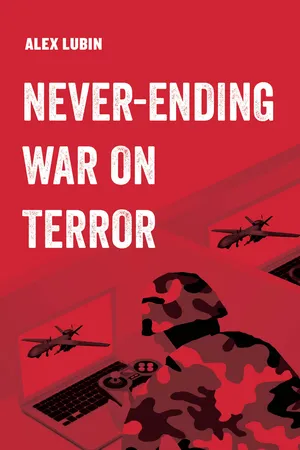
A concise primer to the political, cultural, and social consequences of the perpetual US global war on terror.
An entire generation of young adults has never known an America without the War on Terror. This book contends with the pervasive effects of post-9/11 policy and myth-making in every corner of American life. Never-Ending War on Terror is organized around five keywords that have come to define the cultural and political moment: homeland, security, privacy, torture, and drone. Alex Lubin synthesizes nearly two decades of United States war-making against terrorism by asking how the War on Terror has changed American politics and society, and how the War on Terror draws on historical myths about American national and imperial identity. From the PATRIOT Act to the hit show Homeland, from Edward Snowden to Guantanamo Bay, and from 9/11 memorials to Trumpism, this succinct book connects America's political economy and international relations to our contemporary culture at every turn.
- 152 pages
- English
- ePUB (mobile friendly)
- Available on iOS & Android
eBook - ePub
Never-Ending War on Terror
About this book
Information
Publisher
University of California PressYear
2021Print ISBN
9780520297401
Edition
1eBook ISBN
9780520969773
CHAPTER ONE
Mourning in America
In the days following the September 11, 2001, terrorist attacks on the World Trade Center and the Pentagon, President George W. Bush claimed, “we are entering a new world.” Bush outlined the landscape for this new world by arguing that the attacks were inspired by the terrorists’ evil nature, their disdain for freedom, and their hatred of America. “They hate our freedoms: our freedom of religion, our freedom of speech, our freedom to vote and assemble and disagree with each other.”1 Bush argued that the terrorists were driven by a natural disdain for freedom—apparently there were no political reasons for al-Qaeda’s attacks, only a primordial and racial hatred for freedom and liberty. He equated the terrorists with the mafia, with Nazis, with totalitarianism.
They’re the heirs of all the murderous ideologies of the 20th century. By sacrificing human life to serve their radical visions, by abandoning every value except the will to power, they follow in the path of fascism, Nazism and totalitarianism. And they will follow that path all the way to where it ends in history’s unmarked grave of discarded lies.2
Bush argued to Congress that al-Qaeda was the last remaining detritus of America’s Cold War enemies, and in so doing he echoed the Project for a New American Century’s call to extend the permanent military readiness of the Cold War beyond the fall of the Soviet Union and into an indefinite future. The 9 / 11 attacks took place in a geopolitical context in which the fight against terrorism was understood as a US-led global war pitting those who love “freedom” against those who do not. “This is the world’s fight,” Bush argued. “This is civilization’s fight. This is the fight of all who believe in progress and pluralism, tolerance and freedom.”3
Bush’s address to Congress, like his address to the nation immediately after the terrorist attacks, linked the political resolve to vanquish the “enemies of freedom” with sadness and mourning. In his address to Congress, Bush displayed the badge of a policeman who had died while trying to save those in the World Trade Center. He repeatedly invoked the memory of the passengers on United Flight 93 who sacrificed their lives to prevent a successful terrorist attack, of the firefighters and other first responders who risked their lives to save others. Across media were daily reminders of tragedy, loss, and despair, including photographs taken from around New York of missing loved ones, family members of first responders, ad hoc shrines and public memorials to those who died.
Taken together, the spectacle of mourning and the political resolve for warfare were linked in ways that presented war as the only salve for loss and mourning. No political discussion about why al-Qaeda had attacked the United States was necessary—or welcomed—because the force of mourning closed down any critical analysis, including within the US Congress. The violence of terrorism was somehow regarded as substantively distinct from the violence of states, and the political grievances of terrorists fell on disinterested ears.
Judith Butler argues that mourning and the recognition of human vulnerability can serve as the basis for human community rooted to radical notions of human vulnerability. The recognition of fragility and loss is a moment when the human condition is most exposed, and we may be compelled to understand our collective connectedness as frail human bodies. Butler asks, “Could the experience of a dislocation of first-world safety not condition the insight into the radically inequitable ways that corporeal vulnerability is distributed globally?”4 However, Butler also notes that vulnerable life, rooted in the notion of human frailty and loss, may also be the basis for revenge or violence as we attempt to fill the void of loss and grief with something other than the recognition of human frailty. Instead, what can occur in the face of unspeakable grief is violence; rather than dwell on the frailty of all human bodies, following 9 / 11 Americans sought to expunge their grief through violence, to regard the terrorist as an ungrievable life, to make American grief exceptional.
Marita Sturken notes that the impulse to memorialize the loss of the World Trade Center in Lower Manhattan took place much more rapidly than the memorialization of other tragedies in American history. September 11, 2001, became a spectacle marked by the absence of the World Trade Center’s former presence; and, although the buildings had never been central to conceptions of American national identity, their memorialization seemed to elevate the buildings to national prominence. Sturken argues: “In the face of absence, especially an absence so violently and tragically wrought at the cost of so many lives, people feel a need to create a presence of some kind, and it may be for this reason that questions of memorialization have so quickly followed this event.”5 The rush to fill the absence, to replace grief with national resolve, meant unleashing state violence rather than reconfiguring community along lines of human frailty.
Only three days following the 9 / 11 attacks, the US Senate unanimously passed Senate Joint Resolution 23, the “Authorization for Use of Military Force” (AUMF), in compliance with the War Powers resolution. Ever since the secret wars in Southeast Asia, the US Congress has attempted to limit the authority of the president to wage war without congressional approval (as required by the United States Constitution). And yet, the post-9 / 11 war authorization granted the president the authority to
use all necessary and appropriate force against those nations, organizations, or persons he determines planned, authorized, committed, or aided the terrorist attacks that occurred on September 11, 2001, or harbored such organizations or persons, in order to prevent any future acts of international terrorism against the United States by such nations, organizations, or persons.6
The House of Representatives soon followed, with 425 members voting for approval, and only one lone vote opposing. The authorization was nothing short of a blank check; it not only granted the president the authority to go to war anywhere in the name of fighting terrorism but also turned back decades of efforts to limit the war powers of the executive branch in order to prevent the mistakes of Vietnam, where the president acted unilaterally, and often in secret, without the approval of the people’s elected representatives. The AUMF continues to be a presence in the political life of a never-ending war—it has justified the expansion of a limitless battlefield and handed the executive branch unfettered use of the largest and most powerful military in the world.
The lone vote against the Authorization for Use of Military Force was by Barbara Lee, the congressional representative from Oakland, California, who argued for some restraint and time for reflection. Recognizing that mourning could be a powerful impetus for violence rather than solidarity, Lee sought to halt the rush to war. “However difficult this vote may be,” she argued, “some of us must urge the use of restraint. Our country is in a state of mourning. Some of us must say, let’s step back for a moment. Let’s just pause, just for a minute, and think through the implications of our actions today, so that this does not spiral out of control.”7 Lee’s caution was prophetic, and only at the time of this writing in 2019 has the US Congress fully realized that the 2001 military authorization granted a blank check for the president to wage war in any way, at any time, in any place in the name of protecting the abstract goals of “freedom.” In 2001, however, when the Congress voted to authorize military force, the power of mourning, and the melancholic desire to fill loss with something that had been lost, was greater than the power of reason—dissent was understood to aid terrorists.
The combined power of mourning, melancholia, and militarism shaped the days, months, and years following 9 / 11—these combined powers contributed to a national culture bent on actively forgetting US complicity in a global world order that made life across large parts of the globe unlivable, to “return” to some lost era of American purity, to displace historical acts of American violence onto others. The work of forgetting and projecting was obvious in the nationally televised “Tribute to Heroes” concert that aired ten days following the terrorist attacks on all network television stations and cable channels. As Jeffrey Melnick has persuasively argued in his book 9 / 11 Culture, the concert paid tribute to a fallen, masculine nation, but in the process rewrote aspects of American history in ways that gave renewed focus to the task ahead of the nation.8 The work of culture was to facilitate forgetting while repurposing vulnerability and decline as justifications for US reconstruction and retribution—here we see the nation’s imperial melancholia at work, as the harms of slavery and of globalization were mapped onto the terrorists, as the United States framed itself as victim rather than perpetrator.
The concert’s stagecraft evoked the somber mood of the nation, featuring a dark stage often lit only by candlelight. While the concert seemed to convey universal emotions of mourning and national resolve, the performances also demonstrated a nation attempting to reconcile aspects of disunity that characterized the nation in the days, years, decades, and centuries prior to the terrorist attacks. Although it appeared that 9 / 11 unified the nation around a shared sense of grief, in fact, the terrorist attack also exposed several fault lines in American society, lines forged by the history and present of settler colonialism, racism, classism, sexism, and homophobia.
The “Tribute to Heroes” concert included twenty-one artists, but the iconic moments of the concert took place when Bruce Springsteen—“the Boss”—performed the song that would become something of a post-9 / 11 national anthem, “My City of Ruins.” The song is a melodrama of “beset manhood,” to quote the classic analysis of literary scholar Nina Baym—it is about the decline of a city and the resolve to “rise up” and rebuild.9 The terms of resilience and rejuvenation are not defined, and just like Springsteen’s other iconic hit, “Born in the U. S. A.”—an antiwar song about the abandonment of working-class Vietnam veterans—“My City of Ruins” became something of a masculine and patriotic anthem despite its rather dystopian intended message.
The lyrics of “My City of Ruins” are about deindustrializing America, where cities like Springsteen’s Asbury Park, New Jersey, that once symbolized America’s manufacturing prowess were closed down and vacated as a result of the offshoring of production. As recently at 1970, Asbury Park was the site of race riots, setting underemployed working-class Black and white people against each other. Springsteen’s 1999 song was about working-class discontent, but without any recognition of the divisions between the city’s Black and white residents. Springsteen croons, “Young men on the corner / Like scattered leaves / The boarded-up windows / The empty streets / While my brother’s down on his knees.”10 The song’s chorus, “Come on, Rise Up!” was likely targeted at working-class union members struggling to keep jobs from moving offshore in the midst of globalization’s assault of working people. And yet, by the time Springsteen performed the song at the post-9 / 11 “Tribute to Heroes” concert, “My City of Ruins” gained new purchase on the American consciousness, transforming from a song about declension and uncertainty in the face of deindustrialization to one about resilience and redemption in the face of a new threat.
As Melnick has suggested, by the time of the concert it was impossible to hear the song as anything but a tribute to Lower Manhattan. While the song’s ode to a city’s deterioration was experienced as an analogy for the terrorist attacks on New York City, the renewed focus of the song was its chorus, its invocation of “rising.” In order to make clear that “My City of Ruins” was about national rising and not declension, Springsteen’s first post-9 / 11 album—explicitly dedicated to the memory of 9 / 11—was titled “The Rising” and featured “My City of Ruins.” The 2002 version of the song conjured very different meanings than the 1999 version as the narrative of working-class struggle in the face of neoliberalism became a durable story of national redemption in the face of terrorism.
Another performance featured during the “Tribute to Heroes” concert did work similar to Springsteen’s in concealing one history while opening up another. Wearing a leather jacket covered in American stars and stripes, Wyclef Jean, the Haitian lead singer of the Fugees, performed the Bob Marley classic, “Redemption Song.” Marley’s version of the song is a story firmly grounded in the Black radical tradition; it is about the cultural inheritance of resistance and redemption that comes from struggling against legacies of anti-Blackness and chattel slavery. It was significant that Jean sang Marley’s redemption song; as a Haitian singer, Jean inherits a legacy of Black anticolonialism similar to Marley’s. Haiti was the scene of the first successful slave rebellion in the Western Hemisphere, and its first Black sovereign state. Moreover, the military barracks at Guantanamo Bay, Cuba, which would figure so prominently in the US War on Terror, had by the time of Jean’s performance been used by the Clinton administration as a place to detain indefinitely, and often without care, Haitian refugees with HIV / AIDS.11
Jean’s haunting performance of “Redemption Song” opens on a black stage with the isolated sound of a snare drum beating a military cadence. Jean punctures the darkness and military beat with Marley’s words, “Old pirates, yes, they rob I / Sold I to the merchant ships / Minutes after they took I / From the bottomless pit / But my hand was made strong / By the hand of the Almighty / We forward in this generation / Triumphantly.”12 These jarring words about the enslavement of human beings could have seemed out of place at a concert intended to unify American national identity; the song is an indictment of the international slave trade that contributed to the making of the West. And yet, by the end of Jean’s song, Marley’s ode to slave rebellion and redemption gives way to Jean and fellow Fugee Lauren Hill singing “God Bless America” to the rhythm of Marley’s song. Thus, the “Tribute to Heroes” concert transformed a song about slavery and redemption into a song about US resilience in the face of terrorism. In the process, the US history of chattel slavery was transferred onto the horrors of terrorism, and the redemption found in the Black radical tradition was displaced onto the righteous fury of the United States as it embarked on a war against terrorism.
How could a song about the organized abandonment of Springsteen’s Asbury Park become a song about masculine resilience and strength in the face of terrorism? How could a song about slavery and slave rebellion do the cultural work of mourning 9 / 11 and consolidating US nationalism for the War on Terror? From what was the United States being redeemed in Jean’s “Re...
Table of contents
- Title
- Copyright
- Contents
- Overview
- An Introduction without a Beginning
- 1. Mourning in America
- 2. Privacy and Security
- 3. Liberal Torture
- 4. Extrajudicial Assassination by Drone
- A Conclusion without an Ending
- Acknowledgments
- Notes
- Glossary
- Key Figures
- Selected Bibliography
Trusted by 375,005 students
Access to over 1.5 million titles for a fair monthly price.
Study more efficiently using our study tools.
Frequently asked questions
Yes, you can cancel anytime from the Subscription tab in your account settings on the Perlego website. Your subscription will stay active until the end of your current billing period. Learn how to cancel your subscription
No, books cannot be downloaded as external files, such as PDFs, for use outside of Perlego. However, you can download books within the Perlego app for offline reading on mobile or tablet. Learn how to download books offline
Perlego offers two plans: Essential and Complete
- Essential is ideal for learners and professionals who enjoy exploring a wide range of subjects. Access the Essential Library with 800,000+ trusted titles and best-sellers across business, personal growth, and the humanities. Includes unlimited reading time and Standard Read Aloud voice.
- Complete: Perfect for advanced learners and researchers needing full, unrestricted access. Unlock 1.5M+ books across hundreds of subjects, including academic and specialized titles. The Complete Plan also includes advanced features like Premium Read Aloud and Research Assistant.
We are an online textbook subscription service, where you can get access to an entire online library for less than the price of a single book per month. With over 1.5 million books across 990+ topics, we’ve got you covered! Learn about our mission
Look out for the read-aloud symbol on your next book to see if you can listen to it. The read-aloud tool reads text aloud for you, highlighting the text as it is being read. You can pause it, speed it up and slow it down. Learn more about Read Aloud
Yes! You can use the Perlego app on both iOS and Android devices to read anytime, anywhere — even offline. Perfect for commutes or when you’re on the go.
Please note we cannot support devices running on iOS 13 and Android 7 or earlier. Learn more about using the app
Please note we cannot support devices running on iOS 13 and Android 7 or earlier. Learn more about using the app
Yes, you can access Never-Ending War on Terror by Alex Lubin in PDF and/or ePUB format, as well as other popular books in History & North American History. We have over 1.5 million books available in our catalogue for you to explore.