How should we share the truth about the environmental crisis? At a moment when even the most basic facts about ecology and the climate face contestation and contempt, environmental advocates are at an impasse. Many have turned to social media and digital technologies to shift the tide. But what if their strategy is not only flawed, but dangerous?
The Truth about Nature follows environmental actors as they turn to the internet to save nature. It documents how conservation efforts are transformed through the political economy of platforms and the algorithmic feeds that have been instrumental to the rise of post-truth politics. Developing a novel account of post-truth as an expression of power under platform capitalism, Bram Büscher shows how environmental actors attempt to mediate between structural forms of platform power and the contingent histories and contexts of particular environmental issues. Bringing efforts at wildlife protection in Southern Africa into dialogue with a sweeping analysis of truth and power in the twenty-first century, Büscher makes the case for a new environmental politics that radically reignites the art of speaking truth to power.
eBook - ePub
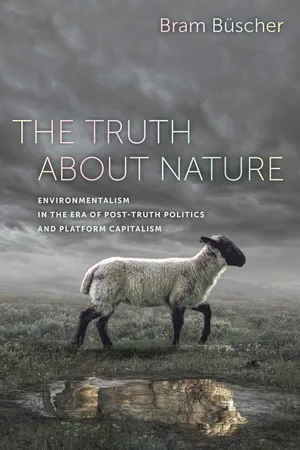
The Truth about Nature
Environmentalism in the Era of Post-truth Politics and Platform Capitalism
- 254 pages
- English
- ePUB (mobile friendly)
- Available on iOS & Android
eBook - ePub
The Truth about Nature
Environmentalism in the Era of Post-truth Politics and Platform Capitalism
About this book
Information
Publisher
University of California PressYear
2020Print ISBN
9780520371453
Edition
1eBook ISBN
9780520976153
PART ONE
(Meta)theoretical Bearings
CHAPTER 1
Truth Tensions
#PowerOfTruth
#TruthAsPower
The term truth tensions performs a lot of work in this book. It aims to register the deep tensions and fault lines related to the idea of truth in and behind much contemporary critical theory. It is also the umbrella that holds together the book’s theoretical arguments and interventions. On a metatheoretical level, the term indicates that we need to always be critical of any truth claims and the powers behind them while at the same time always continue to search for truth. Contemporary engagements with truth focus mainly on the first part of this statement. They do so in often nuanced and sophisticated ways that I will not be able to do justice to. Yet a basic problem remains: if truth is only power, issues can only be settled through “truth wars” where organizing (counter)power ultimately trumps understanding. This is also the reason why for many others the term is so loaded that they prefer to stay away from it entirely. Both of these responses regard truth as not very productive or useful for providing meaningful theoretical bearings.
We need to rethink this stance. I argue that a metaphysics of truth tensions is crucial for any effective and meaningful environmental politics going forward. This is because, theoretically, it allows for mediating between different statuses of the term in different times and spaces and in relation to different objectives or aims, and because, politically, it provides direction in the tension-ridden space between more solid and shifting forms of knowledge. These claims may not be new, but the need to make truth productive in this way has regained urgency against the background of the emergence of post-truth. First, this emergence was deeply troubling for those who had been working hard to state that truth is nothing but power, a construction, or an (actor-)network. It has led to an emerging debate in the fields arguably most critical to this discussion, science and technology studies (STS) and the sociology of knowledge more generally. Delving into this debate in the next section will show the need for the proposed shift from truth wars to truth tensions.
This shift might seem impossible, seeing how a second major outcome of the emergence of post-truth is that political polarization has greatly intensified around the world. Yet it is necessary, nonetheless. Opposing factions seem to dig themselves ever deeper into their own, hardened truth regimes, and defend these ever more fiercely regardless of evidence or nuance. (The debates around Brexit in Britain, party politics in the United States, or climate change are just some contemporary examples that come to mind). These dynamics, combined with the urgency of the environmental crisis, render the question of how to move forward in relation to truth an equally urgent proposition, both in scientific and in public debates. The (meta)theoretical reflections in this chapter are therefore no mere abstract matter: they must be part of our collective discussions about our political bearings as we confront the necessity for urgent, structural transformation.
FROM TRUTH WARS TO TRUTH TENSIONS?
Science and technology studies and the sociology of knowledge have long reflected deeply on the relations between truth, nature, and power. In the process, and since their study objects are science, scientists, and knowledge-technology systems, they have also had a long-standing and tension-ridden relationship with other disciplines, especially the natural sciences. Steven Ward usefully chronicles some of the major developments in this relationship from the time of Emile Durkheim and argues that since early postmodernist and feminist critiques and deconstructions of science, much of this tension was situated between two basic sociologies of knowledge: a modernist one, which included more positivist social realists who believe objective truths about social reality are possible, and a postmodern approach that broadly sees truth as fully emerging from social dynamics and the textual strategies that follow from this.1 To this, he adds a third approach based on Latour’s actor-network theory, which he holds may be able to help us break through what is referred to as the “science wars” between modernists and postmodernists.
According to Ward: “One of the potential strengths of actor-network theory’s approach is that it adopts a view of truth, reality, and knowledge that is allegedly void of the objectivistic expectations of traditional realist epistemology, the relativistic conclusions of postmodern theory, and the reductionistic and reflexivity-ridden accounts found in social realism.”2 I agree with Ward and Latour that actor-networks are crucial in making truths count and accepted. However, leaving behind any idea of realism outside of networks quickly brings actor-network theory into trouble. Ward states that “for Latour, if truth claims are not attacked and there is no controversy among competing truth providers, then the claims are true.”3 This is a bizarre proposition. The converse would mean that everything that is attacked is by definition untrue. In general, but particularly in a post-truth era of intensified political polarization, this is deeply problematic. It basically turns the science wars into what Peter Lee calls “truth wars” where only the power of networks determines what is true or not.
Lee views “truth as something that is produced within complex relations between the individuals who wield political power, those who manage vast economic resources, the people who control the institutions and mechanisms that validate or invalidate scientific or other knowledge claims, and those who are subject to that power.”4 For Lee, objective truth is impossible and the search for it useless. Instead, he prefers to investigate “the ways in which opposing protagonists stake their claims and make their arguments.” I agree that objective truth does not exist. But the problem with Lee’s argument is that it does not require the term truth. The concept of truth in his account has no special significance and is basically the same as “claims” or “knowledge.” It does not become productive beyond it being a claim about a claim (namely, that it is important or powerful). Truth wars, from this perspective are interesting only to those who defend (a) truth and to those who attack or deconstruct it. But again, the post-truth conundrum forces us to rethink this power-only understanding of truth: it is clear that a public sphere based on ever-intensifying truth wars is highly toxic and runs a real risk of undermining what is critically important in science. A Latourian approach cannot provide the way forward here.
Fortunately, this conundrum has become subject to a growing debate within STS over the last years, with different arguments to consider.5 Fujimura and Holmes, for one, believe that STS must “stay the course.” They argue that “STS makes scientific practices more transparent by providing knowledge that helps to locate science in its social, institutional, and material contexts.”6 Others, like Angermuller, focusing on discourses studies in STS, believe that “contemporary post-truth discourses put the constructivist foundations of discourse studies to a test.” He argues for a “strong programme” “that is constructivist, without being relativist.”7 Yet others, like Palliser and Dodson, with reference to environmental conflict in New Zealand, believe that in the face of post-truth, defined as “ambiguous statements in between truth and lie,” better transparency, deliberative governance and communication can lead to improved collaboration and deflect post-truth.8 Lastly, famous sociologist of science Naomi Oreskes felt compelled to take “the other side.” Her recent book, tellingly titled Why Trust Science, argues that the “social character of scientific knowledge is its greatest strength.”9
Whether STS must stay the course or change is of no concern to me here. This book is not a sociology of knowledge or STS study, even though these debates have left clear traces on its content. Rather than aspire to settle the grand matter of truth, I wish to make the concept productive for understanding contemporary environmental politics within the context of post-truth politics and platform capitalism. It is, again, a political ecology of truth I am after. Several contributions to the debate in STS on post-truth, however, do start to point at what I am interested in. Noortje Marres, for example, argues that we “can’t have our facts back” and pleads for the idea of “experimental facts” in public life: a “statement whose truth value is unstable.” In doing so, she points to social media as a “truth-less public sphere by design,” since its algorithms are designed to encourage the circulation of popular messages, not truth.10 Equally important is the point by Giraud and Aghassi-Isfahana that the defense against post-truth seems to also come at the expense of “gender studies, postcolonial theory, and feminist science.” This, they argue, runs the real risk of further marginalizing already marginalized knowledges and peoples or other ways of understanding the world.11
These two issues—the design structures behind social media and broader political economic inequalities—are key in my own reflections moving forward. A political ecology of truth, however, emphasizes nature and power in relation to truth, which adds to but also rectifies some of the major gaps in the above STS contributions.12 For one, their engagement with political economy and power is superficial at best. Next, and remarkably, none of the studies cited here makes a clear distinction between fact, truth, and sometimes even knowledge or claims. This not only obfuscates our understanding of these terms but also makes it impossible to render them productive. Lastly, they all follow the mainstream understandings of post-truth as either the mixing of emotion and truth in public debates or as an updated variant of lying or bullshitting. A political ecology of truth theorizes post-truth very differently.
Before I get there, I must note an irony in the above critique, seeing how it may force me back to Latour. After all, this tactic resembles his when he concludes his book Politics of Nature with the question “What Is to Be Done” and answers it with “Political Ecology!’” Unlike Latour, however, I do not understand the world to be a flat “ensemble” of actors, networks, and their forms of experimentation with fact and fiction. For Latour, there are no “forces” that manipulate actors without their knowledge, and for him the social sciences merely serve for the collective to somehow “collect itself again.”13 Yet he hardly places any collective in context, nor does he entertain the possibility that certain forces may manipulate actors who are fully aware of this manipulation and may desire spokespersons to help them picture another world and ways to get there.14
Latour thus ends up with a politics where dominance, hierarchy, inequality, and power do not play a serious role and where it is unclear how these can be confronted. In short and despite the appearance of an understanding of truth as power (of networks), Latour’s is an epistemology of shifting sand, with little solid rock. It is therefore not surprising that the main actor he places his faith in is the diplomat, that quintessential actor who needs to shift not just her politics but even her personality depending on circumstances. In the face of contemporary obscene inequalities and environmental crises, we must do better than that; we need to confront power directly and do so on solid grounds while also doing justice to the shifting relations between truth, nature, and power.
THE POWER OF TRUTH TENSIONS
Many scholars who emphasize the point that truth is directly connected to power often start with the work of Michel Foucault, in particular one of his most famous quotes:
The important thing here is that truth isn’t outside power, or lacking in power. . . . Truth is a thing of this world: it is produced only by virtue of multiple forms of constraint. And it induces regular effects of power. Each society has its régime of truth, its “general politics” of truth: that is, the types of discourses which it accepts and makes function as true; the mechanisms and instances which enable one to distinguish true and false statements, the means by which each is sanctioned; the techniques and procedures accorded value in the acquisition of truth; the status of those who are charged with saying what counts as true.15
This quote is fascinating in many respects, especially in relation to the power of new media platforms discussed in chapters 2 and 3. But Foucault did not merely argue that truth and power are always interconnected. He also emphasized the politically liberating potential of this insight: “It’s not a matter of emancipating truth from every system of power (which would be a chimera, for truth is already power) but of detaching the power of truth from the forms of hegemony, social, economic and cultural, within which it operates at the present time.”16 This phrasing is interesting. It suggests that while truth is power, it is at the same time more than that, which gives it power. Precisely what Foucault means might be gleaned from what he stated shortly before his death in 1984. In his last lecture series, The Courage of Truth, Foucault, according to Frédéric Gros, emphasized truth as “that which makes a difference in the world and in people’s opinions, that which forces one to transform one’s mode of being, that whose difference opens up the perspective of an other world to be constructed, to be imagined.”17
I take Foucault’s prompt seriously. If we wish to realistically understand and confront the environmental crisis in the era of post-truth, then the courage of truth in the sense of speaking truth to power is precisely what is at stake, both in theory and in practice.18 But it is hard to promote the art of speaking truth to power if truth can only ever be uttered in brackets—as something that exists solely to be deconstructed rather than also constructed or sought after.19 As something that only leads to wars and not (also) to understanding. And yet: much social theory, even in its most deconstructionist, anti-essentialist forms, believes that deconstructin...
Table of contents
- Subvention
- Title Page
- Copyright
- Dedication
- Contents
- Preface and Acknowledgments
- Introduction: The Truth about Nature?
- Part One. (Meta)Theoretical Bearings
- Part Two. The Political Economy of Platforms, Post-truth, and Power
- Part Three. Environmentalism 2.0
- Conclusion: Speaking Truth to Power
- Notes
- Bibliography
- Index
Trusted by 375,005 students
Access to over 1.5 million titles for a fair monthly price.
Study more efficiently using our study tools.
Frequently asked questions
Yes, you can cancel anytime from the Subscription tab in your account settings on the Perlego website. Your subscription will stay active until the end of your current billing period. Learn how to cancel your subscription
No, books cannot be downloaded as external files, such as PDFs, for use outside of Perlego. However, you can download books within the Perlego app for offline reading on mobile or tablet. Learn how to download books offline
We are an online textbook subscription service, where you can get access to an entire online library for less than the price of a single book per month. With over 1.5 million books across 990+ topics, we’ve got you covered! Learn about our mission
Look out for the read-aloud symbol on your next book to see if you can listen to it. The read-aloud tool reads text aloud for you, highlighting the text as it is being read. You can pause it, speed it up and slow it down. Learn more about Read Aloud
Yes! You can use the Perlego app on both iOS and Android devices to read anytime, anywhere — even offline. Perfect for commutes or when you’re on the go.
Please note we cannot support devices running on iOS 13 and Android 7 or earlier. Learn more about using the app
Please note we cannot support devices running on iOS 13 and Android 7 or earlier. Learn more about using the app
Yes, you can access The Truth about Nature by Bram Büscher in PDF and/or ePUB format, as well as other popular books in Social Sciences & Environment & Energy Policy. We have over 1.5 million books available in our catalogue for you to explore.