This volume is the first in a series of full-length English translations from one of the foremost classics in Daoist religious literature, the Zhen gao or Declarations of the Perfected. The Declarations is a collection of poems, accounts of the dead, instructions, and meditation methods received by the Daoist Yang Xi (330–ca. 386 BCE) from celestial beings and shared by him with his patrons and students. These fragments of revealed material were collected and annotated by the eminent scholar and Daoist Tao Hongjing (456–536), allowing us access to these distant worlds and unfamiliar strategies of self-perfection. Bokenkamp's full translation highlights the literary nature of Daoist revelation and the place of the Declarations in the development of Chinese letters. It further details interactions with the Chinese throne and the aristocracy and demonstrates ways that Buddhist borrowings helped shape Daoism much earlier than has been assumed. This first volume also contains heretofore unrecognized reconfigurations of Buddhist myth and practice that Yang Xi introduced to his Daoist audience.
eBook - ePub
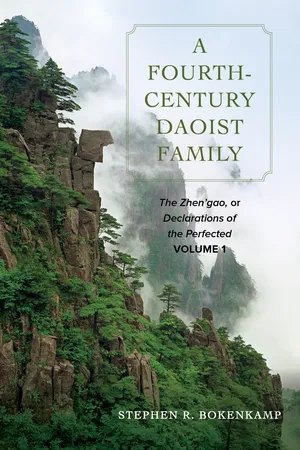
A Fourth-Century Daoist Family
The Zhen'gao, or Declarations of the Perfected, Volume 1
- 216 pages
- English
- ePUB (mobile friendly)
- Available on iOS & Android
eBook - ePub
A Fourth-Century Daoist Family
The Zhen'gao, or Declarations of the Perfected, Volume 1
About this book
Information
Publisher
University of California PressYear
2020Print ISBN
9780520356269
Edition
1eBook ISBN
9780520976030
CHAPTER ONE
Tao Hongjing’s Postface (DZ 1016, Chapters 19–20)
The chapter that follows was added by Tao Hongjing as a postface to his work. While it is not structured in quite the same fashion as a modern preface, it provides information that is vital to our attempt to understand the Declarations. Tao provides a precise description of each section as he has divided the work, but the contents are not quite so orderly and tend to spill over the boundaries implied by Tao’s subtitles. This is, after all, a collection of disparate fragments. Further, the text of the Declarations, as we have it today, is not the same as when it left Tao’s hand. But Tao’s postface does provide a rough overview to the work’s contents and serves very well as an introduction. We gain vital information as to how Tao organized the manuscript materials that came into his possession.
Tao has divided his postface into discrete parts. First, there is a general introduction. This is followed by an account of the diffusion of the manuscript corpus. Finally, Tao gives a genealogy providing biographies of Yang Xi and the Xu family. He also provides what appears to be self-commentary throughout. There are, however, traces of at least one later editor. This unknown person divided the Declarations of the Perfected into its present twenty-chapter form. This new division of the text is highly unlikely to be by Tao Hongjing himself, as he shows himself inordinately proud of his division of the Declarations into seven chapters, the same number of divisions seen in two other works he admires, the Lotus sūtra and the Zhuangzi.
Given our own interests, we might further divide the three major sections into parts dealing with Tao’s organization of the work, calligraphy, etc. I have thus interspersed commentaries as translator notes to guide our reading.
Tao’s introduction is quite complete, providing for instance the only surviving biographies of the principals, Yang and the Xus, but it fails in one respect. It provides no introduction to Tao Hongjing himself. Fortunately, we have a complete biography in the Daoist canon. This is the Intimate Traditions of Recluse Tao of Huayang 華陽陶隱居內傳, completed by Jia Song 賈嵩 (ca. 830).1 Jia’s work is based on quite detailed earlier accounts written during Tao Hongjing’s lifetime, one by Tao’s nephew Tao Yi 陶翊 (n.d.) and another by Pan Yuanwen 潘淵文, one of Tao’s disciples.2 The following brief account, like other modern biographies of Tao, is based on those works.3
Tao Hongjing was born on 18 June 456. We can be so precise since he gives the date himself to demonstrate how to calculate one’s destiny-day, important for Daoist ritual.4 He descended from a distinguished family that moved south of the Yangzi River at the end of the second century CE when the fate of the Han dynasty became clear. Generations of his forebears served the southern kingdoms. Both his father and his grandfather were famed as calligraphers and had an interest in herbal lore, two pursuits in which Tao Hongjing would also excel.
Tao Hongjing himself served both the Liu-Song dynasty and the subsequent Qi dynasty in official posts. He served the Qi as secretary to several crown princes, but left his position as Left Palace guard on the death of his mother in 484.5 During the three years of mourning, Tao was instructed in Daoism by Sun Youyue 孫遊嶽 (399–489), a disciple of Lu Xiujing 陸修靜 (406–477) and head of the Abbey to Revivify the Age 興世館 in the capital.6 Lu had completed a first listing of the scriptures and writings that would come to be known as the Daoist canon and Sun seems to have instructed Tao Hongjing in its contents. He also passed autograph manuscripts from Yang and the Xus on to Tao, though Tao mentions only a single title in his account of the diffusion of the Shangqing manuscript corpus. And that mention concerns the Five Talismans of Lingbao, a text that, Tao claims, Lu had kept secret in order to circulate his own version. Tao’s remarks in this case indicate that the textual integrity of the manuscripts he began to collect at this time was even more important to him than his relations with his Master, who had studied under Lu Xiujing.
In 492, Tao retired from his official career and took residence at the structure he built on Mount Mao, where Yang Xi had worked.7 It was here at the Abbey of Flourishing Yang 華陽館 that Tao Hongjing completed his three exegetical works. These include two important Daoist works, his annotated copy of the Shangqing scriptures, the Secret Instructions on the Ascent to Perfection 登真隱訣, and the present work.8 These two exegetical works were likely completed by 499, though it is also probable that Tao continued to add material after this time. In addition, Tao is also known for his writings on pharmaceuticals and his annotation of the Bencao gangmu.9
As this indicates, Tao Hongjing was a scholar of the first order. His scholarly methods will become clear as we work through his struggles with the manuscript material he had collected. We will, for instance, have ample opportunity to see how he reacted to certain of the pronouncements of the gods he believed in when these contradicted what he knew from other reliable human sources. In this, as in many other respects, the Declarations of the Perfected proves a fascinating window into a world long gone, as well as into the thought processes of an intelligent individual who tried to make sense of that world.
One striking aspect of this complex person—Tao Hongjing’s attitudes toward the foreign religion of Buddhism--will be discussed below in relation to Yang Xi’s citations from what would become the Buddhist Sūtra in Forty-two Sections. Suffice it to mention here that Tao several times refused to serve under Xiao Yan 蕭衍 (r. 502–549), the Martial Thearch of the Liang dynasty. In 504, Xiao Yan took Buddhist vows and issued an empire-wide proscription of Daoism that required Daoist priests to return to lay life.10 Nonetheless, the emperor continued to patronize Tao Hongjing and even expected Tao to complete an elixir for him. Tao wisely made excuses and declined. The emperor’s support of Tao even resulted in an imperial command that resulted in the construction of another Daoist establishment, the Abbey of Vermilion Yang 朱陽館, on Mount Mao. At the same time, Tao Hongjing, whose grandfather and mother had both been pious practitioners of Buddhism, is recorded as having taken Boddhisattva vows and practiced Buddhist ritual on Mount Mao as well as Daoist. Michel Strickmann has suggested that these signs of faith might have been strategic, meant to protect Tao’s community of Daoists.11 Wang Jiakui 王家葵 presents evidence that Tao venerated the Buddha throughout his life, but holds that he was forced to do so by pressure from the emperor.12 While determining the true motives of historical actors is always dangerous, we will see that the answer to this question is likely yes and no. There is evidence that Tao did venerate one version of the teachings of the Buddha, while denigrating other versions.
The matter does not come up in Tao’s postface to the Declarations of the Perfected. What is very clear from Tao Hongjing’s account of his work is his devotion to the teachings of the Perfected. For...
Table of contents
- Title
- Copyright
- Dedication
- Contents
- Acknowledgments
- Introduction
- 1) Tao Hongjing’s Postface (DZ 1016, Chapters 19–20)
- 2) The Poems of Elühua
- 3) The Sons of Sima Yu
- 4) “Eight Pages of Lined Text”
- Works in the Daoist Canon
- Works Cited
- Index
Trusted by 375,005 students
Access to over 1.5 million titles for a fair monthly price.
Study more efficiently using our study tools.
Frequently asked questions
Yes, you can cancel anytime from the Subscription tab in your account settings on the Perlego website. Your subscription will stay active until the end of your current billing period. Learn how to cancel your subscription
No, books cannot be downloaded as external files, such as PDFs, for use outside of Perlego. However, you can download books within the Perlego app for offline reading on mobile or tablet. Learn how to download books offline
Perlego offers two plans: Essential and Complete
- Essential is ideal for learners and professionals who enjoy exploring a wide range of subjects. Access the Essential Library with 800,000+ trusted titles and best-sellers across business, personal growth, and the humanities. Includes unlimited reading time and Standard Read Aloud voice.
- Complete: Perfect for advanced learners and researchers needing full, unrestricted access. Unlock 1.5M+ books across hundreds of subjects, including academic and specialized titles. The Complete Plan also includes advanced features like Premium Read Aloud and Research Assistant.
We are an online textbook subscription service, where you can get access to an entire online library for less than the price of a single book per month. With over 1.5 million books across 990+ topics, we’ve got you covered! Learn about our mission
Look out for the read-aloud symbol on your next book to see if you can listen to it. The read-aloud tool reads text aloud for you, highlighting the text as it is being read. You can pause it, speed it up and slow it down. Learn more about Read Aloud
Yes! You can use the Perlego app on both iOS and Android devices to read anytime, anywhere — even offline. Perfect for commutes or when you’re on the go.
Please note we cannot support devices running on iOS 13 and Android 7 or earlier. Learn more about using the app
Please note we cannot support devices running on iOS 13 and Android 7 or earlier. Learn more about using the app
Yes, you can access A Fourth-Century Daoist Family by Stephen R. Bokenkamp in PDF and/or ePUB format, as well as other popular books in History & Chinese History. We have over 1.5 million books available in our catalogue for you to explore.