In recent decades, there has been a new surge of interest in the history and legacies of the Silk Roads both within academic and public discourses. A field of Silk Roads Studies has come into its own. Consciously mirroring the temperament of its subject, the field has moved out of the narrow niches of particular disciplines to become a truly interdisciplinary endeavor. New research findings about the historical operations of the Silk Roads and interpretations of their legacies for the modern and contemporary world have broken down geographical and temporal divides that once demarcated the Silk Roads as primarily pre-modern and Old World-centered conduits of globalization. In light of these developments, the time is ripe to begin formulating a new definition of the contour of Silk Roads Studies and laying a new foundation for further work in this field.
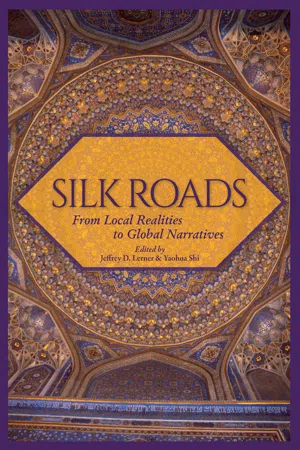
Silk Roads: From Local Realities to Global Narratives brings together leading scholars in multiple disciplines related to Silk Roads studies. It highlights the multiplicity of networks that constituted the Silk Roads, including land and maritime routes, and approaches the Silk Roads from Antiquity to China’s One Belt One Road Initiative from Afro-Eurasia to the Americas. This holistic approach to understanding ancient globalization, exchanges, transformations, and movements—and their continued relevance to the present—is in line with contemporary academic trends toward interdisciplinarity. Indeed, the Silk Roads is such an expansive topic that many approaches to its study must be included to represent accurately its many facets.
The volume emphasizes exchange and transformation along the Silk Roads—moments of acculturation or hybridization that contributed to novel syncretic forms. It highlights the multiplicity of networks that constituted the Silk Roads, including land and maritime routes, and approaches to the Silk Roads from Antiquity to China’s One Belt One Road Initiative from Afro-Eurasia to the Americas.
eBook - ePub
Silk Roads
From Local Realities to Global Narratives
- 312 pages
- English
- ePUB (mobile friendly)
- Available on iOS & Android
eBook - ePub
Silk Roads
From Local Realities to Global Narratives
About this book
Information
Subtopic
Business GeneralIndex
HistorySection Three
Tradition as Continuity and Change
Chapter 8
Devotional Prints and Practice: Woodcuts from the Library Cave at Dunhuang1
Bernadine Barnes
In both Europe and China, most of the earliest surviving printed images are religious woodcuts. In the West, these date from the 15th century, but in China we have woodcuts that date to around 700 CE – about 700 years earlier. Our knowledge of these prints and how they were used is largely due to their almost miraculous survival in a small cave within the Mogao complex near Dunhuang in western China. The oasis at Dunhuang, located at the point where the northern and southern routes of the Silk Road converge, was a thriving and cosmopolitan city for traders and pilgrims for hundreds of years. It became famous for the hundreds of meditation caves which were carved into the soft rock between the 4th and 14th century; the site was largely abandoned in the 15th century. A mingling of cultures at Dunhuang brought with it a myriad of faiths and religious practices. However, Buddhism was the dominant religion there, and the woodcuts found at Dunhuang give rich evidence of the use of prints in Buddhist practice.
The Chinese woodcuts I will discuss were found in Cave 17, the so-called Library Cave. A stele from the cave states that it was dedicated in 862 as a memorial chapel to the monk Hongbian; a statue of the monk has now been returned to its original location in the cave.2 However, the more interesting use of the cave for my purposes happened between the 9th and 11th centuries, when the statue was moved out and the cave began to be used to store manuscripts and other objects – eventually approximately 50,000 objects were put into the cave. The cave was sealed around the year 1000, and the doorway was later covered with plaster and paintings that date to the Song dynasty (960–1279). We do not know why the cave was sealed – a number of invasions around that time suggest that it was for protection of the documents, but they were not hastily stashed there; instead, they were neatly rolled and densely packed in the dry and nearly airless cave. Many of the items from the cave are very well-worn religious works, and some scholars believe that the space served as a repository for sacred texts awaiting repair or as a way to bury them away in anticipation of the end of the world.3 Yet, not all the objects found in the cave were texts – a very significant collection of paintings on silk and many small bronze Buddhist statues were also found. There were also many secular works, including almanacs, star charts, and documents on various mundane matters like boundary disputes, advice for women, and textbooks on writing and math. Sometimes these secular items were used to back or repair later Buddhist scrolls.4 Sketches and stencils used in making the wall paintings were also found in the cave, and these provide precious information about the artisans and their working methods.5 Of the documents found in the cave, manuscript scrolls far outnumber the printed works, and even fewer items contain images – only a few dozen exist in various collections.
The cave remained sealed until 1900, when it was rediscovered by Wang Yuanlu, a Daoist monk who had appointed himself abbot of Mogao. The Hungarian-born archeologist, Aurel Stein was the first European to explore the contents of the cave on his second expedition to the area in 1907, funded by the British and Indian governments. Because of the way the objects were brought to Stein and the manner in which he catalogued them (by type of object), it is impossible to know whether the scrolls and packets were placed in the cave in any sort of order; indeed, by the time Stein arrived Wang Yuanlu had repacked the entire cave.6 Stein convinced Wang to allow him to remove many scrolls (including the famous Diamond Sutra) and take them to England; these form the core of the collections at the British Museum and the British Library. The following year the French Sinologist Paul Pelliot visited the cave and secured many more items for French collections. Since then, many other items have been dispersed to collections in Asia, Europe, and the United States.7
The techniques and materials used in these prints were ancient even by the time the earliest examples from the cave were made. The process of woodcut printing is very simple. It involves spreading ink on the upper surface of a block that has been carved in relief and then transferring that ink to another surface like paper or fabric. The use of seals is a related form of relief printing; we know that signature seals, made from materials like bronze or jade, were used as early as the 2nd century BCE in China.8 These or similar stamps could make impressions on many types of materials, including fabric, wax, or earth, and textual sources point to the use of impressions in ritual practice around 600 CE.9 However, these practices produced ephemeral images, or in the case of printing on fabric only a limited number of works. The widespread use and distribution of woodcut prints depended upon the availability of paper. According to ancient Chinese annals, paper was invented in China in 103 CE so that it could be used for taking rubbings of the Confucian texts that had been carved on stone. However, paper-making certainly existed for two or three centuries before that.10 By the 2nd or 3rd century very fine paper was being made in several centers in China. It would still be some time before paper was inexpensive enough to allow it to be used extensively for printing; this happened by the 7th or early 8th century.11
Images and texts printed from woodblocks would need to be carved into a block of wood in reverse before printing. However daunting this may seem to us, the process was simple and could be carried out by even an illiterate block cutter because the characters would be transferred in reverse to the block from paper; the carver only needed to work around the outlines. The woodblocks could print as many as 15,000 identical copies – but it would be rare to print so many at once; a small run could be printed to test a market before producing many more identical copies. This is very different from using a press with moveable type (known in China by the 11th century), which would require the printer to anticipate how well a work would sell and make that many pages, then reset the type to create the next page; the possibility of error was much greater on both points.12 Perhaps for this reason – and because of the large number of characters – Chinese books continued to be printed from woodblocks into the 19th century.
In spite of the probability that many hundreds of impressions of printed books and images were made from each block, the fact that they were inexpensive works on paper meant that the prints were often reused or destroyed. Early examples of printmaking – either texts or images or both – are very rare, so the trove found in the Library Cave presents a truly extraordinary collection that shows the range of prints and their uses.
Certainly, the most famous printed work from the Library Cave is a Chinese translation of the Diamond Sutra, often considered the world’s earliest complete printed book; it is dated 868. The Diamond Sutra is one of the most important texts of Mahāyāna Buddhism; it is a relatively short text that was often committed to memory, since by doing so, one could attain enlightenment.13 It is a dialog between the Buddha and the monk Subhūti; the conversation itself is depicted in the frontispiece (Fig. 8.1). The Buddha faces toward the beginning of the text, although the first words in this scroll are not from the sutra itself, but are instructions to the devotee to purify the mouth and recite certain mantras before beginning.14 The densely packed composition shows the Buddha in the center surrounded by monks (identified by their bald heads), while delicate apsaras (angel-like figures) float above. Subhūti himself is shown praying below, with his slippers set neatly by his side, while two not very ferocious lions guard the throne. More fearsome are the guardian figures on either side. In the right corner is the patron whose name is recorded in the colophon at the end of the scroll, which states that the sutra was ‘Reverently made for universal free distribution by Wang Jie on behalf of [his] two parents on the fifteenth day of the fourth month of the ninth year of Xiantong [11 May 868].’15 For Buddhists, the accurate reproduction of the text was important, but perhaps more important was the idea that copying and dispersing sacred texts and images brought merit to the makers and patrons. That merit could be transferred to others including deceased relatives.
Artistically, this is a much more sophisticated image than many other printed images found in the cave; the rich composition as well as the skill it took to carve the curving lines of varied thicknesses suggests that a well-trained artist was at work. The paper too is very fine and is dyed with three different yellow compounds. Yellow was the sacred, imperial color – it represented solemnity and was thought to be auspicious; but the dyes, made from cork trees, also have insecticidal properties and made the sheets water-repellant. Scholars have concluded that it was probably made in Sichuan province, where the print industry was already well developed; the paper also appears to have been made in southwestern China, near the border of Tibet.16 Presumably, the owner brought the scroll with him on a pilgrimage to the caves and perhaps left it as an offering. The fact that this is a printed book suggests that it was one of many copies, but only the one example survives. It is not, however, the only copy of the Diamond Sutra that was found in the cave; some 500 manuscript copies or fragments survive, including some with colophons that describe why the copy was made: in one case the donor wanted the merit to be given to his ox, another had copies made in thanksgiving for a promotion.17

Fig. 8.1. The...
Table of contents
- Cover
- Title
- Copyright
- Table of contents
- Preface
- Acknowledgements
- Contributors
- Introduction : Jeffrey D. Lerner and Yaohua Shi
- Section One: Acculturation and Hybridization
- Section Two: Understanding Spice Through Interdisciplinarity
- Section Three: Tradition as Continuity and Change
- Section Four: Cultural Transactions
- Section Five: Long-Distance Commodity Trade
Trusted by 375,005 students
Access to over 1.5 million titles for a fair monthly price.
Study more efficiently using our study tools.
Frequently asked questions
Yes, you can cancel anytime from the Subscription tab in your account settings on the Perlego website. Your subscription will stay active until the end of your current billing period. Learn how to cancel your subscription
No, books cannot be downloaded as external files, such as PDFs, for use outside of Perlego. However, you can download books within the Perlego app for offline reading on mobile or tablet. Learn how to download books offline
Perlego offers two plans: Essential and Complete
- Essential is ideal for learners and professionals who enjoy exploring a wide range of subjects. Access the Essential Library with 800,000+ trusted titles and best-sellers across business, personal growth, and the humanities. Includes unlimited reading time and Standard Read Aloud voice.
- Complete: Perfect for advanced learners and researchers needing full, unrestricted access. Unlock 1.5M+ books across hundreds of subjects, including academic and specialized titles. The Complete Plan also includes advanced features like Premium Read Aloud and Research Assistant.
We are an online textbook subscription service, where you can get access to an entire online library for less than the price of a single book per month. With over 1.5 million books across 990+ topics, we’ve got you covered! Learn about our mission
Look out for the read-aloud symbol on your next book to see if you can listen to it. The read-aloud tool reads text aloud for you, highlighting the text as it is being read. You can pause it, speed it up and slow it down. Learn more about Read Aloud
Yes! You can use the Perlego app on both iOS and Android devices to read anytime, anywhere — even offline. Perfect for commutes or when you’re on the go.
Please note we cannot support devices running on iOS 13 and Android 7 or earlier. Learn more about using the app
Please note we cannot support devices running on iOS 13 and Android 7 or earlier. Learn more about using the app
Yes, you can access Silk Roads by Jeffrey D. Lerner, Yaohua Shi, Jeffrey D. Lerner,Yaohua Shi in PDF and/or ePUB format, as well as other popular books in History & Business General. We have over 1.5 million books available in our catalogue for you to explore.