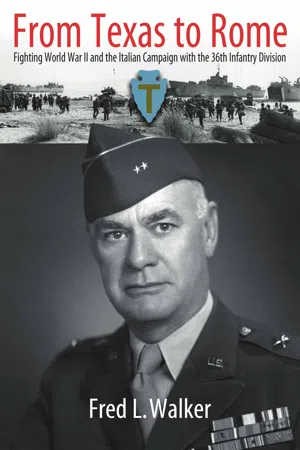
This remarkable and very rare memoir discusses the bloody combat history of the Texas National Guard 36th Infantry Division in World War II, from pre-embarkation training through the capture of Rome. The perspective, as seen through the eyes of its author, General Fred Walker, is refreshing for its refusal to rely upon hindsight and revisionist history.Walker led a division longer than any other American officer during World War II. The 36th earned a formidable reputation—and paid a high price for that distinction. Only five divisions in the entire U.S. Army suffered more casualties than the 36th during the course of the war.Some of the division’s fighting included the hard battles of Salerno and Monte Cassino. The 36th was assigned an assault river crossing at the Rapido to outflank the Cassino position and although several companies made it to the far bank, their tank support failed to cross the river. A German panzer grenadier counterattack pushed the infantry of the 36th back across the river with heavy losses. General Mark Clark, the 5th Army Commander, in what appeared to be an effort to scapegoat, relieved several key 36th division officers, although General Walker was retained as its commanding general. After the allies captured Rome, Walker was reassigned to command the Infantry School at Fort Benning. Includes a special guest Preface by Jeffrey W. Hunt, Director of the Texas Military Forces Museum, illustrations, photographs, maps. 504 pages.
eBook - ePub
From Texas to Rome
Fighting World War II and the Italian Campaign with the 36th Infantry Division
- 504 pages
- English
- ePUB (mobile friendly)
- Available on iOS & Android
eBook - ePub
From Texas to Rome
Fighting World War II and the Italian Campaign with the 36th Infantry Division
About this book
Information
PART I
THE 36TH DIVISION IN TRAINING SEPTEMBER 1941-MARCH 1943
CHAPTER ONE
JOINING THE 36TH
My service with the 36th-Texas National Guard-Division began prophetically in the middle of a hurricane alert during maneuvers in Louisiana in the Fall of 1941. I say “prophetically” because the Division had something of the quality of a hurricane. It was potentially the great fighting force which was to culminate in an overwhelming break-through of the German defenses at Velletri—thereby opening the road to Rome.
Merryville, Louisiana Saturday, September 13, 1941
I was tired and went to bed early, but before 9:00 PM a messenger awakened me to deliver an order from Division Headquarters that all equipment should be made secure immediately. A hurricane was expected to strike during the night.
I got up, routed out my orderly and drivers, and with their help was staking down my tent when I spotted someone with a flashlight approaching from the direction of Headquarters. I thought, “Order, counterorder, disorder.”
The orderly reported that General Greely wanted to see me at his tent. Major General John N. Greely, Commanding General, 2nd Infantry Division—the son of Adolphus Washington Greely, the Arctic explorer daringly rescued by Admiral Schley when a young officer—was my Chief.
“Why me? And at this hour of the night?” I wondered as I rapped at his tent.
“Come in,” he said.
I entered and, without any comment, he handed me a telegram. It read:
“WASHINGTON, D. C., 3 PM, SEPTEMBER 13, 1941. BY DIRECTION OF THE PRESIDENT, BRIGADIER GENERAL FRED L. WALKER IS HEREBY PLACED IN COMMAND OF THE 36TH DIVISION, REPLACING GENERAL CLAUDE V. BIRKHEAD.”
I was so surprised I read it twice, just to be sure.
When I looked up at last, Greely said,
I congratulate you.
Thank you, sir, but I don’t want it.
Why not?
The 36th is a National Guard Division. The Guard won’t like having a Regular as a Commanding General.
Oh, no! You are really very fortunate. All you have to do is threat them right. If you do, they will soon respect you.
When shall I move to the 36th?
John had anticipated my question and gave me some help. “Theoretically you have been in command since 3:00 PM and you are six hours late. You should go at once. On your way, stop at VIII Corps Headquarters. General Strong may want to talk to you.
Another salute and I was on my way, but I was not happy about it. I felt I knew the Guard and recalled my service as an enlisted in Troop B, Ohio National Guard, during my college days at Ohio State University. I remembered how rightly proud we were of our unit, which was a good one. After I had been commissioned in the Army, I heard some regular officers speak in a critical fashion of the Guard and imply a lack of cooperation. On the other hand, I remembered that when I was on duty in Washington, I attended some sessions of the National Guard Association during its conventions and had heard speakers make equally critical remarks about the Regular Army.
When I told my Aide, Captain Earle G. Wheeler—I call him Bus—and my orderly and drivers, they were delighted, all smiles and apparently did not share my skepticism. They suffered no pain in pulling up stakes, cheerfully undoing what they had been doing for the past half hour. The hurricane was completely forgotten.
On my way to the 36th Division, bivouacked about 12 miles to the north between Merryville and DeRidder, I stopped to see Major General George V. Strong, commanding the VIII Corps. General Strong is a cavalryman. He impresses me as a person who is quite unhappy. I have never seen him smile or laugh. In my opinion he does not have a sense of humor. He is pessimistic and is anything but physically strong. It may be that he has indigestion. He is known in his command as the “Little Scorpion.”
He seated me on a campstool inside his trailer which serves as an improved substitute for a tent. Without congratulating me on the appointment, he explained that I had been placed in command of the 36th upon his recommendation; that Major General Walter Krueger, Third Army Commander, had concurred, and that he would help me in any way he could to get the Division into a proper state of training and discipline.
“Do you know the Division?” he asked.
I did not.
“Well, then, you’ve got a lot of cleaning up to do. The Division has been in the Federal Service and the active Army for only ten months.”
Then he took up each general officer in turn, appraising his capabilities. He didn’t consider any of them qualified for combat duty. He told me flatly that I would have to replace them.
I did not like this. It was contrary to the generally accepted rule that a Division Commander has a free hand in the selection and rejection of his subordinates, but is held responsible for the efficient performance of his command.
I thought to myself, “There goes my military career. I am being made a whipping boy for Strong. He is giving me an unpleasant job which he should have done himself.”
If I am to be responsible to Strong for the proper functioning of the 36th Division, the means by which I accomplish this should not concern him—so long as I use good judgment, obtain desired results and maintain a high morale. But, in effect, he had said: “You are indebted to me for your command and I expect you to be my hatchet man, using my judgment and not yours with respect to the qualifications of your subordinates.” That is not my idea of my duty as a commander.
When all the general officers had been raked over the coals, Strong gave the division staff officers and some regimental commanders individual attention. In his opinion some possessed no promise. Some could be utilized, if they had the capacity to learn. Others had ability but would have to have proper leadership. I did not know a single one of them. They were just names to me, and I decided to reserve my judgment until after I had lived and worked with them. It seemed to me there was some Regular Army prejudice in his remarks. I listened carefully, but made mental reservations.
Continuing on our way to the 36th, I discussed with Bus much of what Strong had said. Wheeler and I are close friends. We served together in Tientsin, China, and at Fort Lewis, Washington. He is blessed with a high IQ and has unusually good judgment. To me he is more than an Aide, and I do not hesitate to discuss my problems with him.
NOTE: My judgement has been completely justified, since he is now Chairman of the Joint Chiefs of Staff.
When I finished my account of Strong’s version of the 36th, Bus said, “Well, General, it looks like we are going to have a hell of a time.”
When we arrived at Headquarters, 36th Division, General Birkhead of the Texas National Guard was waiting for me. I introduced myself and Wheeler, and at the same time presented the telegram, Birkhead did not glance at it.
I’ve been expecting you,” he said, “and I want to tell you are not welcome here.”
I was shocked, and at a loss for an immediate reply. I fully appreciated the blow his removal from command must have been and his natural, if illogical, resentment at my appointment. But professional courtesy is obligatory with rank, rooted as it is in the determination to keep things running smoothly.
When I had recovered, I told him I hoped that he would not look upon my replacing him as a personal matter; that I had been surprised by my assignment. My remarks received little or no attention and, as I felt there was nothing to be gained by prolonging the unfriendly conversation, I asked if there were any place for visitors where we might spend the night.
“No, none,” was the curt answer. “But you may put up your tents in the open space in the rear.”
We had brought with us only pup tents. Not a soul showed up to help us get settled. Wheeler, with his usual ingenuity located a vacant tent for the two of us and my orderly and drivers slept in our vehicles.
Near Hunter, Louisiana Sunday, September 14, 1941
Last night I did not do much sleeping; my thoughts were a jumble. “What kind of an outfit is this, anyway? Will the members of the Division Staff, having been appointed by Birkhead, find it difficult to transfer their loyalty to me, a Regular Army officer? Strong may be right. Maybe the Division does need changes.
“On the other hand, he could be wrong. I will find out for myself, I will treat them right, but I won’t trifle. I will meet situations as they come. I will not let myself leap to conclusions. True, in some National Guard Divisions, personalities and politics play an important role. But this Division is in the Federal Service and I will not let personalities interfere with my official responsibilities, One thing I know. I will get the job done.”
The hurricane never arrived.
Wheeler and I were up soon after daylight. When we stepped from our tent to get a look at our surroundings, I noticed that General Birkhead was up, so I went over to say good morning. He apparently had been up for some time, for he was neatly dressed and gave the impression of a man all set and ready to go. I saluted and meticulously paid every respect to his seniority of rank and age.
He returned my salute and it was every bit as smart as mine. His reply to my “Good Morning, Sir” was friendly. He stated that he was going to leave right after breakfast and take his Aide, sedan and driver with him. He did not ask my permission to take his sedan and driver which courtesy required.
I wanted to be generous and correct. “Of course, and take any other personnel or transportation you may desire. You may keep the sedan and driver as long as you like. Return them when you are through with them.” I extended this courtesy to him. As for myself I shall send my vehicles and drivers back to the 2nd Division tomorrow.
The question of breakfast then arose. He pointed out the mess tent and mentioned the hour. Wheeler and I were there on time, as was Birkhead. As the three of us were entering the tent in order of rank, Wheeler said to me in a low voice, “I hope they don’t put poison in our coffee.”
The Division Staff officers had preceded us and were standing at attention. Birkhead told me to sit on his immediate right, where I belonged. Wheeler was ignored, but he found a place at another table.
During the meal, General Birkhead talked mostly about his dieting habits which were rather unusual. He ate only one item of food at a meal—and this morning it was chocolate cake.
At length he signaled that the meal was ended by rapping on his plate for attention. He arose and introduced me as the new Division Commander, adding that he knew the members of his staff would give me the same high quality of loyalty and service that they had given him. Then he sat down and indicated that it was my turn to speak.
He had not warned me that he was going to do this—and certainly his actions of the previous evening had given no intimation of his intention—but I made a few remarks. I simply said that the staff was to carry on as usual; changes would be made only if necessary and when changes would be an improvement, but that there would be no changes until I had become acquainted with personnel and procedures. Outside I asked Birkhead to give me his personal appraisal of the military qualifications of each of his General Staff officers. He rated them all superior.
NOTE: The Staff of a Division Headquarters is divided into two groups. The General Staff is composed of five executives who form the principal study group and who supervise all of the activities of the Division. Their responsibilities are coordination, intelligence, personnel, supply, operations and training. The Special Staff is composed of chiefs of services such as ordnance, medical, signal, religion, quartermaster, finance, military justice, chemical, administration and military police. Also the commanders of artillery, engineer, reconnaissance, armor, tank destroyers and tank units were Special Staff Officers.
What I must do is to prevent speculation and political maneuverings by maintaining the personal dignity of men who are serving their country. When the axe has to fall it will, but not until I know when and where it is essential.
I arrived at the 36th just in time for a five-day maneuver under the direction of GHQ, so we buckled down to work at once. The Second Army under Lt. General Ben Lear, and the Third Army under General Walter Krueger, are going to butt into each other tomorrow. I checked the part the 36th will play and made no changes in Birkhead’s plans.
Shortly after noon I assembled the regimental commanders and their staffs. They are a splendid-appearing group of officers. Their faces reflect intelligence, friendliness and curiosity. Perhaps General Greely was right. Anyway I am favorably impressed.
I spoke to them briefly, reiterating what I had said to the Division Staff at breakfast, adding that I considered it a serious responsibility as well as a high honor to be their Division Commander. Then, after commenting on the coming maneuver I described a certain procedure I wanted them to follow on our first contact with the troops of the Second Army. They were intensely interested.
After they were dismissed, Colonel Nat S. Perrine, whom I had not spotted previously, came up to speak to me. I was delighted to see him again. As a part of his National Guard training he served four years on the War Department General Staff. During the years I was an instructor at the Army War College, he was on duty in the College Map Section there, and voluntarily attended the College lectures whenever he could find the time. I saw him almost every school day and we became good friends. I am pleased to learn that he is in command of the 142nd Regiment.
Saturday, September 20, 1941
Not all casualties in the military service are suffered on the battlefield. There is one enemy I can see we will have to fight before we become a real combat Division. That enemy is carelessness, which can be deadly and which, if allowed to expand, will be responsible for deaths—even defeat—when it comes to combat.
During the five days we were on maneuvers, some men were killed and others severely injured because of carelessness.
The troops had to move in and out of bivouacs at night; no lights allowed. Of course the men were tired and some would lie dow...
Table of contents
- Cover
- Title
- Copyright
- Dedication
- Table of contents
- Foreword to the 2021 Edition
- Foreword to the 1969 Edition
- Preface
- Prologue: The National Guard—Heir to the Militia
- PART I: The 36th Division in Training September 1941 – March 1943
- PART II: The 36th Division in Combat April 1943 – July 1944
- Appendix A
- Appendix B
- Appendix C
- Appendix D: A Classic Stratagem on Monte Artemisio by Ernest F. Fisher
- Appendix E
- Appendix F: General Comments
- About the Author: Major General Fred L. Walker
- Plate section
Trusted by 375,005 students
Access to over 1.5 million titles for a fair monthly price.
Study more efficiently using our study tools.
Frequently asked questions
Yes, you can cancel anytime from the Subscription tab in your account settings on the Perlego website. Your subscription will stay active until the end of your current billing period. Learn how to cancel your subscription
No, books cannot be downloaded as external files, such as PDFs, for use outside of Perlego. However, you can download books within the Perlego app for offline reading on mobile or tablet. Learn how to download books offline
Perlego offers two plans: Essential and Complete
- Essential is ideal for learners and professionals who enjoy exploring a wide range of subjects. Access the Essential Library with 800,000+ trusted titles and best-sellers across business, personal growth, and the humanities. Includes unlimited reading time and Standard Read Aloud voice.
- Complete: Perfect for advanced learners and researchers needing full, unrestricted access. Unlock 1.5M+ books across hundreds of subjects, including academic and specialized titles. The Complete Plan also includes advanced features like Premium Read Aloud and Research Assistant.
We are an online textbook subscription service, where you can get access to an entire online library for less than the price of a single book per month. With over 1.5 million books across 990+ topics, we’ve got you covered! Learn about our mission
Look out for the read-aloud symbol on your next book to see if you can listen to it. The read-aloud tool reads text aloud for you, highlighting the text as it is being read. You can pause it, speed it up and slow it down. Learn more about Read Aloud
Yes! You can use the Perlego app on both iOS and Android devices to read anytime, anywhere — even offline. Perfect for commutes or when you’re on the go.
Please note we cannot support devices running on iOS 13 and Android 7 or earlier. Learn more about using the app
Please note we cannot support devices running on iOS 13 and Android 7 or earlier. Learn more about using the app
Yes, you can access From Texas to Rome by Fred L. Walker in PDF and/or ePUB format, as well as other popular books in History & Historical Biographies. We have over 1.5 million books available in our catalogue for you to explore.