Simonides of Keos was one of the most important praise-poets of the early fifth century BCE, ranking alongside Pindar and Bacchylides. In Simonides Lyricus, a group of leading international experts revisit familiar questions about his lyric poetry, and pose new ones.Themes discussed include textual criticism and attribution of fragments; poetic genre and the place of the poet’s melic fragments in his larger oeuvre; the historical, cultural and political background of the poems; and Simonides’ afterlife in the biographical and anecdotal traditions that formed around his name.The volume makes a substantial contribution to modern discussions of Simonides’ place in Greek literary and cultural history and to the understanding of this poet’s often fragmentary and difficult texts.
eBook - ePub
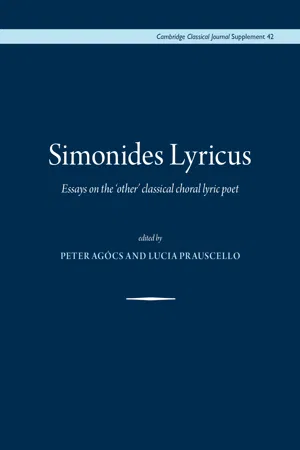
Simonides Lyricus
Essays on the 'other' classical choral lyric poet
- 297 pages
- English
- ePUB (mobile friendly)
- Available on iOS & Android
eBook - ePub
Simonides Lyricus
Essays on the 'other' classical choral lyric poet
About this book
Trusted by 375,005 students
Access to over 1.5 million titles for a fair monthly price.
Study more efficiently using our study tools.
Information
Subtopic
Greek Ancient HistoryIndex
LiteraturePART I
Simonides’ Songs:
Transmission and Authorship
CHAPTER 1
More Simonides among the fragmenta lyrica adespota?
A Survey of the Fragments and a Case Study: P.Strass inv. 1406–9
Giuseppe Ucciardello
1 A Survey of the adespota
The edition of Simonides’ lyric fragments by Orlando Poltera published in 2008 provides a revised text and an updated, full-scale commentary on everything that can be securely ascribed to the Cean poet.1 Compared with Pindar or Bacchylides, the corpus of Simonidean text preserved for us through the ages is much smaller than what we have of the other two poets. This is even more frustrating when one considers the quality of the fragments and the evidence they provide. Many of Simonides’ extant fragments cannot be anchored to any firm context, to say nothing of their putative location in the multiple books of the poet’s Alexandrian edition.
These books are described in the Suda entry s.v. ‘Simonides’. The relationship between the surviving fragments and the testimonia (TT2–4 Poltera) about the whole edition or selected books of it in the Suda and other similar sources is puzzling and leaves many questions open. On the one hand, we are told that some of Simonides’ lyric poems were classified as epinicians, thrēnoi, enkōmia, partheneia or paeans.2 On the other, however, we have some additional and highly suspicious titles such as the mysterious Deliaca (cited by Strabo as a collection of poems including a dithyramb entitled Memnon: PMG 539 = oo351 Poltera = dith. 131 Ieranò),3 and the still more enigmatic Kateukhai (Curses or Prayers), the meaning of which title is difficult to grasp: was there a collection of songs under this genre-label? Was it a title of a single poem only?4 We lack, furthermore, any understanding of the editorial arrangement of even such famous fragments as Simonides’ ‘Scopas ode’ (PMG 542 = 260 Poltera): did it stand among Simonides’ enkōmia?5 Ancient sources mention also a Hymn to Poseidon (PMG 576 = 242 Poltera), despite the fact that any reference to a book-roll of hymns is totally lacking in our eidographic sources.6
If, moreover, we cast a glance at the two and a half pages of ‘anonymous fragments of dubious attribution’ listed at the start of Poltera’s edition,7 we will find a group of lyric texts that deserve fresh consideration as possible authentic works of Simonides. Indeed, there are further snippets of text recovered from the papyri that might reasonably be attributed to an early choral poet, and that still await closer inspection. Might one not reasonably expect to discover more Simonides in these tantalising scraps?
Our knowledge of the processes by which Greek lyric songs were transmitted over the centuries is highly sketchy, especially since there was hardly any form of fixed authorial control over a text once it left the hands of its creator.8 Still, one can make informed guesses as to which book-roll of the Alexandrian edition a given fragment may have belonged to.
The purpose of the present chapter is to explore this issue, even if only partially. After a general review of the current evidence for papyrus fragments that might possibly be considered as Simonidean, I will focus on a single case study that concerns a set of papyri (P.Strass. inv. 1406–9) tentatively attributed to Simonides by their first editor, Bruno Snell, and which since then have never been re-examined in any detail. We may or may not end up learning new things about Simonides, but the case in question certainly has much to teach us about the difficulties of establishing authorship in a corpus of fragmentary papyrus texts.
Let us start by reviewing the papyrus evidence for Simonides’ lyric poetry. Of the papyri available to us today, some of which were already known when it was published, Page’s Poetae melici Graeci (for a long time the standard edition for Simonides’ lyric fragments) took into account only P.Oxy. XXV.2430, 2431, 2432, 2434 (= PMG 511, 519, 541, 608 = 7–9, 11–15, 22–35, 100–241, 256, 315 Poltera)9 and P.Berol. 13875.10
Since that time, new lyric fragments from Oxyrhynchus and elsewhere have been published,11 some of which might be Simonidean. Only P.Oxy. XXXII.2623 (MP3 1459.2 = LDAB 3918) has, however, been convincingly ascribed to the Cean poet, and hence incorporated into Poltera’s recent edition as fragments 21, 34 and 36–99.12 As with the earlier Simonidean papyri, the issue of authorship is controversial and slippery at least for three reasons:
(i) the very fragmentary state of the adespota available to us;
(ii) the fact that the corpus of Simonides’ extant lyric output which can be taken at face value is very small: hence, we are unlikely to be able to use comparison with securely attributed material as definitive evidence for authorship;
(iii) the fact that features of diction and style in the fragments transmitted to us as Simonidean are uneven: compare e.g. the pathos of the mother’s speech in the ‘Danae fragment’ (PMG 543 = 271 Poltera) with certain other lyric pieces redolent of traditional epic diction (e.g. PMG 581 = 262 Poltera).13 This inconsistency may well be due to variations of literary genre and performative setting; be that as it may, it means that we do not have predictable, fixed patterns of linguistic and stylistic usage that might allow us to compare our Simonidean fragments with those of the lyric adespota.
A balanced assessment of the evidence can thus be achieved only if we constantly remember that there is a large margin of uncertainty in everything we do. This is mainly due to the present state of the material and its erratic transmission. The list below sets out in alphabetical order those papyri for which Simonidean authorship has ever been suggested. Each entry also provides a brief, updated discussion of the likely content of each given fragment or set of fragments. For clarity’s sake, the survey falls into two sections. I first list the fragments recovered from papyri, and then those from the ancient indirect tradition (including both those that come to us e.g. from ancient papyrus commentaries or metrical manuals, and those that have reached us from the Byzantine manuscript tradition).14
1.1 Papyrus Fragments
(1) P.Ashm. inv. 20 + P.Oxy. XXIII.2364 + P.Oxy. XXXII.2364add. and P.Berol. inv. 16139 + BKT IX.113 = inv, 21209 (MP3 177.2 = LDAB 437; Bacch. dith. **24–9 M). Fragments from two rolls of the second/third century CE.
Provenance: Oxyrhynchus (P. Oxy.) and Soknopaiou Nesou (P.Berol.).
Content: a group of lyric fragments (a–d) with mythological content:
(a) Pasiphae, her beloved bull, Daedalus and the wooden cow, possibly with reference to her desire to escape Minos’ revenge? (P.Oxy. 2364, fr. 1.2 Πασι[φ]ά̣[α, 7 φράσε Δαιδάλωι, 11–12 κ̣ρύπτουσα σύννο̣[μ- | Μίνωα [τ]οξοδάμαν[τα]);
(b) Meleager and the siege of Calydon (P.Ashm. inv. 20.10 θ]αρσέα θηροδα̣[ΐκταν, 28 Κλυτ[ί]ον Προκάωνά τε);
(c) Some verses of P.Oxy. 2364, fr. 2 overlap with those in P.Berol. inv. 16139 + BKT IX.113 (inv. 21209). The content is uncertain: ll. 1–12 are likely to be part of a direct speech (cf. l. 13 ταῦτ’ ε[ἶ]πε φιλαγλαο[), with a sentence at ll. 7ff. on the unavoidable fate spoken by the Moirai (οὐ γάρ τις ἀνθρώπ̣[ω- | φύξις …). Irigoin 1993: 62 tentatively suggested a reference to Erechtheus’ destiny, while West 1993c: 237 speculated about Theban myth, positing a passage of direct speech uttered by Eteocles;
(d) P.Oxy. 2364, fr. 3, ii contains a speech uttered by Chiron prophesying Achilles’ future achievements (ll. 1–3 εὔβ[ο]υ̣λ̣[ο]ς̣ θαμ[ὰ Φ]ιλλυρί[δας] … φατί νιν [δινᾶ]ντα φοινίξειν Σκά[μανδρον, and cf. Hor. Ep. 13.11–17);15
(e) P.Oxy. XXXII.2364add. 6–11 presents a fragment of text about Οrpheus and the power of his songs to control nature (trees and the sea), followed by reference to Apollo and h...
Table of contents
- Cover
- Title
- Copyright
- Content
- List of Contributors
- List of Illustrations
- List of Abbreviations
- Introduction
- Part I. Simonides’ Songs: Transmission and Authorship
- Part II. Genres and Contexts of Performance, Patronage and Reception
- Part III. Simonides σοφòς: The Early Reception and the Creation of a Poet-Philosopher?
- Bibliography
Frequently asked questions
Yes, you can cancel anytime from the Subscription tab in your account settings on the Perlego website. Your subscription will stay active until the end of your current billing period. Learn how to cancel your subscription
No, books cannot be downloaded as external files, such as PDFs, for use outside of Perlego. However, you can download books within the Perlego app for offline reading on mobile or tablet. Learn how to download books offline
Perlego offers two plans: Essential and Complete
- Essential is ideal for learners and professionals who enjoy exploring a wide range of subjects. Access the Essential Library with 800,000+ trusted titles and best-sellers across business, personal growth, and the humanities. Includes unlimited reading time and Standard Read Aloud voice.
- Complete: Perfect for advanced learners and researchers needing full, unrestricted access. Unlock 1.5M+ books across hundreds of subjects, including academic and specialized titles. The Complete Plan also includes advanced features like Premium Read Aloud and Research Assistant.
We are an online textbook subscription service, where you can get access to an entire online library for less than the price of a single book per month. With over 1.5 million books across 990+ topics, we’ve got you covered! Learn about our mission
Look out for the read-aloud symbol on your next book to see if you can listen to it. The read-aloud tool reads text aloud for you, highlighting the text as it is being read. You can pause it, speed it up and slow it down. Learn more about Read Aloud
Yes! You can use the Perlego app on both iOS and Android devices to read anytime, anywhere — even offline. Perfect for commutes or when you’re on the go.
Please note we cannot support devices running on iOS 13 and Android 7 or earlier. Learn more about using the app
Please note we cannot support devices running on iOS 13 and Android 7 or earlier. Learn more about using the app
Yes, you can access Simonides Lyricus by Peter Agócs,Lucia Prauscello, Peter Agócs, Lucia Prauscello in PDF and/or ePUB format, as well as other popular books in Literature & Greek Ancient History. We have over 1.5 million books available in our catalogue for you to explore.