Differential Diagnosis in Dermatology
eBook - ePub

Differential Diagnosis in Dermatology

  1. 358 pages
  2. English
  3. ePUB (mobile friendly)
  4. Available on iOS & Android
eBook - ePub

Differential Diagnosis in Dermatology

About this book

DIFFERENTIAL DIAGNOSIS IN DERMATOLOGY

Fifth Edition

RICHARD ASHTON, MA, MD, FRCP, Consultant Dermatologist, Lighthouse Clinic, Isle of Wight, UK, formerly Consultant Dermatologist to the Royal Navy

BARBARA LEPPARD, DM, FRCP, Retired Consultant Dermatologist, Southampton University NHS Trust, UK

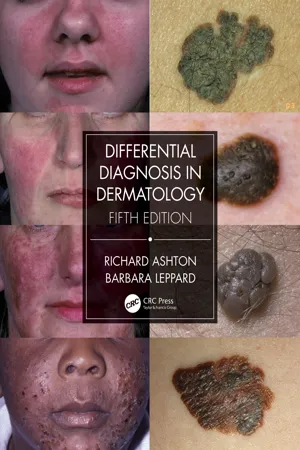
The ethos of this bestselling text is that however much or little you know about skin disease you can always arrive at the right diagnosis. The secret is to examine the surface of the rash or skin lesion which will help you classify the clinical features correctly - colour, surface features, type of lesion, border and how long it has been present. Algorithms throughout each chapter give the differential diagnosis for the features you have elicited. Accompanying clinical photographs and clear descriptions of the conditions will enable you to check whether you are right or not. If your choice seems unlikely, any conditions that could be confused with the one you selected are listed along the base of the algorithm to help you compare diagnoses so that you can get to the right answer.

We hope this new edition - enhanced with specific instructions on treatment - will be the only quick clinical reference you will ever need for dermatology diagnoses.

With over 1000 illustrations.

Information

Publisher
CRC Press
Year
2021
Print ISBN
9780367085971
9780367085988
eBook ISBN
9780429662867
Edition
5
Subtopic
Dermatology

1

Introduction to dermatological diagnosis

DIAGNOSIS OF SKIN DISEASE

The diagnosis of skin disease is made by following the same general principles as in any other branch of medicine. Begin by taking a history. This is followed by careful physical examination. If at this stage the diagnosis has not been made, further investigations can be carried out. It is very easy to look at a rash or skin lesion and ‘guess’ the diagnosis. This is quite unnecessary. In this chapter, we give you the tools you will need to enable you to make the correct diagnosis.

HISTORY OF PRESENTING COMPLAINT

Duration of individual lesions

How long have the lesion(s) been present? This is the most important question in the history. Acute lesions present for less than 2 weeks need to be distinguished from chronic ones.
Do the lesions come and go? Do they occur at the same site or at different sites? This question is particularly important if the diagnosis of urticaria or herpes simplex is being considered. Urticaria (p. 125) can be diagnosed by a history of lesions coming and going within a 24 hour period. To establish the transitory nature of urticarial weals, draw a line around a weal and ask the patient to return the next day. You will see that the site and shape will have changed. Herpes simplex (p. 77) and fixed drug eruptions (p. 133) last around 7–14 days and usually reoccur at the same site.

Relationship to physical agents

A past history of living or working in a hot climate may be the clue you need for the diagnosis of skin cancer. Determine the patient's skin response to sun exposure. Six skin types are recognised depending how well a patient develops a skin tan.
Table 1.01 Skin types
Type 1: Always burns, never tans
Type 2: Always burns, tans minimally
Type 3: Sometimes burns, tans gradually
Type 4: Rarely burns, tans well
Type 5: Asian skin
Type 6: Black skin
Those with fair skin (types 1 and 2) are more liable to develop skin cancers.
In rashes on the face and backs of the hands, ask about relationship to sun exposure. The important questions to ask are the time interval after sun exposure before the rash occurs and whether the patient gets the rash through window glass on a sunny day. In solar urticaria‚ the rash occurs within 5 minutes of sun exposure and is gone in an hour. In polymorphic light eruption (p. 71)‚ the rash occurs several hours after sun exposure and lasts several days. In porphyria (which is very rare, p. 301), the rash occurs within a few minutes and lasts several days. Rashes that occur through window glass are due to UVA and will need a sunblock containing titanium dioxide or zinc oxide (see p. 27).
Ask about irritants on the skin in hand eczema (p. 305), e.g. detergents and oils and about working practices and hobbies. Are the hands protected by rubber gloves or in direct contact with irritants?

Itching

Itching is a nuisance to the patient but may not help you in making a diagnosis. Severe itching especially at night bad enough to prevent sleep should make you think ...

Table of contents

  1. Cover
  2. How to use this book
  3. Dedication
  4. Title Page
  5. Copyright Page
  6. Contents
  7. 1 Introduction to dermatological diagnosis
  8. 2 Introduction to dermatological treatment
  9. 3 Hair and hairy scalp
  10. 4 Acute erythematous rash on the face
  11. 5 Chronic erythematous rash on the face
  12. 6 Mouth, tongue, lips and ears
  13. 7 Acute erythematous rash on the trunk and limbs
  14. 8 Chronic erythematous rash and lesions on trunk and limbs
  15. 9 Non-erythematous lesions
  16. 10 Flexures
  17. 11 Genitalia
  18. 12 Lower legs
  19. 13 Hands & feet
  20. 14 Nails
  21. General index
  22. List of drugs and associated drug reactions
  23. Classification of topical steroids by potency
  24. Emollient products – how and when to use
  25. Wash products
  26. Bath emollients
  27. Summary of types of wound and dressing to use
  28. Debriding agents
  29. Reducing bacterial counts and odour
  30. Absorption of exudate
  31. Wound and ulcer dressings
  32. Index of algorithms

Trusted by 375,005 students

Access to over 1.5 million titles for a fair monthly price.

Study more efficiently using our study tools.

Frequently asked questions

Yes, you can cancel anytime from the Subscription tab in your account settings on the Perlego website. Your subscription will stay active until the end of your current billing period. Learn how to cancel your subscription
No, books cannot be downloaded as external files, such as PDFs, for use outside of Perlego. However, you can download books within the Perlego app for offline reading on mobile or tablet. Learn how to download books offline
Perlego offers two plans: Essential and Complete
  • Essential is ideal for learners and professionals who enjoy exploring a wide range of subjects. Access the Essential Library with 800,000+ trusted titles and best-sellers across business, personal growth, and the humanities. Includes unlimited reading time and Standard Read Aloud voice.
  • Complete: Perfect for advanced learners and researchers needing full, unrestricted access. Unlock 1.5M+ books across hundreds of subjects, including academic and specialized titles. The Complete Plan also includes advanced features like Premium Read Aloud and Research Assistant.
Both plans are available with monthly, semester, or annual billing cycles.
We are an online textbook subscription service, where you can get access to an entire online library for less than the price of a single book per month. With over 1.5 million books across 990+ topics, we’ve got you covered! Learn about our mission
Look out for the read-aloud symbol on your next book to see if you can listen to it. The read-aloud tool reads text aloud for you, highlighting the text as it is being read. You can pause it, speed it up and slow it down. Learn more about Read Aloud
Yes! You can use the Perlego app on both iOS and Android devices to read anytime, anywhere — even offline. Perfect for commutes or when you’re on the go.
Please note we cannot support devices running on iOS 13 and Android 7 or earlier. Learn more about using the app
Yes, you can access Differential Diagnosis in Dermatology by Richard Ashton,Barbara Leppard in PDF and/or ePUB format, as well as other popular books in Medicine & Dermatology. We have over 1.5 million books available in our catalogue for you to explore.