Water and wastewater infrastructure are a somewhat invisible, yet critical, part of modern life. Incredibly, many buried assets have been in service for 50-100 years and are still in good condition. Conversely, other systems fail well before their predicted design lives, causing property damage, injury, and even loss of life. In many cases, early detection could have prevented catastrophic failure, and understanding the state of underground infrastructure has become a key priority for many municipalities. Industry has responded with a number of new and innovative technologies for condition assessment, however, understanding these tools can be difficult, as many vendors treat their proprietary systems as trade secrets.
Water and Wastewater Pipeline Assessment Technologies: Classification Systems, Sensors, and Results Interpretation provides a thorough guide to the technical workings of some of the most popular water and wastewater assessment technologies available, including CCTV crawlers, acoustic listening devices, laser sensors, 360? video cameras, pipe penetrating radar, and more.
Features:
Presents an overview of current technologies in CCTV inspection, including next generation video formats, high-definition resolution, and fisheye/sidescan technology.
Provides helpful tips and tricks to cut through technical jargon and identify the technological specifications to compare between multiple vendors.
Examines the pros and cons of competing technologies including laser and lidar, and provides an overview of unique approaches such as Pipe Penetrating Radar, Focused Electrode Leak Location, and more.
Highlights the importance of coding standards, data management, and software tools that can be leveraged to create a successful asset management program.
Water and Wastewater Pipeline Assessment Technologies: Classification Systems, Sensors, and Results Interpretation provides a mixture of theory and real-world, practical considerations ranging from deployment tips and data exchange formats to the technical limitations of different technologies. The book is a valuable resource for municipal employees, project engineers, and others involved in designing and implementing major inspection programs.
1Infrastructure and the Need for Condition Assessment
An Abbreviated History: Ancient Times through the Modern Era
Sewer and water lines are often thought of as modern conveniences in the United States as many rural areas of Appalachia continued to use outhouses and wells until the 1930s. It was not until electrification made it possible to pump water long distances that indoor plumbing became a reality for many Americans. Yet, in the rest of the world, this was not the case – piping systems have been found in ruins dating back to pre-Roman times.
This should not come as a surprise! When humans began to transition from tribes of nomadic hunter-gatherers and form cities centered around agriculture, their earliest needs centered around water. A supply of fresh water was needed for cooking, cleaning, and irrigation. A means of removing waste was critical for disease prevention. It follows that some of the earliest attempts at engineering involved constructing structures to solve these problems. While this is not a history textbook (see Walksi, Journal AWWA 2006), some important milestones will be discussed, as they directly relate to the state of our infrastructure today.
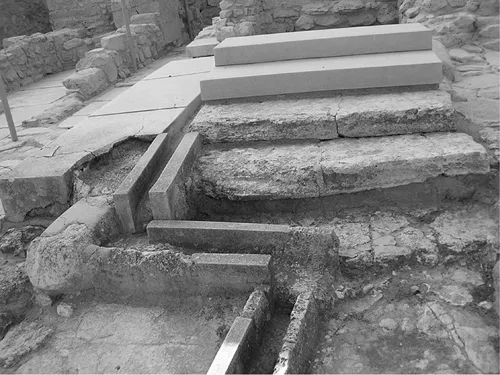
Civilizations able to channel gravitational energy were able to bring water into their homes and expel waste with ease. Many different cultures offer competing claims to the first water and wastewater systems. Ruins in Crete reveal that the Ancient Greeks were installing elaborate plumbing systems as far back as 1800 BC (Figure 1.1). Modern-day tourists gawk at Roman aqueducts and lead piping dating back as far as 312 BC. Amazingly, the great sewer or cloaca maxima, running through the heart of Rome, not only has portions surviving to the present day, but many sections have been integrated into the city’s modern sewer system.
FIGURE 1.1 Ancient sewers in Knossos, Crete. The Minoan civilization had some of the earliest examples of water and sewer systems. Public Domain: https://commons.wikimedia.org/wiki/File:Knossos_sewers_PA067399.webp
This triumph of engineering spread throughout the Roman empire – elaborate sewer and water systems survive in Italy, France and Britain. While the design and construction techniques did not benefit from computers or modern principles of design, many aspects of the system are impressive: smaller gradients throughout the system prevent the buildup of water pressure and excess erosion. Conduits were constructed above and below ground, and stepped cascades were used to introduce aeration. Siphons were even constructed to enable water to pass through depressions and valleys where arch construction would have been cost-prohibitive.
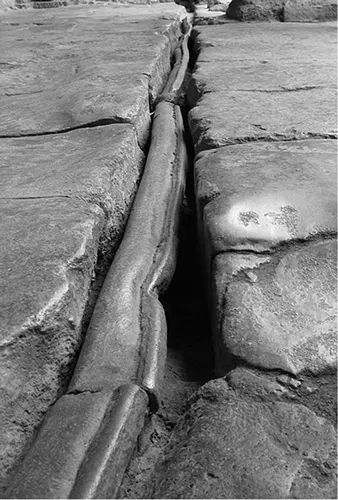
The Romans were also ahead of their time in their use of lead for piping considerations. Flexible, durable, and inexpensive, lead was a natural choice for piping applications. Lead also resisted developing cracks, pinholes, and other leaks, and could be easily connected segment by segment through soldering or brazing. It is also waterproof and relatively corrosion-free. The two concepts are so intertwined that the modern word “plumbing” even stems from the Latin word for lead: plumbum. Many scholars and historians have argued over whether or not chronic lead poisoning may have played a role in the decline and fall of Roman civilization or in displays of madness by Roman emperors and citizens (Figure 1.2).
FIGURE 1.2 Surviving Roman lead pipe used to supply water to the public baths. This example is located in Bath, England, showing both the breadth of the Roman Empire and the longevity of their engineering. Photograph by Andrew Dunn. Creative Commons: https://commons.wikimedia.org/wiki/File:Lead_pipe_-_Bath_Roman_Baths.webp
The truth may be difficult to fully establish, even with two millennia of hindsight. While some Roman skeletons have been found with elevated levels of lead, it is important to note that Romans encountered lead in far more aspects of daily life than the water supply: lead was a key component in plates and cosmetics; many wealthy Romans even used lead acetate as an alternative to sugar – one of the first artificial sweeteners.
An analysis of surviving water lines suggests that very little lead leaching occurred. These gravity-fed systems carried water from the same sources for centuries, allowing chemical processes to form a protective oxide coating on the interior of these pipes. This oxide coating largely prevented widespread leaching of lead into the water supply. As publicly funded structures, many aqueducts benefited from central planning and proactive maintenance. Roman aqueduct managers avoided connecting acidic sources of water into the system, preserving that protective oxide layer – a lesson that the public works staff in Flint, Michigan, would have been wise to take note of.
Unfortunately, the fall of Rome led to an abandonment of many engineering techniques throughout the Middle Ages. It wasn’t until industrialization and urbanization led to outbreaks of typhoid and cholera that countries invested in updated piping systems. Many European cities took in drinking water from the same rivers to which waste was discharged – making it difficult for residents to escape waterborne disease. Prior to the construction of sewers, residents who did not simply dump waste into gutters along the street made use of large cesspits – chambers under floors or in yards into which waste was regularly dumped.
Cesspits were not watertight structures – nor were they designed to be. Over time, liquid would seep out of the sides and bottom of the structure, leaving behind solid waste. This liquid seepage often contaminated groundwater, and the built-up filth remaining in the cesspits had to be emptied every few years. Nightmen or “gong farmers” had the unenviable job of entering and cleaning out cesspits, loading excrement into carts for disposal at predetermined locations, ranging from dumps to fields for fertilizer use.
As the prevalence of disease grew with urban populations, in the 1700s and 1800s, major engineering activities commenced to bring water into private homes and connect individual buildings to shared sewer systems for the disposal of waste. Sometimes these undertakings were driven by emperors: Napoleon commissioned the construction of 30 km of sewers in Paris. Other times, influential engineers spread the evangelism of water and sewer systems: British engineer William Lindley and his sons designed and constructed systems in Hamburg, Warsaw, St. Petersburg, Prague, and Budapest.
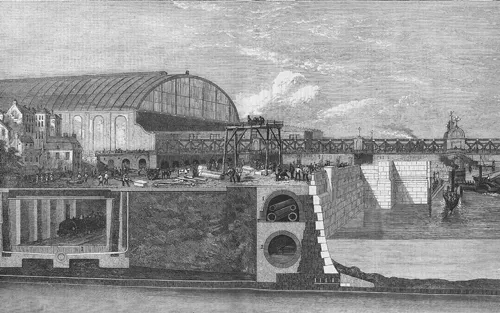
Perhaps the most well-known designer of sewerage systems was the British civil engineer, Joseph Bazalgette, who was responsible for the design and construction of a major network of interceptors (large diameter sewers that “intercept” flow from smaller upstream pipes) in London, designed to channel waste to the Thames estuary, far from drinking water supplies. Bazalgette’s design incorporated more than 100 miles of interceptors fed by an additional 400+ miles of feeder systems. Waste that needed to be discharged upstream of the estuary was fed into treatment plants, and pumping stations allowed sewage to flow through regions ill-suited to gravitational design (Figure 1.3).
FIGURE 1.3 The Victoria embankment was constructed to allow interceptors to collect sewage and prevent discharge to the Thames. This graphic showing construction is from the Illustrated London News, 1867. Public Domain: https://www.museumoflondon.org.uk/application/files/7315/5360/9930/Cross-section-of-the-Embankment.webp
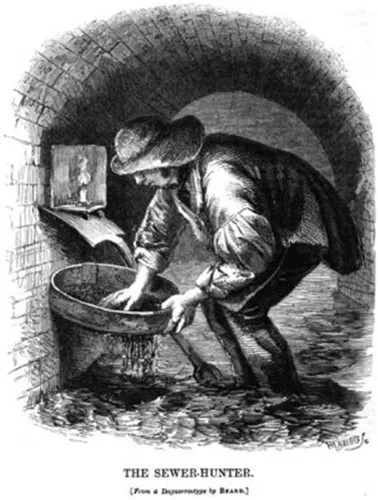
Bazalgette commenced his efforts with broad public support from both government and citizens. Recent legislation outlawing cesspits in London required buildings to connect to sewer systems – nearly all of which drained to the Thames. The result was a massive increase in sewage discharges, much of which was in close proximity to the intakes for water supply. This led to a series of cholera epidemics which killed tens of thousands of Londoners in 1848 and 1853. In 1858, an unseasonably warm summer, coupled with a prolonged drought, concentrated sewage in the Thames. This produced an additional outbreak of cholera, coupled with the “Great Stink” – a smell of sewage so foul that it spread throughout the city. In the days before germ theory was widely accepted, this stink was not just an inconvenience, but rather a source of panic, as residents feared that inhaling the smell could cause them to contract cholera or other diseases (Figure 1.4).
FIGURE 1.4 Drawing of a “tosher” – an individual who entered sewers and searched for valuables among the excrement in Victorian-era London. Public Domain: From London Labour and the London Poor (1850, Mayhew) https://www.smithsonianmag.com/history/quite-likely-the-worst-job-ever-319843/
Thus, British society was receptive to Bazalgette’s proposal for comprehensive water and sewerage systems. In addition to being functional, these systems were a testament to Victorian design sensibilities. Pumping stations from the era have decorative, elaborate ironworks, and tourists today can descend into the system, wade through waist-deep sewage, and marvel at how this Victorian-era system continues to serve London to the present day. Bazalgette’s design not only effectively eliminated cholera in the city, but his idea to double capacity estimates allowed his structures to endure into the 21st century, even as London continues to grow.
In the United States, the first sewer systems took shape around the same time. While early colonial settlements sometimes used sewers or drainpipes made of hollowed-out logs to drain waste from homes into nearby streams, the first comprehensive interceptor systems were constructed in the mid-1800s in cities like Boston, Chicago, and Brooklyn.For more information on the history of sewers in America, see the excellent sewer history website compiled by Jon C. Schladweiler, http://www.sewerhistory.org.
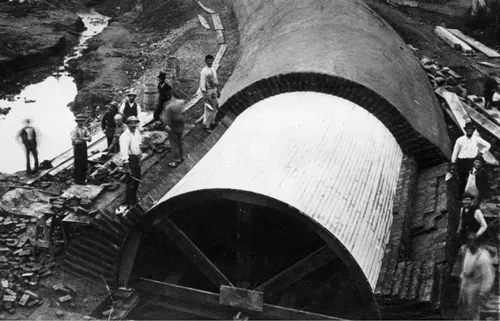
American sanitation engineers – like Bazalgette – were attempting to design systems that could be future-proofed to some degree. Installing a large interceptor sewer was a major capital project (Figure 1.5). Cities investing in a system would not be thrilled at the prospect of digging new tunnels and boring through rock again in just a few years – as many engineers learned the hard way. In the absence of actual water usage data, trial and error was an unfortunate part of early sewer design, with backups and overflows becoming a common occurrence.
FIGURE 1.5 East Coast cities such as Philadelphia were some of the earliest developers of sewer systems in the United States. This photo shows an interceptor under construction in 1883. Public Domain: http://www.phillyh2o.org/canvas/canvas07.htm
Critically, many of these engineers also made a decision that would have significant future consequences – they decided to kill two birds with one stone and design wastewater conveyance systems that not only took sewage to treatment plants, but also conveyed stormwater away from streets and surfaces during precipitation events. These combined sewer systems have become a major Achilles heel in America’s buried infrastructure.
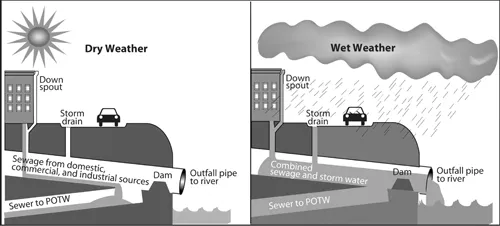
The idea behind combined sewer systems is logical: it doesn’t make sense to install two complete sets of pipes for stormwater and sewage. In a completely separate system, the stormwater side will sit empty when there is no precipitation – something that applies to most days in places like Phoenix, Pittsburgh, and St. Louis. In a combined system, stormwater flows into the same interceptors that are carrying sewage to the treatment plant. In the event that rainfall exceeds the capacity of the system, combined sewers were designed to intentionally overflow into surrounding waterways in order to prevent damage to the treatment plant (Figure 1.6).
FIGURE 1.6 Combined sewers were commonly constructed before the passage of the Clean Water Act. This EPA image shows operation during dry weather and discharges during wet-weather events. Public Domain: https://en.wikipedia.org/wiki/Combined_sewer#/media/File:CSO_diagram_US_EPA.svg
While many of us recoil at the thought of intentionally discharging sewage into a waterway, at the time many of these systems were built, this was not so egregious. Until the 1970s, most wastewater treatment plants only engaged in primary treatment – debris were physically screened out of the system, solids were separated and allowed to settle, and effluent was discharged into waterways. This is a far cry from systems of today, and produced water that was visually clean, yet capable of harboring waterborne diseases and illnesses. Fecal coliform bacteria discharged in Pittsburgh can travel down the Ohio River, enter the Mississippi River, and impact users hundreds of miles downstream. To early engineers and designers, a few wet-weather discharges at strategic locations seemed more like smelly inconveniences rather than major threats to public health. At the time, industrial discharges meant that rivers and other waterways were not seen as desirable recreational destinations for the population. It was not uncommon for old cars to be placed along riverbanks as a method of erosion control – how picturesque!
America’s waterways were so bad that they literally could catch on fire. In 1969, the Cuyahoga River was carrying significant amounts of debris from factories and industries in nearby Cleveland. In June of that year, a spark into the river caused the mixture of trash, chemicals, and other waste to ignite, causing a blaze that floated down the river. While the event did not cause loss of life, it indicated just how polluted rivers in the United States had become and was cited as one of the events that drove the passage of the Federal Water Pollution Control Act (or Clean Water Act) in 1972.
The Clean Water Act changed the regulatory landscape significantly, making it illegal for any person or entity to discharge a pollutant into a protected waterway. While this targeted industrial users, it also applied to wastewater treatment plants – effluent from primary trea...
Table of contents
Cover
Half-Title
Title
Copyright
Contents
Preface
Author Bio
Introduction
Chapter 1 Infrastructure and the Need for Condition Assessment
Chapter 2 Visual Inspection Technology and Data Coding Systems
Chapter 3 Classifying and Analyzing Visual Inspection Data
Chapter 4 Quantifying Condition above and below the Flow: An Overview of Sonar and Laser Technologies
Chapter 5 Methods for Detecting Hydrogen Sulfide Gas
Chapter 6 Leak Detection – Static Sensors and Acoustic Inspections
Chapter 7 Other Leak Detection Technologies: Focused Electrodes, Gas Tracers, and Infrared Imaging
Chapter 8 Condition Assessment in Water Lines
Chapter 9 Manholes, Laterals, and Ancillary Structures
Chapter 10 Software Packages and Asset Management
Chapter 11 Future Trends in Condition Assessment
Chapter 12 The Importance of Condition Assessment
Appendix A: Sample Cleaning and CCTV Inspection Specification
Index
Trusted by 375,005 students
Access to over 1.5 million titles for a fair monthly price.
Study more efficiently using our study tools.
Frequently asked questions
Yes, you can cancel anytime from the Subscription tab in your account settings on the Perlego website. Your subscription will stay active until the end of your current billing period. Learn how to cancel your subscription
No, books cannot be downloaded as external files, such as PDFs, for use outside of Perlego. However, you can download books within the Perlego app for offline reading on mobile or tablet. Learn how to download books offline
Perlego offers two plans: Essential and Complete
Essential is ideal for learners and professionals who enjoy exploring a wide range of subjects. Access the Essential Library with 800,000+ trusted titles and best-sellers across business, personal growth, and the humanities. Includes unlimited reading time and Standard Read Aloud voice.
Complete: Perfect for advanced learners and researchers needing full, unrestricted access. Unlock 1.5M+ books across hundreds of subjects, including academic and specialized titles. The Complete Plan also includes advanced features like Premium Read Aloud and Research Assistant.
Both plans are available with monthly, semester, or annual billing cycles.
We are an online textbook subscription service, where you can get access to an entire online library for less than the price of a single book per month. With over 1.5 million books across 990+ topics, we’ve got you covered! Learn about our mission
Look out for the read-aloud symbol on your next book to see if you can listen to it. The read-aloud tool reads text aloud for you, highlighting the text as it is being read. You can pause it, speed it up and slow it down. Learn more about Read Aloud
Yes! You can use the Perlego app on both iOS and Android devices to read anytime, anywhere — even offline. Perfect for commutes or when you’re on the go. Please note we cannot support devices running on iOS 13 and Android 7 or earlier. Learn more about using the app
Yes, you can access Water and Wastewater Pipeline Assessment Technologies by Justin Starr in PDF and/or ePUB format, as well as other popular books in Tecnologia e ingegneria & Gestione delle risorse umane. We have over 1.5 million books available in our catalogue for you to explore.