eBook - ePub
Inductors and Transformers for Power Electronics
- 478 pages
- English
- ePUB (mobile friendly)
- Available on iOS & Android
eBook - ePub
Inductors and Transformers for Power Electronics
About this book
Although they are some of the main components in the design of power electronic converters, the design of inductors and transformers is often still a trial-and-error process due to a long working-in time for these components. Inductors and Transformers for Power Electronics takes the guesswork out of the design and testing of these systems and provides a broad overview of all aspects of design.
Inductors and Transformers for Power Electronics uses classical methods and numerical tools such as the finite element method to provide an overview of the basics and technological aspects of design. The authors present a fast approximation method useful in the early design as well as a more detailed analysis. They address design aspects such as the magnetic core and winding, eddy currents, insulation, thermal design, parasitic effects, and measurements. The text contains suggestions for improving designs in specific cases, models of thermal behavior with various levels of complexity, and several loss and thermal measurement techniques.
This book offers in a single reference a concise representation of the large body of literature on the subject and supplies tools that designers desperately need to improve the accuracy and performance of their designs by eliminating trial-and-error.
Information
1
Fundamentals of Magnetic Theory
This chapter gives a brief review of the basic laws, quantities, and units of magnetic theory. Magnetic circuits are included together with some examples. The analogy between electric and magnetic circuits and quantities is presented. Hysteresis and basic properties of ferromagnetic materials are also discussed. The models of the ideal transformers and inductors are shown.
1.1 Basic Laws of Magnetic Theory
The experimental laws of electromagnetic theory are summed up by the Maxwell equations. In 1865, after becoming acquainted with the experimental results of his fellow Englishman Faraday, Maxwell gave the electromagnetic theory a complete mathematical form. We will present specific parts of the Maxwell equations: Ampere’s law, Faraday’s law, and Gauss’s law, which together with Lenz’s law are the basis of magnetic circuit analysis. These are the laws that are useful in the design of magnetic components for power electronics.
1.1.1 Ampere’s Law and Magnetomotive Force
When an electrical conductor carries current, a magnetic field is induced around the conductor, as shown in Fig. 1.1. The induced magnetic field is characterized by its magnetic field intensity H. The direction of the magnetic field intensity can be found by the so-called thumb rule, according to which, if the conductor is held with the right hand and the thumb indicates the current, the fingers indicate the direction of the magnetic field.
The magnetic field intensity H is defined by Ampere’s law. According to Ampere’s law the integral of H [A/m] around a closed path is equal to the total current passing through the interior of the path (note that a line above a quantity denotes that it is a vector):
(1.1) |
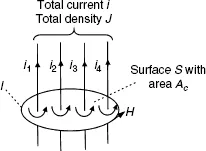
Illustration of Ampere’s law. The MMF around a closed loop is equal to the sum of the positive and negative currents passing through the interior of the loop.
where
H is the field intensity vector [A/m]d l is a vector length element pointing in the direction of the path l [m]J is the electrical current density vector [A/m2]dS is a vector area having direction normal to the surface [m2]l is the length of the circumference of the contour [m]S is the surface of the contour [m2]
If the currents are carried by wires in a coil with N turns, then
(1.2) |
where
i is the current in the coilN is the number of the turns.
The terms and Ni in Equation (1.2) are equivalent to a source called magnetomotive force (MMF), which is usually denoted by the symbol F [A · turns]. Note that the number of turns N does not have dimension, but th...
Table of contents
- Cover
- Half Title
- Title Page
- Copyright Page
- Dedication
- Preface
- Acknowledgments
- About the Authors
- Nomenclature
- Table of Contents
- 1 Fundamentals of Magnetic Theory
- 2 Fast Design Approach Including Eddy Current Losses
- 3 Soft Magnetic Materials
- 4 Coil Winding and Electrical Insultion
- 5 Eddy Currents in Conductors
- 6 Thermal Aspects
- 7 Parasitic Capacitances in Magnetic Components
- 8 Inductor Design
- 9 Transformer Design
- 10 Optimal Copper/Core Loss Ratio in Magnetic Components
- 11 Measurements
- Appendix A RMS Values of Waveforms
- Appendix B Magnetic Core Data
- Appendix C Copper Wires Data
- Appendix D Mathematical Functions
- Index
Trusted by 375,005 students
Access to over 1.5 million titles for a fair monthly price.
Study more efficiently using our study tools.
Frequently asked questions
Yes, you can cancel anytime from the Subscription tab in your account settings on the Perlego website. Your subscription will stay active until the end of your current billing period. Learn how to cancel your subscription
No, books cannot be downloaded as external files, such as PDFs, for use outside of Perlego. However, you can download books within the Perlego app for offline reading on mobile or tablet. Learn how to download books offline
We are an online textbook subscription service, where you can get access to an entire online library for less than the price of a single book per month. With over 1.5 million books across 990+ topics, we’ve got you covered! Learn about our mission
Look out for the read-aloud symbol on your next book to see if you can listen to it. The read-aloud tool reads text aloud for you, highlighting the text as it is being read. You can pause it, speed it up and slow it down. Learn more about Read Aloud
Yes! You can use the Perlego app on both iOS and Android devices to read anytime, anywhere — even offline. Perfect for commutes or when you’re on the go.
Please note we cannot support devices running on iOS 13 and Android 7 or earlier. Learn more about using the app
Please note we cannot support devices running on iOS 13 and Android 7 or earlier. Learn more about using the app
Yes, you can access Inductors and Transformers for Power Electronics by Vencislav Cekov Valchev,Alex Van den Bossche in PDF and/or ePUB format, as well as other popular books in Technology & Engineering & Electrical Engineering & Telecommunications. We have over 1.5 million books available in our catalogue for you to explore.