Timing for Animation, 40th Anniversary Edition
eBook - ePub

Timing for Animation, 40th Anniversary Edition

  1. 166 pages
  2. English
  3. ePUB (mobile friendly)
  4. Available on iOS & Android
eBook - ePub

Timing for Animation, 40th Anniversary Edition

About this book

Timing for Animation has been one of the pillars of animation since it was first published in 1981. Now this 40th anniversary edition captures the focus of the original and enhances this new edition with fresh images, techniques, and advice from world-renowned animators. Not only does the text explore timing in traditional animation, but also timing in digital works.

Vibrant illustrations and clear directions line the pages to help depict the various methods and procedures to bring your animation to life. Examples include timing for digital production, digital storyboarding in 2D, digital storyboarding in 3D, and the use of After Effects, as well as interactive games, television, animals, and more. Learn how animated scenes should be arranged in relation to each other, how much space should be used, and how long each drawing should be shown for maximum dramatic effect.

All you need to breathe life into your animation is at your fingertips with Timing for Animation.

Key Features:

  • Fully revised and updated with modern examples and techniques
  • Explores the fundamentals of timing, physics, and animation
  • Perfect for the animation novice and the expert

Get straight to the good stuff with simple, no-nonsense instruction on the key techniques like stretch and squash, animated cycles, overlapping, and anticipation.

Trying to time weight, mood, and power can make or break an animation—get it right the first time with these tried and tested techniques.

Authors

Harold Whitaker was a BAFTA-nominated professional animator and educator for 40 years; many of his students number among today's most outstanding animation artists.

John Halas, known as "The father of British animation" and formerly of Halas & Batchelor Animation Studio, produced more than 2,000 animation films, including the legendary Animal Farm (1954) and the award-winning Dilemma (1981). He was also the founder and president of the International Animated Film Association (ASIFA) and former Chairman of the British Federation of Film Societies.

Tom Sito is Professor of Animation at the University of Southern California and has written numerous books and articles on animation. Tom's screen credits include Shrek (2001) and the Disney classics Who Framed Roger Rabbit (1988), The Little Mermaid (1989), Beauty and the Beast (1991), Aladdin (1992), and The Lion King (1994). In 1998, Tom was named by Animation Magazine as one of the 100 Most Important People in Animation.

Frequently asked questions

Yes, you can cancel anytime from the Subscription tab in your account settings on the Perlego website. Your subscription will stay active until the end of your current billing period. Learn how to cancel your subscription.
No, books cannot be downloaded as external files, such as PDFs, for use outside of Perlego. However, you can download books within the Perlego app for offline reading on mobile or tablet. Learn more here.
Perlego offers two plans: Essential and Complete
  • Essential is ideal for learners and professionals who enjoy exploring a wide range of subjects. Access the Essential Library with 800,000+ trusted titles and best-sellers across business, personal growth, and the humanities. Includes unlimited reading time and Standard Read Aloud voice.
  • Complete: Perfect for advanced learners and researchers needing full, unrestricted access. Unlock 1.4M+ books across hundreds of subjects, including academic and specialized titles. The Complete Plan also includes advanced features like Premium Read Aloud and Research Assistant.
Both plans are available with monthly, semester, or annual billing cycles.
We are an online textbook subscription service, where you can get access to an entire online library for less than the price of a single book per month. With over 1 million books across 1000+ topics, we’ve got you covered! Learn more here.
Look out for the read-aloud symbol on your next book to see if you can listen to it. The read-aloud tool reads text aloud for you, highlighting the text as it is being read. You can pause it, speed it up and slow it down. Learn more here.
Yes! You can use the Perlego app on both iOS or Android devices to read anytime, anywhere — even offline. Perfect for commutes or when you’re on the go.
Please note we cannot support devices running on iOS 13 and Android 7 or earlier. Learn more about using the app.
Yes, you can access Timing for Animation, 40th Anniversary Edition by Harold Whitaker,John Halas, Tom Sito in PDF and/or ePUB format, as well as other popular books in Computer Science & Digital Media. We have over one million books available in our catalogue for you to explore.

Information

Publisher
CRC Press
Year
2021
eBook ISBN
9781000338225
Edition
3

Timing to Suggest Weight and Force—1

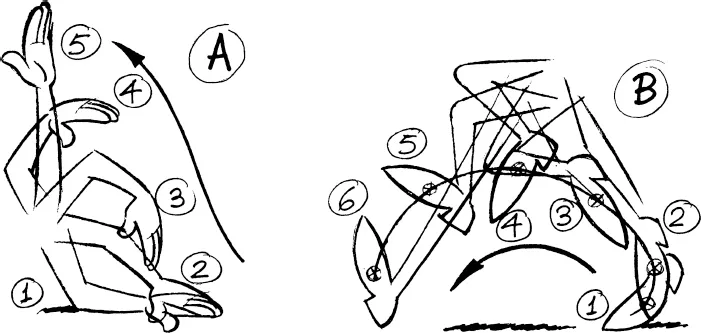
Each part of the body moves as a result of the action of muscles, or as a result of the movement of another part of the body to which it is attached. For instance in Fig. 33A, when the arm is raised, the upper arm tends to be raised first by the shoulder muscles. As the elbow is a flexible joint, there is a time lag before the forearm starts to move and similarly another time lag before the hand moves.
images
images
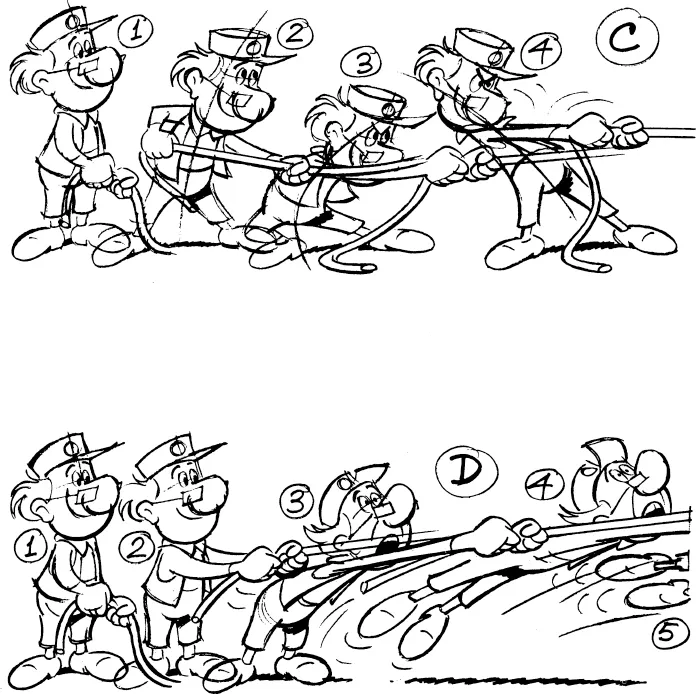
FIG 33A Raising an arm, showing effect of flexible joints. B In a walk the flexible ankle joint results in the foot (railing downward as the ankle goes up on drawings 2 and 3, and trailing upward as the ankle goes down on drawings 5 and 6. C The sequence of events when a man pulls on a rope. On drawing 2 he takes up the slack, on 3 he starts to move his body weight backward, and on 4 he leans back on the rope. D When the rope itself is jerked, the man’s arms are drawn forward until they are in a straight line with the rope. At this point his shoulders are pulled forward in drawing 3 and in 4 and 5 his whole body is dragged away.
In a walk, the knee is a hinge joint and the ankle acts almost like a ball and socket joint. If the angle between the shin and the foot is kept the same, the ankle joint appears to be rigid, so this angle must vary. In Fig. 33B the foot starts on the ground (position 1) and is lifted forward for the step. The knee is raised, but the foot tends to hang back and so comes up heel first. The toe trails downward until the top of the movement (position 4), but as the leg straightens the foot tends to keep going up and so, as the heel goes down, the foot rotates until the heel hits the ground (positions 5 and 6). The foot now tends to continue its downward movement but as it is stopped by the ground it quickly slaps down flat.
If, as in Fig. 33C, a character is to give a strong pull on a rope, the first part of the body to move is probably the hips, followed by the shoulders, the arms, and finally by the rope. The amount of movement depends on the strength of the character, the weight on the other end of the rope, and the mood of the scene, but the order in which different parts of the movement take place is the same.
If, in the same situation, the character is being pulled by a force at the other end of the rope, as in Fig. 33D, then the order of events is reversed. First the rope moves, then the arm, the shoulders, and the hips. The first part of the pull takes up the slack in the rope, and if the movement is fast, the shoulders do not move until the rope and the arms have been pulled into a straight line. At this point the shoulders jerk forward and the character tends to pull out into a straight line as he goes out of screen. In a slow, steady pull the character may have time to react and try to resist.

Timing to Suggest Weight and Force—2

To give the impression that a character is wielding a heavy hammer it is important to time the movement carefully.
The start position is as Fig. 34-1. The man is relaxed with the hammer head resting on the peg which he is going to hit. To start the movement he lifts the hammer. If it is heavy, he cannot do this in the position shown in Fig. 34-1A as he would then be off-balance and would topple over. In order to transfer the weight of the hammer over his feet so that he is balanced, he must step forward and grasp the hammer near its head (Fig. 34-2). He can now slide the hammer toward himself and lift it above his widely spaced feet (Fig. 34-3). As the head of the hammer rises above shoulder level, he starts to move its weight backward in preparation for the forward action. However he cannot let it go too far behind him or he would overbalance backward (Fig. 34-4). So he starts to move his body weight forward, and this eventually starts the hammerhead moving forward (Fig. 34-5). He jerks his body forward and downward to give a forward impetus (Fig. 34-6) and the job is done. Now he need only step back and the hammer will fall and hit the peg. This position links up to Fig. 34-1 or at least Fig. 34-2.
images
FIG 34To make the hammer look heavy, the man must keep the weight of the hammerhead more or less balanced above his feet, until he hits the ground with it. Only a light hammer could be lifted, as in 1A, without the man falling over.

Timing to Suggest Weight and Force—3

In an energetic, repeated movement, for example, a man hitting something with a pitchfork, the different parts of the figure move in a particular way to give the maximum feeling of effort (Fig. 35).
Drawing 1 shows the impact of the pitchfork with the ground. The end of the pitchfork remains in contact with the ground for drawings 2–4, while the body begins to move out of the extreme position in readiness for the next stroke. The shoulders arrive at their furthest backward position in drawing 7 and begin to move forward again in drawing 8, although the head of the pitchfork is still moving backward. In drawing 9, the hips move quickly backward as the shoulders and arms come forward and downward, leaving a big gap between the position of the pitchfork in this drawing and that in drawing 1 to give a final impact to the movement. Note how the curvature of the body changes from convex to concave by means of ā€œSā€ curves on drawings 2 and 7.
images
FIG 35The man is repeatedly hitting something on the ground with a pitchfork. Note how the weight of the body is maneuvered to get the maximum effort into the impact on drawing 1.
images
FIG 35AScene from Bill Plympton’s Idiots & Angels (2008). (Courtesy of Bill Plympton.)

Timing to Suggest Weight and Force—4
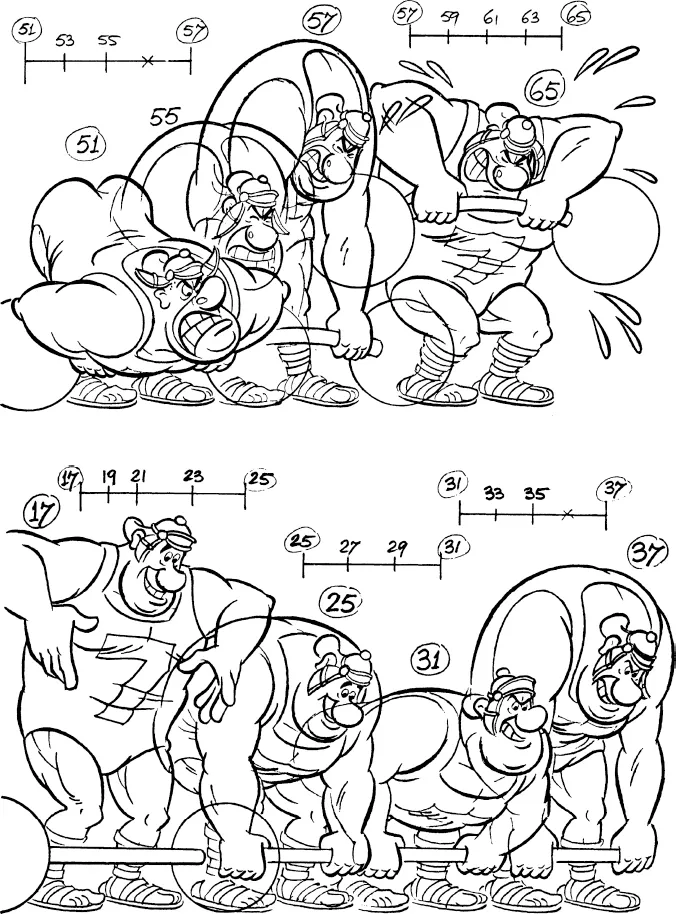
An athlete is going to lift the heavy bar bell. He starts confidently, and in drawing 17 is anticipating grabbing the bar. He grabs the bar on 25, and 31 is the anticipation to the first attempted lift. He is still confident but grits his teeth somewhat as he makes the effort, as shown in drawing 37. The bar bell does not move. After 37 he comes to a puzzled hold as he realizes he has a more difficult problem than he thought. In drawing 57 he makes a much bigger jerk after making a more determined and annoyed anticipation in drawing 51. After this jerk he manages to lift the bar bell with great difficulty. A few frames after drawing 65 he collapses out of screen under the weight.
images
FIG 36On drawing 17 the Roman athlete confidently prepares to lift the heavy bar bell. He anticipates on drawing 31 and tries to lift on drawing 37. The weight does not move so he makes a much bigger anticipation on drawing 51 and a big jerk on drawing 57, which enables him to get the weight up in the air on drawing 65, before collapsing with exhaustion.

Timing to Suggest Force: Repeat Action

In a repetitive to and fro action such as sawing, it is not sufficient to draw the forward and backward extremes and then in-between them. To convey the feeling of effort being put into the action ...

Table of contents

  1. Cover
  2. Half Title
  3. Title Page
  4. Copyright Page
  5. Table of Contents
  6. Foreword
  7. Preface to the 3rd edition
  8. Preface to the 1st edition
  9. Acknowledgments
  10. Introduction
  11. Timing for Broadcast Media
  12. What Is Good Timing?
  13. The Storyboard
  14. Traditional Storyboards
  15. Digital Storyboarding
  16. Additional Storyboard Effects
  17. Responsibility of the Director
  18. Directing for Interactive Games
  19. The Basic Unit of Time in Animation
  20. Timing for Television, Web-Based Programming vs. Timing for Features
  21. Slugging
  22. Bar Sheets
  23. Timing for a Hand-Drawn Film: Exposure Charts or Exposure Sheets
  24. Timing for an Overseas Production
  25. Timing for a 2D Digital Production
  26. Timing for a 3D Digital Production
  27. Timing for an Actor-Based Program (Performance or Motion Capture)
  28. Animation and Properties of Matter
  29. Movement and Caricature
  30. Cause and Effect
  31. Newton’s Laws of Motion
  32. Objects Thrown Through the Air
  33. Timing of Inanimate Objects
  34. Rotating Objects
  35. Force Transmitted Through a Flexible Joint
  36. Force Transmitted Through Jointed Limbs
  37. Spacing of Drawings—General Remarks
  38. Spacing of Drawings
  39. Timing a Slow Action
  40. Timing a Fast Action
  41. Getting Into and Out of Holds
  42. Single Frames or Double Frames? Ones or Twos?
  43. How Long to Hold?
  44. Anticipation
  45. Follow Through
  46. Overlapping Action
  47. Timing an Oscillating Movement
  48. Timing to Suggest Weight and Force—1
  49. Timing to Suggest Weight and Force—2
  50. Timing to Suggest Weight and Force—3
  51. Timing to Suggest Weight and Force—4
  52. Timing to Suggest Force: Repeat Action
  53. Character Reactions and ā€œTakesā€
  54. Timing to Give a Feeling of Size
  55. The Effects of Friction, Air Resistance, and Wind
  56. Timing Cycles—How Long a Repeat?
  57. Scenes with Multiple Characters
  58. Digital Crowds (Massive)
  59. Effects Animation: Flames and Smoke
  60. Water
  61. Rain
  62. Snow
  63. Explosions
  64. Repeat Movements of Inanimate Objects
  65. Timing a Walk
  66. Types of Walk
  67. Spacing of Drawings in Perspective Animation
  68. Timing Animals’ Movements: Horses
  69. Timing Animals’ Movements: Other Quadrupeds
  70. Timing an Animal’s Gallop
  71. Bird Flight
  72. Drybrush (Speed Lines) and Motion Blur
  73. Accentuating a Movement
  74. Strobing
  75. Fast Run Cycles
  76. Characterization (Acting)
  77. The Use of Timing to Suggest Mood
  78. Synchronizing Animation to Speech
  79. Lip-Sync—1
  80. Lip-Sync—2
  81. Lip-Sync—3
  82. Timing and Music
  83. Animating for Interactive Games
  84. Traditional Camera Movements
  85. 3D Camera Moves
  86. Peg Movements in Traditional Animation
  87. Peg Movements in 3D Animation
  88. Editing Animation
  89. Editing for Feature Films
  90. Editing for Children’s Programming
  91. Editing for Internet Programs
  92. Conclusion
  93. Index