- English
- ePUB (mobile friendly)
- Available on iOS & Android
eBook - ePub
Strategic Action Planning Now Setting and Meeting Your Goals
About this book
Filling the need for a "how-to," step-by-step guide to strategic planning, Strategic Action Planning NOW! outlines team-based planning in four steps. Gate Gable's techniques provide detailed guidance into planning processes, strategic skills, recognition of challenges, consideration of goals, monitoring and measurement, and implementation tips to help the reader begin the planning process almost immediately.
Written in three parts, the author provides exercises with each chapter. Part one covers the pre-planning stages, defining who and what your team is and what your teams' goals are. The second part goes over the actual planning, identifying the challenges and setting the goals for your team. The third and final part deals with post planning, implementation and evaluating your team's progress.
II
THE PLANNING PROCESS
5
SEEING THE CHALLENGES
All truths wait in all things.
Walt Whitman1
If truth waits in all things, then it is your job as team facilitator to assist in revealing the truth that exists in the structures, ideas, situations, and even personalities around you. Schrage says, “a gifted leader is capable of creating a meeting environment that fosters collaborative conversations and brings the group to greater understanding and focus.”2
If that sounds like a big job, it is! But not an impossible one.
A critical place to start is in making sure that the parameters of your team process are clear and accepted by all team members. So, just be sure that, before beginning the four-step procedure for planning outlined in these next five chapters, you have already taken your team through Exercise 1: Creating Agreement. This will guide your team in establishing ground rules for your meeting communications, roles and responsibilities, and project commitments.
That done, this planning procedure can now get off the ground.
WHAT IS WRONG WITH THIS PICTURE?
A colleague of mine who manages a welfare office in the Midwest recently made an interesting comment. I had called him because I assumed that all the budget cuts and new policies in social services that Congress had been passing in the last several years meant that the atmosphere in his office must be pretty grim. I assumed that the workload was impossible, that his staff was depressed because of all the families who would now go unserved, and that, certainly, social services was not a place one would want to be working in the late 1990s.
“It’s not always easy,” he said, “but, in a way, it’s just the opposite of what you might think. The spotlight is on us now, it’s true. But there’s a tremendous amount of energy in my office. Everyone is having to rethink everything.”
Suddenly in his office, ‘we’ve always done it that way’ was not a good enough answer to the question of why things could not be changed. Everything was being scrutinized; the entire status quo was challenged. Only days or weeks before, everyone had assumed that they must work with the way things had always been done; but now, every aspect of doing business provided a possible opportunity for innovation.
Despite, or perhaps because of, the tremendous challenges laid out before his staff, no spirit of defeat existed. On the contrary, what my friend was experiencing in his office was a surge in energy and inspiration. Change, even enforced change, was providing a focus and renewal of energy, a new beginning, and a chance to redo and rethink systems in a comprehensive way.
Identifying the challenges in U.S. social services agencies took a groundswell of public opinion and Congressional legislation. How can your planning process inspire a similar level of commitment to change and innovation? Can you set the tone and encourage a truly innovative exploration of challenges in your business?
One of the truisms about planning is that it works best when change is necessary. If your business is facing some impending financial crisis, or a competitor has just revolutionized the marketplace by introducing a product using new technology, or you are experiencing either explosive growth or market stagnation, these are clearly situations in which something must be done; the status quo cannot be maintained.
But more than likely, your organization is not facing conditions that force change. A more common situation in planning is that things look OK for the moment. In this situation—where there is no apparent reason to change—you must still look closely, with insight, to see if there are any patterns that exist in your organization that could become problems in the future. In this situation, you and your team should be conducting a preventative planning process.
You may remember those children’s puzzles called “What’s Wrong with This Picture?”. In these drawings of everyday objects and settings, there are usually several things amiss. Someone’s sock is mismatched. A picture frame is missing a side. One side of a tree is drawn in front of the fence and the other side behind the fence. The cat has only its left set of whiskers.
This childhood game is actually a pretty good metaphor for “Seeing the Challenges.” The game is never as easy as it looks. Your mind’s eye is tricked into not seeing what is out of place or missing because the mind is looking for coherence and often fills in the gap if there is one.
In the same way, the problems in your business might be masked by things that have existed for so long that they may be impossible to “unsee.” The challenges are there, but they are invisible because you are conditioned not to see them; or even if you can see them, the assumption is that they cannot be changed.
Some think that one of the reasons the British Army was defeated during the American Revolution was because British soldiers were accustomed to marching in colors in squadrons; they brought their military traditions with them across the ocean and applied them in a new land where conditions were very different. Our Yankee sharpshooters, battling in the rolling hills and dense forests of Pennsylvania, New Hampshire, Virginia, and Massachusetts, thought it made more sense to shoot from behind the trees; and Redcoats in formation were pretty easy to spot.
Are there traditions in your industry that no longer make sense? Are there processes and procedures that exist just because “that’s the way we’ve always done things?” What are the ‘sacred cows’ in your corporate culture? Are they still serving the aims of your organization?
IDENTIFYING CHALLENGES: AN OVERVIEW
A planning process properly begins with a situational analysis. There are dozens of strategic planning books that propose dozens of different methodologies for situational analyses. There is a range of procedures from conducting in-depth research and statistical analyses using comparative historical data and projections into the future, to simple survey vehicles. An entire industry of consultants and analyst organizations has grown up around this task.
The first planning step, “Identifying the Challenges,” offers a nontechnical, grassroots method for getting your planning process started quickly. One assumes that either you have been given specific strategic direction from your top management or that you have sufficient knowledge of your business and team territory to be able to identify your major challenges without conducting extensive research. Or maybe both.
If you feel that a more in-depth and classic situational analysis is needed, refer to the “Selected Readings,” under the section heading “Situational Analysis.” There are several excellent books with a special focus on analysis that either give detail about the process, if you want to undertake it yourself, or suggest parameters to consider if you want to hire an analyst group to conduct research for you.
As for us, the first step of this strategic planning process is made up of several substeps. It is the most complex of the four major planning steps. The component tasks for this step are outlined in schematic fashion in Figure 5.1.
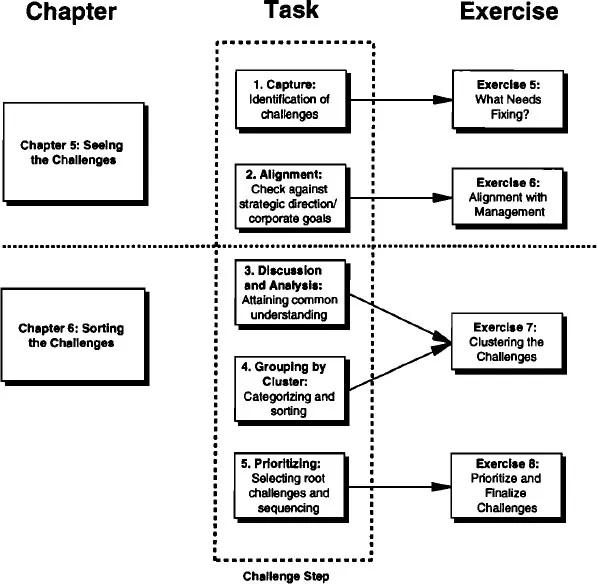
The process for the entire challenge step contains the following substeps:
1. Capture: identifying new challenges, and/or reviewing or updating existing challenges.
2. Alignment: checking against strategic direction or corporate goals that are mandated by your executive leadership team.
3. Discussion and Analysis: evaluating challenges in order to come to a common understanding of what they are and to reveal their interrelationships.
4. Grouping by Clusters: categorizing, sorting, rewording, or refocusing the challenges based on discussion and analysis.
5. Prioritization: selecting the key or root challenge in each cluster, arranging them in order of importance or impact, and/or assigning a sequence if necessary.
Just a few words about how this rather more complex series of tasks will be approached. The entire challenge step can be completed in four exercises. There will be one exercise for the initial identification of challenges. A second exercise will assess your team’s alignment with top management regarding challenge identification. A third exercise encompasses steps 3 and 4 above: challenge discussion, analysis, and clustering; and a fourth exercise will cover step 5, selecting final challenges.
Steps 1 and 2 will be completed in this chapter. Chapter 6 picks up steps 3 through 5.
TASK 1: CAPTURING CHALLENGES
—identifying new challenges, and/or reviewing or updating existing challenges.
This step begins by you and your team completing an informal exercise called “What Needs Fixing”? In this exercise, your team will generate an initial set of challenges. If you have a strategic mandate that has been given to you by an upper management team, hold that aside for now. Let your team generate its own list of challenges first, and then review the corporate mandates as a check on alignment.
In this exercise, a type of mind mapping technique is used as a starting point. A ‘mind map’ is simply a free-associative drawing or series of ideas sketched out informally in a combination of words or pictures, sometimes drawn in the style of icons. In this case, that old saying, “a picture is worth a thousand words” is true because a visual image or metaphor can capture succinctly a more complex situation. The exercise uses this technique to lead your team through the process of beginning to ‘see’ what challenges your company or department is facing.
This mind mapping technique is a way to allow the individuals on your team to be free of the constraints imposed by a more formal discussion. And because it is a mixture of words and images, and something that is privately constructed, sometimes a more creative or intuitive part of the brain can be utilized in the process of capturing information.
Figure 5.2 is a sample of how this technique works. (This is a copy of a mind map that I drew as part of a similar exercise for my own business.)
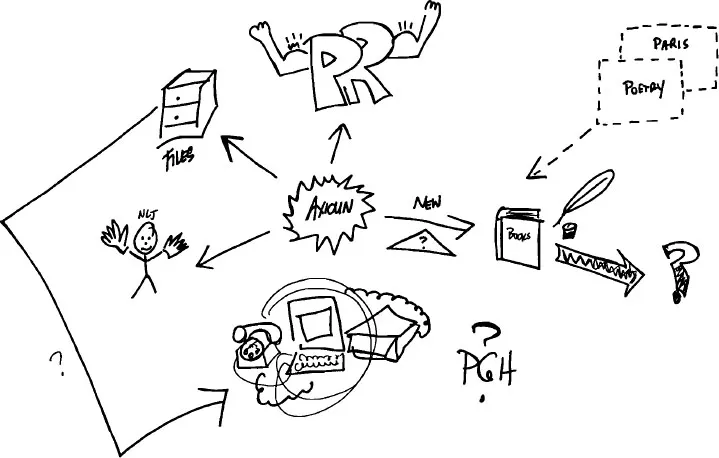
I started with my business, Axioun, at the center and put a kind of radiant halo around it to indicate the key strengths—some people call these key or core competencies—that the business already has. Then I started indicating the aspects of the business that needed to be strengthened.
First, I drew the file cabinet as a way of symbolizing my desire to create a better system for organizing information. I generate a lot of paper, read tremendous numbers...
Table of contents
- Cover
- Title Page
- Copyright Page
- Dedication
- Table of Contents
- List of Figures
- Introduction
- Section I: Pre-planning Preparation
- Section II: The Planning Process
- Section III: Post Planning
- Postscript
- Appendices
- Glossary
- Selected Readings
- Bibliography
- Index
Trusted by 375,005 students
Access to over 1.5 million titles for a fair monthly price.
Study more efficiently using our study tools.
Frequently asked questions
Yes, you can cancel anytime from the Subscription tab in your account settings on the Perlego website. Your subscription will stay active until the end of your current billing period. Learn how to cancel your subscription
No, books cannot be downloaded as external files, such as PDFs, for use outside of Perlego. However, you can download books within the Perlego app for offline reading on mobile or tablet. Learn how to download books offline
Perlego offers two plans: Essential and Complete
- Essential is ideal for learners and professionals who enjoy exploring a wide range of subjects. Access the Essential Library with 800,000+ trusted titles and best-sellers across business, personal growth, and the humanities. Includes unlimited reading time and Standard Read Aloud voice.
- Complete: Perfect for advanced learners and researchers needing full, unrestricted access. Unlock 1.5M+ books across hundreds of subjects, including academic and specialized titles. The Complete Plan also includes advanced features like Premium Read Aloud and Research Assistant.
We are an online textbook subscription service, where you can get access to an entire online library for less than the price of a single book per month. With over 1.5 million books across 990+ topics, we’ve got you covered! Learn about our mission
Look out for the read-aloud symbol on your next book to see if you can listen to it. The read-aloud tool reads text aloud for you, highlighting the text as it is being read. You can pause it, speed it up and slow it down. Learn more about Read Aloud
Yes! You can use the Perlego app on both iOS and Android devices to read anytime, anywhere — even offline. Perfect for commutes or when you’re on the go.
Please note we cannot support devices running on iOS 13 and Android 7 or earlier. Learn more about using the app
Please note we cannot support devices running on iOS 13 and Android 7 or earlier. Learn more about using the app
Yes, you can access Strategic Action Planning Now Setting and Meeting Your Goals by Cate Gable in PDF and/or ePUB format, as well as other popular books in Business & Business Strategy. We have over 1.5 million books available in our catalogue for you to explore.