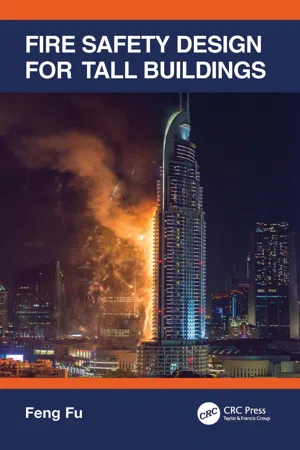
Fire Safety Design for Tall Buildings provides structural engineers, architects, and students with a systematic introduction to fire safety design for tall buildings based on current analysis methods, design guidelines, and codes. It covers almost all aspects of fire safety design that an engineer or an architect might encounter—such as performance-based design and the basic principles of fire development and heat transfer.
It also sets out an effective way of preventing the progressive collapse of a building in fire, and it demonstrates 3D modeling techniques to perform structural fire analysis with examples that replicate real fire incidents such as the Twin Towers and WTC7. This helps readers to understand the design of structures and analyze their behavior in fire.
Across the world, there are many fire incidents happening in tall or multistorey buildings every year. It causes loss of life and damage to the properties. About 69% fires are caused by electricity. As a result, fire safety is one of the key tasks in tall building designs. Particularly, a large percentage of tall buildings are steel structures or partially made of steel frames which require more stringent fire safety design requirements. The recent disaster in Grenfell Tower (Fu, 2017) caused huge casualties. It has embarked increasing concerns from the public and building engineers in fire safety design for tall buildings.
Fire development and subsequent thermal response of the building depend upon numerous factors, invariably featuring a high degree of uncertainty. While permitted within performance-based frameworks and supported by design codes (EN 1991-1-2, 2002; EN1992-1-2, 2004; EN 1993-1-2, 2005; EN 1994-1-2, 2005), the appraisal of structural response in fire is challenging given the sources of uncertainty that exist. This is primarily due to the complexity caused by different fire scenarios which can possibly be formed when fire occurs. In addition, for a structure such as a tall building, the structural systems are much more complicated, which also brings extra difficulties in the structural fire analysis.
In the past two decades, an increasing number of tall buildings have been built worldwide. Advancements in structural engineering make possible the increase in height, size, and complexity of modern tall buildings. Particularly, in modern tall building design, the structural system of tall buildings becomes increasingly complicated. Figure 1.1 shows the structural system of a newly built tall building in Beijing with a height of 528 m. The lateral stability system comprises so-called Mega Frame system and Diagrid system. Its more complex structural system makes its fire safety design a challenging job. In order to effectively design fire safety for tall buildings, it is essential to understand the behavior of the buildings in fire.
Figure 1.1 China Zun Tower in construction. (Photo taken by the author’s father.)
In addition, a significant amount of new construction materials—elements such as new type of cladding systems and new construction techniques—have also been developed. The tall building of today is different from that of a decade ago with foreseen changes even greater in the immediate future. These advancements make fire safety design for tall buildings an even more challenging task for design engineers.
In the current design practice, detailed fire safety design guidelines has been developed across the world, such as Eurocode (EN 1991-1-2, 2002; EN1992-1-2, 2004; EN 1993-1-2, 2005; EN 1994-1-2, 2005). As a design engineer, it is imperative to guarantee that in the design process, sufficient measures for fire safety should be made. An engineer should also have the capacity to analyze the response of structures under different fire scenarios and subsequent fire protection measures using appropriate procedure and analysis software.
Therefore, this textbook is designed to help fire safety engineering practitioners such as structural engineers, architectural engineers, and students to fully understand the principles of fire safety design and the relevant design guidance, particularly for tall buildings; the effective way to model different fire scenarios and thermal response of building in fire; and introduction of a systematic fire safety design approach for tall buildings. Detailed demonstrations of 3D modeling techniques for fire safety analysis are also made. In addition, case studies based on various fire scenarios and different structural layouts of tall buildings are provided to demonstrate failure mechanisms of buildings in fire and effective design methods for fire safety.
1.2 Main fire safety design issues for tall buildings
The main objective of the fire safety design for tall buildings is life safety of the occupants. Therefore, all the design processes are centered around life safety. Among them, compartmentation design, evacuation route design, and structural fire design are the three key design focuses. These three factors are affecting each other, for example, when designing the evacuation route, the time of evacuation is affected by the time of failure of structural members. The size and layout of the compartment also affect the evacuation route design. The integrity of the compartment is very important in containing the fire in its original place or delaying its spread. However, the integrity of the compartment is greatly affected by structural fire design. For example, the deformation of the compartment wall in fire reduces its capacity to maintain its integrity. Its deflection is controlled primarily by its supporting beams. Designing a beam with reduced deflection in fire will improve the whole integrity of the compartment. These design processes will be explained in detail in Chapters 3–5.
Fire scenario analysis and its corresponding structural fire analysis are both unique and complicated procedures, and they also require an engineer to have the ability to use modern commercial software for fire scenarios simulation or a finite element package to analyze the structural responses of a building in fire. Therefore, this book also features a detailed introduction to the use of fire analysis software such as OZONE and FDS®1 as well as finite element programs such as Abaqus®,2 ANSYS, and LS_DYNA OpenSees, ADINA.
1.3 Structure of the book
Chapter 1 is the introduction of the book. It introduces the aims and scope, as well as the structure, of this book.
Chapter 2 introduces several fire incidents that happened in tall buildings, followed by the regulatory requirements from various codes across the world. At the end of this chapter, the basic principles for fire safety design of tall buildings will be discussed.
Chapter 3 introduces the fundamental knowledge of fire and fire safety design. The characteristics of fire and its development are introduced at the beginning. The key fire scenarios that affect the performance of the building members in fire—such as ventilation-controlled or fuel-controlled fire and long-cool, short-hot fire—will be explained. In addition, the fundamentals of heat transfer, a process of the heating up of structural members due to fire, will be introduced. The basic structural fire design principles will also be explained. In fire safety design, most of the codes specify the fire resistance of building elements. The relevant information will be provided in the latter part of this chapter followed by the introduction of fire protection methods.
Chapter 4 introduces the structural fire design in depth on the basis of Chapter 3. It introduces the structural fire design procedures for steel, concrete, and composite structural members based on Eurocodes and British Standards. Two key structural fire design methods are introduced: critical temperature method and moment capacity method. It also covers the design of post-tensioning slabs, connection, and beams with openings.
Chapter 5 provides a detailed design strategy for tall buildings. The prescriptive and performance-based fire design approaches are first introduced, followed by fire risk analysis. The deterministic and probabilistic approach to determine the worst-case fire scenarios is then introduced. A detailed demonstration of compartment design and evacuation route design for tall buildings is made followed by the description of other design issues such as firefighter access and fire protection requirement to façade. The fire alarm system, communication system, fire and smoke suppression system are also discussed. At the end of this chapter, case studies for two real construction projects, namely, Burj Khalifa and the Shard, are made.
Chapter 6 introduces various theoretical and numerical methods for fire analysis. It starts with the method to determinate the compartment fire including a detailed introduction of Zone model and CFD model. It is followed by the methods of solving thermal response of structural members such as heat transfer analysis and thermal–mechanical analysis. In addition, the probabilistic method for fire safety analysis will be covered. In the final part of this chapter, various numerical modeling software for fire analysis will be explained.
Chapter 7 discusses how to design a building to prevent fire-induced collapse. The collapse mechanism of a tall building in fire and methods for mitigating the collapse are introduced, all based on existing research and fire-induced collapse incidents.
Chapter 8 introduces new technologies developed for fire safety design, such as PAVA system, IOT, and smart building management system. Some pilot studies of using machine leaning in fire safety design will also be introduced in this chapter.
Chapter 9 introduces the post fire damage assessment methods. Different damage assessment techniques including destructive and nondestructive assessment methods for concrete and steel structures are introduced.
2 Abaqus is a registered trademark of Dassault Systemes S.E. and Its affiliates.
References
EN 1991-1-2 ...
Table of contents
Cover
Half Title
Title Page
Copyright Page
Dedication
Table of Contents
Preface
Acknowledgments
Author
1 Introduction
2 Regulatory requirements and basic fire safety design principles
3 Fundamentals of fire and fire safety design
4 Structural fire design principles for tall buildings
5 Typical fire safety design strategy for tall buildings
6 Fire analysis and modeling
7 Preventing fire-induced collapse of tall buildings
8 New technologies and machine learning in fire safety design
9 Post-fire damage assessment
Index
Trusted by 375,005 students
Access to over 1.5 million titles for a fair monthly price.
Study more efficiently using our study tools.
Frequently asked questions
Yes, you can cancel anytime from the Subscription tab in your account settings on the Perlego website. Your subscription will stay active until the end of your current billing period. Learn how to cancel your subscription
No, books cannot be downloaded as external files, such as PDFs, for use outside of Perlego. However, you can download books within the Perlego app for offline reading on mobile or tablet. Learn how to download books offline
Perlego offers two plans: Essential and Complete
Essential is ideal for learners and professionals who enjoy exploring a wide range of subjects. Access the Essential Library with 800,000+ trusted titles and best-sellers across business, personal growth, and the humanities. Includes unlimited reading time and Standard Read Aloud voice.
Complete: Perfect for advanced learners and researchers needing full, unrestricted access. Unlock 1.5M+ books across hundreds of subjects, including academic and specialized titles. The Complete Plan also includes advanced features like Premium Read Aloud and Research Assistant.
Both plans are available with monthly, semester, or annual billing cycles.
We are an online textbook subscription service, where you can get access to an entire online library for less than the price of a single book per month. With over 1.5 million books across 990+ topics, we’ve got you covered! Learn about our mission
Look out for the read-aloud symbol on your next book to see if you can listen to it. The read-aloud tool reads text aloud for you, highlighting the text as it is being read. You can pause it, speed it up and slow it down. Learn more about Read Aloud
Yes! You can use the Perlego app on both iOS and Android devices to read anytime, anywhere — even offline. Perfect for commutes or when you’re on the go. Please note we cannot support devices running on iOS 13 and Android 7 or earlier. Learn more about using the app
Yes, you can access Fire Safety Design for Tall Buildings by Feng Fu in PDF and/or ePUB format, as well as other popular books in Technology & Engineering & Civil Engineering. We have over 1.5 million books available in our catalogue for you to explore.