In recent years, Republicans and Democrats have drifted toward polarized immigration policy positions, forestalling congressional efforts at comprehensive reform. In this book Gary M. Reich helps explain why some states have enacted punitive policies toward their immigrant populations, while others have stepped up efforts to consider all immigrants as de facto citizens.
Reich argues that state policies reflect differing immigrant communities across states. In states where large-scale immigration was a recent phenomenon, immigrants became an electorally-enticing target of restrictionist advocates within the Republican party. Conversely established immigrant communities steadily strengthened their ties to civic organizations and their role in Democratic electoral and legislative politics. Reich contends that these diverging demographic trends at the state level were central to the increasing partisan polarization surrounding immigration nationally. He concludes that immigration federalism at present suffers from an internal contradiction that proliferates conflict across all levels of government. As long as Congress is incapable of addressing the plight of unauthorized immigrants and establishing a consensus on immigration admissions, state policies inevitably expand legal uncertainty and partisan wrangling.
The Politics of Immigration Across the United States will appeal to scholars and instructors in the fields of immigration policy, social policy, and state government and politics. The book will also encourage public policy practitioners to reflect critically on their work.
In June 2007, the moment for comprehensive immigration reform seemed to have finally arrived in Congress. After three failed attempts in as many years, a bill containing a mix of border security measures and a path to citizenship for millions of unauthorized immigrants reached the floor of the US Senate. The bipartisan group of senators that crafted the legislation counted with the backing of a Republican president, George W. Bush, the Democratic Senate Majority Leader, Harry Reid, and the Republican Senate minority whip, Trent Lott.
However, the Senate bill died without ever receiving an up or down vote. Twice it failed to receive the 60 votes needed to end debate and move to a floor vote. Key to the bill’s failure was the unexpected lobbying of a grassroots anti-immigration movement. Lambasting the bill as amnesty for “illegal immigrants,” opponents from across the country flooded members of Congress with phone calls, e-mails, and online petitions.1 Republican Senate support dissipated in the process. Only 12 of 49 Republican senators voted to end debate, despite last-minute phone calls from the president asking for their support of the bill.2
The movement that helped kill comprehensive immigration reform in 2007 was notable for both its methods and its geographic reach. Its political tools were conservative talk radio, internet chat rooms, online petitions, and signature-gathering campaigns for ballot initiatives. In the early- to mid-2000s, its presence altered Republican state party conventions and primaries, the outcome of ballot initiatives, and the tenor of state laws—and not just in a border state like California, where immigration was long a hot-button issue. The restrictionist movement inspired anti-immigration activism in places like Alabama, Georgia, the Carolinas, Indiana, Pennsylvania, and Oklahoma. Appraising the geographic expansion of restrictionist fervor, the national field director for the anti-immigration Federation for American Immigration Reform (FAIR) waxed metaphorical, suggesting “Every state is now a border state.”3
During the same period, opposing groups of activists began mobilizing on behalf of policies that sought a broader inclusion of immigrants in American society. The pro-immigrant movement gathered strength, in part, as an urgent response to the legislative inroads of anti-immigration forces. In December 2005, the Republican-controlled US House of Representatives passed HR 4437, its own sweeping version of immigration reform that, among other things, created a new felony for assisting an unauthorized immigrant to remain in the country.
HR 4437 would also die in the Senate, but not before spurring counter-protest marches in the spring of 2006 that involved over a million people across 200 cities—recruiting millions of voting-eligible Latinos immigrants into the electoral process. A common slogan appearing at the marches, “Today we march, tomorrow we vote,” spoke to its aspirations to unleash the clout of immigrant voters.4 By the mid-2000s, Latino and Asian immigrant voters increasingly become a key constituency with Democratic Party politics, in the process helping to enact pro-immigrant policies in places like California, Washington, Oregon, Illinois, and Connecticut. Cities with large immigrant communities (New York, Miami, Chicago, and Los Angeles) and several that housed major research universities (Ann Arbor, Michigan; Durham, North Carolina; Austin, Texas) moved to protect unauthorized immigrants from deportation by restricting their compliance with Immigration and Customs Enforcement (ICE) requests to detain immigrants.
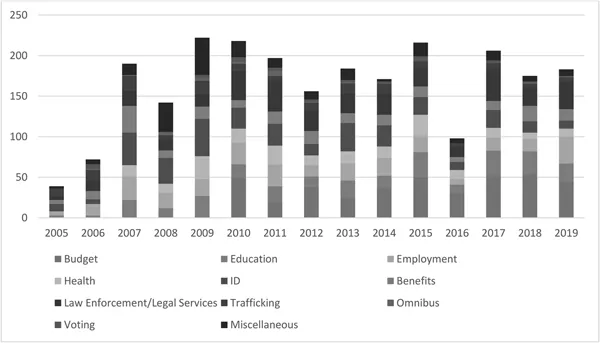
The mobilization of pro- and anti-immigrant movements in the mid-2000s heralded a period of intense immigrant policy activity among state governments. As in the divided US Congress, the politics of immigration intensified partisan fault lines, with Republicans moving toward more restrictionist positions and Democrats frequently embracing more inclusive laws. However, unlike Congress, where polarization engendered legislative paralysis, state governments produced a torrent of new laws, both restrictive and integrative. Between 2005 and 2007, the output of immigrant-related legislation and resolutions among the fifty states increased five-fold. After 2007, policy activity intensified, with state legislatures approving an average of 150 immigrant-related laws through 2019. Data from the National Council of State Legislatures (shown in Figure 1.1) showed that this legislation affected a wide range of programs, services, and regulations falling under state control, including public education, health care, employment, law enforcement, and identification documents, among other topics.
FIGURE 1.1State government immigrant policy enactments, by policy area (2005–2019)
Source: National Conference of State Legislatures. Immigration Laws and Current State Immigration Legislation, 31 March 2020, https://www.ncsl.org/research/immigration/state-laws-related-to-immigration-and-immigrants.aspx.
Today, state government is the entity that most directly affects the life opportunities available to US immigrants, including their ability to secure a job, a public education, access government-provided health care and welfare assistance, and even the likelihood of encountering federal immigration enforcement authorities. This book is about the politics of immigration across state government in the first two decades of the 21st century. It is about two radically different visions of the place of immigrants in the life of the nation, ...
Table of contents
Cover
Half Title
Endorsement
Title Page
Copyright Page
Dedication
Contents
List of Figures
List of Tables
Preface and Acknowledgments
1 The New Immigration Federalism: The Great Divergence
2 Party, Polarization, and Place: The Sources of State Immigrant Policies
3 States in the Changing Landscape of American Immigration
4 Policy Divergence in Immigrant-Rich States: California and Texas
5 Grassroots Restriction in “New Gateway” States: Arizona and North Carolina
6 “Dreamers” and “Illegals”: Voting Behavior in State Legislatures
7 The Disequilibrium of Immigration Federalism
Index
Trusted by 375,005 students
Access to over 1.5 million titles for a fair monthly price.
Study more efficiently using our study tools.
Frequently asked questions
Yes, you can cancel anytime from the Subscription tab in your account settings on the Perlego website. Your subscription will stay active until the end of your current billing period. Learn how to cancel your subscription
No, books cannot be downloaded as external files, such as PDFs, for use outside of Perlego. However, you can download books within the Perlego app for offline reading on mobile or tablet. Learn how to download books offline
Perlego offers two plans: Essential and Complete
Essential is ideal for learners and professionals who enjoy exploring a wide range of subjects. Access the Essential Library with 800,000+ trusted titles and best-sellers across business, personal growth, and the humanities. Includes unlimited reading time and Standard Read Aloud voice.
Complete: Perfect for advanced learners and researchers needing full, unrestricted access. Unlock 1.5M+ books across hundreds of subjects, including academic and specialized titles. The Complete Plan also includes advanced features like Premium Read Aloud and Research Assistant.
Both plans are available with monthly, semester, or annual billing cycles.
We are an online textbook subscription service, where you can get access to an entire online library for less than the price of a single book per month. With over 1.5 million books across 990+ topics, we’ve got you covered! Learn about our mission
Look out for the read-aloud symbol on your next book to see if you can listen to it. The read-aloud tool reads text aloud for you, highlighting the text as it is being read. You can pause it, speed it up and slow it down. Learn more about Read Aloud
Yes! You can use the Perlego app on both iOS and Android devices to read anytime, anywhere — even offline. Perfect for commutes or when you’re on the go. Please note we cannot support devices running on iOS 13 and Android 7 or earlier. Learn more about using the app
Yes, you can access The Politics of Immigration Across the United States by Gary M. Reich in PDF and/or ePUB format, as well as other popular books in Politics & International Relations & American Government. We have over 1.5 million books available in our catalogue for you to explore.