eBook - ePub
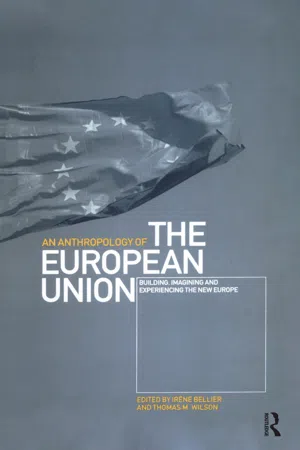
An Anthropology of the European Union
Building, Imagining and Experiencing the New Europe
- 216 pages
- English
- ePUB (mobile friendly)
- Available on iOS & Android
eBook - ePub
An Anthropology of the European Union
Building, Imagining and Experiencing the New Europe
About this book
One of the problems facing Europe is that the building of institutional Europe and top-down efforts to get Europeans to imagine their common identity do not necessarily result in political and cultural unity. Anthropologists have been slow to consider the difficulties presented by the expansion of the EU model and its implications for Europe in the 21st Century. Representing a new trend in European anthropology, this book examines how people adjust to their different experiences of the new Europe. The role of culture, religion, and ideology, as well as insiders' social and professional practices, are all shown to shed light on the cultural logic sustaining the institutions and policies of the European Union. On the one hand, the activities of the European institutions in Brussels illustrate how people of many different nationalities, languages and cultures can live and work together. On the other hand, the interests of many people at the local, regional and national levels are not the same as the Eurocrats'. Contributors explore the issues of unity and diversity in 'Europe-building' through various European institutions, images, and programmes, and their effects on a variety of definitions of identity in such locales as France, Denmark, the United Kingdom, Ireland and Belgium.
Information
1 Building, Imagining and Experiencing Europe: Institutions and Identities in the European Union
Irène Bellier and Thomas M. Wilson
The issues of culture and identity have long been marginal aspects of the general scholarship of the European Union (EU). Until recently, most academic studies of the EU have treated the thorny problems of local and national identities, loyalties, traditions, ideologies and affiliations as secondary concerns to the more important projects of creating, sustaining, and understanding the EU as a political and economic entity and system. But the importance of the roles which national and other cultures play in the processes of ‘Europe-building’ (a phrase often used to refer to the strengthening of the institutions of the EU and to the expansion of its membership), and in Europeanization (which is a much wider and perhaps more important process connoting the role of European culture in the integration of disparate European communities and societies), has not gone unnoticed by social scientists. This attention has been generated by what some believe was the shock inflicted on political insiders, government leaders, journalists and academics by the initial Danish rejection of the Maastricht Treaty on European Union. Recently a number of sociologists and political scientists have recognized the need for more studies of European culture and identity, as they are related to European integration (Hedetoft 1994: 1-2; see also Landau and Whitman 1997). In fact one leading scholar, in his critique of academic European Studies in North America, has specifically called for more involvement by anthropologists and other social scientists in research in cultural and political integration (Tarrow 1994; see also Hedetoft 1994).
Missing from these welcome calls by our cognate disciplines for anthropological attention to the development of the EU and to the processes of Europeanization and European integration is a clear understanding of what anthropologists have already achieved in these regards, and the research designs which they have established and will continue to develop in the future. The simple point is that the anthropology of the EU and of European integration is very much alive and well, on both sides of the Atlantic, and in at least three different anthropological traditions.
In fact, the contributors to this book have worked in varying degrees within the professional and intellectual traditions of American, British and French anthropology. While French anthropology has for a long time been associated with structuralism, studies of non-Western societies, and cultural anthropology, a significant turn has been undertaken by a number of scholars since the 1980s. These studies focus on what has been called ‘new objects’ in France and the wider Europe, and they have contributed to the construction of the conceptual paradigm of‘anthropologie du proche’. Simultaneously, there has been a radical shift within French political anthropology to the examination of political and bureaucratic institutions as well as social and economic organizations. American anthropologists in recent years have increasingly problematized their approaches to culture and identity, as part of their efforts to distance themselves from some methods and theories which placed them in positions of authority and power, albeit often unconsciously. American applied anthropologists have continued within their evolving sub-discipline to investigate policy makers, institutions, and impact at all levels of politics and society. British anthropology has also begun to explore policy making as a new arena of political and social organization within their ethnographic analyses ‘at home’ and abroad. As can be seen in our structuring of this volume, one of the central motifs in the analysis of culture and identity in Europe today is that of ‘belonging’. Among the primary arenas in which this is now being explored are local, state and supranational institutions. We expect that there are scholars in all of the EU member states working in their and other national traditions and in languages other than English and French who are tackling the issues of European integration, culture and identity. We are also hopeful that this volume will delineate common areas of concern among us all, and open up new opportunities for dialogue.
Thus, this collection brings together vanous case studies to illustrate extant anthropological research in the issues of culture and identity within the EU. As such it serves as both a reminder of the prior anthropology of the EU, as well as a profile of emergent anthropological research initiatives and agendas. Its focus is on the EU as both a political project and object. It seeks to delineate the ways in which culture acts to distinguish or to obscure EU institutions, policies, leaders, ideologies, and values in the daily lives of people who live in the peripheries and localities of the EU as well as those at the centres of EU decision-making. The contributors to this volume also demonstrate ways in which culture frames perceptions of the ‘Europe’ of the EU and its project of Europeanization. In this regard nationalism and national identities function at every level of the EU in ways which sometimes complement, and sometimes oppose, the goals of EU decision-makers, government leaders, and civil servants in EU institutions and in the institutions of member states and regions. Although national identities are flourishing throughout the member states of the EU, special attempts have also been made at the EU level to clarify and promote the notion of a common European identity. It is not the intention of the contributors to this volume to reify European culture and identity. Rather the aim is to explore the meanings which are given to the concepts of European and national identities both within the institutions of the EU and beyond their formal limits, as these impinge upon EU structures.
European identity is being shaped within the EU, in part around a typology of European features which has been called ‘a European model of society’ by the Forward Studies Unit of the European Commission.1 This model’s features include similar family structures, the democratic distribution of power, and freedom of individuals vis a vis the state. In other instances, the Commission and other EU institutions construct different, more general, and in some ways more powerful models of European identity, which have remained undefined within the institutional context of the EU but which converge around the notion of a ‘shared common interest’. European identity is also finding expression outside of the EU, in the notion of a common ‘European external identity’, based on the developing role of the EU as a solitary entity in international relations on the continental and world stages. It is the role of EU institutions in the production and perception of common or shared European identity, both within and outside of the EU, which is one of the primary concerns of this volume.
It is perhaps prudent to clarify here, however, what we mean by the term ‘European Union’. In the first instance the ‘EU’ is the formal institutional system of economic and political integration which is based on international treaties agreed by the current 15 member states (Belgium, France, Germany, Italy, Luxembourg, the Netherlands, Denmark, Ireland, the United Kingdom, Spain, Portugal, Greece, Austria, Finland, and Sweden). The ‘EU’also denotes the institutions set up under these treaties. Foremost among these institutions are the Commission, which provides administrative leadership and policy initiatives to the EU, the Council, composed of the member states delegations in what amounts to a policy-making role, and the Parliament, made up of directly-elected representatives who serve in informational and oversight roles. But the ‘EU’ also refers to the wider evolving social system within the 15 member states in which there is very little which is unaffected by EU legislation, even though much of the EU’s involvement in peoples’ everyday lives occurs principally through national administrative channels.
In this introduction we seek to review themes in the anthropology of the EU which has preceded us, and to explore ways in which anthropology can clarify how the EU and its various institutions and policies are understood and experienced in a variety of localities within its borders. We also examine the usefulness of anthropological perspectives on culture and identity for the analysis of the processes of Europe-building and Europeanization, especially regarding the imaginings needed for social integration to be achieved along with the EU’s driving forces of economic and political integration. Anthropological methods and practice offer insights into the ways in which culture and identity are problematized within EU institutions, and they clarify how EU institutions, policies and agendas produce new forms of European culture and identity, as well as affect some old ones.
Anthropological Approaches
There have been anthropological studies of the EU from a variety of perspectives for some time now, and their numbers as well as the general anthropological interest in the EU are growing. In an effort to bring these anthropological viewpoints to the attention of other social scientists, in disciplines such as politics, public administration and economics, which have long been more associated than anthropology with the study of the development of the EU, they have been characterised by Wilson as the study of the EU ‘from above’ and ‘from below’ (1998; see also Hedetoft 1994). Although this schema may be a useful starting point in the characterization and categorization of social anthropological studies of EU institutions, policies, and symbols, it may obscure the dimensions of the EU as an object, as a process, or, in the sense of the creation of the economic and political union of its member states, as an objective. From above and below implies some sort of Platonic ideal, in which anthropologists, and other social scientists who employ this popular metaphor for studying large political and social institutions, like the state, approach an entity from opposite directions but never reach their goal, never actually study it, or only devise strategies to study its outline or its manifestations in the lives of people removed from its core or its head. In this sense it is as if anthropologists just observe the observers, those who distinguish a monolithic EU from afar.
In fact, any categorization or overview which implies an anthropological distance from the organizations and people of the EU risks exoticizing anthropological research in the EU, and does a disservice to many anthropologists who have worked very hard over the years to understand EU decision-makers, committees, cliques, factions, and political parties, all within the context of their homes, families, national backgrounds and political cultures. Still other anthropologists have investigated the role of European institutions in the dissemination of the ideals, policies and practices of the EU, which includes their impact on national and regional governments, businesses, and communities. But analyses such as these aside, there remains the vexing situation that the EU, as a set of institutions, ideas and behaviours, is extremely difficult to approach with the standard, tried and true methods of social anthropology.
This is because the EU is not only a collection of political and bureaucratic institutions, nor simply an umbrella organization for the articulation of member state policies, but it is an arena of cultural relations (Wilson 1993), an entity creating and recreating its own culture, its own sets of representations and symbols. Recurrent efforts within the EU to create symbols and representations of the EU owe much to the fact that the European project is evolving through on-going negotiations among multiple and changing partners in a completely open-ended system. The EU’s goals of European integration and unification may appear to be self-evident to some, but to our contributors as well as other scholars of these processes such goals are extremely problematic, even among the EU leaders who are often seen from a distance to be a homogeneous group of committed idealists, futurists, and Europhiles. In truth, for them, for us, and for most Europeans, the EU is an indistinct entity, a contradictory conglomeration of words and actions, of symbols and policies, of intrusive and liberating values. ‘Always seen as a means to realize some ill-defined community, the EU is increasingly an end in itself. However, this circularity — the EU as both cause and effect of itself - begs the fundamental question of what it in feet is’ (Bomeman and Fowler 1997:488).
There are of course many correct answers to this question, as there would be to questions of ‘What is France?’ or ‘What is Britain?’ But beyond textbook answers regarding the history and functions of European institutions and laws, the responses to the question ‘What is the EU?’ must perforce be much more confused, contradictory and problematic than any response to queries about the nature of one nation or state, precisely because the EU as an object and a project has no modem historical antecedent, and no cultural template or political form with which people have become comfortable through long-standing enculturation. The task at hand for anthropologists who study the evolution of local and national European societies is not to label the form of institutional arrangements which the EU develops (for example, as a federal union, an intergovernmental body, or a supranational entity). Rather, it is to describe and analyze the cultural articulations between local, regional, national and EU levels, and to inform both insiders and outsiders alike about the EU’s structures and functions.
Perceptions of the organs and activities of the EU diverge considerably throughout the member states, depending on a host of factors, including the important ones of national, regional and local culture and identity. While the EU is perceived in places like Britain to be a centralized bureaucratic monster, in other places like Spain, and even in the European Parliament, it is considered to be retarded by its decentralized and poorly staffed institutions, especially in the Commission.2 In fact, the institutions of the EU can be more fruitfully approached as sets of self-representations too complex to be easily reduced to one image or one symbol. In reality, although such institutions as the European Commission, the European Parliament, and the European Court of Justice are all headquartered in European capitals, they do not always share the same capitals, nor are all the sections of one institution always together in one city. This decentralization is matched by the relatively few bureaucrats who work for these institutions. There are only about 20,000 officials working in EU institutions, 80 per cent of whom are in the Commission. This bureaucracy is small indeed when compared to the administration of capital cities of member states alone, which in Paris is made up of around 40,000 people and in Lisbon is approximately 22,000. In fact, the EU is a rather diffused set of political actors and institutions.
The anthropological problems of approach to the EU are exacerbated by the methodological problems of participant observation, based on long-term ethnographic field research. Because of the anthropological intention to immerse the researcher within the total lives of a community, it is very difficult to study political institutions, and ...
Table of contents
- Cover
- Half Title
- Title Page
- Copyright Page
- Contents
- Acknowledgements
- List of Contributors
- 1 Building, Imagining and Experiencing Europe: Institutions and Identities in the European Union
- Part I Institutions, Politics and Society at the Core of the European Union
- Part II Belonging and Identity in the European Union
- Index
Trusted by 375,005 students
Access to over 1.5 million titles for a fair monthly price.
Study more efficiently using our study tools.
Frequently asked questions
Yes, you can cancel anytime from the Subscription tab in your account settings on the Perlego website. Your subscription will stay active until the end of your current billing period. Learn how to cancel your subscription
No, books cannot be downloaded as external files, such as PDFs, for use outside of Perlego. However, you can download books within the Perlego app for offline reading on mobile or tablet. Learn how to download books offline
Perlego offers two plans: Essential and Complete
- Essential is ideal for learners and professionals who enjoy exploring a wide range of subjects. Access the Essential Library with 800,000+ trusted titles and best-sellers across business, personal growth, and the humanities. Includes unlimited reading time and Standard Read Aloud voice.
- Complete: Perfect for advanced learners and researchers needing full, unrestricted access. Unlock 1.5M+ books across hundreds of subjects, including academic and specialized titles. The Complete Plan also includes advanced features like Premium Read Aloud and Research Assistant.
We are an online textbook subscription service, where you can get access to an entire online library for less than the price of a single book per month. With over 1.5 million books across 990+ topics, we’ve got you covered! Learn about our mission
Look out for the read-aloud symbol on your next book to see if you can listen to it. The read-aloud tool reads text aloud for you, highlighting the text as it is being read. You can pause it, speed it up and slow it down. Learn more about Read Aloud
Yes! You can use the Perlego app on both iOS and Android devices to read anytime, anywhere — even offline. Perfect for commutes or when you’re on the go.
Please note we cannot support devices running on iOS 13 and Android 7 or earlier. Learn more about using the app
Please note we cannot support devices running on iOS 13 and Android 7 or earlier. Learn more about using the app
Yes, you can access An Anthropology of the European Union by Irène Bellier,Thomas M. Wilson in PDF and/or ePUB format, as well as other popular books in Social Sciences & Anthropology. We have over 1.5 million books available in our catalogue for you to explore.