Is it right to "just preach the text"?
Why do we preach and do theology? How do we relate them? And how do they relate to God's word?
Theology Is for Preaching helps preachers with theology and theologians with preaching. Though diverse in contexts and disciplines, the contributors share a commitment to equipping the saints to "rightly handle the word of truth." Through essays on foundations, methods, employing theology for preaching, and preaching for theology, this volume will equip preachers and theologians to engage deeply with the text of the Bible and communicate its meaning with clarity.
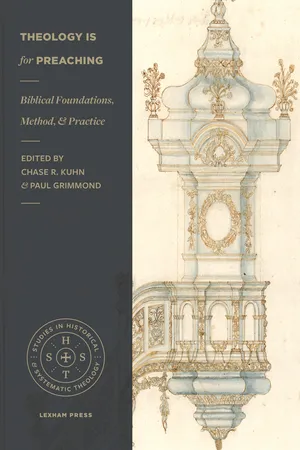
eBook - ePub
Theology Is for Preaching (Studies in Historical and Systematic Theology)
Biblical Foundations, Method, and Practice
- 416 pages
- English
- ePUB (mobile friendly)
- Available on iOS & Android
eBook - ePub
Theology Is for Preaching (Studies in Historical and Systematic Theology)
Biblical Foundations, Method, and Practice
About this book
Information
Topic
Theology & ReligionSubtopic
Christian MinistryPart 1
FOUNDATIONS
1
THEOLOGY FOR PREACHING, PREACHING FOR THEOLOGY
Chase R. Kuhn
There appears to be a growing hesitancy towards the discipline of systematic theology amongst some evangelical leaders.1 There is a concern that theological systems pollute a pure reading of the Bible, so there is no place for theology in the pulpit. Instead it is the exposition of the text in its context that drives the sermon, not how the truth of that text might agree or disagree with other texts. This sentiment wishes to guard the reading and preaching of the word from theological imposition, thus maintaining the integrity of the biblical witness. As well-intentioned as this desire to protect the purity of scriptural reading may be, it is misguided as it fails to recognize the inherently theological character of Scripture and the theological nature of preaching.
In this chapter, it will be argued that preaching in its most biblically faithful form is deliberately theological.2 In order to support this thesis, we will consider a number of facets of the nexus of theology and preaching. First, we will explore some preliminary matters regarding the nature of the church, authority, and epistemology. Second, we will articulate the validity of systematic theology as a discipline. Third, we will consider the relationship of theology and the Bible, in particular taking notice of the complementary natures of biblical and systematic theology. Fourth, we will see Paul’s model for Timothy’s ministry as exemplary of the theology-preaching nexus. Finally, we will conclude with a reflection on the ways that theology and preaching are mutually informed.
PRELIMINARY CONSIDERATIONS: PREACHING, READING, AND AUTHORITY
Preaching is not exclusively a church activity, but it is central to the church’s life together. The activities of the church are grounded in theological convictions and each activity declares those convictions about the God who has acted to gather the church.3 The declaration of truth—whether explicitly in word or implicitly in form—is grounded in an a priori commitment to doctrine, and will be a demonstration of that theology in both its message and its mode.
Preaching is a task founded upon a deep commitment to the belief that God has spoken and continues to speak to his people through the Scriptures. This commitment recognizes the necessity of the word for the church’s ontology and ongoing life together. Thus, the word has the place of primacy in the church as its supreme authority. Yet, even where the authority of the word is recognized in the church, there is not consensus concerning the nature of authority and epistemology with relation to the preaching task. There are many detailed accounts of the history of these challenges, so what follows will only be a brief telling of several positions affecting churches today.4
The Protestant reading and proclamation of Scripture, according to the principle sola Scriptura, is one that recognizes the supreme, but not exclusive, authority of Scripture.5 The Reformers, with the early church fathers, appreciated the value of theological tradition, as the Scriptures themselves are intrinsically traditional. This esteem of tradition did not displace the primacy of Scripture, but rather esteemed tradition because of the highest regard for Scripture. The Roman Catholic church has overstated the value of tradition (non-written), taking it to be of equal authority with Scripture, rather than a part of the recursive interpretive process of engaging with Scripture.6
Since the Reformation there have been some that wished to reject tradition all together.7 In the sixteenth century it was the Anabaptists. After the Enlightenment, however, the rejection grew as reason became the ultimate arbiter of truth. This left interpretation of the text to the individual, and freedom from tradition became a virtue. Webster attributed this anti-intellectualism to Cartesian philosophy, describing such thinking as “traditionless, unshaped awareness, encountering ‘no existing spiritual world’, and always beginning afresh.”8
Much of the rejection of tradition from within evangelicalism has derived from a misconception of the reformed principle of sola Scriptura, believing this principle to mean nothing but the Bible. However, this was never what the Reformers intended in their concept and methodology.9 Nonetheless, we can see evidence of at least two approaches to the Bible that have come from misconceptions of the Reformers’ teaching. First, the solo Scriptura approach that seeks to read the Bible as if it had never been read by any other before. This autonomous reading is more akin to nuda Scriptura. Christopher Hall has astutely noted: “The ideal of the autonomous interpreter can more easily be laid at the steps of the Enlightenment than the Reformation.”10 He continues, “Have Christians at any time and in any place ever read the Scripture in a vacuum, hermetically sealed from all historical, linguistic and cultural influences that potentially blur or skew the Bible’s message?… One wonders. And yet many modern people seem instinctively to assume that an objective, highly individualistic interpretive stance and methodology are laudable goals and realistic possibilities.”11
There certainly is a cultural shaping that drives the desire for autonomous reading. But along with this cultural heritage, there is also a pious justification to accommodate the method: Why would we want to corrupt the pure word of God by importing any information into our reading? Therefore the neutral reading is the best reading. Lewis Sperry Chafer, the father of dispensationalism, rejoiced that he did not have any formal theological training because this allowed him “to approach the subject with an unprejudiced mind and to be concerned only with what the Bible actually teaches.”12 Of course, this pure reading is never truly pure as no one reads a text neutrally. All people are culturally informed and have some preconceptions about truth, no matter what degree of ignorance may be claimed. There is no unconditioned mind, and there is no way to read objectively in an unbiased manner.
The second approach is the modernist hermeneutic championed by theological liberalism. Within this hermeneutic, the arbiter of truth was not just the informed self, as in the neutral reading, but the individual’s experience. Friedrich Schleiermacher, the father of modern liberalism, encouraged meaning from within one’s experience. This left the possiblity for the removal of supernatural occurrences in the text, and revisions that apply such episodes to the individual’s experience.
Both of the trajectories mentioned demand a better way for preachers to “rightly handle the word of truth” (2 Tim 2:15). Wolfhart Pannenberg argued that in light of the current climate, “The weight of the question as to the truth of talk about God has shifted over entirely to dogmatics … It has to establish the specifically theological character of all the theological disciplines.”13 Webster argued that, philosophically speaking, we should follow Hegel rather than Descartes: “Tradition is the medium of our living, not merely a deposit passively absorbed.”14 He continued, “In theology, as in other kinds of thinking, we do not begin de novo, because in one real sense we do not begin. We appropriate and transform, we preserve and enrich by entering upon the use of ‘an existing spiritual world.’ ”15
In Scripture, Paul and James both employ the metaphor of a mirror (1 Cor 13:12; James 1:23 respectively). This metaphor has been taken up by others to describe the relationship of theology to the Bible. For instance, Barth believed “[theology’s] relationship to God’s word cannot be compared to the position of biblical witnesses because it can know the word of God only at second hand, only in the mirror and echo of the biblical witness. The place of theology is not to be located on the same or a similar plane as those first witnesses.”16 Building further on this metaphor, Vanhoozer and Treier write: “Theology is a rather special kind of mirroring, a secondary mirroring, that both reflects and magnifies what it sees in the text—a conceptual mimesis or imitation, nonidentical though faithful human repetition of the divine.”17 So then the Bible is God’s self-revelation to humanity, and theology mirrors this truth. The doctrinal mirroring is meant to image clearly the truth seen. We turn now to explore this relationship further. We will begin by first looking at the validity of systematic theology as a discipline.
THEOLOGY AS A DISCIPLINE
Of the concerns with doctrine, language has been paramount. How can human beings put truth into words, especially truth about God himself? The words of the Bible can be accounted for because of the inspiration of the Spirit (2 Tim 3:16). But how can human beings articulate theological truths, especially when those truths are not stated verbatim in the Bible?
Historically this problem surfaced in the time of the church fathers, when the relationship of Jesus Christ to the Father was being considered. One of the great weapons the Arians sought to employ was the argument that homoousios was not a biblical term, but an import from Greek philosophy. The Arians believed they were being more biblical by containing their argument to exact words of the text of Scripture. However, those arguing at Nicaea, Constantinople, and later at Chalcedon chose their language because they believed it best depicted the truth that was in Scripture, even if their articulation was not the exact words used by Scripture. The word “trinity” was argued for in like fashion. But is extra-biblical language faithful?
The seventeenth-century divine Francis Turretin articulated a case for the appropriateness of employing extra-biblical language to depict truths seen in Scripture. He wrote: “Although it is not lawful to form any doctrines not in Scripture, yet it is lawful sometimes to use words which are not found there if they are such as will enable us either to explain divine things or to avoid errors.”18 Turretin employed the language of “consequences” to describe the truth of Scripture identifiable by reason.19 He argued that things may be said in Scripture in two ways, either explicitly (kata lexin) or implicitly (kata dianonian).20 Outlining a justification for the use of consequences, Turretin offered arguments for the inherent design of Scripture to be read with theological conclusions. He argues that these conclusions are rightly deduced by human beings who are made by God as rational creatures. Furthermore, he believed that “infinitely wise and foreseeing all that could be deduced from the word, God so spoke that whatever could be lawfully gathered from what he said should be considered as his word.”21
But there remain further concerns regarding consequences. How can we trust human constructs? Are not consequences at least one step removed from text, if not more? Do human formulations necessarily introduce error? Turretin agreed that human beings can and do err. However, because one can err does not mean one will err. The difference is a matter of the material being engaged. “The foundation upon which a thing rests is different f...
Table of contents
- Cover
- Title Page
- Copyright
- Dedication
- Contents
- Acknowledgments
- Preface (Chase R. Kuhn and Paul Grimmond)
- Abbreviations
- Part 1: Foundations
- Chapter 1: Theology for Preaching, Preaching for Theology (Chase R. Kuhn)
- Chapter 2: The Declarative God: Toward a Theological Description of Preaching (Mark D. Thompson)
- Chapter 3: “Preaching”: Toward Lexical Clarity for Better Practice (Claire S. Smith)
- Chapter 4: Preaching and Revelation: Is the Sermon the Word of God? (Timothy Ward)
- Chapter 5: Who Can Tell? Preaching, Giftedness, and Commissioning (Christopher Ash)
- Part 2: Methodology
- Chapter 6: Hermeneutics and Preaching: Theological Interpretation and the Preaching Task (David I. Starling)
- Chapter 7: To Them, for Us: The Bible’s Continuing Relevance (Paul R. House)
- Chapter 8: Old Testament Challenges: Christocentric or Christotelic Sermons? (Daniel Y. Wu)
- Chapter 9: New Testament Clarity: The Presence of Christ in the Proclamation of the Word (Peter Orr)
- Chapter 10: The Centrality of the Cross in Proclamation (Will N. Timmins)
- Chapter 11: Expository Preaching in Historical Context: A Rich and Inspiring Resource (Peter Adam)
- Chapter 12: The Preacher as Person: Personality and Relationships in the Pulpit (Graham Beynon)
- Part 3: Theology for Preaching
- Chapter 13: Salvation by Preaching Alone? The Sermon in Soteriology (Edward Loane)
- Chapter 14: Sanctified by Word & Spirit: A Theology of Application (Andrew M. Leslie)
- Chapter 15: Now Is the Time to Preach: Preaching in Eschatological Context (Peter F. Jensen)
- Chapter 16: The Priority of Proclamation: Preaching in a Liturgical Context (David G. Peterson)
- Part 4: Preaching for Theology
- Chapter 17: Theological Formation through the Preached Word: A Biblical-Theological Account (Simon Gillham)
- Chapter 18: The People Who Listen: The Corporate Task of Hearing God’s Word (Jane Tooher)
- Chapter 19: Letting the Word Do the Work: A Constructive Account of Expositional Preaching (Paul Grimmond)
- Part 5: Theology Preached
- Chapter 20: Listening before Speaking—Jeremiah 23:16–32 (Simon Manchester)
- Chapter 21: Meeting Jesus: Luke 5:1–11 (Phillip D. Jensen)
- Contributors
- Subject Index
- Scripture Index
- Old Testament
Trusted by 375,005 students
Access to over 1.5 million titles for a fair monthly price.
Study more efficiently using our study tools.
Frequently asked questions
Yes, you can cancel anytime from the Subscription tab in your account settings on the Perlego website. Your subscription will stay active until the end of your current billing period. Learn how to cancel your subscription
No, books cannot be downloaded as external files, such as PDFs, for use outside of Perlego. However, you can download books within the Perlego app for offline reading on mobile or tablet. Learn how to download books offline
Perlego offers two plans: Essential and Complete
- Essential is ideal for learners and professionals who enjoy exploring a wide range of subjects. Access the Essential Library with 800,000+ trusted titles and best-sellers across business, personal growth, and the humanities. Includes unlimited reading time and Standard Read Aloud voice.
- Complete: Perfect for advanced learners and researchers needing full, unrestricted access. Unlock 1.5M+ books across hundreds of subjects, including academic and specialized titles. The Complete Plan also includes advanced features like Premium Read Aloud and Research Assistant.
We are an online textbook subscription service, where you can get access to an entire online library for less than the price of a single book per month. With over 1.5 million books across 990+ topics, we’ve got you covered! Learn about our mission
Look out for the read-aloud symbol on your next book to see if you can listen to it. The read-aloud tool reads text aloud for you, highlighting the text as it is being read. You can pause it, speed it up and slow it down. Learn more about Read Aloud
Yes! You can use the Perlego app on both iOS and Android devices to read anytime, anywhere — even offline. Perfect for commutes or when you’re on the go.
Please note we cannot support devices running on iOS 13 and Android 7 or earlier. Learn more about using the app
Please note we cannot support devices running on iOS 13 and Android 7 or earlier. Learn more about using the app
Yes, you can access Theology Is for Preaching (Studies in Historical and Systematic Theology) by Chase R. Kuhn,Paul Grimmond in PDF and/or ePUB format, as well as other popular books in Theology & Religion & Christian Ministry. We have over 1.5 million books available in our catalogue for you to explore.