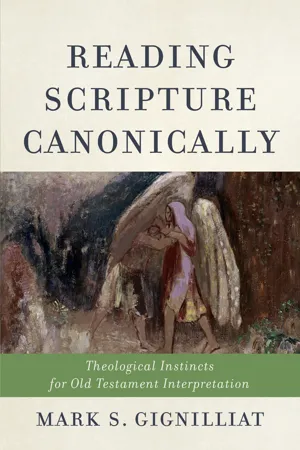
eBook - ePub
Reading Scripture Canonically
Theological Instincts for Old Testament Interpretation
- 144 pages
- English
- ePUB (mobile friendly)
- Available on iOS & Android
eBook - ePub
Reading Scripture Canonically
Theological Instincts for Old Testament Interpretation
About this book
Veteran Old Testament teacher Mark Gignilliat explores the theological and hermeneutical instincts that are necessary for reading, understanding, and communicating Scripture faithfully. He takes seriously the gains of historical criticism while insisting that the Bible must be interpreted as Christian Scripture, offering students a "third way" that assigns proper proportion to both historical and theological concerns. Reading and engaging Scripture requires not only historical tools, Gignilliat says, but also recognition of the living God's promised presence through the Bible.
Information
Part 1
Scripture’s Material Form
1
Scripture and Canon
This book aims to provide an introduction to canonical reading practices for those with some working knowledge of the basic tools of biblical studies. In this sense, the book functions like a hospitable welcome into a very large house rather than a geological survey brushing away the dirt from every potential lead. As will become more obvious as the book progresses, the canonical approach presented in this book resides within the Christian theological tradition. Without the eyes of faith and an ecclesial context for reading and reception, the instincts presented in this volume may appear foreign.1 The second part of the book is devoted to the most basic and defining facet of Christianity’s theological identity: the triune identity of God and the interpretive implications of naming God in this way. Nevertheless, on the front end of our journey, the theological character of this reading strategy must be sorted out as well: How do we define important terms? What theological commitments are required for faithful hearing of the biblical text?
These theological instincts and commitments are the tail wagging the dog of the canonical approach. God is not a god of the gaps, fitted in here or there to make sense of interpretive conundrums. Rather, a doctrine of God’s providence undergirds the entire project, including our grappling with the creaturely/human dimension of the biblical texts—the material classically offered in standard Old Testament introductions and hermeneutical textbooks. I often tell my students, at every level of their training in biblical studies, that without a robust doctrine of God’s providence, their interpretive ship will remain rudderless and lost. Without a Christian metaphysic of some sort (more of this in the second part of the book), the approach offered here falls apart and fails to persuade.
To propel us out of the gate, this chapter focuses primarily on two important front matters. First, what does the appeal to canon entail theologically? Second, when we speak of Scripture broadly or of the Old Testament in particular, what is it? Along Aristotelian lines of reasoning, the object of study determines our methods of study. If this idea holds water, then identifying Scripture’s “whatness,” or Scripture’s ontology, is a crucial matter of first importance. As this chapter will claim, faithful readers cannot identify Scripture’s nature apart from its relation to God’s self-revealing and redemption.
Canon and Scripture: Clarifying Terms
A potential brick wall faces the canonical approach right out of the gate. What exactly does the appeal to canon suggest? What positive effect does a term like canon have on the hermeneutical approach set out in this volume, when its basic, shared definition is so contested? Scholars are of varying opinions when defining canon. The marked tendency within the secondary literature is to distinguish between canon and Scripture. On this account, canon serves a more crystalline, formal, and external role when attending to the character of the Old Testament. Canon, as differentiated from Scripture, relates to the external choice of a religious community regarding what books are deemed in or out of their Holy Writ. Canon connotes list. As such, scholarly investigations of canon are located in the world of religious and social history. Here carefully imagined religious-social projections are weighed against empirical evidence in the hopes of gaining further clarity on the historical and religious forces at work in the canon’s coming to be—a target whose clear aim is equally matched by unclear evidence.2
To place “canon” and “Scripture” in related but distinct silos runs the risk of distorting the internal pressure made by the biblical documents themselves on the community of faith: Jewish and Christian. This is by no means a denial of the historical and religious forces at work in various phases of Jewish and Christian history, forces that properly recognized which books “sullied the hands” and which did not. Nevertheless, canon as list stresses under its own brittleness and allows marginal questions about particular books (is Esther in or out?) a disproportionate influence on the term’s usefulness. According to these terms, canon as a concept becomes hostage to our ability to sort out the historical whence, when, and who as it pertains to these kinds of problems. These questions remain the material of continued scholarly research.
Put in different terms, the fuzziness at the painting’s edge runs the danger of distracting from the whole picture. Questions such as “Did Jesus have a canon?” are answered by a disproportionate appeal to the blurry margins at the edge of the list. In this vein, some would answer this question negatively because of the historical uncertainty about the closure of the last part of the tripartite canon, the Writings (Ketuvim), during Jesus’s own time. Precisely at points such as these do the categories of Scripture and canon bleed into one another so that distinguishing them becomes a formal matter whose substantial difference is hard, if not impossible, to sustain.
The model on offer here softens the distinction between Scripture and canon. The latter, in terms borrowed from Brevard Childs, functions as a cipher that allows ample room for multiple factors contributing to the writing, shaping, and preservation of the biblical materials.3 From this standpoint, the appeal to “canon” or “canonical” recognizes a beginning and an ending to the process of writing, expanding, editing, shaping, and preserving biblical books. Rather than relegate the term canon to the end of that process alone, as the final moment when a book was deemed in or out among a list of other books deemed in or out, the canonical approach allows for more flexibility. The approach offered here takes into account the entire process leading to final “canonization.”4
Emphasizing the distinction between canon and Scripture formalizes the former, relegating it to the final stage of a long and complex process. Yet a “canon consciousness” is actually embedded in the literature itself, and it exerted pressure on various religious bodies in the creaturely act of canonization or the forming of set lists. To make matters clear, canon registers its proper theological force when it is understood first as an internal property of the biblical texts and second as an external decision or act.
A Brief Excursus on Defining “Canon”
Stephen Chapman ranks as one of the clearer and abler voices for sorting through the problem of defining Scripture and canon in relation to each other.5 Chapman’s approach can be set in conversation with Eugene Ulrich, who takes a different view.6 The term and concept of “canon” make no appearance in the Bible, according to Ulrich. Where the word kanōn appears in the New Testament, it does not refer to an authoritative collection of books (see 2 Cor. 10:13, 15, 16; Gal. 6:16). “Thus, the term and discussion of it are absent from the Hebrew and Greek Bibles, suggesting that the term is postbiblical,” concludes Ulrich.7 Ulrich finds it odd that the term “canon” is not discussed as a reality in Judaism and nascent Christianity, especially if the concept was important.8 Furthermore, no entry for the term “canon” is found in the Dictionary of Biblical Theology or the theologies of Eichrodt and von Rad (though the latter can be challenged).9 These noteworthy absences, according to Ulrich, should be taken seriously. However, it appears that Ulrich’s linguistic claim confuses the lack of a term’s presence with a lack of a term’s essential concerns. One could as easily conclude that the Bible makes no claims about the Trinity because of the lexeme’s absence in the Bible.
Ulrich makes use of Gerald Sheppard’s distinction between “canon 1” and “canon 2.”10 The former relates to the ruled character of authoritative books: norma normans non normata (the norming norm, which cannot be normed). The latter promotes the notion of list and by its very nature is closed. For Ulrich, to speak of an open canon is self-defeating because the very term canon precludes openness. However, Chapman believes Ulrich’s use of Sheppard’s categories—canon 1 and canon 2—does not do justice to Sheppard’s overarching concerns. Sheppard did not see a strict sequential linearity between canon 1 and canon 2, with the latter understood as a sequential consequence to the former. In fact, according to Chapman, “fixity is a pole rather than a stage,” just as Sheppard argues.11 A hyperattentiveness to canon as fixity runs into problems in light of the historical evidence, because “determining the precise time and circumstances of the absolute fixation of the canon is a matter of crucial importance—except for one thing: it is in fact chimerical.”12 In fairness to Ulrich’s argument, he seeks for lexi...
Table of contents
- Cover
- Half Title Page
- Title Page
- Copyright Page
- Dedication
- Contents
- Acknowledgments
- Introduction
- Abbreviations
- Part 1: Scripture’s Material Form
- Part 2: Scripture’s Subject Matter
- Epilogue
- Scripture Index
- Subject Index
- Back Cover
Trusted by 375,005 students
Access to over 1.5 million titles for a fair monthly price.
Study more efficiently using our study tools.
Frequently asked questions
Yes, you can cancel anytime from the Subscription tab in your account settings on the Perlego website. Your subscription will stay active until the end of your current billing period. Learn how to cancel your subscription
No, books cannot be downloaded as external files, such as PDFs, for use outside of Perlego. However, you can download books within the Perlego app for offline reading on mobile or tablet. Learn how to download books offline
Perlego offers two plans: Essential and Complete
- Essential is ideal for learners and professionals who enjoy exploring a wide range of subjects. Access the Essential Library with 800,000+ trusted titles and best-sellers across business, personal growth, and the humanities. Includes unlimited reading time and Standard Read Aloud voice.
- Complete: Perfect for advanced learners and researchers needing full, unrestricted access. Unlock 1.5M+ books across hundreds of subjects, including academic and specialized titles. The Complete Plan also includes advanced features like Premium Read Aloud and Research Assistant.
We are an online textbook subscription service, where you can get access to an entire online library for less than the price of a single book per month. With over 1.5 million books across 990+ topics, we’ve got you covered! Learn about our mission
Look out for the read-aloud symbol on your next book to see if you can listen to it. The read-aloud tool reads text aloud for you, highlighting the text as it is being read. You can pause it, speed it up and slow it down. Learn more about Read Aloud
Yes! You can use the Perlego app on both iOS and Android devices to read anytime, anywhere — even offline. Perfect for commutes or when you’re on the go.
Please note we cannot support devices running on iOS 13 and Android 7 or earlier. Learn more about using the app
Please note we cannot support devices running on iOS 13 and Android 7 or earlier. Learn more about using the app
Yes, you can access Reading Scripture Canonically by Mark S. Gignilliat in PDF and/or ePUB format, as well as other popular books in Theology & Religion & Biblical Criticism & Interpretation. We have over 1.5 million books available in our catalogue for you to explore.