"A rare and wonderful theological book that turns something ordinary--being a friend--into an expression of God's greatness."--Jeremiah Rood, Foreword (starred review)
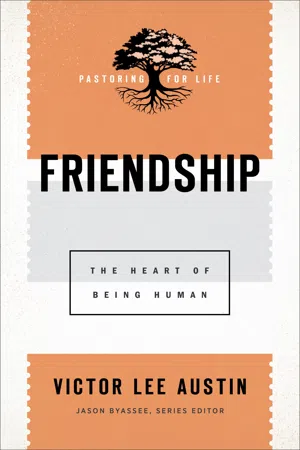
In this vibrant theological reflection on the meaning of friendship, experienced pastor and leading Christian ethicist Victor Lee Austin argues that friendship is the medium through which God shares grace with his creatures. Mixing personal reflection and theological commentary, Austin provides a fresh reading of classical writers and biblical texts; shows how a robust theology of friendship addresses contemporary controversies in the areas of marriage, celibacy, and homosexuality; and draws on cultural examples of the desire for true friendship. Ultimately, Austin helps readers understand the strange yet real possibility of friendship with God.
About the Series
Pastors are called to help people navigate the profound mysteries of being human, from birth to death and everything in between. This series, edited by leading pastoral theologian Jason Byassee, provides pastors and pastors-in-training with rich theological reflection on the various seasons that make up a human life, helping them minister with greater wisdom and joy.
eBook - ePub
Friendship (Pastoring for Life: Theological Wisdom for Ministering Well)
The Heart of Being Human
- 192 pages
- English
- ePUB (mobile friendly)
- Available on iOS & Android
eBook - ePub
Friendship (Pastoring for Life: Theological Wisdom for Ministering Well)
The Heart of Being Human
About this book
Information
Topic
Theology & ReligionSubtopic
Christian MinistryONE
The Limits of Marriage
The Problematic Fallout of Marriage Debates
Why would we look for friendship? It might seem that our heart’s desire is for intimacy and companionship, to have another who will know us and whom we will know, within an embrace of love and truth. But isn’t that what marriage is?
Contemporary controversies over marriage in Western societies and churches go back a good century. Before there were questions about same-sex relationships, there were questions about the place of children in marriage (whether technology can permissibly shape procreation and, if so, how, starting with questions about contraception). Then not that far in the past, questions arose about remarriage after divorce. Views on all sides of these matters have been passionately held, calling forth a lot of thinking and debating, as they should. Developments in society have been seen by some church folk as revelations of new things that God is doing in the world; accordingly, they have urged their churches to reform what they viewed as outdated practices. But others, instead, have found those same societal developments to be temptations to deviate from the truth, and they have urged faithful resistance. And still others have wanted to hold on to traditional beliefs but have felt that pastoral concerns require some measure of accommodation.
What is common to these controversies is that each has led to calls that the shape of marriage be changed and that the limits placed upon marriage be relaxed. There has been a resulting counter-response that urges a defense of marriage, which, it is said, is under attack and has been so for some time. As a result, the energies of the churches have been concentrated on the marital institution to such an extent that, arguably, we have failed to attend to other important things, including friendship.
Perhaps today we need to set aside for a while our disputes over marriage and bring friendship to the fore.
Jesus and the Nonresurrection of Marriage
It is built into the marriage vow that it exists only for this life. While everything that belongs to creation is finite and has limits, it is peculiar to marriage that those limits are expressly this-worldly. Forgive me if I belabor the point; it is, it seems to me, signally unappreciated by Christians in general. In the kingdom of heaven there are human beings, free of sin and doing such great things as humans have the capacity to do. They are fully human—and they do not marry. Marriage is the only social institution that Jesus identifies as not part of human flourishing in the kingdom of his Father.
When some opponents wanted to trap Jesus, they concocted (or co-opted) a scenario according to which a woman had had seven husbands, all of them brothers, each of them taking up with her, as the Mosaic law required, after his predecessor had, well, expired (in each case leaving her childless). These opponents (they were the Sadducees) believed this scenario exposed a problem with holding that there is a resurrection (a doctrine they rejected): if dead people are raised, then this woman, when she is raised, will have seven husbands! Jesus’ refutation is clean and simple: in the resurrection there is no marriage. Here is how Saint Luke records his reply: “The children of this world marry, and are given in marriage: But they which shall be accounted worthy to obtain that world, and the resurrection from the dead, neither marry, nor are given in marriage: Neither can they die any more: for they are equal unto the angels; and are the children of God, being the children of the resurrection” (Luke 20:34–36). It is briefer in Saint Matthew: “For in the resurrection they neither marry, nor are given in marriage, but are as the angels of God in heaven” (Matt. 22:30). Similarly brief, Saint Mark still gets in a reference to the dead: “For when they shall rise from the dead, they neither marry, nor are given in marriage; but are as the angels which are in heaven” (Mark 12:25).
The main point of this encounter is Jesus’ affirmation that there is such a thing as “the resurrection” or a rising “from the dead,” over against the Sadducees’ teaching that denied it. Since it seems they also denied the existence of angels, Jesus’ claim that in the resurrection humans are “equal unto” or “as the angels” is a further underscoring of their difference. To avoid misunderstanding, we should note that Jesus merely compares the resurrected human life with the angelic, and only on this point: just as angels do not marry (nor do they die), so for people in the resurrection. He does not say, for instance, that in the resurrection people are like angels in having no bodies; he does not characterize the resurrection as an ongoing eternal life of a disembodied soul. Most emphatically, he does not say that we die as women and men but rise as angels. It is human beings who “shall rise from the dead,” and they shall not marry.
This is no minor aspect of our Lord’s teaching. Rather, it is his key illustration of both the real promise of the resurrection and the real difference between this life and that one: there is marriage now, and there will not be marriage then. Marriage is temporally circumscribed; it is this-worldly; it is not a part of the life to come. Every marriage has a beginning and has, or will have, an end. To reject this reality is to indulge in fantasy and set oneself up for failure. I recall one of the first couples I prepared for marriage. During our premarital conversations, the groom-to-be balked at the words in the wedding vow “until we are parted by death.” Words that reference death, he felt, would be a downer; they would throw a shadow on what should be an exceedingly happy day. This groom wanted, instead of the vow as written, to say that his love would last forever. Green priest as I then was, I am sure I did not help him much. Yet alas, as it turned out, they were soon divorced; far short of forever, their marriage did not last even a few years. Reality can be hard, but fantasy can be worse.
Is There Something We’re Not Seeing?
O Christians! Do you want to be saying that the highest, most important achievement for a human being is marriage, when it is clear from Scripture and liturgy (if not from popular human sentiment) that marriage is for this world only? Does it make for a truly coherent Christian doctrine of the human being to say that what is most important this side of death does not even exist on the other side? For (as we dare not forget) “on the other side” we will still be human beings, we will still have bodies—indeed, Christians affirm Jesus’ bodily ascension into heaven—and yet, in the resurrection, there is not to be marriage. Respect for our created nature cannot require us taking marriage as the highest thing.
Is there something else on offer, something we should cease overlooking and bring to the center of our attention, at least for a while?
There is, and that something else is, of course, friendship. Let me propose an answer to a question implicit a few pages back. If we are fully human in the life to come, what is the characteristic human activity of that life? This is my answer, which I first heard suggested by Herbert McCabe, a brilliant thinker of the last century: heaven is people living together as friends—friends with each other, friends with God.1
The characteristic activity of a human being is to live in friendship with others.
The rest of this book will try to bring light to this conclusion. We will learn from philosophy, the Bible, Christian thinkers, literature, and indeed our own pondering over what makes sense.
To speak honestly, most of us know little about friendship. We are confused by it, and consequently we don’t know how to work on it, and thus we underprize it. It is a great puzzle. While the limits and nature of marriage are hotly contested, we muddle along in blindness to something that is arguably more universal than marriage and more eternally important.
I awoke to this reality a few years ago. Shortly after Susan died, my children, who were then independent young adults, gently and lovingly told me that they would have no objection if I wanted to remarry. Other friends occasionally asked about such things. I remember a question from a priest—“Are you seeing anyone?”—which surprised me, although it turned out he was wondering not if I had taken up a new romance but if I was seeing a psychologist to work through grief! Still, the question of seeing or dating or marrying is often there, even if not always given voice. And it’s not wrong, but it is interesting that no one asked me how my friendships were doing.
My immediate thoughts after Susan died turned to my calling from God. As a priest in the Episcopal Church, I could remarry as a matter of course, just as all Christian laypeople may regardless of their church. It is different for Orthodox and Roman Catholic clergy. In the Orthodox tradition, marriage, if it comes at all, must precede ordination, and a priest (male, of course) whose wife dies cannot remarry. Similar provisions apply to former Episcopal clergy who are ordained in the Roman Catholic Church, and indeed they apply to married deacons within that church itself.
Wise, practical reasons can be discerned behind such a tradition—it keeps the priest from being “on the market” among his or her parishioners; it’s a boundary that protects pastoral care from turning into a romantic relationship, which could easily sour and harm people. But I felt another reason as well.
Taking care of Susan through her illness had consumed a large part of my attention for nearly two decades. That was time gladly given for the most part (albeit I was sometimes grumpy and unreasonable), and through those decades I learned a lot about myself and grew in ways I would not otherwise have grown. For me, as is the case for many, marriage proved a school in which I learned the joyous practices of sacrificial love. But when Susan died, I saw I would have a lot more time to put at God’s disposal. With grown children, and without a spouse, I would be free to serve God wherever he called me.
And that is the case: I am at God’s disposal, and already I have moved once in response to his call, as I discerned it, not to India (where I had a bit of a fancy he might send me) but to Dallas. (For many New Yorkers, Dallas is at a greater cultural remove than India.) I call myself a theological missionary, someone sent by God to teach and write to help people better understand divine and human things.
Then I thought some more. I was married immediately after college. I never had those post-college single years in which many people develop friendships while living alone. It’s happening to me in reverse, it seems. I married first, and now I am in a time of life to explore what friendship is, to try to make and build friendships, and to learn to be a friend. I am a missionary into friendship, as someone who sees friendship not as a possible preliminary to marriage but as the reverse. Friendship is the good thing that extends beyond any possible marriage. What is it? Premarital, postmarital, extramarital, intramarital, nonmarital—all of these at once and, in fact, something that need not have any intrinsic connection with marriage.
It’s obvious, at least from my standpoint in life, that friendship is the highest human thing. It is, may I say, the final frontier. It is the long game. But what is it?
TWO
The Confusions of Friendship
Our Cultural Landscape
It is a venerable strategy: when you are trying to grasp something that is not clear, you can begin by attending to how people use the word. Friend, we quickly see, is a word used in many different ways that suggest several different things. Here are some notes on our cultural landscape of friendship.
Contrary to what we might expect, many people employ the word friend to suggest distance rather than intimacy. One sees this at the time of a romantic breakup; the two parties might say to one another, “Let’s just be friends.” Thereby they reveal that they think of friendship as something vaguely cordial but lacking closeness, something that falls short of a real relationship.
Now turn to an aspect of the great cultural-shifting gift we have from Mr. Zuckerberg, whose Facebook has verbed the term friend, thereby debasing the friendship currency promiscuously. Of course, to “verb” a noun is part of the fun of English. It’s not the verbing of friend that’s culturally significant but the casualness of the process: “friending” someone amounts to no more than a click of a digital synapse. To say that you have, or to set out to acquire, thousands of friends wantonly cheapens the notion. This is acknowledged still, if guiltily, when one announces that one has a certain number of not “friends” but “Facebook friends.” Yet “friending” continues to gallop along.
Other cases, however, point in the opposite direction, with friend indicating neither someone put off at a distance nor a person breezily “friended” but someone who is close and special. Spoken of in this way, a friend is a person intimate to oneself. Many people will say their spouse is their best friend, or they wish he or she were. Two people who are sexually attracted to each other will try to see if they can be best friends for each other as a sort of test before they commit to marriage. Similarly, and increasingly, they may simply remain each other’s girlfriend or boyfriend—compound terms in which the friend is a spouse-like companion in a substitute-for-marriage relationship.
Behold our culture’s confusion! On the one hand, the epitome of friendship is identified with marriage, which, whether formalized or not, is widely taken to be the most meaningful human relationship. Yet on the other hand, friendships are the dregs of lesser relationships—“just friends” and “Facebook friends”—dregs left for everyone else. On all hands, friendship lacks a proper distinctiveness, and it seems to be anything or nothing at all.
Who Will Teach Us about Friendship?
If Christians have not given friendship the kind of thoughtful attention marriage has received, and if when we do start to think about friendship we realize there is a wide variety of opinion about it and indeed vast confusion even in the way we speak of friends and friendship, where should we turn for guidance? Many people would turn straight to the Bible and investigate what it has to say on the subject. And the Bible does contain deep wisdom concerning friendship. But the path of this book, as I indicate in the introduction, is to attend to some worldly and ancient wisdom before going further into the Scriptures. It just is the case that Aristotle’s thinking about friendship proved decisive for much Western thought that followed. In addition, there is a lacuna in Aristotle’s thought that is almost perfectly explained—and overcome—by the Scriptures. That is to say, the likes of Aristotle will both help us understand friendship and help us see better the distinctively Christian way of friendship.
So, dear reader, you will find this book going back and forth between old classical texts and the Scriptures, even as it goes back and forth between secular cultural artifacts and Christian thinking.
Let me lay my theological cards on the table. I take the Bible to be the Word of God written for us and speaking to us. We humans turn to the Bible with the intelligence we have, and that intelligence is human, which is to say that, while personal, it is not individual but cultural and social and communal. We humans never think alone but are ever (when we think) in some sort of dialogue or conversation with other humans, others who include both the living and the dead. Indeed, the Bible itself speaks in an implicit dialogue with all forms of human wisdom, wherever found; it critiques, illuminates that which is good, and can correct that which falls short.
With each of the ancient pagan writers this book considers, we will bear down on one key text. I could not pretend herein to give you a complete scholarly account of these writers or to go through the various schools of interpretation that have been popular at different times in history. Nor do I think you would find that interesting! What is interesting—I think, for any person, whoever we are—is to consider with care some things these ancients said that seem to be at once true and problematic. Their ideas about friendship still (thousands of years later) attract people who find them beautiful. Yet at the same time, they suggest questions that trouble.
I turn then, for the rest of this chapter, to Aristotle (384–322 BC), the Greek marine biologist (yes!) and philosopher whose thinking on friendship decisively shaped Western culture.
The Ancient Surprise
On the matter of friendship, Aristotle makes a claim that we are unlikely to have expected (although it will turn out to be also the key Christian claim about friendship). Whether our contemporaries think of friendship as a great thing or a minor good thing, whether they esteem it highly or not, they locate friendship in the private realm, treating it as something that supplements, at best, the public ...
Table of contents
- Cover
- Half Title Page
- Series Page
- Title Page
- Copyright Page
- Dedication
- Contents
- Series Preface
- Invocation
- Introduction
- 1. The Limits of Marriage
- 2. The Confusions of Friendship
- 3. Friendship as Success at Being Human
- 4. Friendship and Beauty
- 5. The Weirdness of Divine Love
- 6. Biblical Friendships
- 7. Christian Friendship and Christian Love
- 8. Unapologetic Celibacy
- 9. Is There Friendship in the Trinity?
- 10. Examples of Friendship
- 11. All Together Now
- Postscript
- Credits and Acknowledgments
- Notes
- Scripture Index
- Subject Index
- Back Cover
Trusted by 375,005 students
Access to over 1.5 million titles for a fair monthly price.
Study more efficiently using our study tools.
Frequently asked questions
Yes, you can cancel anytime from the Subscription tab in your account settings on the Perlego website. Your subscription will stay active until the end of your current billing period. Learn how to cancel your subscription
No, books cannot be downloaded as external files, such as PDFs, for use outside of Perlego. However, you can download books within the Perlego app for offline reading on mobile or tablet. Learn how to download books offline
Perlego offers two plans: Essential and Complete
- Essential is ideal for learners and professionals who enjoy exploring a wide range of subjects. Access the Essential Library with 800,000+ trusted titles and best-sellers across business, personal growth, and the humanities. Includes unlimited reading time and Standard Read Aloud voice.
- Complete: Perfect for advanced learners and researchers needing full, unrestricted access. Unlock 1.5M+ books across hundreds of subjects, including academic and specialized titles. The Complete Plan also includes advanced features like Premium Read Aloud and Research Assistant.
We are an online textbook subscription service, where you can get access to an entire online library for less than the price of a single book per month. With over 1.5 million books across 990+ topics, we’ve got you covered! Learn about our mission
Look out for the read-aloud symbol on your next book to see if you can listen to it. The read-aloud tool reads text aloud for you, highlighting the text as it is being read. You can pause it, speed it up and slow it down. Learn more about Read Aloud
Yes! You can use the Perlego app on both iOS and Android devices to read anytime, anywhere — even offline. Perfect for commutes or when you’re on the go.
Please note we cannot support devices running on iOS 13 and Android 7 or earlier. Learn more about using the app
Please note we cannot support devices running on iOS 13 and Android 7 or earlier. Learn more about using the app
Yes, you can access Friendship (Pastoring for Life: Theological Wisdom for Ministering Well) by Victor Lee Austin, Byassee, Jason, Jason Byassee in PDF and/or ePUB format, as well as other popular books in Theology & Religion & Christian Ministry. We have over 1.5 million books available in our catalogue for you to explore.