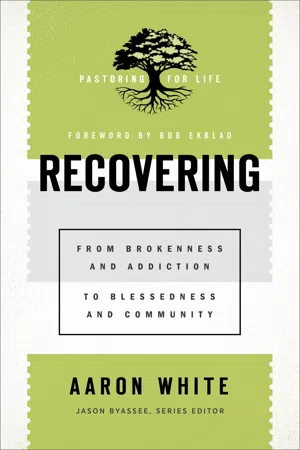
This book provides a theologically rich commentary on the challenge of addiction and the long road to recovery. Written by a minister with extensive experience working with people who struggle with addictions, this book helps pastors understand the roots and realities of our universal human struggle with addictions and attachments while showing that together we have great hope for freedom, wholeness, and recovery. Readers will learn how to create and foster a Beatitude Community, the kind of environment Jesus prescribed for his people, to help addicts and those who love them heal from brokenness. Foreword by Bob Ekblad.
About the Series
Pastors are called to help people navigate the profound mysteries of being human, from birth to death and everything in between. This series, edited by leading pastoral theologian Jason Byassee, provides pastors and pastors-in-training with rich theological reflection on the various seasons that make up a human life, helping them minister with greater wisdom and joy.
eBook - ePub
Recovering (Pastoring for Life: Theological Wisdom for Ministering Well)
From Brokenness and Addiction to Blessedness and Community
- 208 pages
- English
- ePUB (mobile friendly)
- Available on iOS & Android
eBook - ePub
Recovering (Pastoring for Life: Theological Wisdom for Ministering Well)
From Brokenness and Addiction to Blessedness and Community
About this book
Information
Topic
Theology & ReligionSubtopic
Christian MinistryPart 1: Broken and Blessed
ONE
Broken
What causes quarrels and what causes fights among you? Is it not this, that your passions are at war within you?
James 4:1
The first step 5 confession I ever heard is seared into my heart and mind. I was leading worship during a church meeting in Victoria, BC. Our congregation met near the local Addictions Rehabilitation Centre, but that was not remotely the demographic of our worshiping community. This evening, however, a stranger had somehow discovered our meeting and made his way inside. When the time came for prayer requests, the man stood up and shakily announced, “I am an alcoholic. . . . If I don’t get help, I’m going to die.” Then he sat down. Nobody knew what to do. Someone uttered a simple prayer for strength and courage or something, and we moved awkwardly to the next prayer request. The man sat for a while in his pew, alone, and then eventually got up and walked out. Seeing this from the front, I was self-righteously incensed. Why had no one moved to sit with this man? Why was no one following him out the front door? What is wrong with this church? And then I realized the problem with my judgment: I had not moved to sit with him; I was not following him; there was something wrong with me. I walked off the stage and ran out of the building to find him. He was sitting on the front step, and I scared him badly as I burst out the front door in a blaze of missional zeal. Once we both calmed down he told me he wanted to do a step 5. Step 5 of the twelve steps is when we “admit to God, to ourselves, and to another human being the exact nature of our wrongs.” This is what he proceeded to do, confessing the exact and horrifying nature of his wrongs to a passionate but overwhelmed eighteen-year-old. We spent an hour together, him talking, me listening, on that cold, cement step. I was shocked by his vulnerability and honesty, something I had never witnessed in a church setting. At the end he let me pray for him, then we hugged, and he left. I went back inside and promptly broke down crying. When my pastor asked why I was so emotional, the best I could come up with was that this was what God wanted for that man and for our congregation, and I was so blessed to participate. There was a gift that God had for that man through our prayer and through my listening, and I suspect there could have been a lot more for him had we been better prepared to offer it. But there was also something God wanted to give to us, to me, in that encounter, a beautiful gift that could come only through the man’s broken, honest cry and confession. That was the question I left with that night: Are we ready to be part of the blessing God wants to pour out on his children through real, raw encounters with people in pain? And will we know what to do when we receive it? I have heard many step 5 confessions since that first one, and I have never ceased to wonder at how God uses honesty and vulnerability to effect healing and wholeness.
You and Me
There is a frighteningly true AA aphorism: you are only as sick as your secrets. So let’s start with some honesty and vulnerability: I am not a stranger to addiction. I have been addicted to different thought patterns, behaviors, relationships, and things throughout my life, some of which will be discussed in the body of this book. I do not say this with either pride or resignation; I just say that it is true, that I am working on it, and that by the grace of God and the help of my community I have experienced growing freedom and hope. You have been affected by addiction too. Even if you are a pastor (or a would-be pastor), it is not simply that you have people who are addicted to drugs and alcohol in your congregation, which you most certainly do. If you are honest, you will acknowledge that there are dark areas in your heart and mind where you have little to no control. You feel trapped and hypocritical. This interior darkness is the place where most of us have hidden our addictions. Addiction does not just refer to chemical substances, so whether you are addicted to alcohol, amphetamines, pornography, control, a relationship, procrastination, your self-image, money, success, or anything else, you are still addicted. And we all live in a society with addiction enthroned at its very core: addiction to capital, to development, to celebrity, to GDP, to nationalism, to exceptionalism, and more. This is a huge concern personally, societally, and spiritually, yet it is one that very few people are willing to acknowledge and that even fewer people know what to do about. The good news is that something can be done about this—the major something has in fact already been done about this—and we can participate in our own healing, the healing of others, and even the healing of our broken society. That is the point of this book. The more difficult news, which I refuse to downplay, is that this is really, really hard work that requires absolutely everything we have. We cannot begin to help others if we do not take this work seriously in our own lives.
Addiction is a holistic issue: it affects body, soul, and spirit as well as relationships, employment, housing, finances, leisure, and all forms of societal engagement. Any response to addiction must likewise consider the fullness of the human condition. Portugal has done this with some success in the last decade by decriminalizing drugs and investing massively in treatment, prevention, housing, education, and job training for people in recovery. In Vancouver the policy around homelessness and addiction has shifted to include Housing First, which is an attempt to help people get into safer housing, without barriers, before trying to address any deeper issues. Once housed, efforts are made to help with recovery, to acknowledge the unique needs and decisions of individuals, and to integrate people into social life. This is good, but even the best government policies cannot speak to the deep wounds and desires of our hearts. We are invested with a profound longing for fulfillment, for wholeness, for kinship, and for love—longings that can only be satisfied by something outside of ourselves. This necessarily includes human community. Frederick Buechner says, “You can survive on your own; you can grow strong on your own; you can prevail on your own; but you cannot become human on your own.”1 But even human community is not enough. We were created with an inner desire for God, a deep yearning for relationship with our Creator, a relationship that contains within it our very meaning and purpose.
Knowing and pursuing our heart’s divine longing is central to finding our way—and helping others to find their way—out of addiction and into recovery. Richard Rohr asserts that “spiritual desire is the drive that God put in us from the beginning, for total satisfaction, for home, for heaven, for divine union, and it just got displaced onto the wrong object.”2 That is, addiction co-opts and redirects the energy behind our created purpose. Gerald May describes it this way: “Addiction exists wherever persons are internally compelled to give energy to things that are not their true desires. . . . Addiction is a state of compulsion, obsession, or preoccupation that enslaves a person’s will and desire. Addiction sidetracks and eclipses the energy of our deepest, truest desire for love and goodness.”3
This applies to all addictions, not just to drugs and alcohol. Of course, there is a significant difference in degree between an addiction to social media and an addiction to heroin. Both are enslavements, but one tends to wreck your life, or even kill you, a lot quicker. And even within those general categories there are differing intensities to our addictions, and different short- and long-term consequences. At the core of this book is the assertion that addiction affects us all, personally and societally, and all our addictions should be taken seriously. Yet our eyes must be open to the acute suffering and danger experienced by those whose pain and trauma has led them to drug and alcohol addiction. There is a cost when I fall back into my old temptations and attachments, but it is still possible that nobody will even know about it except me and God. When some of my friends fall back into their old temptations and attachments, they risk losing their sobriety, their reputation, their job, their family, their sanity, their homes, and their lives. Not only this, but there is a stigma attached to drug and alcohol use that makes these addictions all the more dangerous. One of the reasons many people die when they resume using drugs after a period of abstinence is the need to keep it a secret out of fear and shame.
This has been particularly true in our neighborhood over the last few years with the influx of a powerful opioid called fentanyl, which resembles heroin but is one hundred times stronger. British Columbia was home to 3,400 overdose deaths in the past four years—in 2017 the province averaged four fatal overdoses per day, over 1,500 for the whole year—with roughly a quarter of those deaths occurring in Vancouver.4 As I write, there have been eleven overdose deaths in the past week. The issue is not specific to Vancouver, however. In a 2012 study, 21.6 percent of Canadians, or roughly six million people, met the criteria for a substance abuse disorder.5 The heroin industry brings in a reported fifty-five billion dollars (US) annually worldwide, which is not all coming from our neighborhood. In the United States, approximately twenty million people over the age of twelve have an addiction to drugs or alcohol, with one hundred reported overdoses each day, a rate that has tripled in the last twenty years. The highest reported substance-use numbers are among those eighteen to twenty-five years old, and 90 percent started their addiction before the age of eighteen.6 Poverty tends to increase the severity of the consequences, but addiction itself is no respecter of class, gender, age, race, or religious background—which is why I confidently say that you have people who are addicted to drugs and alcohol in your congregation. But these stats are incomplete because they only deal with one small part of worldwide addictions. When you add in other “process addictions” such as pornography, gambling, power, money, codependent relationships, overwork, food, social media, and more, you see how this affects absolutely everyone.
Pain and Dislocation
But where do these addictions come from? And why are they so powerful?
We should start by acknowledging that while we are affected by addictions, there is no such thing as a “universal addict.” Each person has her or his own unique backstory and context, and each one is beautifully and wonderfully designed to reflect and carry the image of God. Let us be careful to remember the inherent dignity at the heart of every single person we meet, no matter how “lost” they appear to us.
It is still possible, however, to identify certain commonalities and shared experiences that are connected to addictive behavior. The primary common denominator for addiction is not a weak will or moral failing, but pain. Gabor Maté calls addiction a “stupid friend” that starts as a response to pain but then becomes an issue in and of itself.7 Drugs, alcohol, and other substances or habits, while wreaking terrible harm on the...
Table of contents
- Cover
- Half Title Page
- Series Page
- Title Page
- Copyright Page
- Dedication
- Epigraph
- Contents
- Series Preface
- Foreword
- Introduction
- Part 1: Broken and Blessed
- Part 2: The Beatitude Community
- Resources
- Notes
- Bibliography
- Index
- Back Cover
Trusted by 375,005 students
Access to over 1.5 million titles for a fair monthly price.
Study more efficiently using our study tools.
Frequently asked questions
Yes, you can cancel anytime from the Subscription tab in your account settings on the Perlego website. Your subscription will stay active until the end of your current billing period. Learn how to cancel your subscription
No, books cannot be downloaded as external files, such as PDFs, for use outside of Perlego. However, you can download books within the Perlego app for offline reading on mobile or tablet. Learn how to download books offline
Perlego offers two plans: Essential and Complete
- Essential is ideal for learners and professionals who enjoy exploring a wide range of subjects. Access the Essential Library with 800,000+ trusted titles and best-sellers across business, personal growth, and the humanities. Includes unlimited reading time and Standard Read Aloud voice.
- Complete: Perfect for advanced learners and researchers needing full, unrestricted access. Unlock 1.5M+ books across hundreds of subjects, including academic and specialized titles. The Complete Plan also includes advanced features like Premium Read Aloud and Research Assistant.
We are an online textbook subscription service, where you can get access to an entire online library for less than the price of a single book per month. With over 1.5 million books across 990+ topics, we’ve got you covered! Learn about our mission
Look out for the read-aloud symbol on your next book to see if you can listen to it. The read-aloud tool reads text aloud for you, highlighting the text as it is being read. You can pause it, speed it up and slow it down. Learn more about Read Aloud
Yes! You can use the Perlego app on both iOS and Android devices to read anytime, anywhere — even offline. Perfect for commutes or when you’re on the go.
Please note we cannot support devices running on iOS 13 and Android 7 or earlier. Learn more about using the app
Please note we cannot support devices running on iOS 13 and Android 7 or earlier. Learn more about using the app
Yes, you can access Recovering (Pastoring for Life: Theological Wisdom for Ministering Well) by Aaron White, Byassee, Jason, Jason Byassee in PDF and/or ePUB format, as well as other popular books in Theology & Religion & Christian Ministry. We have over 1.5 million books available in our catalogue for you to explore.