2020 Book Award Winner, The Gospel Coalition (History & Biography)
2020 For the Church Book Award
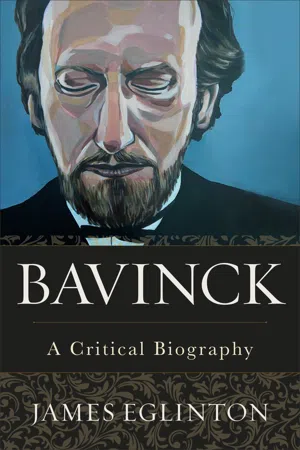
Dutch Calvinist theologian Herman Bavinck, a significant voice in the development of Protestant theology, remains relevant many years after his death. His four-volume Reformed Dogmatics is one of the most important theological works of the twentieth century.
James Eglinton is widely considered to be at the forefront of contemporary interest in Bavinck's life and thought. After spending considerable time in the Netherlands researching Bavinck, Eglinton brings to light a wealth of new insights and previously unpublished documents to offer a definitive biography of this renowned Reformed thinker.
The book follows the course of Bavinck's life in a period of dramatic social change, identifying him as an orthodox Calvinist challenged with finding his feet in late modern culture. Based on extensive archival research, this critical biography presents numerous significant and previously ignored or unknown aspects of Bavinck's person and life story. A black-and-white photo insert is included.
This volume complements other Baker Academic offerings on Bavinck's theology and ethics, which together have sold 90,000 copies.
- 480 pages
- English
- ePUB (mobile friendly)
- Available on iOS & Android
eBook - ePub
About this book
Information
Topic
Theology & ReligionSubtopic
Religious BiographiesPart 1
Roots
1
The Old Reformed Church in Bentheim
“From the farmhouse to the town”
The Modern European Experience of Upheaval
Insofar as it is seen as a story of upheaval, the history of nineteenth- and twentieth-century Europe forms a striking backdrop to Herman Bavinck’s own life story. Tim Blanning portrays the experience of modern Europeans—including, by implication, our subject—as characterized by the conviction that “the ground [was] moving beneath their feet.”1 Theirs was an epoch of staggering, broad, and often dramatic social, political, intellectual, and religious shifts. As the nineteenth century dawned, the French Revolution had finished and was followed by the Napoleonic Wars. The First Industrial Revolution, which had begun in the eighteenth century, was in full swung. Europeans of that era saw the rise of nationalisms and the peak of the age of Eurocentric world empires. Europe at the time was the birthplace of new liberal democratic political ideals. In the twentieth century, its inhabitants knew the Great Depression and World Wars and watched as their world reoriented itself from modernization to globalization. Modern Europe was the garden in which diverse species of secularism bloomed.
In the Netherlands, more specifically, Bavinck was born into a tumultuous period of political, industrial, and religious change. In the decade before his birth, King William I, the authoritarian ruler of the nondemocratic Dutch state, abdicated. In 1848, his successor, King William II, consented to a new liberal constitution. Overnight, the Netherlands became a constitutional monarchy, the king’s powers were constrained, and a new set of modern democratic civil liberties became the framework that guided Dutch social interaction. With the advent of parliamentary democracy and enlarged suffrage came a basic set of rights—the freedoms of assembly, religion, and education. The immediate social context into which Bavinck was born, as the son of a preacher in a movement of ecclesiastical secession from the established Dutch Reformed Church, was also one of flux: it was a cultural moment in which religious affiliations were regularly realigned, often with drastic consequences.
Bavinck entered the world in the midst of a period busy with its own reinvention—a constant setting of change that spanned the entirety of his lifetime. Indeed, the worlds into which he was born (in 1854) and died (in 1921) were dramatically different places. The backdrop to our story is thus anything but static. Had Bavinck been disengaged from this relentless process of social change, his biography would likely take a distinct shape. It would be the story of a theologically orthodox monolith, unyielding and immutable, weathering decades of storm, grounded in bygone and seemingly better days. That, however, is not the story to be told in this book. Our subject was profoundly aware of his social and historical context. To borrow Blanning’s phrase again, Bavinck had no difficulty in recognizing that the ground was moving beneath his feet. The fact of this movement, however, was not inherently problematic to him—and often enough, he would be the one willing that ground to move in particular ways. The bare fact of change was not Bavinck’s enemy. As he would articulate later, the only thing in this world that grace opposes is sin itself. In his eyes, this process of constant becoming, including perpetual change in human culture, was a basic feature of the created order. The great challenge of Bavinck’s life was, rather, where he—as an orthodox Calvinist—should place his feet in this ever-shifting terrain.
If not read carefully, the basic details of Bavinck’s early life could tempt the reader to caricature his life in a certain fashion. Following his upbringing in a pious Reformed family in small towns, he chose to study under the leaders of the unorthodox “Modern theology” movement at a secular university in a large city.2 If not read carefully, that move to Leiden might be seen as a rejection of the conservative subculture that nurtured him. And his decision to study under that university’s heterodox theologians might then be read as his first intellectual foray into the modern world. Our story will present Herman Bavinck quite differently, showing that the direction of his life was not to break with his tradition, as though he was simply a force of nature who moved forward into modern European culture while his fellow orthodox Calvinists were retreating from it. Rather, he emerged at the forefront of an already established social movement in the Dutch Reformed world that developed as early modern Europe was consumed by revolution and as a newly ordered form of late modern culture arose from its ashes.
As will be explained, in the mid-nineteenth century—the end phase of early modern culture—a movement of spiritually reawakened Dutch Reformed Christians seceded from the Dutch Reformed Church and were pushed to the periphery of their society as a result. As that century reached its midpoint, their society underwent seismic change. The early modern period came to a close and was superseded by a considerably different expression of late modern culture—one in which power shifted from the monarch to the people.
This new age’s social conditions presented these marginalized Protestants with a set of possibilities, one of which was the chance to reenter a newly liberalized democratic society as equal participants. Herman Bavinck emerged as one of the most noteworthy and outstanding figures in that period, speaking in a recognizably orthodox voice as his movement negotiated its place in the late modern Netherlands. Bavinck’s story might be remarkable, and is certainly unique, in that he stood at the forefront of a much larger movement and played a distinctive role within it. However, it remains the story of one person whose outstanding contribution was enabled and compelled by the lives of others. When approached through their stories, Bavinck’s own life begins to take a particular, fascinating shape.
Saint Bavo’s Wandering Children
To trace Bavinck’s roots, we must begin in the early nineteenth century, in Bentheim, on the eastern side of the then-porous Dutch-German border. Bentheim, the capital of Lower Saxony, was his father’s birthplace and had been home to generations of Bavincks.
Although Herman’s life was spent in the Netherlands, he was well aware of his Lower Saxon heritage. In 1909, shortly before his own father died, Herman supplied the editor of De Zondagsbode—a Dutch Mennonite newspaper—with an account of their family’s history in Bentheim, which was Mennonite on one side and a mix of Lutheran and Reformed on the other.3 In the distant past, if the family folklore is to be believed, the Bavincks were Bauingas, Bavingas, Bauinks, and Bavinks—the offspring of a sixteenth-century Roman Catholic from Bauingastede (now Bangstede, a hamlet in northern Germany) who became a Lutheran and moved south to Bentheim. Bauingastede was named in honor of Saint Bavo, a seventh-century Catholic hermit, as were the subsequent generations of Bauingas, Bauinks, Bavinks, and Bavincks who all bore Bavo’s name in Bentheim through the centuries that followed.4
Some of those descendants left the Lutheran church, becoming Mennonites who moved to the Netherlands in search of greater religious tolerance. (One of Herman’s own contemporaries, the Dutch Mennonite preacher Lodewijk Gerhard Bavink [1812–90], descended from this branch of the family.)5 Of those who remained in Bentheim, more still left the Lutheran church to become Reformed. While that ecclesiastical realignment did not push the first Reformed Bavincks to leave their hometown, subsequent developments in the mid-nineteenth century would eventually lead one of their clan—Herman’s father, Jan—to look across the border, as his Mennonite cousins had done, in search of freedom to follow his religious conscience. Across its history, even into the nineteenth century, the Bavinck line was well acquainted with enforced religious sojourn. In that regard, they remained the sons and daughters of Saint Bavo—a man whose own conversion experience led him to abandon the comforts of home and hearth in favor of a long missionary journey through France and Flanders.
Lower Saxony and the Netherlands in Modern Europe
The capital of Lower Saxony, Bentheim had a long-standing, diffuse cultural identity, with its historically bilingual population reflecting its frontier location. However, and perhaps typical of its location as a border town, its history was marked by annexations and conquests. Swenna Harger has described this as producing a local population of resilient and independent spirit: “They became Hanoverians; they were invaded by Napoleon. Prussia took them over in 1866. They lived under the Kaiser and under Hitler. Through all this they came with good courage. If you ask them today about their identity, they just might tell you, ‘Wy bin’t Groofschappers’ (We are from the County).”6 Bentheim’s nineteenth-century history was also one of emigration—in the case of different branches of the Bavinck family, from Germany to the Netherlands, but in many instances from Bentheim to North America.7
Although Bentheim’s cultural identity straddled the Dutch-German border, it was nonetheless a German town, and the ecclesiastical ties of Herman’s branch of the Bavinck family were to German denominations. At some earlier point, these particular Bavincks had left the Lutheran church and joined the (German) Reformed church (Reformirte Kirche),8 although Herman’s father would leave the church of his birth to join the Evangelical Old Reformed Church in Lower Saxony (Evangelisch-altreformierte Kirche in Niedersachsen). In order to understand their family history, however, we must look beyond their context in Lower Saxony, beginning instead with earlier historical developments across Europe, and then, more specifically, in the Netherlands.
Nineteenth-Century Secessions and Revivals
Across Protestant northern Europe, much early nineteenth-century theology had been profoundly affected by the values and beliefs of the Enlightenment, which, in turn, had produced (and given dominance to) a liberal, antisupernatural, rationalistic form of Christianity. Alongside this, by the mid-nineteenth century, the reordering o...
Table of contents
- Cover
- Endorsements
- Half Title Page
- Title Page
- Copyright Page
- Epigraph
- Contents
- A Note on Sources
- Acknowledgments
- Introduction
- Chronology
- Map of the Netherlands
- Image Gallery
- Part 1: Roots
- Part 2: Student
- Part 3: Pastor
- Part 4: Professor in Kampen
- Part 5: Professor in Amsterdam
- Postscript
- Appendix One “My Journey to America”
- Appendix Two “An Autobiographical Sketch of Dr. H. Bavinck”
- Appendix Three “Propositions: The Concept and the Necessity of Evangelization”
- Abbreviations
- Key Figures, Churches, Educational Institutions, and Newspapers
- Notes
- Bibliography
- Index
- Cover Flaps
- Back Cover
Trusted by 375,005 students
Access to over 1.5 million titles for a fair monthly price.
Study more efficiently using our study tools.
Frequently asked questions
Yes, you can cancel anytime from the Subscription tab in your account settings on the Perlego website. Your subscription will stay active until the end of your current billing period. Learn how to cancel your subscription
No, books cannot be downloaded as external files, such as PDFs, for use outside of Perlego. However, you can download books within the Perlego app for offline reading on mobile or tablet. Learn how to download books offline
Perlego offers two plans: Essential and Complete
- Essential is ideal for learners and professionals who enjoy exploring a wide range of subjects. Access the Essential Library with 800,000+ trusted titles and best-sellers across business, personal growth, and the humanities. Includes unlimited reading time and Standard Read Aloud voice.
- Complete: Perfect for advanced learners and researchers needing full, unrestricted access. Unlock 1.5M+ books across hundreds of subjects, including academic and specialized titles. The Complete Plan also includes advanced features like Premium Read Aloud and Research Assistant.
We are an online textbook subscription service, where you can get access to an entire online library for less than the price of a single book per month. With over 1.5 million books across 990+ topics, we’ve got you covered! Learn about our mission
Look out for the read-aloud symbol on your next book to see if you can listen to it. The read-aloud tool reads text aloud for you, highlighting the text as it is being read. You can pause it, speed it up and slow it down. Learn more about Read Aloud
Yes! You can use the Perlego app on both iOS and Android devices to read anytime, anywhere — even offline. Perfect for commutes or when you’re on the go.
Please note we cannot support devices running on iOS 13 and Android 7 or earlier. Learn more about using the app
Please note we cannot support devices running on iOS 13 and Android 7 or earlier. Learn more about using the app
Yes, you can access Bavinck by James Eglinton in PDF and/or ePUB format, as well as other popular books in Theology & Religion & Religious Biographies. We have over 1.5 million books available in our catalogue for you to explore.