Explore the contemporary significance of the Old Testament and hear the Word of God afresh
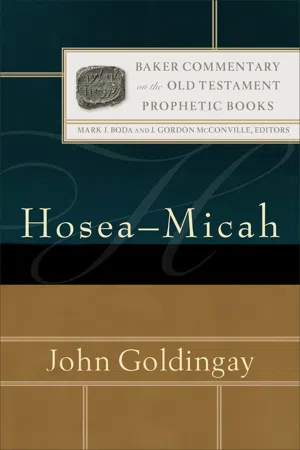
Highly regarded Old Testament scholar John Goldingay offers a substantive and useful commentary on Hosea through Micah and explores the contemporary significance of these prophetic books.
This volume, the first in a new series on the Prophets, complements the successful Baker Commentary on the Old Testament: Wisdom and Psalms series. Each volume is both critically engaged and sensitive to the theological contributions of the text. Series editors are Mark J. Boda and J. Gordon McConville.
In addition to paragraph-level commentary, all volumes of the Baker Commentary on the Old Testament series feature:
● A fresh translation of the Hebrew text
● Incisive comments based on the author's translation
● Linguistic, historical, and canonical insights
● Concluding reflections
● Footnotes addressing technical matters
Pastors, teachers, and all serious students of the Bible will find here an accessible commentary that will serve as an excellent resource for their study.
eBook - ePub
Hosea-Micah (Baker Commentary on the Old Testament)
- 543 pages
- English
- ePUB (mobile friendly)
- Available on iOS & Android
eBook - ePub
Hosea-Micah (Baker Commentary on the Old Testament)
About this book
Information
Subtopic
Commentaire bibliqueHosea

Introduction
The Hosea scroll takes its name from a prophet who lived and worked in Ephraim (northern Israel) in the eighth century, during the decades running up to the time when Ephraim fell to the Assyrians in 722 BC. The Hosea scroll describes itself as a message from Yahweh to his people, to which wise people will pay heed (14:9 [10]). Calling it a message (lit., a “word,” 1:1) implies that it has some coherence or unity. It comprises a challenge to pay heed to
- God’s confronting his people for their unfaithfulness,
- his pointing out how their lives are out of keeping with the beginnings of his relationship with them,
- his warning of severe chastisement that is therefore to come,
- his promising that chastisement will not be the end of the story, and
- his urging them to come back to him.
Origin and Background
Within the First Testament, 2 Kings 15–17 tells the story of Hosea’s time. Hosea sometimes uses words in distinctive ways, which may reflect his coming from Ephraim, which had a Hebrew dialect different from Judah’s. While the messages thus come from Hosea himself, the scroll opens with a chapter about him, which I take to have been written by someone who wanted to make a contribution to his message becoming known. The very beginning of that first chapter dates him in relation to the kings of Judah, which suggests that whoever produced this introduction wanted people in Judah to take notice of it. It would be interesting to relate different prophecies within the scroll to aspects of the history of Ephraim’s final decades,1 but the scroll does not give us concrete information that enables us to make such connections. “The intended and primary readerships” of Hosea “are not asked to historicize the text, to look at historical but ‘well-hidden’ clues, but to set it in the frame of that which is presented as essentially trans-temporal discourse” of “trans-temporal relevance.”2
Hosea is dominated by a critique of the life and worship of Ephraim as a people, and the dominant image of the book is marital infidelity. Hosea speaks poetically, which makes it complicated to infer what he is literally referring to; there may be several aspects to this unfaithfulness as Hosea critiques it.
- Ephraimites worshiped Yahweh in ways that Yahweh had forbidden—specifically, with the use of images of Yahweh. Second Kings 15 accuses Ephraim in Hosea’s time of worship that followed the innovations of Jeroboam ben Nebat, which meant worshiping Yahweh in forbidden ways.
- Before Hosea’s day, Ephraimites also worshiped deities other than Yahweh. While 2 Kings 10 tells of Jehu purging Samaria of the worship of the Master (Baʿal), worship of El as opposed to Yahweh may have continued in a sanctuary such as Beth-el.3
- Worshiping Yahweh in ways comparable to other peoples’ ways of worshiping the Master might be hard to distinguish from worshiping the Master and/or might be viewed by Hosea as little different.4 (Christians refer to “idolatry” in a way that risks confusing worship of Yahweh by means of an image or idol and worship of other deities, but paradoxically this confusion may also be suggestive.)
- Ephraim’s sealing of political alliances with Aram and Assyria would involve shared religious rites implying recognition of these peoples’ gods. In human societies, even where religion and politics are formally separate, they are commonly interwoven (at the first church service I attended in the United States, I noticed the prominence of the flag in the church, and the first thing we did was pray for the president as commander in chief). In effect, Hosea raises the question whether the separation of church and state is possible.5 Perhaps there was seepage between recognition of other gods at the international political level and such recognition in Ephraim’s own festivals and in ordinary people’s spirituality.6
- If Hosea mixes critique of Ephraim’s praying to the Master with critique of Ephraim’s alliances with other nations, it points to another sense in which such alliances involved unfaithfulness. Seeking these alliances was itself an act of unfaithfulness. It implied a failure of trust in Yahweh. Even if politicians in Ephraim (and Judah) negotiating alliances with other nations did not see themselves as going back on faith in Yahweh, Hosea’s talk of seeking the help of the Master may refer to implications of Ephraim’s political involvements. Ephraim pursued alliances with other nations as a means of protection and defense rather than regarding Yahweh as its protection and defense. Accepting such non-Israelite ideas about politics would mean a change in Ephraim’s understanding of Yahweh. In Ephraim’s thinking, Yahweh had become like the Master. The Ephraimites might as well have been asking the Master for help.
- Ephraim ran its internal politics in a way that ignored Yahweh’s attitudes, specifically in the series of violent coups in which it engaged. Yahweh’s critique of Ephraim’s self-directed internal politics may extend back to Israel’s original institution of monarchy.
- Worship offered by people in their homes and villages and at local shrines (the “high places”) might have been more affected by overt worship of the Master than worship offered at a national sanctuary. Archaeological evidence suggests that Israelites did not follow the Masters rather than Yahweh. They followed other gods as well as Yahweh, assuming it was possible to combine the two commitments. They did not see themselves as going back on their Israelite faith in Yahweh as the God who brought them out of Egypt (see 11:1–2) and enabled them to live in their land. They simply recognized other deities as well as Yahweh and sought their blessing in connection with the harvest and with human fertility. They saw the Master as the deity who could help to ensure that the crops grew and that animals and human beings were fertile, and they engaged in prayer and sacrifice to this end in the same way as they prayed and offered sacrifice to Yahweh.7 The requirement to pay taxes and the related necessity for the administration to pay tribute to Assyria would have put extra pressure on people to generate the equivalent of cash crops (grain, wine, oil), adding to the pressure to turn to other deities to make the harvest “work” (see the comments on 2:8 [10]).
- People may also have been involved in sexual activities in the context of worship; following the traditional religion of the land might involve sexual initiation at the sanctuary, further sexual intercourse with a priest as a kind of acted prayer for fertility, or a ritual enactment of the union of god and goddess. While Herodotus (Histories 1.199) describes such practices in Babylon, it is not clear that his account is based on anything more than hearsay, and we have no description of them from the First Testament or from other Middle Eastern writings. While it used to be assumed that Hosea’s references to such activities were literal accounts, it is now common to take them as a metaphorical portrayal of people being unfaithful to Yahweh in seeking the help of the Master.8
Poetry and Rhetoric in Hosea
Hosea is the premier poet among the Prophets; with the authors of Job and Song of Songs, he is one of the three premier poets of the First Testament.
Like all poetry, his work is dense, intense,...
Table of contents
- Cover
- Baker Commentary on the Old Testament Prophetic Books
- Title Page
- Copyright Page
- Contents
- Series Preface
- Author’s Preface
- Abbreviations
- Map
- Introduction to Hosea-Micah
- Hosea
- Joel
- Amos
- Obadiah
- Jonah
- Micah
- Bibliography
- Subject Index
- Author Index
- Index of Scripture and Other Ancient Writings
- Back Cover
Trusted by 375,005 students
Access to over 1.5 million titles for a fair monthly price.
Study more efficiently using our study tools.
Frequently asked questions
Yes, you can cancel anytime from the Subscription tab in your account settings on the Perlego website. Your subscription will stay active until the end of your current billing period. Learn how to cancel your subscription
No, books cannot be downloaded as external files, such as PDFs, for use outside of Perlego. However, you can download books within the Perlego app for offline reading on mobile or tablet. Learn how to download books offline
We are an online textbook subscription service, where you can get access to an entire online library for less than the price of a single book per month. With over 1.5 million books across 990+ topics, we’ve got you covered! Learn about our mission
Look out for the read-aloud symbol on your next book to see if you can listen to it. The read-aloud tool reads text aloud for you, highlighting the text as it is being read. You can pause it, speed it up and slow it down. Learn more about Read Aloud
Yes! You can use the Perlego app on both iOS and Android devices to read anytime, anywhere — even offline. Perfect for commutes or when you’re on the go.
Please note we cannot support devices running on iOS 13 and Android 7 or earlier. Learn more about using the app
Please note we cannot support devices running on iOS 13 and Android 7 or earlier. Learn more about using the app
Yes, you can access Hosea-Micah (Baker Commentary on the Old Testament) by John Goldingay, Boda, Mark J., McConville, J., Mark J. Boda,J. McConville in PDF and/or ePUB format, as well as other popular books in Théologie et religion & Commentaire biblique. We have over 1.5 million books available in our catalogue for you to explore.