eBook - ePub
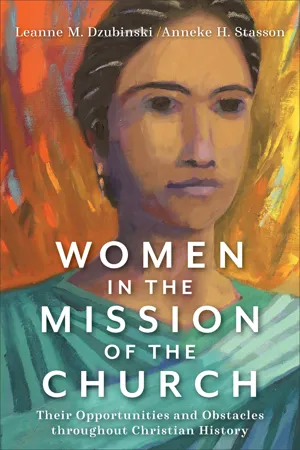
Women in the Mission of the Church
Their Opportunities and Obstacles throughout Christian History
- 256 pages
- English
- ePUB (mobile friendly)
- Available on iOS & Android
eBook - ePub
Women in the Mission of the Church
Their Opportunities and Obstacles throughout Christian History
About this book
Outreach 2022 Resource of the Year (Theology and Biblical Studies)
2021 ASM (American Society of Missiology) Book of the Year Award
Women have been central to the work of Christian ministry from the time of Jesus to the twenty-first century. Yet the story of Christianity is too often told as a story of men. This accessibly written book tells the story of women throughout church history, demonstrating their integral participation in the church's mission. It highlights the legacies of a wide variety of women, showing how they have overcome obstacles to their ministries and have transformed cultural constraints to spread the gospel and build the church.
2021 ASM (American Society of Missiology) Book of the Year Award
Women have been central to the work of Christian ministry from the time of Jesus to the twenty-first century. Yet the story of Christianity is too often told as a story of men. This accessibly written book tells the story of women throughout church history, demonstrating their integral participation in the church's mission. It highlights the legacies of a wide variety of women, showing how they have overcome obstacles to their ministries and have transformed cultural constraints to spread the gospel and build the church.
Tools to learn more effectively

Saving Books

Keyword Search

Annotating Text

Listen to it instead
Information
Part 1
Women’s Leadership
in the
Early Church
1
Patrons, Missionaries, Apostles, Widows, and Martyrs

The New Testament shows that women were involved as leaders in the church from its earliest days. Women were disciples and supporters of Jesus. After Jesus’s death, some women patrons hosted house churches, some served the church as widows, and some became important apostles, missionaries, and teachers of the faith. When persecution came, courageous martyrs held fast to their faith even to the point of physical death. This chapter describes some of these early Christian women. It shows how the ministry of women influenced the developing church and unpacks why their ministry was controversial in light of Roman social norms.
Women in the Life of Jesus
Jesus loved women, and women were an integral part of his ministry from the very beginning. God the Father could have sent his Son into the world in any number of ways, but God chose childbirth; God gave Mary the honor of being the Theotokos, the “Mother of God.”1 Mary carried the Son of God in her womb for nine months. She birthed him, nursed him, reared him, and urged him to do his first miracle. When so many deserted him, Mary stood by Jesus at the foot of the cross. She rejoiced when he rose again, she was in the upper room when he sent the Holy Spirit, and she was a revered leader of the early church.
Mary was Jesus’s first teacher and first disciple. Jesus learned about devotion to God from his mother, and she in turn learned from him. At one point in Jesus’s public ministry, a woman called out from the crowd, “Blessed is the womb that bore you and the breasts that nursed you!” Jesus responded, “Blessed rather are those who hear the word of God and obey it!” (Luke 11:27–28 NRSV). On first glance, this passage seems to depict Jesus as dismissive of his mother, but it actually makes more sense to read it as Jesus praising his mother’s devotion to God.2 During this time, women were valued for their capacity to bring forth children. They were especially valued when they bore children who turned out to be important figures. But Jesus says that Mary is not to be valued primarily for her ability to bring forth children but for her ability to “hear the word of God and obey it” (Luke 11:28).3
Tradition says that Mary’s parents dedicated her to God from an early age.4 Perhaps that is why she demonstrated such courage when the angel Gabriel visited her and told her she was going to bear the Son of God. Mary dared to ask the powerful, holy angel a question: “How will this be . . . , since I am a virgin?” (Luke 1:34). The angel told her that the Holy Spirit would come upon her, and Mary agreed to this amazing proposition. By saying yes, Mary became the “new Eve,” just as Jesus would be the “new Adam.” The first Eve had turned away from God and was told her husband would rule over her; this pattern of gender relations came to dominate history. Instead of letting this curse or her own fears rule over her, Mary courageously submitted herself to God and said, “I am the Lord’s servant. . . . May your word to me be fulfilled” (1:38). In saying yes to God, she became part of God’s plan of redemption. She birthed the savior of the world, trained him in the wisdom of God, and learned to follow him when he began his earthly ministry.
Other women followed Jesus too. Many people need to shift their mental picture a bit to accommodate them. Usually Jesus is pictured with the twelve disciples, but Luke states that as Jesus “traveled about from one town and village to another, proclaiming the good news of the kingdom of God,” the Twelve were not the only ones with him. There were “also some women who had been cured of evil spirits and diseases: Mary (called Magdalene) from whom seven demons had come out; Joanna . . . ; Susanna; and many others” (Luke 8:1–3). When Jesus taught women, he did not speak in a way that differed from how he spoke with men. “It was no occasion of surprise to Him that woman could grasp His highest truths. He presented them as simply and naturally to women as He did to men, expecting the same response.”5 The Samaritan woman at the well discussed theology with Jesus and became a disciple and evangelist (John 4). Mary and Martha became his dear friends, and Martha, like Peter, confessed him as the Christ (John 11:27). Jesus affirmed Mary for sitting at his feet, making him the first rabbi to accept a woman as a disciple in this manner.6 And Mary demonstrated her love for Jesus by anointing his feet with perfume and wiping his feet with her hair. Even though the disciples chastised her for this act, Jesus made her an exemplar of faith.7 According to New Testament scholar Ben Witherington, these “female disciples . . . were as loyal to Jesus as the male disciples, indeed more so at the end when the men abandoned, denied, or betrayed him.”8
Women were also the first witnesses of the resurrection. The “Myrrh-Bearing Women” carried spices to the tomb, found it empty, and ran to tell the disciples. There is difference in the four Gospel accounts about exactly which women went to the tomb, but in each account Mary Magdalene is prominent. For her role in telling the male disciples about the empty tomb, she has been honored with the title “Apostle to the Apostles.”
Women actively participated in the inauguration of the kingdom of God through Christ’s life, death, and resurrection, and they were integral to the continued growth of the kingdom after he ascended into heaven. Paul chose a woman, Phoebe, to take his letter to Rome and proclaim it in the sanctuary, a task that required her to speak publicly in church. In Paul’s letter to the Corinthian church, where he speaks of women being “silent,” he also tells women that when they are speaking in church (prophesying), they should keep their heads covered—so it is clear that women were speaking in church (1 Cor. 11:5).9 In the book of Acts, Luke tells the story of Lydia, the first convert to Christianity in Philippi. After listening to Paul and Silas preach the gospel, Lydia established the first church in Philippi. A wealthy merchant, Lydia supported the church financially and drew other people to it (Acts 16:13–15). The issue of women in ministry was debated in the early church; some in the church opposed the leadership of women, but not Paul. Time and again, Paul affirmed the women who were his coworkers in the mission of the church.
Women Were Patrons, Hosted House Churches, and Likely Officiated the Eucharist
The early church depended on patrons like Lydia, who is named in Acts 16. Patrons were people of means who used their wealth and influence for the mission of the church. In the early church, women as well as men were patrons, and some of these wealthy women opened up their homes so that communities of Christians could worship there. After all, there were no church buildings yet. Christians were a small sect within the Roman Empire, and these Christian communities depended on the generosity of wealthy believers to supply space for their meetings. Luke recorded the stories of some of these women in the book of Acts. For example, after an angel led Peter out of prison, “he went to the house of Mary the mother of John, also called Mark, where many people had gathered and were praying” (Acts 12:12). Scholars think they had gathered there to pray because Mary hosted a house church in her home. Several of Paul’s letters mention other women who hosted house churches. In his letter to the Colossians, he says, “Give my greetings to the brothers and sisters at Laodicea, and to Nympha and the church in her house” (Col. 4:15). Lydia, Mary, and Nympha were patrons of the church, women who donated their resources to its mission and were regarded as leaders of the church.
Roman society had a complex and long-standing system of patronage that regulated the relationship betw...
Table of contents
- Cover
- Half Title Page
- Title Page
- Copyright Page
- Dedication
- Contents
- Preface
- Introduction
- Part 1: Women’s Leadership in the Early Church
- Part 2: Women’s Leadership in Late Antiquity and the Middle Ages
- Part 3: Women’s Leadership since the Reformation
- Conclusion
- Bibliography
- Index
- Back Cover
Frequently asked questions
Yes, you can cancel anytime from the Subscription tab in your account settings on the Perlego website. Your subscription will stay active until the end of your current billing period. Learn how to cancel your subscription
No, books cannot be downloaded as external files, such as PDFs, for use outside of Perlego. However, you can download books within the Perlego app for offline reading on mobile or tablet. Learn how to download books offline
Perlego offers two plans: Essential and Complete
- Essential is ideal for learners and professionals who enjoy exploring a wide range of subjects. Access the Essential Library with 800,000+ trusted titles and best-sellers across business, personal growth, and the humanities. Includes unlimited reading time and Standard Read Aloud voice.
- Complete: Perfect for advanced learners and researchers needing full, unrestricted access. Unlock 1.4M+ books across hundreds of subjects, including academic and specialized titles. The Complete Plan also includes advanced features like Premium Read Aloud and Research Assistant.
We are an online textbook subscription service, where you can get access to an entire online library for less than the price of a single book per month. With over 1 million books across 990+ topics, we’ve got you covered! Learn about our mission
Look out for the read-aloud symbol on your next book to see if you can listen to it. The read-aloud tool reads text aloud for you, highlighting the text as it is being read. You can pause it, speed it up and slow it down. Learn more about Read Aloud
Yes! You can use the Perlego app on both iOS and Android devices to read anytime, anywhere — even offline. Perfect for commutes or when you’re on the go.
Please note we cannot support devices running on iOS 13 and Android 7 or earlier. Learn more about using the app
Please note we cannot support devices running on iOS 13 and Android 7 or earlier. Learn more about using the app
Yes, you can access Women in the Mission of the Church by Leanne M. Dzubinski,Anneke H. Stasson in PDF and/or ePUB format, as well as other popular books in Theology & Religion & Christian Ministry. We have over one million books available in our catalogue for you to explore.