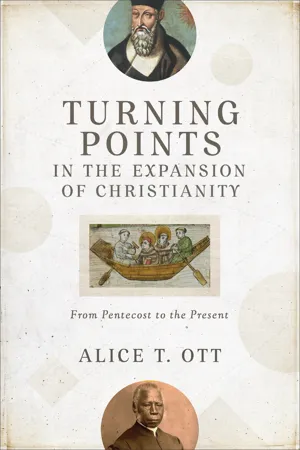
This readable survey on the history of missions tells the story of pivotal turning points in the expansion of Christianity, enabling readers to grasp the big picture of missional trends and critical developments. Alice Ott examines twelve key points in the growth of Christianity across the globe from the Jerusalem Council to Lausanne '74, an approach that draws on her many years of classroom teaching. Each chapter begins with a close-up view of a particularly compelling and paradigmatic episode in Christian history before panning out for a broader historical outlook. The book draws deeply on primary sources and covers some topics not addressed in similar volumes, such as the role of British abolitionism on mission to Africa and the relationship between imperialism and mission. It demonstrates that the expansion of Christianity was not just a Western-driven phenomenon; rather, the gospel spread worldwide through the efforts of both Western and non-Western missionaries and through the crucial ministry of indigenous lay Christians, evangelists, and preachers.
This fascinating account of worldwide Christianity is suitable not only for the classroom but also for churches, workshops, and other seminars.
eBook - ePub
Turning Points in the Expansion of Christianity
From Pentecost to the Present
- 320 pages
- English
- ePUB (mobile friendly)
- Available on iOS & Android
eBook - ePub
About this book
Information
Topic
Theology & ReligionSubtopic
Christian Ministry1
Embracing Ethnic Diversity
The Jerusalem Council (49)
The Lord has directed my [Jesus’s] mouth by His Word. . . .
He has caused to dwell in me His deathless life; and gave me that I might speak the fruit of His peace: to convert the souls of them that are willing to come to Him: and to lead captive a good captivity for freedom. . . . And the Gentiles were gathered together who were scattered abroad. And I was unpolluted by my love for them, because they confessed me in high places . . . and they walked in my life and were saved and became my people for ever and ever. Hallelujah.1
The hymn quoted above is from the earliest Christian hymnbook, the Odes of Solomon, written in Syriac, a Semitic language, in AD 100–125. Jesus, the speaker in the hymn, affirms his love for the Gentiles, whom he has saved, gathered into his church, and made his people. This ode mirrors the successful resolution at the Council of Jerusalem (AD 49) of the most significant controversy of the church in the apostolic age—the terms of acceptance for Gentiles into the Christian community. The controversy revolved around whether non-Jews could be received into the church merely by faith in Christ and baptism, or whether they must be circumcised and adhere to aspects of the Jewish law—that is, whether they must first become Jewish proselytes in order to join the church. The answer to that question and its implications for mission were not immediately evident to all within the early church, hence the controversy.
The answer was not self-evident in part because Christianity had been born within the cradle of Judaism. Its earliest center was the Jewish capital, Jerusalem. The first converts to the messianic faith were Jews of one stripe or another. Some of the Jewish-background believers in the capital were converted Pharisees, who strictly followed the Torah. Others, including the majority of Jesus’s disciples, interpreted the law more broadly and not always literally. Most of these, however, still kept the Jewish food laws and worshiped in the temple, at least in the first months or years after Pentecost. Finally, a sizable group of Hellenistic Jews were in the Jerusalem church—Greek-speaking diaspora Jews, who had returned to the capital to live. Hellenistic Jews had adopted some aspects of Greek culture and were in general more universalist and inclusive in their cultural and theological outlook. They were the first to engage in mission to the Gentiles.
Apostolic Christianity not only had its roots in the Jewish religion. It was also perceived by both Romans and Jews as a “sect” (Acts 24:5; 28:22) or “Way” (Acts 24:14) within the broad diversity of contemporary Judaism, and not as a new and separate religion. The Roman proconsul Gallio refused to listen to the charges brought against Paul by hostile Jews in Corinth, since they involved “questions about words and names and your own law” (Acts 18:12–16). Gallio clearly regarded Paul’s faith as a faction or subgroup within Judaism, and therefore outside his jurisdiction. The Roman historian Suetonius likewise made no distinction between the new faith and Judaism: the Jews were expelled from Rome in AD 49/51 “because of Chrestus” or Christ.2 Non-Christian Jews in the first decades after Pentecost also initially tolerated followers of the “Nazarene sect” in their synagogues, since they still viewed them as fellow Jews. Finally, Jewish-background Christ-followers in Jerusalem saw themselves as children of Abraham living in the prophesied eschatological age of the Spirit, which had been inaugurated by the death and resurrection of Jesus, Israel’s Messiah. They were the “remnant [of Israel] chosen by grace” and the rebuilt “tabernacle of David” (Rom. 11:5; Acts 15:16 ASV)—in other words, Jews. The earliest Christian assemblies in Jerusalem were not labeled “churches” but “synagogue” meetings by James, the half brother of Jesus and a leader of the Jerusalem church (James 2:2).
The strong Jewish character of the church in Jerusalem was retained throughout much of the first century. Therefore, it is not surprising that Jewish-born Christians struggled to comprehend the exact relationship between their messianic faith and its roots in Judaism/Israel. For example, it was not readily obvious how the Old Testament law should be interpreted and applied in light of the new covenant initiated by Jesus. They were well aware that their risen Lord had commissioned them to “make disciples” of Gentiles (“all nations”), as well as Jews (Matt. 28:16–20; Acts 1:8). But what precisely did that entail? Could Gentiles become “children of Abraham” by faith alone—in other words, as Gentiles—or must they first be circumcised? These issues were exposed and gradually clarified during key missional moments in the church’s development until they were finally settled at the Jerusalem Council in AD 49.
In this chapter, I will first discuss the key stages in the rise and development of the Jewish-Gentile controversy in the early church. Then, in a second section, I will sketch the historical context of, the debates during, and the decree issued by the Jerusalem Council. I argue that the Jerusalem Council was a turning point in the history of the expansion of Christianity for several notable reasons. First, the apostolic decision at the council to not require circumcision of Gentiles had broad ramifications. It removed the “dividing wall” of separation and hostility between Jewish and Gentile believers (Eph. 2:14). It declared that Gentile ethnicities had equal standing with Jewishness within the Christian community. Ethnic diversity was officially embraced by the church. Second, the Jerusalem Council formally established the nature of salvation. Both Jews and Gentiles were saved by grace through faith and not by works of the law. Third, the council gave momentum to the development whereby Christianity gradually emerged from its Jewish roots. Soon it was no longer regarded as a sect within Judaism. Finally, and most importantly for this chapter, the Jerusalem Council “represents a turning point in the history of the Church” because “it prepared the way for the spread of Christianity in the Greco-Roman world” in the first three centuries.3 It opened wide the door to full-scale mission to Gentiles of all ethnicities. The Gentile mission of Paul, the apostle to the uncircumcised, was affirmed at the Jerusalem Council. In the third section of this chapter, I examine Paul’s ministry to Gentiles and that of his successors in the first century, with a special focus on the mission methods employed. In the final section, we will explore the church’s Gentile mission in the second and third centuries. The church in that period abandoned some of the first-century missional practices pioneered by Paul. Despite some significant weaknesses, the church in the pre-Constantinian era continued to expand rapidly. This chapter focuses on the westward expansion of Christianity, while chapter 3 explores its eastward expansion.
Stages in the Jewish-Gentile Controversy
The dramatic arrival of the Holy Spirit on the day of Pentecost transformed the 120 disciples of Jesus, who had been cowering in the upper room. Filled with God-given power, Peter called the “God-fearing Jews from every nation” who had gathered at the sound of the mighty wind to respond in faith, and three thousand were baptized that day. The new converts were “one in heart and mind,” and the church grew rapidly (Acts 4:32; 2:42–47). But in time the first cracks in the Jerusalem church’s unity appeared when Hellenistic Jews complained against the Aramaic-speaking (Hebraic) Jews that Hellenistic widows were being overlooked in the daily distribution of food (6:1). Prompt and wise action by the Twelve prevented a rift from developing between these two culturally diverse branches of Judaism. Seven Hellenistic deacons were chosen to administer the food distribution. Two of them, Stephen and Philip, preached, evangelized, and performed miracles as well (Acts 6–8).
The scattering of Jewish Christians due to persecution after the martyrdom of Stephen (Acts 8:1, 4) launched the church’s mission beyond Jerusalem (1:8). Hellenistic Jewish Christians formed the spearhead of these evangelizing efforts, in part because they had fewer scruples about contact with Gentiles than Hebraic Jews. Furthermore, their Greek linguistic competency equipped them well for mission work among Gentiles and diasporic Jews. Finally, Hellenistic Jewish believers “reflected more consistently about the consequences of Jesus’s death and resurrection for the Torah and the temple, and thus for Israel, than did the apostles.”4 They were quicker to realize that the believers’ relationship to God was mediated by Jesus Christ alone and did not require additional Torah adherence. God’s presence was no longer located in the temple, but was now in the Spirit-filled community of believers. Thus, it was not surprising that Philip, one of the Seven, initiated mission among the Samaritans, converted a prominent eunuch from Nubia, and evangelized in towns on the coastal plain with a strong Gentile presence (Acts 8). Other unnamed Hellenistic Jewish Christians carried the gospel to Phoenicia, Cyprus, and Syrian Antioch (11:19–21). In Antioch, these unnamed evangelists proclaimed the good news not only to Jews but also to Gentiles, who responded in great numbers. The apostles in Jerusalem viewed the conversion of non-Jews as a serious issue that required investigation. They sent trusted members of their circle for this purpose: the apostles Peter and John were sent to Samaria, and Barnabas to Antioch. In both cases, the Jerusalem delegates “saw what the grace of God had done” (11:23) and rejoiced that the gospel had crossed ethnic and racial boundaries. The mother church in Jerusalem presumably rejoiced as well.
The Jewish-Gentile controversy began in earnest with Cornelius’s conversion through Peter’s preaching (ca. AD 37). Cornelius was a Roman centurion and an uncircumcised but God-fearing Gentile who “prayed to God regularly” and gave alms (Acts 10:2). Both Cornelius and the apostle were prepared by visions for their encounter with one another. Three times Peter had a vision of a sheet filled with unclean animals. Through this vision, Peter recognized that God had not only canceled the kosher food laws but also directed him to “not call anyone impure or unclean,” not even Gentiles (10:28). Therefore, when he arrived in Caesarea, Peter did not hesitate to enter Cornelius’s house and accept his hospitality, something a law-abiding Jew would have been reluctant to do. Cornelius and his household believed Peter’s message. The Holy Spirit descended on them as it had on the Jews at Pentecost, and they spoke in tongues, signaling the acceptance of Gentiles by God.
But when Peter returned to Jerusalem, the “circumcised believers criticized him” (Acts 11:2). Peter and his companions were, of course, also circumcised (10:45), though not a part of the ultrastrict “circumcision group” within the Jerusalem church. The circumcision group took offense at Peter’s association and table fellowship with uncircumcised Gentiles, even God-fearing one...
Table of contents
- Cover
- Half Title Page
- Title Page
- Copyright Page
- Dedication
- Contents
- Sidebars
- Acknowledgments
- Abbreviations
- Introduction
- 1. Embracing Ethnic Diversity
- 2. Pushing beyond the Boundaries of Empire
- 3. Expanding Eastward
- 4. Confronting Pagan Gods
- 5. Accommodating Culture
- 6. Pioneering a Global Outreach
- 7. Launching a Mission Movement
- 8. Breaking the Chains of Sin and Slavery
- 9. Empowering Indigenous Churches
- 10. Converting the Lost in the Era of Imperialism
- 11. Debating the Meaning of Mission
- 12. Reaching Missional Maturity
- Conclusion
- Select Bibliography
- Index
- Back Cover
Trusted by 375,005 students
Access to over 1.5 million titles for a fair monthly price.
Study more efficiently using our study tools.
Frequently asked questions
Yes, you can cancel anytime from the Subscription tab in your account settings on the Perlego website. Your subscription will stay active until the end of your current billing period. Learn how to cancel your subscription
No, books cannot be downloaded as external files, such as PDFs, for use outside of Perlego. However, you can download books within the Perlego app for offline reading on mobile or tablet. Learn how to download books offline
We are an online textbook subscription service, where you can get access to an entire online library for less than the price of a single book per month. With over 1.5 million books across 990+ topics, we’ve got you covered! Learn about our mission
Look out for the read-aloud symbol on your next book to see if you can listen to it. The read-aloud tool reads text aloud for you, highlighting the text as it is being read. You can pause it, speed it up and slow it down. Learn more about Read Aloud
Yes! You can use the Perlego app on both iOS and Android devices to read anytime, anywhere — even offline. Perfect for commutes or when you’re on the go.
Please note we cannot support devices running on iOS 13 and Android 7 or earlier. Learn more about using the app
Please note we cannot support devices running on iOS 13 and Android 7 or earlier. Learn more about using the app
Yes, you can access Turning Points in the Expansion of Christianity by Alice T. Ott in PDF and/or ePUB format, as well as other popular books in Theology & Religion & Christian Ministry. We have over 1.5 million books available in our catalogue for you to explore.