Christianity Today 2022 Book Award Winner (Church/Pastoral Leadership)
Outreach 2022 Recommended Resource (Church)
Southwestern Journal of Theology 2021 Book Award (Honorable Mention, Preaching/Ministry/Leadership)
Offering an important corrective to a pain-averse culture that celebrates individualism and success, veteran preacher and teacher Matthew Kim encourages pastors to preach on the painful issues their congregations face. Through vulnerability and self-disclosure, pastors can help their congregants share their suffering in community for the purpose of healing and transformation. The book includes stories, shares relevant Scripture texts imparting biblical wisdom, and offers best practices for preaching on specific topics. Each chapter ends with discussion questions and a sample sermon.
eBook - ePub
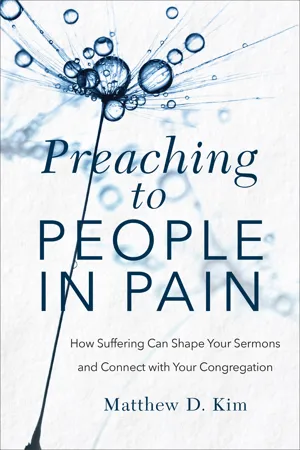
Preaching to People in Pain
How Suffering Can Shape Your Sermons and Connect with Your Congregation
- 240 pages
- English
- ePUB (mobile friendly)
- Available on iOS & Android
eBook - ePub
Preaching to People in Pain
How Suffering Can Shape Your Sermons and Connect with Your Congregation
About this book
Information
Topic
Theology & ReligionSubtopic
Christian MinistryPart 1: Naming the Pain
1
The Preacher’s Pain
In nearly ten years of serving in pastoral ministry as a youth pastor, college pastor, and senior pastor, I can count on one hand the number of times that a church member asked me how I was doing and actually cared enough to listen to my pain and suffering. Why has this lack of care for pastors become so normative in our society? The minister, as perceived by the average churchgoer, is the person who does the work of ministry, but rarely does he or she need a form of “listening ministry”1 from others. Yet pastors are human too. As Chuck DeGroat observes, “Lost pastors can make it a long way on the fuel of the false self. They may be successful, influential, endearing, charming, and smart. But beneath the veneer are people deeply afraid, lost and lonely, powder kegs of unmet and neglected needs. They have stories that have never been explored, pain never acknowledged, violations of others unconfessed.”2
In the seminary context, I have seen similar one-directional exchanges occur between students and me, also leading me toward the conclusion that opportunities are few and far between for Christian leaders like pastors, professors, teachers, counselors, and others to disclose their spiritual, physical, relational, emotional, economic, and other ontological selves. Perhaps you have encountered comparable indifference from your congregants or students. They assume that—while you are not always perched on a spiritual mountaintop—you are doing just fine in your soul. The truth is that perhaps the most sequestered person—struggling the most at any given time within a congregation—is the pastor himself or herself. Yet, is your prolonged silence eating at your very existence?
Isn’t it refreshing to be able to admit aloud, “I am human too,” or to be able to say freely, “My pastor is human too”? Depending on your church culture or ethnic culture, divulging one’s pain and suffering as a minister of the gospel may be simply taboo. However, suffering and pain are no respecters of persons. Some of the most horrifically painful stories I have heard are from pastors who have undergone or are presently experiencing immense suffering.
In preparing to write this book, I surveyed several church pastors about preaching on pain and suffering. One pastor battled a brain tumor and experienced a form of chronic pain resembling “cluster” headaches for over a decade—one of the worst pains known to humanity other than childbirth. Yet a different pastor is haunted by the hollowing effect of his parents’ divorcing and remarrying, each more than once. Another pastor struggles to make sense of the heinousness of systemic racism and how the gospel challenges our sinfulness. One pastor laments the daily grind of having a child who suffers from a genetic disorder that has required numerous surgeries. Another pastor tries to make sense of birthing a child with Down syndrome later in life. One pastor shares about his wife having numerous miscarriages. Another pastor expresses the agony of internalizing the collective suffering of his congregants. One pastor that I know of lost his wife and children in a horrific car accident. Stories of suffering endured by pastors are endless. Pastors are not immune from encountering unspeakable tragedy and hardship. If we believe in the power of the local church, why, then, are we so reluctant to share struggles with our beloved Christian communities?
Part of the pastor’s dilemma is how our culture reacts to the suffering of others. People frankly don’t want to hear about it. Consider how we, at least in North America, commonly greet others. We ask a person, “How are you?,” but it’s merely a courtesy acknowledgment of their existence, just in question form. We expect the other person to respond with some trite retort such as “Good” or “Can’t complain.” In other words, we don’t really want to know how the other is really doing. Admit it. Suffering is often painful, raw, shocking, gut-wrenching, lonely, maddening, exposing, annoying, confusing, and even volatile. The pain of others exacerbates these and other feelings of being downtrodden.
At the same time, not all suffering is identical. The mystery of pain is that no two people experience pain identically even in the midst of very similar trials. Pain is also polarizing and perplexing. There are generally two converse attitudes toward suffering. Either people love to tell others of (i.e., vent and revel in) their misery and feel entitled to complain or grumble incessantly as if they are the only ones on the planet going through the hells of life, or people may try to conceal it from others because they feel ashamed or don’t want to be judged. It’s no wonder why pastors often err on the side of silence.
Moreover, Christians often minimize suffering by putting on a happy face upon entering the sanctuary and fellowship hall on Sunday morning. Such is the existence of the average pastor. We may feel like being transparent about our hardships, but then we wonder if such vulnerability may somehow undermine our leadership or pastoral authority. We might plow ahead by telling ourselves, “There is no time for wallowing in my agony when there is gospel work to be done.” But as theologian Kelly Kapic points out in his book Embodied Hope, “We can acknowledge the struggle of being a follower of Yahweh, the creator of heaven and earth, and having to deal with suffering as it is: real, tragic, and heartbreaking.”3 In many ways, suffering is the great equalizer. At some point, every human being suffers and experiences pain—both Christians and non-Christians alike. Pastors and preachers are no exception. We cannot allow ourselves to stand “above the congregation” as if we are better than they. We can admit and share our pain and suffering with judiciousness.
Since pain is ubiquitous, the pulpit can be a place to address the topic strategically with biblical, theological sophistication as well as with cultural sympathy and empathy.4 But merely mentioning the pain while offering a few flavorful biblical tonics is not the end or the catchall solution. We pastors and preachers must make ourselves available to our people postsermon. It’s not prudent to preach on pain from Scripture, dumping our demons on our listeners, and then run off to the fellowship hall for refreshments. We must walk with our people in their pain, through their pain, and after their pain, and even in moments when hopelessness resurfaces and they relapse into their pain. More about that later in chapter 2.
This opening chapter addresses various pains in your life as a pastor and offers a road map for discovering and disclosing those pains from the pulpit and as a member of congregational life. Let’s pause briefly to entertain insights that Scripture offers about pain and suffering.
Scriptural Snapshots on Pain and Suffering
Pain and suffering enter Scripture’s purview immediately after the fall in Genesis 3. Postfall, there is no reentry into God’s perfect Eden. Adam and Eve are banished forever, never to return to the garden. Strangely, as Christians, however, we can temporarily forget that we live in a fallen, sinful, and broken world. We live today as if we deserve readmittance into an amusement theme park called “Utopic Universe”—that is, the prefallen state of the garden of Eden (Gen. 1 and 2).
God has, no doubt, been extremely patient with humanity. He is not surprised by our suffering, nor does he tune us out when we sinfully murmur and grumble against him. God is here among us and present in our suffering and pain. He is not distant even though it can feel like it. The Bible includes more verses about suffering than about joy, which tells of the somber reality of the Christian life in a postfall world. Turning the pages of Scripture, we read sporadically about existential enjoyment and the pursuit of pleasure—yes, God created us to enjoy his creation—and yet, more verses speak directly to suffering and pain in the Old and New Testaments. The portrait of discipleship brushed on the canvas of life by the very words of our Savior (such as in John 16:33) only reinforces our sense of a Christian life brimming with sweat and struggle.
The passages of Scripture on pain and suffering are copious indeed. Job might be one of the most referenced books of the Bible associated with pain and suffering, but Scripture is replete with countless characters who suffered in both great and small ways. In the Old Testament, Sarah, Rebekah, Rachel, Samson’s mother, Hannah, and Michal (King David’s first wife), and Elizabeth (the cousin of Mary and eventual mother of John the Baptist) in the New Testament were tortured by their barrenness or infertility. Some scholars have suggested that over 40 percent of the Psalms are songs of lament.5 For example, King David is baffled by God’s tolerance of his enemies. His imprecatory psalms throw down visceral, violent words against his foes. The Old Testament prophesies concerning the Messiah’s impending suffering. Later in the Gospels, Jesus shares regularly about his suffering and pain. Paul writes extensively in portions of his letters about his suffering—for example, in 2 Corinthians. Jesus also foretells that his disciples will not escape suffering. At times, he sounds as if suffering was a prerequisite or precondition for any bona fide disciple. Many characters in Scripture encounter various forms of pain and suffering in their lifetime. The narratives of broken, pain-filled personalities are littered throughout the Gospels. Why, then, are we so astounded by suffering?
A Prosperity Gospel or a Pain-Full Gospel?
Perhaps, if we can be transparent, the problem with Christianity is not suffering and pain in and of themselves. Yes, it is perfectly acceptable and normal to mourn and lament. God expects to hear the cries of his children. At the same time, the tension is that we are also invited to embrace Christ’s call to discipleship—to pick up our cross daily (with every Christian receiving a different form of ...
Table of contents
- Cover
- Endorsements
- Title Page
- Copyright Page
- Dedication
- Contents
- Acknowledgments
- Introduction
- Part 1: Naming the Pain
- Part 2: Preaching on Pain
- Conclusion
- Appendix: Worksheet for Understanding Pain
- Scripture Index
- Subject Index
- Back Cover
Trusted by 375,005 students
Access to over 1.5 million titles for a fair monthly price.
Study more efficiently using our study tools.
Frequently asked questions
Yes, you can cancel anytime from the Subscription tab in your account settings on the Perlego website. Your subscription will stay active until the end of your current billing period. Learn how to cancel your subscription
No, books cannot be downloaded as external files, such as PDFs, for use outside of Perlego. However, you can download books within the Perlego app for offline reading on mobile or tablet. Learn how to download books offline
Perlego offers two plans: Essential and Complete
- Essential is ideal for learners and professionals who enjoy exploring a wide range of subjects. Access the Essential Library with 800,000+ trusted titles and best-sellers across business, personal growth, and the humanities. Includes unlimited reading time and Standard Read Aloud voice.
- Complete: Perfect for advanced learners and researchers needing full, unrestricted access. Unlock 1.5M+ books across hundreds of subjects, including academic and specialized titles. The Complete Plan also includes advanced features like Premium Read Aloud and Research Assistant.
We are an online textbook subscription service, where you can get access to an entire online library for less than the price of a single book per month. With over 1.5 million books across 990+ topics, we’ve got you covered! Learn about our mission
Look out for the read-aloud symbol on your next book to see if you can listen to it. The read-aloud tool reads text aloud for you, highlighting the text as it is being read. You can pause it, speed it up and slow it down. Learn more about Read Aloud
Yes! You can use the Perlego app on both iOS and Android devices to read anytime, anywhere — even offline. Perfect for commutes or when you’re on the go.
Please note we cannot support devices running on iOS 13 and Android 7 or earlier. Learn more about using the app
Please note we cannot support devices running on iOS 13 and Android 7 or earlier. Learn more about using the app
Yes, you can access Preaching to People in Pain by Matthew D. Kim in PDF and/or ePUB format, as well as other popular books in Theology & Religion & Christian Ministry. We have over 1.5 million books available in our catalogue for you to explore.