Outreach 2022 Resource of the Year (Cross-Cultural and Missional)
Southwestern Journal of Theology 2021 Book Award (Evangelism/Missions/Global Church)
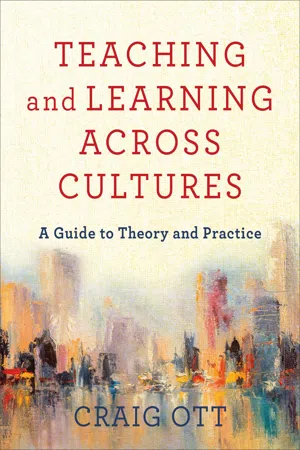
Representing the fruit of a lifetime of reflection and practice, this comprehensive resource helps teachers understand the way people in different cultures learn so they can adapt their teaching for maximum effectiveness. Senior missiologist and educator Craig Ott draws on extensive research and cross-cultural experience from around the world. This book introduces students to current theories and best practices for teaching and learning across cultures. Case studies, illustrations, diagrams, and sidebars help the theories of the book come to life.
- 368 pages
- English
- ePUB (mobile friendly)
- Available on iOS & Android
eBook - ePub
About this book
Information
Topic
Theology & ReligionSubtopic
Christian Church1
Understanding the Challenge
Chapter Overview
- Who Is the Cross-Cultural Teacher?
- The Challenges of Teaching across Cultures
- What Does It Mean to Teach and Learn?
- Culture and the Content of Teaching
- Meeting the Challenge
- About This Book
The Rodgers and Hammerstein musical The King and I tells the nineteenth-century story of British schoolteacher Anna Leonowens, who becomes governess to the children of King Mongkut of Siam. One of the musical’s best-known songs is “Getting to Know You,” which describes not only how she has become a student of her students, but how—as the lyrics go—she is “getting to feel free and easy, . . . getting to know what to say,” and ultimately feeling “bright and breezy.” Though highly romanticized, this captures in many ways the ideal attitude of every cross-cultural teacher: willingness to be a learner, striving to like and understand the students, and working toward a relationship that is honest, open, and relaxed. The teacher with the right attitude will truly be personally enriched by the experience.
But such an attitude and commitment are only the starting points for cross-cultural effectiveness as a teacher. Other challenges will abound that can sour that “bright and breezy” spirit. Here’s a sampling:
- “My students just want me to tell them all the answers. They don’t think for themselves.”
- “I arrived and there was no PowerPoint projector. But it wouldn’t have mattered since there were constant power outages.”
- “Students complained bitterly when I assigned them even the simplest homework.”
- “As a woman teacher, the boys showed me no respect and ignored my instructions.”
- “They are great at memorizing large amounts of material, but don’t seem to have critical reasoning skills.”
- “I tried to develop personal friendships with some of my students. They nod and smile, but remain cool and distant.”
- “Plagiarism is rampant, and I don’t know what to do about it.”
- “My contract stated that I would teach three hours per day, but when I arrived, my schedule included five hours per day.”
- “I thought I could teach by using the lecture notes I had from seminary, but quickly had to scrap that idea, because students found my material too abstract and irrelevant.”
- “When students write papers, they just seem to ramble and not come to the point. There is no clear thesis, no logical argument, and no compelling conclusion.”
Jude Carroll describes these most common sources of misunderstanding and frustration for cross-cultural teachers in higher education: “(1) relations between teachers and students; (2) teaching methods (how they work and how they support learning); (3) assessment; (4) academic writing; and (5) academic/critical reading” (2015, 32). The list could go on.
Much of this book is devoted to addressing these and other issues, especially as they relate to student preferences and expectations. This chapter will define what is meant by cross-cultural teaching. Then, after describing some of the most common challenges and frustrations cross-cultural teachers encounter, we consider what is necessary to face the challenge and become more effective. Because there are differing understandings of what it even means to teach and learn, we will examine these basic concepts. Even the content of our teaching, especially theological teaching, must take culture into consideration; therefore, we briefly consider the importance of contextualization. Finally, an overview of the structure of this book will be provided.
Who Is the Cross-Cultural Teacher?
Teaching is one of the wonderful ways in which people invest in the lives of others. This may occur in a school, vocational training, adult continuing education, an English as a second language (ESL) class, individual mentoring, or a spiritual formation relationship. Today, more than ever, teachers, trainers, pastors, and people who have never formally taught before are traveling abroad to teach people of another culture. The low cost of airfare, the ease of international communication via the internet, and globalization in general have opened up to thousands of people opportunities for international teaching. International migration has also brought literally millions of people from the most diverse cultures into our schools and churches at home. Thus, the challenges of cross-cultural teaching are present nearly everywhere.
Today there are worldwide an estimated 420,000 Christian missionaries, of whom a high percentage are involved in some form of teaching, be it in formal schools and seminaries, or in the context of church and development work (Zurlo, Johnson, and Crossing 2020). Each year from America alone approximately 1.6 million people serve on international short-term mission assignments lasting from a few days to a few years (Wuthnow 2009, 170–71), and over 20 percent of these are explicitly in teaching roles of some kind (Priest 2010, 99). By one estimate there are some 250,000 native English speakers teaching ESL in some 40,000 schools and language institutes.1 Annually the Fulbright Scholar Program sponsors some 1,200 US scholars and 900 visiting scholars who lecture internationally.2 The list could go on documenting the growing number of persons involved in some form of teaching across cultures, all facing to a greater or lesser extent the kinds of challenges described above in bridging the cultural gap between teacher and learner.
Today, schoolteachers, professors, community workers, and pastors are increasingly involved in teaching ethnically or culturally diverse learners like never before. With increasing immigration and cultural diversity, schools have wrestled with the challenges of teaching in a classroom of learners from a variety of ethnic backgrounds, varying levels of English skills, and little or no familiarity with the expectations of school or university study in the US. There is a large literature devoted to teaching in the multicultural classroom. A teacher from an affluent suburb who teaches ethnic minority students in the inner city will encounter many of the cross-cultural challenges described in this volume.
Although teachers everywhere can benefit from insights discussed here, primarily in view is the teacher who has traveled to another country or location to teach students of a single culture significantly different from her own: for example, an American3 science teacher teaching Chinese students in Beijing, a German teaching English as a foreign language in Indonesia, or a Korean missionary teaching at a theological seminary in Chile. Our term cross-cultural teacher is not to be confused with a cross-cultural trainer, whose task is to help people (usually of his own culture) develop intercultural competency in preparation for an international assignment.
Most examples in this volume will be taken from formal teaching in schools. In non-formal teaching, such as seminars or workshops, similar cultural dynamics and challenges are at play, though the teacher may have a different role or status. The cross-cultural teacher may also be an after-school tutor, a church Sunday school teacher, a community health worker, a trainer for a corporation, an athletic coach, or in any other number of contexts in which teaching, in the broadest sense, is the task. The teaching assignment may be relatively long-term—as for a professor, development worker, or missionary teacher whose assignment lasts months or years—or for a relatively short period of time, such as for a visiting lecturer or short-term missionary whose teaching assignment lasts only a week or two.
The Challenges of Teaching across Cultures
Teachers tend to teach others in the same manner by which they were taught, and if they do change their teaching methods, it will be in ways that feel most natural to them. Teaching methods, expectations about relationships between teachers and learners, the institutional parameters of teaching, and even the physical conditions of teaching are all influenced by culture. Thus, teaching that comes naturally and is effective in one’s home culture can become like the proverbial square peg trying to fit in a round hole when it is attempted in another culture. Or to switch metaphors, sometimes the cultural gap can be measured in millimeters and be easily bridged, but in other cases the gap resembles the Grand Canyon. Bridging the chasm seems daunting if not impossible!
The opening paragraphs of this chapter listed typical frustrations that teachers regularly experience due to culture conflict. Later chapters of this book will explore in detail the various dimensions of how culture influences teaching and learning, and the reasons behind those conflicts. Strategies will be proposed for reducing frustration and increasing teaching effectiveness. But first we will describe briefly just some of the challenges that a cross-cultural teacher commonly encounters, as a heads-up regarding some of the largest stumbling stones. These illustrate why effective teaching across cultures doesn’t come naturally, and why the cross-cultural teacher needs not only pedagogical preparation but also personal preparation to meet the challenge.
Conflicting Expectations
At the root of much frustration experienced by cross-cultural teachers and learners are conflicting expectations. Culture defines appropriate ways for people to interact, how learning institutions function, and what it even means to learn. Culture therefore shapes the expectations that both teacher and learner bring to the teaching-learning experience. When a teacher and learners come from different cultures, divergent expectations and ensuing frustration or conflict are preprogrammed. The disconnect can relate to course content, teaching methods, roles, scheduling—nearly every aspect of teaching. For example, the teacher may plan for students to engage in lengthy class discussions, but learners desire formal lectures. Over twenty years ago, a comparative study of teaching in various countries concluded, “To put it simply, we were amazed at how much teaching varies across cultures and how little it varied within cultures” (Stigler and Hiebert 1999, 11). Despite globalization, the challenges persist today. This means that teaching expectations that are considered normal in one culture may well be in conflict with the expectations of other cultures. “Teaching is a cultural activity. We learn how to teach indirectly through years of participation in classroom life, and we are largely unaware of some of the most widespread attributes of teaching in our own culture” (11). When such firm but subconscious expectations are in conflict with the firm and subconscious expectations of a cross-cultural teacher, conflict and frustration are preprogrammed.
Often poor advance communication is also a source of conflicting expectations. Especially for short-term assignments, cross-cultural teachers depend on receiving accurate information about their students, teaching responsibilities, and classroom conditions. However, that information may be inadequate and come late or not at all. The teacher may arrive only to find that the number of teaching hours has changed, textbooks aren’t available, power outages make use of electronic media impossible, class size is not as expected, or students do not possess the academic background or skills to perform as planned. One teacher arrived at a college in Nepal having prepared to teach an intensive one-week English course. Upon arrival he was informed that he would be teaching a theology course instead!
Steven T. Simpson describes how Western ESL teachers have misinterpreted China’s invitation to come teach English as a desire for them to contribute pedagogical expertise and methodology. The Chinese, however, were more interested in these teachers’ linguistic and cultural expertise to enrich their English ability. “When these two expectations are in conflict, the potential results are frustration and accusations of wrongful treatment, ignorance, and laziness of both sides, by both sides” (2008, 382). The effective cross-cultural teacher must learn to adjust expectations and negotiate such conflicts.
False Perception of Teaching Effectiveness and Learner Response
Even when teachers feel that they have been effective, their perceptions often don’t reflect reality. One experienced English teacher from Canada described his first day ...
Table of contents
- Cover
- Half Title Page
- Title Page
- Copyright Page
- Dedication
- Contents
- Sidebars
- Preface
- 1. Understanding the Challenge
- 2. Culture and the Teaching Context
- 3. Learning Styles, Teaching Styles, and Culture
- 4. The Cognitive Dimension
- 5. The Cognitive Dimension
- 6. The Cognitive Dimension
- 7. The Worldview Dimension
- 8. The Worldview Dimension
- 9. The Social Dimension
- 10. The Social Dimension
- 11. The Media Dimension
- 12. The Media Dimension
- 13. The Environmental Dimension
- Works Cited
- Index
- Back Cover
Trusted by 375,005 students
Access to over 1.5 million titles for a fair monthly price.
Study more efficiently using our study tools.
Frequently asked questions
Yes, you can cancel anytime from the Subscription tab in your account settings on the Perlego website. Your subscription will stay active until the end of your current billing period. Learn how to cancel your subscription
No, books cannot be downloaded as external files, such as PDFs, for use outside of Perlego. However, you can download books within the Perlego app for offline reading on mobile or tablet. Learn how to download books offline
Perlego offers two plans: Essential and Complete
- Essential is ideal for learners and professionals who enjoy exploring a wide range of subjects. Access the Essential Library with 800,000+ trusted titles and best-sellers across business, personal growth, and the humanities. Includes unlimited reading time and Standard Read Aloud voice.
- Complete: Perfect for advanced learners and researchers needing full, unrestricted access. Unlock 1.5M+ books across hundreds of subjects, including academic and specialized titles. The Complete Plan also includes advanced features like Premium Read Aloud and Research Assistant.
We are an online textbook subscription service, where you can get access to an entire online library for less than the price of a single book per month. With over 1.5 million books across 990+ topics, we’ve got you covered! Learn about our mission
Look out for the read-aloud symbol on your next book to see if you can listen to it. The read-aloud tool reads text aloud for you, highlighting the text as it is being read. You can pause it, speed it up and slow it down. Learn more about Read Aloud
Yes! You can use the Perlego app on both iOS and Android devices to read anytime, anywhere — even offline. Perfect for commutes or when you’re on the go.
Please note we cannot support devices running on iOS 13 and Android 7 or earlier. Learn more about using the app
Please note we cannot support devices running on iOS 13 and Android 7 or earlier. Learn more about using the app
Yes, you can access Teaching and Learning across Cultures by Craig Ott in PDF and/or ePUB format, as well as other popular books in Theology & Religion & Christian Church. We have over 1.5 million books available in our catalogue for you to explore.