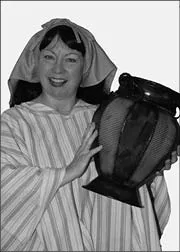
’s Journey to Love
Samaritan from Sychar
(John 4:5)
living with a man she had not married; widowed, divorced, or abandoned five times
(John 4:18)
worshiper of God
(John 4:20)
waiting for The Messiah
(John 4:25)
apostle to Sychar
(John 4:28–30)
The Book does not give you my name, but according to Eastern Orthodox Church tradition, my name is Photini. It means “luminous one.” My “lumination” began with one, not so very long, conversation with The Light of the World. I became a light for Sychar.
My story, “The Woman of Samaria” or “The Woman at the Well,” is only told in John’s gospel. John’s is also the only gospel to tell you of the woman taken in adultery. Interesting, to my thinking, that our stories are only told once and both in John’s gospel. You see, Jesus’s dealings with the two of us were anti the religious practices of the day and, to some extent, the religious practices of your day.
The “religious” are too frequently disinterested in truth, justice, or mercy, all the while claiming unlimited grace for themselves, without them repenting.
Jesus knew all about the “religious;” they’d been withstanding Him from the beginning. At the time of my story, Jesus had been ministering in the Jerusalem area. The “religious” (Pharisees) had heard that Jesus was making and baptizing more disciples than John. That was both true and false.
Jesus was making more disciples, but it was His disciples who were doing more baptizing (John 4:1–2). Jesus, however, knew that the “religious” are afraid of losing their position and power, both within the religious community and whatever political power they had with Rome. He knew that they intended to stop Him—permanently. But it was not yet His time. So Jesus left Judea for Galilee to avoid this confrontation (John 4:3). The confrontation would come but not before His appointed time.
It was about a three-and-a-half-day journey to Galilee, depending upon where in Galilee you were headed. The seventy miles was if one traveled directly north. Now no good Jew passed through Samaria, not if he or she could help it. Jews went to great extremes to avoid passing through Samaria, walking west to the coast, north past Samaria, and then back east into Galilee. Alternatively, they crossed the Jordan at Jericho, walked north past Samaria, then crossed the Jordan again, even if it did add another day or so in travel time. They really hated us (John 4:9). And being fallen creatures, we returned the “favor” in good measure.
We were half-breeds, you understand—that is, a mixture of Hebrew with other nations.
The Northern Kingdom had been overrun by the Assyrians nearly seven hundred years before my day. It was Assyrian policy to remove conquered peoples from their homelands and transplant them into other conquered nations. In keeping with this strategy, Hebrews in the Northern Kingdom had been forcibly removed from our region to other nations, while conquered peoples from other nations were forcibly settled in with us (2 Kings 17:23–24). That reduced the probability of a revolt among the conquered against the conquering Assyrians, as you may well imagine.
Of course, there had been intermarriage. We were conquered peoples, living cheek by jowl with captives from five different Babylonian city-states. These marriages introduced into our culture a variety of idols and contemptible pagan practices, including child sacrifice. Being mongrels of Assyrian social engineering was not our most serious problem. The undermining of The Faith, by the inclusion of pagans and their idolatry, proved our greatest difficulty (2 Kings 17:29–31).
So we, the Samaritans, were hated for our mixed blood and the pagan practices in our midst. Another reason the purebloods hated us was that we had been using an alternative site, Mount Gerizim rather than Jerusalem, for worship. We had reasons for choosing Gerizim as our place of worship other than the distance to Jerusalem and the political animosity of the purebloods against us.
This is the mount of Jacob’s dream (Gen. 28:10–16). According to Samaritan tradition, this is where Abraham prepared to worship and sacrifice Isaac when The Lord God intervened (Gen. 22:9–13). This is where Moses had instructed the Hebrews to stand and receive God’s instructions and blessings (Deut. 11:29; Deut. 27:12; Josh. 8:33–35).
The purebloods refused to acknowledge those reasons. Not that we would have been welcomed at The Temple. In fact, when it was time to rebuild The Temple, our help had been refused. To this day, my people celebrate Passover on Mount Gerizim.
In the purebloods’ minds, we were at fault for these: our mixed blood, the undermining of The Faith, and the schism between us and them. It’s true it was our fault. It was the judgment of The Almighty upon our sin. Of course, the purebloods were judged in like manner. It didn’t matter if some of us chose to worship the God of Abraham, Isaac, and Jacob.
John tells you Jesus had to pass through Samaria (John 4:4). Well, not really. I’ve explained Jewish practice. Jesus’s presence in Samaria was counter to the religious practice of His time. And as I’ve explained, He wasn’t in Samaria because there was no other way to get to Galilee. Why? Why must He go through Samaria?
Let me tell you. The Savior had a divine appointment that day—with me, of all people. You think I’m putting on airs? Think again. I’m just telling you what Jesus is like.
John tells you that Jesus was tired from the walk—a walk of what? Thirty-five-odd miles? Jesus walked back and forth from Capernaum to Jerusalem repeatedly during His earthly ministry, usually taking the long way around Samaria.
You’re told that the disciples had gone into Sychar (John 4:8), just half a mile on, to buy lunch. So Jesus was sitting beside the well. Does it strike you as strange that Jesus needed a rest when the disciples, evidently, did not? Since when does it take twelve men to buy lunch for thirteen?
Could not The One who turned water to wine and multiplied fish and loaves have produced food and water for Himself and His disciples? No, all this description of the situation does not explain why Jesus was waiting at Jacob’s well, alone, at noon, on that warm day.
Jacob’s well is a special place. This well was among the first bits of The Holy Land that Jacob owned. On His death bed, he recalls how he won the well in a battle with the Amorites. He tells Joseph that he took it with his sword and bow. And he gives this piece of land to Joseph, as one who is over his brothers. This is no doubt a reference to Joseph’s life of faithfulness. So the well is a physical testimony of faithfulness. It is a well with a history.
My mind was far from thoughts of faithfulness that day. I couldn’t think of Joseph and Asenath, their faithfulness to each other, to the Almighty, nor this well as a testimony of faithfulness. Perhaps I was too busy trying not to think, trying not to feel. My life included faithlessness that had wounded me and continued to plague me. It clouded my future. I could not know I was about to meet my destiny.
Jacob’s well is over one hundred feet deep. The lower walls are through limestone. It’s considered living water since it is fed from an under...