![]()
CHAPTER 1
I’m Going to Tell Them I Raised Hell
George Vaughn came from Brooklyn—from the Washington Avenue area, to be exact. Born in May 1897, he enrolled at Princeton University in 1915 and two years later put his name down for the fledging Aviation Corps. “They are organizing here,” Vaughn wrote his parents on February 7, 1917. “But [I] don’t know whether I will be able to get in it or not, as they are going to have examinations for nerves, endurance, etc.”
Vaughn had to wait a couple of months for his medical examination, by which time the Princeton Aviation School had been firmly established and war had been formally declared by Congress. “Committees composed of members of the Faculty and of the undergraduates were formed,” reported the Princeton Bric-a-Brac, the university’s undergraduate yearbook. “Several members of the Faculty volunteered to give lectures on the construction, operation and maintenance of an airplane motor…[and] towards the end of March came the gratifying announcement that sufficient funds had been collected and orders for two airplanes of the Curtiss JN-4B type of military tractor biplane were at once placed with the Curtiss Aeroplane Company.”
Vaughn underwent his physical examination in April, the doctor noting the cadet’s brown hair, blue eyes, and ruddy complexion in his file. Vaughn wrote his family on May 4 to explain that after undergoing the equilibrium and eye test, he had been subjected to a thorough medical “that has put a good many fellows out of the Corps. It was a physical examination such as I never even imagined before, and lasted over two hours and a half. You have to be practically perfect in every part of your body to get by, so I at least have the satisfaction of knowing that I am physically pretty well off.”
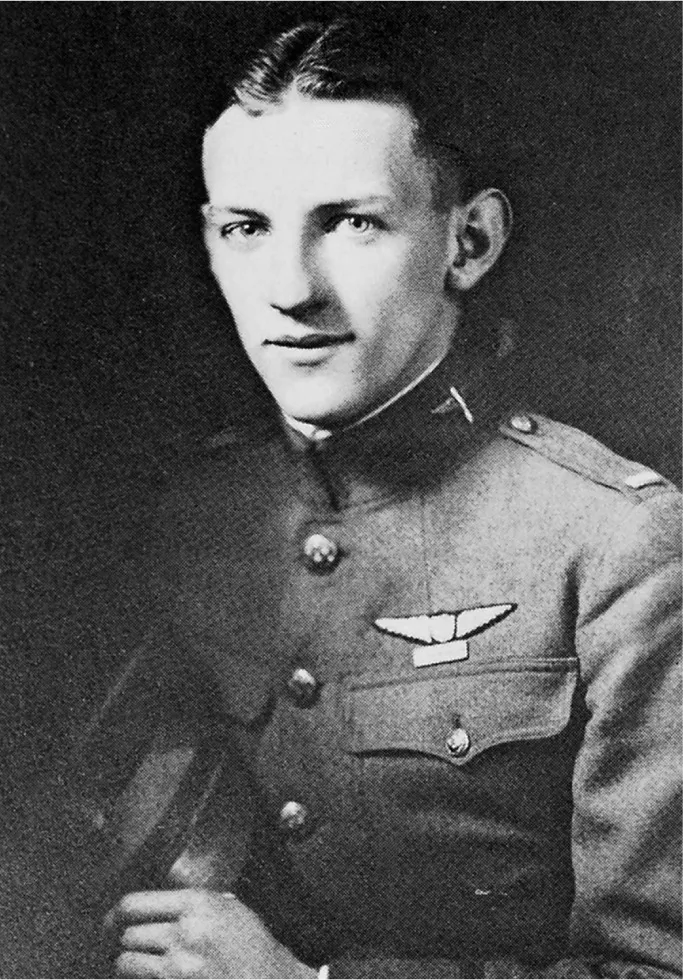
George Vaughn was an ace with thirteen victories who lived to be ninety-two. “All you had to do was fly the plane and shoot the guns,” he said modestly, shortly before his death.
Vaughn was one of thirty-six Princeton men out of more than one hundred volunteers who passed the medical, as was Elliott White Springs. “They are very particular about whom they take for the Aviation Corps and examine us very minutely,” Springs had written his father on May 1. “It’s the most exacting examination the Army gives. They spin you around on a stool, make you balance blindfolded, fire pistols behind you and all sorts of things like that.”
Springs confessed to his father that he’d feared his eyes might let him down—“as they only allow a small percentage of variations from normal”—but he passed the medical, unlike Arthur Taber, who failed his. Though an enthusiastic rower and member of the Princeton gun team, the portly young man lacked finesse and aggression. He didn’t lack connections, however, not with so wealthy and influential a father. The dean of the college, Howard McClenahan, wrote to the Aviation Corps to tell them of the student’s “strictest integrity,” while Taber also paid a visit to Washington “and called on a friend…a retired Brigadier-General, whose help in attaining this object he asked.”
At first the RFC resisted the pressure to accept Taber, but, finally, they relented and he was admitted into the Princeton Aviation School in July, by which time Vaughn and Springs and their thirty-four classmates were already accomplished aviators. “I can’t begin to tell you the wonderful fascination of flying and I enjoy it more every time I go up,” Springs wrote his father. “I had control of the plane yesterday for twenty minutes at an altitude of 4,000 feet and I don’t know when I enjoyed anything more.”
The students were taught in the Curtiss JN-4 biplanes on what Vaughn described as “a privately-operated field, located between Princeton and Lawrenceville,” and it was here that Taber joined them, if not trusted to take to the skies, then at least able to participate in “such subjects as theory of flight, internal combustion engines, machine guns, Morse code telegraphy, navigation, etc.” The students, most of whom had hitherto led lives of easy deportment, also encountered military discipline and close order drill for the first time. “All this drill was excessively tiresome and a dreadful bore,” Taber wrote his father on July 26. “…I sometimes regret that I did not join the naval aviation for in that branch now I could make a greater contribution to the Allied cause than where I am.”
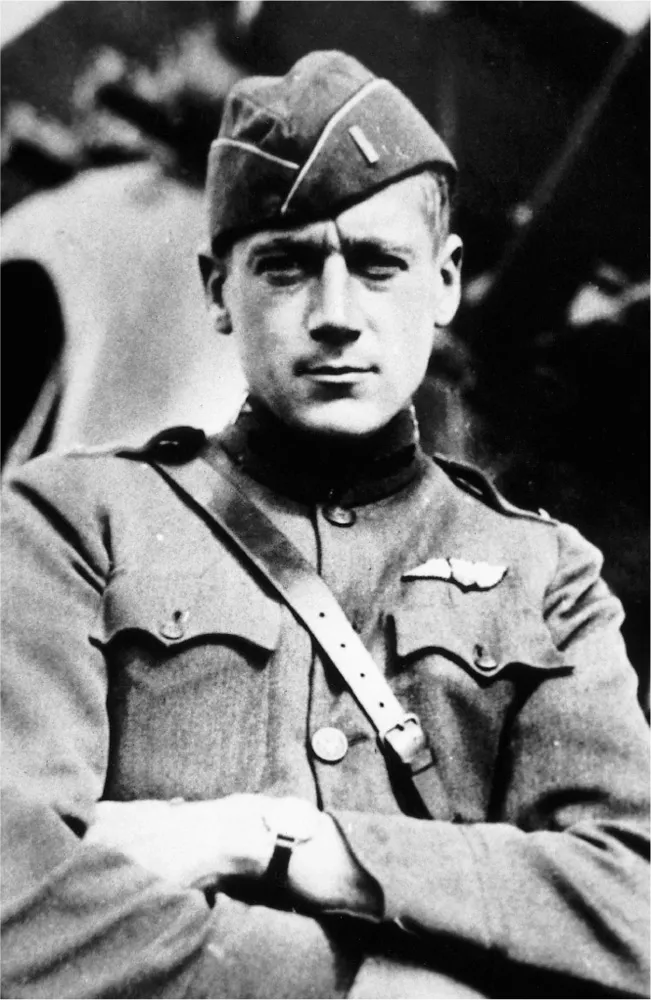
Elliot White Springs beams for the camera after walking away unscathed from this flying accident in France.
With the six-week course complete and the cadets now “enlisted as Privates First Class in the Aviation Section of the Signal Corps,” the army faced the problem of what to do with them. “At that time there were no advanced flying schools in this country,” recalled Vaughn. “Fortunately for us, the Allies had started offering the use of their flying training facilities, so the army finally decided to send us abroad for advanced flying training.”
At the end of August the Princeton cadets were sent to Mineola flying field on Long Island, later the site of the Roosevelt Raceway, where they encountered cadets from other flying schools also waiting to embark overseas, some to France and others to Italy.
For Arthur Taber the stay at the Mineola airfield was his first exposure to the rich diversity of his country’s inhabitants. Reared in Lake Forest, Illinois, and schooled in Coconut Grove, Florida, the formative years of Taber’s young life had been spent in a privileged and serene environment. Earnest and studious, Taber entered Princeton, where he was a member of the university’s gun team, which contested an intercollegiate shoot with teams representing Dartmouth, Yale, and Cornell. This was the circle in which Taber felt comfortable: among the wealthy and well-educated, among America’s elite.
On August 28, his first evening at Mineola, Taber wrote his father, explaining: “This seems to be a concentration point for the men who are going to Italy: today a batch came in from Cornell. They are a clean-cut, military-looking lot, and I am rather heartened by their appearance. They are surely exceptional in being trim in appearance, for the average is very low, I regret to say.”
Taber had no issue with the Cornell men, nor with fellow Princetonians such as George Vaughn, Frank Dixon, Harold Bulkley, and Elliott Springs, even if Springs did have something of a wild reputation. At Princeton, he had spent much of his time striking a pose in his Stutz Bearcat, even driving the vehicle to Long Island when they were ordered to Mineola.
However, at least Springs—the son of a wealthy cotton-mill owner from South Carolina—had breeding. Taber wasn’t so sure of some of Springs’s acquaintances, budding aviators who had been ordered to Mineola from other flying schools across America. Clayton Knight, a native of Rochester, New York, and, at twenty-six, one of the oldest men at Mineola, was an artist who had studied under the iconoclastic modernist painter Robert Henri before enlisting in the military in 1917 and being sent to aviation school in Texas.
But if Knight was tainted by association in the eyes of Taber, John McGavock Grider was tainted, period. Born in 1892 at the family cotton plantation in Sans Souci, Arkansas, Grider—or “Mac” as he preferred to be called—had quit the Memphis University School aged seventeen to marry a fellow student, Miss Marguerite Samuels. To escape the scandal, Grider and his young bride retreated to the plantation, where she soon gave birth to two sons, John McGavock and George William. Neither Grider nor his wife adapted well to parenthood; he was working all hours on the plantation, and she found the responsibility too much to bear. The couple separated, Marguerite returning to her family in Memphis with the children, Grider throwing himself into his work. But he was still young and restless, and America’s entry into the Great War was the excuse he needed to flee Arkansas. Writing his family of his decision to enlist, he said: “Do you think I’m going to tell John and George when they get to be men that I raised cotton and corn during the war? Not by a damned sight, I’m going to tell them I raised hell.”
One of the “Three Musketeers,” Laurence Callahan was not just a brilliant ragtime pianist but also an ace with 85 Squadron and 148th Aero.
Grider was sent to the School of Military Aeronautics of the University of Illinois for aviation training, during which he wrote a friend back home of his first flight. “I have been up. God it is wonderful! I have never experienced anything like it in my life.”
Grider’s roommate was Larry Callahan, a tall, laid-back twenty-three-year-old from Kentucky who had curtailed a career in finance to serve his country. The pair hit it off straight away. Callahan was a gifted pianist and Grider loved to dance, the foxtrot being his favorite. They also shared a passion for liquor, women, and cards. Such pastimes were not the preserve of Taber. “I am not a prude about the question of drinking,” he wrote his father, “but I don’t like to see men take too much, first, because of the dire result of their actions upon themselves, and secondly, because someone else is sure to suffer, for some regrettable thing never fails to occur when one is temporarily and abnormally excited.”
Grider and Callahan were separated upon arrival at Mineola. Grider, like Taber, had volunteered for active service in Italy, while Callahan had been assigned to the contingent headed to France. The Italian detachment had as its cadet sergeant Elliott Springs, confident and strong willed despite having just turned twenty-one. A natural leader and a superb aviator, Springs was invested with the limited authority by the officer in charge, Maj. Leslie MacDill, with instructions to ensure the men did nothing to discredit America in the eyes of the watching world.
It was an onerous task for Springs, an exuberant and forceful personality whose character had been shaped in a large part by his prickly relationship with his domineering father. “I am opposed to your joining the aviation corps,” Leroy Springs had written his son in April 1917. “I do not feel that I should give my consent to it.” Aviation was the younger Springs’s escape from parental control, a joy he described in a letter to his stepmother as “the nearest thing to the Balm of Gilead I know.”
But there were other balms in Springs’s life: the same pleasures enjoyed by Grider. At Mineola, Grider discovered that Springs played bridge and liked music, so he told him, “I have a friend over here at this other place that’s a good bridge player and plays the piano. You better get him over here.” The friend in question was Callahan. Springs did as requested, arranging the transfer of Callahan to the Italian detachment of aviators. The three young men complemented each other: the blond, handsome Grider, the eldest of the three but with an infectious boyish enthusiasm for life; Springs, who looked like a boy, his face unmarked by toil or trauma, but whose personality was more complex than either Grider’s or Callahan’s; and Callahan, who asked himself fewer questions than his two friends and just got on with life, taking its vagaries in his languid stride. Before long the trio were calling themselves “the Three Musketeers.”
A reporter from the New York Times ventured to Mineola to spend several days in the company of the cadets and captured the tedium felt by many of the raw recruits in an article entitled “Long, Weary Waiting for Airplane Student.” “The first sight of the high board inclosure [sic] of the flying field brings a distinct thrill,” wrote the correspondent. “But after sitting in barracks day after day, fingering brand-new equipment, cleaning brand-new pistols, hearing the airplanes of the fortunate buzz by overhead, ever and again sneezing in the plentiful dust—that yellow Long Island dust which rises so thickly when the ground is scratched that even the general’s car must slow down on the high road—well, that thrill wears off.”6
As for the cadets who sat listlessly in the classroom, desperate to fly but damned to spend hour after hour studying theory, the reporter from the New York Times sympathized with their plight, writing: “The men who have volunteered for training in Italy are in a curious state of mind. They have no idea of where they are going or of what is going to happen to them when they get there; but they are perfectly sure that it will be the best possible. No one has been sent to Italy for flying training yet, or at least no one has been there long enough to send back word what it is like, and these men will be the first in that particular field, pioneers, explorers. And that is enough.”
On Sunday, September 16, 1917, Major MacDill ordered Springs to tell “everyone to get rid of their cars” except for Springs himself and to “place sentinels around the barracks to keep anyone from leaving even for a few moments.” MacDill and Springs then drove into New York to “arrange the final details” of their embarkation for Europe, and the following day, September 17, Springs deposited his treasured Stutz at the Blue Sprocket garage with instructions for it to be returned to the manufacturer. Springs then drew some money, dined out at a fashionable restaurant, and returned to Mineola at 2:00 a.m. “to find special orders waiting on me to have breakfast at 4:30 and be ready to break up camp at 6:30.”
A Curtiss-Herring at Mineola airfield in the early days of aviation. Library of Congress
Springs did as instructed, and at 7:00 a.m. on Tuesday, September 18, he and approximately 150 other cadets boarded a train bound for Long Island City. Once they arrived, remembered George Vaughn, they were taken on a tugboat to SS Carmania of the Cunard Line. “Since there were not supposed to be any troops abroad, we were boarded via rope ladders on the river side, where we could not be seen from the dock.”
Carmania wasn’t the first vessel to transport American aviators across the Atlantic to Europe. A month earlier RMS Aurania had sailed from New York to Liverpool with a detachment of fifty two cadets under the command of Capt. Geoffrey Dwyer, including 1st Lts. Bennett Oliver and Paul Winslow, both of whom had been obliged to take their turn on watch, their eyes scanning the gray ocean for signs of dreaded German submarines. Half an hour before midnight on August 30, Winslow had spotted a light in the distance. “It was Ireland,” he wrote in his diary, “and nothing ever seemed so good as the sight of something indicating land, as it meant we were safe once more.”
The mood among the second contingent of American flyers destined for Europe was carefree; the men were unconcerned by the prospect of submarine attack. After nearly three weeks of being stranded at Mineola they were finally on their way to war, and wrapped tight around them as they scaled Carmania’s rope ladders was the invincibility of youth.
Carmania, launched in 1905, was the pride of the Cunard fleet, powered by steam turbines with a speed of eighteen knots. The aviators were shown to their quarters in first class along with a handful of civilian passengers, some army officers, and forty Red Cross nurses. “The boat we have is a very good one,” wrote Vaughn to his family. “There are a lot of regulars with us, mostly infantry, and all riding in the steerage, and I guess it is not too pleasant down there.”
For Vaughn and his fellow aviators, however, the voyage was “just like a vacation trip for us; lots of sleep, excellent food, deck chairs and all our time to ourselves.”
Once she left New York on Tuesday, Septem...