eBook - ePub
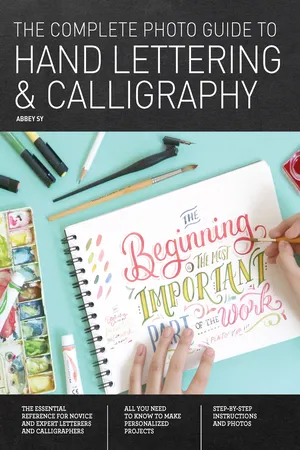
The Complete Photo Guide to Hand Lettering and Calligraphy
The Essential Reference for Novice and Expert Letterers and Calligraphers
- 192 pages
- English
- ePUB (mobile friendly)
- Available on iOS & Android
eBook - ePub
The Complete Photo Guide to Hand Lettering and Calligraphy
The Essential Reference for Novice and Expert Letterers and Calligraphers
About this book
Written by best-selling author and hand letterer Abbey Sy, The Complete Photo Guide to Hand Lettering and Calligraphy covers the basics and beyond for creative lettering techniques.
The book begins with an overview of tools and materials, both traditional (pointed pen and fountain pen) and modern (including brush markers and chalk), then presents a visual glossary of letterforms, highlights the unique characteristics of the featured alphabets, and demonstrates how to draw letterforms to foster an understanding of how they’re created. The core chapters explore traditional, modern, and special effects lettering using a variety of mark-making tools, with in-depth how-to on adding flourishes and other special details, plus creative projects. There’s also an introduction to modifying and creating letterforms digitally, as well as practice sheets for the featured alphabets.
So whether you’ve never tried lettering before or you’d like to develop your skills and consider all your creative options, The Complete Photo Guide to Hand Lettering and Calligraphy will guide and inspire you on your lettering journey.
The book begins with an overview of tools and materials, both traditional (pointed pen and fountain pen) and modern (including brush markers and chalk), then presents a visual glossary of letterforms, highlights the unique characteristics of the featured alphabets, and demonstrates how to draw letterforms to foster an understanding of how they’re created. The core chapters explore traditional, modern, and special effects lettering using a variety of mark-making tools, with in-depth how-to on adding flourishes and other special details, plus creative projects. There’s also an introduction to modifying and creating letterforms digitally, as well as practice sheets for the featured alphabets.
So whether you’ve never tried lettering before or you’d like to develop your skills and consider all your creative options, The Complete Photo Guide to Hand Lettering and Calligraphy will guide and inspire you on your lettering journey.
Frequently asked questions
Yes, you can cancel anytime from the Subscription tab in your account settings on the Perlego website. Your subscription will stay active until the end of your current billing period. Learn how to cancel your subscription.
No, books cannot be downloaded as external files, such as PDFs, for use outside of Perlego. However, you can download books within the Perlego app for offline reading on mobile or tablet. Learn more here.
Perlego offers two plans: Essential and Complete
- Essential is ideal for learners and professionals who enjoy exploring a wide range of subjects. Access the Essential Library with 800,000+ trusted titles and best-sellers across business, personal growth, and the humanities. Includes unlimited reading time and Standard Read Aloud voice.
- Complete: Perfect for advanced learners and researchers needing full, unrestricted access. Unlock 1.4M+ books across hundreds of subjects, including academic and specialized titles. The Complete Plan also includes advanced features like Premium Read Aloud and Research Assistant.
We are an online textbook subscription service, where you can get access to an entire online library for less than the price of a single book per month. With over 1 million books across 1000+ topics, we’ve got you covered! Learn more here.
Look out for the read-aloud symbol on your next book to see if you can listen to it. The read-aloud tool reads text aloud for you, highlighting the text as it is being read. You can pause it, speed it up and slow it down. Learn more here.
Yes! You can use the Perlego app on both iOS or Android devices to read anytime, anywhere — even offline. Perfect for commutes or when you’re on the go.
Please note we cannot support devices running on iOS 13 and Android 7 or earlier. Learn more about using the app.
Yes, you can access The Complete Photo Guide to Hand Lettering and Calligraphy by Abbey Sy in PDF and/or ePUB format, as well as other popular books in Art & Art Techniques. We have over one million books available in our catalogue for you to explore.
Information
chapter
1
Tools and Materials
Tools are important parts of the creative process. Traditional and modern tools each create a different impact on the final piece of art. Each artist has her own preferences and needs, but it is best to experiment with a variety of techniques and tools to learn how you can incorporate new methods and materials into your work.
This chapter explains the various kinds of materials you will encounter as you try your hand at calligraphy and lettering, highlighting their distinct qualities, where to find them, and which types best fit each area of calligraphy or hand lettering.

Traditional Tools

Nibs
Nibs come in two styles: pointed and italic. Each type has a specific set of qualities that suit different calligraphic styles.
Pointed nibs are flexible and can be used for most calligraphy styles, as they have the versatility to produce both thick and thin strokes. The nibs two tines have the ability to split and produce wide lines. When the tines are together, they produce a thin stroke.
Italic, or broad-edged, nibs are flat and not designed to flex. These are used for italic, black letter, and gothic letterforms. This nib type is used to create consistent and uniform strokes. Its blunt edge creates strokes that are thin or bold.
Flat-Tip Dip Pens
Flat-tip dip pens are commonly used for black letter, italic, and other hands. Although the parallel pen is available, there are still those of us that favors this tool. Flat-tip dip pens have two parts: the nib and the holder. There are various types of flat-tip nibs that come in different cuts and sizes. These pens have stiff nibs and thus a low flex level.
Although this pen produces a very engaging and alluring contrast between the thin and thick strokes, it still requires more skill and practice to keep lines in place. Another good thing about this pen is that you have more options when choosing nibs, inks, and even holders. For ink loading, it is best to use a paintbrush and add ink on it rather than dipping the nib directly to the bottle of ink. This ensures minimal disruption and lets you control the amount of ink on the nib.
Nib Holders
Nib holders come in both straight and oblique styles. Each type has distinct characteristics and its use depends on calligraphy style and the artist’s preference.
Straight Nib Holder
The straight holder is generally easy to control and is good for beginners because the orientation is similar to a pencil or pen. It is also recommended for left-handed writers as it is easier to adjust the angle of the nib and pen to paper to accommodate their writing. Although it is more common now to see straight holders used for broad-edged writing, they are also used for scripts and flourishing. Using the straight holder gives a modern and straight effect to your work because, unless you deliberately angle your paper, your writing will be upright.

Oblique Nib Holder
The oblique pen holder gives an automatic slanted effect to your letters and flourishes, making it great for practicing formal styles such as Spencerian and copperplate calligraphy. Oblique holders allow the writer to achieve a specific angle, which helps to form consistently slanted forms.
Inks
Calligraphy inks come in a variety of colors—from the commonly used black ink, to metallic, and many types of colors. They are also made of different transparencies, but most inks appear opaque. Inks can be thick or thin, which creates a variety of effects on paper.
Depending on the style of letters you want to achieve, your ink choice will differ. A carbon-based ink such as sumi is useful for the beginner, as it can be diluted with water to adjust flow. India and acrylic inks are also widely used because of their opacity and vivid colors. Gouache may also be mixed to make a wider sel...
Table of contents
- Cover
- Title
- Contents
- Preface
- How to Use This Book
- 1 Tools and Materials
- 2 Lettering Primer
- 3 Classic Calligraphy
- 4 Modern Hand Lettering
- 5 Decorative Lettering
- 6 Digital Lettering
- Practice Sheets
- Resources
- Glossary
- Contributors
- Acknowledgments
- About the Author
- Index
- Dedication
- Copyright