Pen & Ink
eBook - ePub

Pen & Ink

  1. 208 pages
  2. English
  3. ePUB (mobile friendly)
  4. Available on iOS & Android
eBook - ePub

Pen & Ink

About this book

Pen & Ink is packed with page after page of bite-sized creative sketching tips and accessible advice, and offers aspiring artists the freedom to dip in and out for practical information or flick through for fresh inspiration and ideas.

Exploring around 200 pieces of artwork by young contemporary artists, Pen & Ink highlights and examines the different techniques, qualities, and effects relating to each piece. Organized into chapters according to the technique exemplified (e.g.water soluble, mixed media) artwork is featured large and luscious, accompanied by extended captions, insightful tips, and practical advice. A detailed index at the front of the book also groups the paintings according to three main categories: Principles (e.g. composition), Media, Type of sketch (e.g. abstract), and Subject (e.g. nature). Listing each page where similar examples may be found, this category index enables the reader to easily identify and cross reference subjects that have been painted in similar styles.

Throughout the book, useful information and practical tips are provided on a wide range of topics such as tone, perspective, color, and much more besides. Readers are encouraged to discover the various ways in which similar subjects and styles are executed by different artists, while also being inspired to use the tips in the book as a way of building on their existing skills. Offering a bold, refreshing change from other run-of-the-mill art books, Pen & Ink adopts the unique approach of accessing practical information via the images, focusing on the way subjects can be treated using a whole range of different drawing techniques, rather than looking at how to master one single style. This gives the reader a much wider skill set—allowing them to capture or create the essence of any image in a variety of different ways.

Frequently asked questions

Yes, you can cancel anytime from the Subscription tab in your account settings on the Perlego website. Your subscription will stay active until the end of your current billing period. Learn how to cancel your subscription.
No, books cannot be downloaded as external files, such as PDFs, for use outside of Perlego. However, you can download books within the Perlego app for offline reading on mobile or tablet. Learn more here.
Perlego offers two plans: Essential and Complete
  • Essential is ideal for learners and professionals who enjoy exploring a wide range of subjects. Access the Essential Library with 800,000+ trusted titles and best-sellers across business, personal growth, and the humanities. Includes unlimited reading time and Standard Read Aloud voice.
  • Complete: Perfect for advanced learners and researchers needing full, unrestricted access. Unlock 1.4M+ books across hundreds of subjects, including academic and specialized titles. The Complete Plan also includes advanced features like Premium Read Aloud and Research Assistant.
Both plans are available with monthly, semester, or annual billing cycles.
We are an online textbook subscription service, where you can get access to an entire online library for less than the price of a single book per month. With over 1 million books across 1000+ topics, we’ve got you covered! Learn more here.
Look out for the read-aloud symbol on your next book to see if you can listen to it. The read-aloud tool reads text aloud for you, highlighting the text as it is being read. You can pause it, speed it up and slow it down. Learn more here.
Yes! You can use the Perlego app on both iOS or Android devices to read anytime, anywhere — even offline. Perfect for commutes or when you’re on the go.
Please note we cannot support devices running on iOS 13 and Android 7 or earlier. Learn more about using the app.
Yes, you can access Pen & Ink by James Hobbs in PDF and/or ePUB format, as well as other popular books in Art & Art Techniques. We have over one million books available in our catalogue for you to explore.

Information

Year
2019
Print ISBN
9780711238046
eBook ISBN
9780711245044
Topic
Art

The sketches

Image
ÒSCAR JULVE, BAR OLLER
Medium: pen and ink
Dimensions: 23 × 90 cm
Line

A wide-angle view

Swasky
To look at this drawing is to feel as though you are teetering on the edge of a balcony, or looking through a wide-angle lens at the quiet Spanish village. The fish-eye effect means that we can see almost straight down to the street below, and right across to the distant rooftops opposite. It results in a cheerful distortion that captures the street’s character in a web of lines and angles.
The strong element of pattern also catches the eye. The roof tiles are meticulously drawn and there are the striped lines of the awning over the bar, and the closed shutters. Electrical wiring passing from one side of the road to the other leads the eye around the picture, their lines doubled up by the inclusion of their shadows painted in a lighter tone wash.
Swasky found it impossible not to eavesdrop on the conversations he could hear from below while he worked: ‘As I was drawing I discovered that someone had been to hospital, that the weather this year was great, that the bar’s owner is from Majorca, and more stories that I’ll keep to myself,’ he says.
Image
THE CROSS ROADS (WHERE YOU FIND OUT EVERYTHING)
Medium: fountain pen, brush and ink
Dimensions: 22 × 30 cm

Modern-day hieroglyphics

Cachetejack
This drawing has been created by assembling scanned elements of a selection of still life compositions by Cachetejack and arranging them in Photoshop. The straightforward simplicity of the line that comes from a thick marker pen, compared with the subtler marks offered by, for instance, brush pens or dip pens, means that the subjects are stripped back to their most direct forms, becoming almost a form of modern day hieroglyphics.
The items – most of them familiar from everyday life, some more surreal – are immediately recognisable and yet reduced to their starkest outlines, which is accentuated further by the lack of colour or tonal variation. There is black and white, and nothing in between. ‘The drawings are like symbols – everything is reduced to its simplest form,’ the Cachetejack duo say. ‘The effect we wanted was simple and descriptive. Marker pens let you keep drawing very easily and give the perfect feeling of a line.’
While permanent pens may leave no room for correction or adjustment, there is a degree of flexibility in choosing to arrange the drawings digitally. The cigarette symbol is repeatedly copied, rotated and pasted throughout the arrangement to bring a consistent element to the composition, which was used by the illustrators as the endpapers in a fanzine.
Image
VANITAS
Medium: marker pen
Dimensions: 13 × 13 cm

Finding expressive lines

Rolf Schroeter
What is the difference between drawing animals and people? Rolf admits that he can struggle with the anatomy of horses, but here he has approached the task just as he would have if he were drawing a human subject: through close observation.
A fountain pen with a fine, flexible nib has been used with waterproof ink on very thin and smooth 50 gsm paper. The subject has been composed on the sketchbook’s page so that the foreshortened body of the horse sits on one side of its spine, and its head and tether lie on the other.
The drawing is a great example of how direct and nuanced pen and ink can be. There is a calligraphic feel to the lines describing the horse’s back as they widen and then taper. The long descriptive arcs of its outline and the drooping quiff of the mane contrast with the lighter, flicked marks that represent hair on the legs, rump and nose. The drawing is about more than just the horse’s character, but about the expressive act of drawing: it is possible to imagine the sweep and flick of the pen as Rolf draws from the marks he has made.
Image
WESENDAHL_GINETTE_070315
Medium: fountain pen and waterproof ink
Dimensions: 13 × 18 cm

People in motion

Nina Johansson
Drawing people in action, such as these musicians rehearsing together, can be a challenge, especially in pen and ink, as postures can come and go quickly. But by working ...
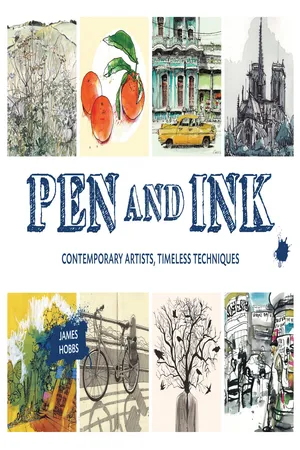
Table of contents

  1. Cover
  2. Title Page
  3. Contents
  4. Visual index
  5. What is pen and ink?
  6. The sketches
  7. Fundamentals
  8. Artist index
  9. Index
  10. Acknowledgements
  11. Copyright